- Kalorien
- 145
- Eiweiß
- 13g
- Ballaststoffe
- 0g
- Ges. Fett
- 3g
- Natrium
- 220mg
- Zugesetzter Zucker
- 0g
Was dieses Rezept für Sie leistet.
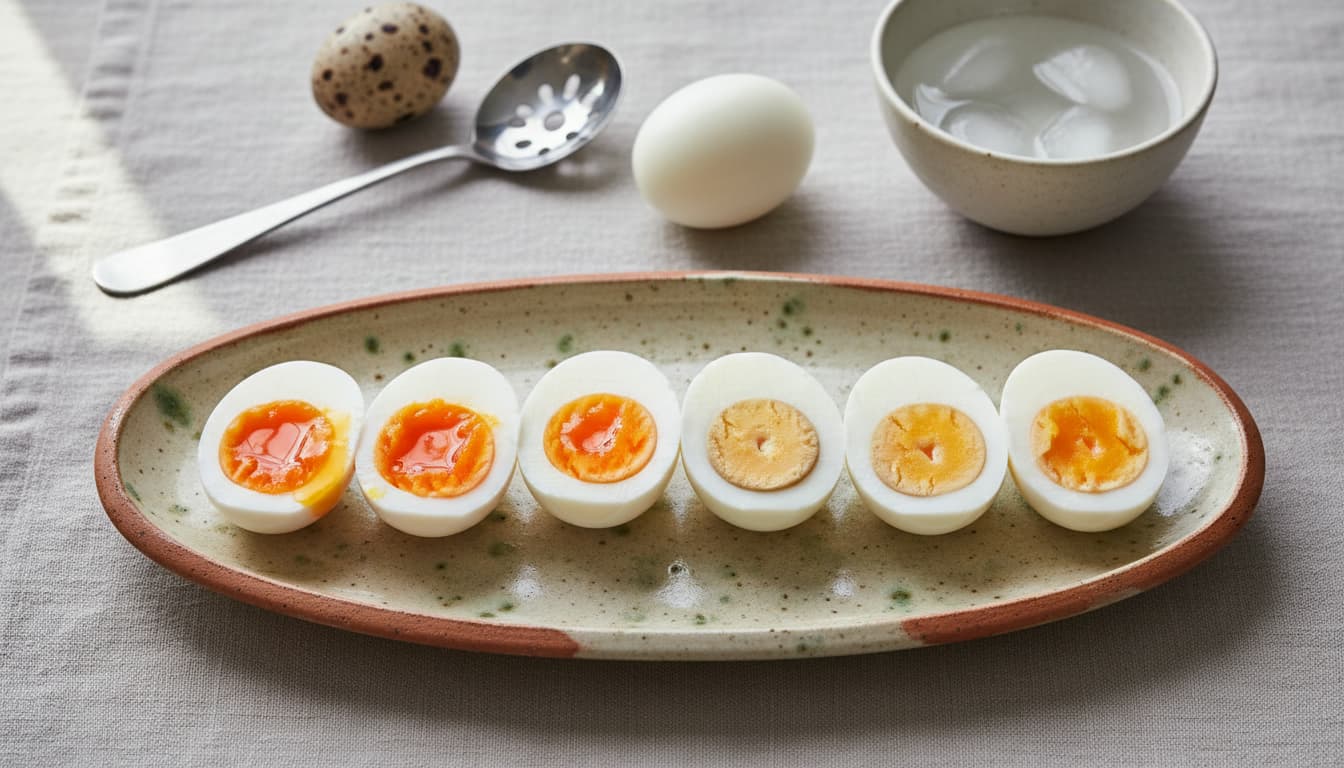
Almost every problem people have with boiled eggs is one of two things: they started the eggs in cold water, or the eggs were too fresh. Lower them into water that is already boiling, run the timer by the minute rather than by guesswork, and shock them hard. Six minutes for jammy, nine for creamy, eleven for fully set with no grey ring.
Warum das funktioniert
Jedes Rezept auf dieser Seite kommt mit einer Erklärung der Technik-Entscheidungen: warum erst anbraten, dann schmoren, warum die Säure zum Schluss kommt, warum das Fett vor den Aromaten ausgelassen wird. Die Methode unten besteht aus genau diesen Entscheidungen, der Reihe nach.
Zutaten
6 Portionen- 12 wholelarge eggs · ideally 7 to 10 days old, straight from the fridge
- 4 quartswater · enough to cover the eggs by at least an inch once they are in
- 1 tbspkosher salt · optional, it seasons any cracks and makes the whites set faster
- 1 tbspdistilled white vinegar · optional, it coagulates leaking white if a shell cracks
- 4 cupsice · for the ice bath, and use more than you think you need
- 1 tspflaky salt · to finish, if you are eating them plain
Methode
Start with boiling water, not cold water, and this is the whole trick
The cold-water start you learned from a cookbook is the single biggest cause of eggs that refuse to peel. Bringing eggs up slowly from cold gives the white a long window in which it bonds to the inner shell membrane. Lowering a cold egg into water that is already at a rolling boil hits the outer white with instant heat, it sets and contracts away from the membrane, and the shell comes off in two or three pieces. Same egg, same pot, entirely different outcome.
The timings, by yolk, at a bare simmer
From a hard boil, lowered in cold from the fridge, then held at a bare simmer: six minutes gives a set white and a liquid orange yolk. Seven and a half is jammy at the centre. Nine is creamy and fudgy all the way through, which is the one most people actually want when they say hard-boiled. Eleven is fully firm with no grey ring. Thirteen and beyond is where the sulphur smell and the green edge arrive. Set an actual timer, because ninety seconds is the difference between two of these.
Drop the heat to a bare simmer the moment the eggs go in
A rolling boil for eleven minutes bangs the eggs against each other and the pot, cracks shells and gives you streamers of white in the water. Get the water to a full boil, lower the eggs in on a spider or a slotted spoon, then immediately turn the heat down until the surface is barely moving with a few bubbles breaking. The water is still around 200F, which is more than enough to cook an egg, and nothing is being knocked about.
Lower them in, do not drop them
Use a spider strainer, a slotted spoon or a wire basket and take four seconds per egg. Dropping cold eggs into boiling water from a height cracks perhaps one in six, and a cracked egg leaks white in feathery clouds and comes out with a dented flat side. If one does crack, the tablespoon of vinegar in the water makes the escaping white coagulate almost instantly and seals it, which is the only reason vinegar is on the ingredient list.
Buy the eggs a week before you plan to boil them
The pH of egg white rises as the egg ages, carbon dioxide escapes through the porous shell, and the bond between the white and the inner membrane weakens. Eggs at seven to ten days old peel cleanly. Eggs bought at a farmers market two days after laying will fight you no matter what technique you use, and no amount of baking soda or vinegar fixes it. Keep the very fresh ones for frying and poaching, where the tight white is an advantage, and boil the older carton.
The ice bath is not optional and five minutes is not enough
Move the eggs straight from the pot into a bowl with as much ice as water, and leave them fifteen minutes. Two things happen. Cooking stops dead, which is what prevents the grey-green iron sulphide ring at the edge of the yolk. And the contents contract faster than the shell does, which pulls the white away from the membrane and creates the small air gap you need to get a thumb under. A five-minute bath on a warm egg gets you halfway and it shows.
Crack the fat end first, then roll
The air cell sits at the wide end, so tapping there gives you an entry point with no white attached to the shell. Crack it, then roll the whole egg firmly on the counter under your palm until the shell is crazed all over like a windscreen. Get a thumb under the membrane at the fat end and the shell lifts in sheets. Peeling under a thin run of cold water helps the membrane release, and it also washes away the fragments you would otherwise chase around the bowl.
Steaming, when you want the method that almost never fails
An inch of water, a steamer basket, lid on, twelve minutes for fully set. Steam is gentler than agitating water so fewer shells crack, the eggs never touch a boiling pot floor, and the peel rate is as good as the boiling-water start. It is also the method that scales best, because a steamer basket holds a dozen eggs in a single layer without them fighting for space. Add ninety seconds if you are cooking a full dozen straight from the fridge.
Altitude, egg size and the two adjustments nobody mentions
Water boils cooler as you go up, so above about 3,000 feet add roughly a minute to every timing here, and above 6,000 feet add two. Egg size matters almost as much: a jumbo egg needs about a minute more than a large, and a medium about a minute less. If you cook the same eggs in the same pot every week, run the eleven-minute version once, cut one open, and write the number that worked on the inside of a cupboard door.
The grey ring, and why it means you overcooked them
Sulphur from the white and iron from the yolk meet at the boundary under prolonged heat and form ferrous sulphide, which is the green-grey ring and the eggy smell that goes with it. It is harmless and it tastes chalky. It is entirely a time-and-temperature problem, so the fix is to shorten the cook and shock the eggs immediately rather than to change anything you buy. If you see it at eleven minutes, your simmer is closer to a boil than you think.
Storage, in the shell and out of it
In the shell, refrigerated, hard-cooked eggs keep one week and no longer, which is much shorter than a raw egg because boiling strips the protective bloom off the shell. Peeled, they keep about five days in a sealed container with a damp paper towel over them to stop the whites going rubbery. Do not store peeled eggs submerged in water, which waterlogs them. Never leave cooked eggs at room temperature for more than two hours.
What to do with twelve of them, since you are here
Two eggs is 13g of protein for around 145 calories, which makes a boiled egg the most efficient high-protein snack in the fridge and the reason this is a meal prep staple. Halve them over greens with a mustard vinaigrette, mash with Greek yogurt instead of mayonnaise for an egg salad, drop a jammy one into a bowl of lentils, or turn six of them into deviled eggs. Season with flaky salt at the moment you eat them, never in advance, because salt draws water out of a cut white.
Variationen
Substitutionen und Anpassungen folgen mit der Foto-Produktion. Die Methode hält bei den meisten sinnvollen Austauschen.
Aufbewahrung
Kühlschrank: 3 bis 4 Tage, verschlossen. Gefrierfach: bis zu 3 Monate. Abgedeckt aufwärmen, um die Feuchtigkeit zu halten.
Warum wir dieses hard-boiled eggs: eleven minutes, and why yours will not peel 3-mal getestet haben.
Jedes wichtige Rezept auf dieser Seite durchläuft vor der Veröffentlichung mindestens drei Testrunden. Wir protokollieren, was sich zwischen den Tests geändert hat, damit Sie die Entwicklung des Rezepts sehen und wir die Fehlschläge nicht stillschweigend weglassen können.
- 01
Test 1
- Was wir versucht haben
- Cold-water start, brought to a boil, then covered off the heat for twelve minutes, which is the classic instruction.
- Was passiert ist
- The yolks were fine. Seven of the twelve eggs shed white in chunks during peeling and two were unusable for anything sliced.
- Was wir geändert haben
- Switched to lowering cold eggs into already-boiling water. Peel failures dropped to one egg in twelve.
- 02
Test 2
- Was wir versucht haben
- Ice bath for five minutes instead of fifteen, to see whether the long chill actually matters.
- Was passiert ist
- The eggs were still warm in the middle, the shells clung, and two showed the beginning of a grey ring from carryover cooking.
- Was wir geändert haben
- Fifteen minutes in a bath with as much ice as water, non-negotiable.
- 03
Test 3
- Was wir versucht haben
- A carton bought the day it was laid, against a supermarket carton that was nine days old, cooked side by side.
- Was passiert ist
- The nine-day eggs peeled in two pieces each. The day-old eggs tore no matter how they were cracked, rolled or run under water.
- Was wir geändert haben
- Buy the eggs a week ahead. This turned out to matter more than any technique variable tested.
Häufige Fragen
- How long do you boil eggs for hard-boiled?
- Eleven minutes at a bare simmer, from cold eggs lowered into water that is already boiling, then straight into an ice bath for fifteen minutes. That gives a fully set yolk with no grey ring. Nine minutes gives a creamy, fudgy centre, which is what most people are actually after. Seven and a half is jammy and six leaves the yolk liquid. Add about a minute for jumbo eggs and about a minute for every 3,000 feet of altitude.
- Why are my hard-boiled eggs so hard to peel?
- Almost always because the eggs are too fresh, or because you started them in cold water. Fresh egg white has a lower pH and bonds tightly to the inner shell membrane, and a slow warm-up from cold gives that bond a long time to set. Buy eggs a week before you boil them, lower them into water that is already at a rolling boil, and shock them in a proper ice bath for fifteen minutes. Those three changes fix it without any additive.
- Should I add vinegar or baking soda to the water?
- Vinegar does one useful thing: if a shell cracks, the acid makes the escaping white coagulate on contact and seals the leak. It does not improve peeling. Baking soda raises the water pH and does help marginally with very fresh eggs, but it also makes the whites taste faintly soapy and it is a much weaker lever than egg age and a boiling-water start. Fix the technique first and you will not need either.
- Why is there a green ring around my yolk?
- It is iron sulphide, formed where sulphur compounds in the white meet iron in the yolk under prolonged heat. It is harmless, it tastes chalky, and it is purely a signal that the eggs cooked too long or cooled too slowly. Shorten the cook by two minutes and move the eggs into a heavy ice bath the second the timer goes. If you still see it at eleven minutes, your water is at a rolling boil rather than the bare simmer this method calls for.
- How long do hard-boiled eggs last in the fridge?
- One week in the shell, refrigerated at or below 40F. Boiling removes the natural protective coating on the shell, so a cooked egg spoils considerably faster than a raw one. Peeled, they keep about five days in a sealed container with a damp paper towel laid over the top so the whites do not dry out and go rubbery. Do not leave cooked eggs at room temperature for more than two hours, and do not refreeze them.
- Can you hard boil eggs in an air fryer or Instant Pot?
- Both work. In an Instant Pot the five-five-five method is reliable: five minutes at high pressure, five minutes natural release, five minutes in ice water, and the peel rate is excellent because the pressure change pulls the membrane away. In an air fryer, 270F for fifteen minutes gives a fully set yolk, though the whites can come out slightly rubbery and browned in spots. Neither is faster than a pot of water once you count preheating.
- How much protein is in a hard-boiled egg?
- About 6.3g of protein in a large egg, for roughly 72 calories, along with 5g of fat and essentially no carbohydrate. Two eggs is 13g of protein for around 145 calories, which is why they anchor so many high-protein breakfasts. The protein is split roughly 60 percent white and 40 percent yolk, so discarding yolks costs you not only the fat but choline, vitamin D, lutein and about two fifths of the protein.
- Is it safe to eat an egg with a crack in the shell after boiling?
- If it cracked during cooking, yes, because the contents reached a temperature that handles any surface bacteria and the leaking white sealed the gap. If you found the crack before cooking, in the carton, discard it rather than boiling it, since the shell is the barrier that keeps bacteria out and it has been compromised for an unknown length of time at an unknown temperature. Cook raw eggs to a firm white and yolk when serving anyone vulnerable.
Ähnliche Rezepte
Alle ansehen →- Technique
Steak braten: früh salzen, trocken tupfen, Kerntemperatur messen
Ein Steak hat vier Variablen, und die Pfanne gehört nicht dazu. Die Dicke bestimmt die Methode, die Oberflächenfeuchte entscheidet über Kruste oder Dampf, die Kerntemperatur über den Garpunkt. Mindestens 45 Minuten vorher salzen, alle 30 Sekunden wenden und nach Thermometer garen statt nach Uhr.
80m42g Eiweiß - Technique
Rührei: niedrige Hitze, ständig rühren, früh vom Herd nehmen
Rührei ist eine Temperaturübung mit acht Minuten Spielraum, den kaum jemand nutzt. Eiweiß gerinnt zwischen 63 und 74 Grad, darüber presst es Wasser heraus und wird gummiartig. Kalte Pfanne, kalte Butter, Salz ins rohe Ei, ununterbrochen rühren und die Pfanne vom Herd nehmen, solange die Masse noch feucht aussieht.
15m19g Eiweiß - Technique
Kartoffelpüree: kalt aufsetzen, Milch erwärmen, niemals mixen
Klebriges Püree ist kein Würzproblem, sondern ein mechanisches. Stärkekörner platzen, sobald man sie schlägt, und danach ist die Textur nicht mehr zu retten. Kartoffeln in kaltem Salzwasser aufsetzen, im Topf trocken dämpfen, durch die Presse drücken und die Butter vor der warmen Milch zugeben.
45m5g Eiweiß
Erhalten Sie jeden Sonntag ein getestetes Rezept und eine Nährwert-Notiz in Ihr Postfach.
Ein Rezept pro Woche, fotografiert am selben Dienstag, an dem es getestet wurde. Von einer Ernährungsberaterin geprüft. Keine Werbung, keine Pop-ups, kein Tracking.
Das Clean-Chef-Starter-Kit.
Ein 14-Tage-Plan für entzündungshemmende Ernährung als PDF, Einkaufsliste nach Abteilungen, Makros pro Tag aufsummiert, Sonntags-Vorbereitung. Kostenlos.
Mit der Anmeldung stimmen Sie unserer Datenschutzerklärung zu. Eine ruhige E-Mail pro Woche. Jederzeit abbestellbar.
Wir bauen einen Shop.
Kuratiertes Kochgeschirr, Vorratsbasics, die wir wirklich kaufen, Rezept-Bundle-PDFs. Erfahren Sie als Erste, wann er öffnet.
Wir schreiben Ihnen nur zur Shop-Eröffnung. In jeder E-Mail abbestellbar. Siehe unsere Datenschutzerklärung.