- Kalorien
- 285
- Eiweiß
- 19g
- Ballaststoffe
- 0g
- Ges. Fett
- 8g
- Natrium
- 390mg
- Zugesetzter Zucker
- 0g
Was dieses Rezept für Sie leistet.
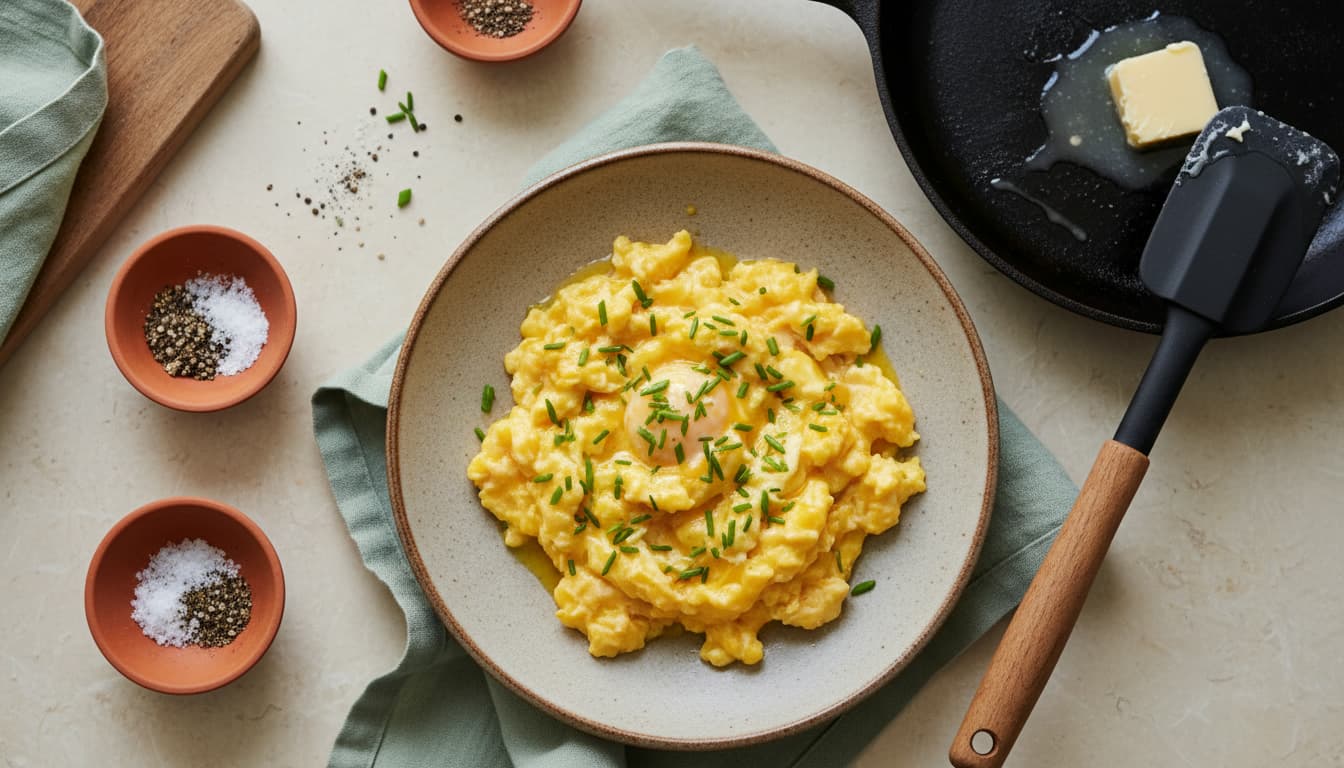
Scrambled eggs are a temperature exercise with an eight-minute margin for error and almost nobody uses it. Egg protein sets between 145F and 165F, and above that it squeezes out water and turns to rubber sitting in a grey puddle. Low heat, a spatula that never stops, fat that goes in cold, salt at the start, and the pan off the burner while they still look underdone.
Warum das funktioniert
Jedes Rezept auf dieser Seite kommt mit einer Erklärung der Technik-Entscheidungen: warum erst anbraten, dann schmoren, warum die Säure zum Schluss kommt, warum das Fett vor den Aromaten ausgelassen wird. Die Methode unten besteht aus genau diesen Entscheidungen, der Reihe nach.
Zutaten
2 Portionen- 6 largeeggs · three per person, and the fresher they are the more the whites hold together
- 1/2 tspkosher salt · beaten into the raw eggs at least 15 minutes before cooking, not at the end
- 1 1/2 tbspunsalted butter · cold and cubed, added to the cold pan with the eggs
- 1 tbspcreme fraiche · optional, folded in off the heat to stop the cooking and add richness
- 1/4 tspwhite pepper · added at the end, since black pepper scorches and shows as specks
- 1 tbspchives · finely sliced, over the top rather than stirred through
- 2 slicessourdough or good bread · toasted and buttered, ready before the eggs go in the pan
Methode
The whole dish happens between 145F and 165F
Egg white proteins begin to coagulate around 145F and yolk proteins around 150F. Push past roughly 165F and the protein network contracts hard enough to wring out the water it was holding, which is the grey liquid at the bottom of the plate and the rubbery bounce in the curd. Everything below is a way of keeping the pan inside that twenty-degree window for long enough that you can see what is happening and stop.
Beat them properly, until there is no streaking
Whisk until the mixture is one uniform yellow with no ribbons of white visible. Undermixed eggs cook unevenly, because whites set at a lower temperature than yolks and you end up with rubbery white flecks in a soft yolk curd. Whisk hard enough to combine and no harder: whipping air in gives you a foam that puffs, collapses and goes dry, which is what happens in most hotel breakfast buffets.
Salt at the start, and give it fifteen minutes
The advice to salt eggs at the end is one of the more durable pieces of bad kitchen folklore. Salt added to raw beaten egg dissolves and interferes with protein bonding, which loosens the network and produces a measurably more tender curd that holds more water. Salting a quarter of an hour ahead is better than salting immediately, and both beat salting at the end, which just seasons the outside of the curds and does nothing to the texture.
Butter goes in cold, with the eggs, in a cold pan
Put the pan on the hob with butter and beaten eggs together, then turn the heat on low. Starting cold means the pan cannot get ahead of you: by the time it is hot enough to set anything, you are already stirring and watching. The butter melts into the egg rather than browning, and the fat coats the protein strands as they form, which is a second lever on tenderness alongside the salt.
Nonstick or well-seasoned carbon steel, and a flexible spatula
Egg protein bonds chemically with bare metal, which is why scrambled eggs weld to stainless steel and why you then need to scrape, which breaks the curd. Use nonstick or a carbon steel or cast iron pan with a genuinely good seasoning layer. A silicone spatula with a flexible edge reaches into the corner where the pan wall meets the base, which is exactly where eggs overcook first and where a wooden spoon cannot go.
Keep the spatula moving, and change what it does as you go
For the first two minutes, stir constantly and scrape the base and the corners so nothing sets in place. Once you see the first soft ribbons, slow down and switch from stirring to folding, pushing the set curd from the edge into the middle so the liquid runs out to the hot surface. Constant motion at the start builds small curds; folding at the end builds larger ones. Stopping to check your phone builds a flat omelette.
The French curd and the American fold are two different dishes
The French style is the lowest possible heat, constant stirring, eight to ten minutes, and a result closer to a savoury custard that you spoon rather than lift. The American style is medium-low, mostly folding, three to four minutes, and gives you distinct soft pillows. Neither is more correct. Decide which one you are making before you turn the heat on, because they diverge in the first minute and you cannot switch halfway.
Pull the pan while they still look wet
The pan holds enough heat to keep cooking the eggs for a good thirty seconds after you lift it, and the eggs hold enough heat to keep cooking themselves on the plate. Take them off when they look about eighty percent done, glossy and still loose in places. Every cook who says they cannot get soft scrambled eggs is taking them off when they look right in the pan, which is one stage too late.
A spoon of cold dairy at the end is a brake, not an enrichment
A tablespoon of creme fraiche, cold butter or a splash of cream folded in the second the pan comes off the heat drops the temperature immediately and stops carryover cooking in its tracks. It also adds fat, which coats protein and softens the set. This is different from adding milk at the start, which mostly adds water: water dilutes the protein, thins the curd and eventually leaks back out onto the plate.
The milk question, answered
Milk in raw scrambled eggs is a habit inherited from wartime cooking, when it stretched an expensive ingredient. It does not make them fluffier. It dilutes the egg protein, which means the curd sets weaker and more of the added liquid separates out during cooking, giving you exactly the watery plate the milk was supposed to prevent. If you want richer eggs, add fat rather than liquid, and add it off the heat.
Three eggs a person, and do not cook for six at once
Three large eggs per person for a breakfast portion, two if there is a lot else on the plate. A ten-inch pan handles six eggs comfortably. Beyond that the layer gets deep enough that the bottom overcooks before the top has set, and no amount of stirring fixes a depth problem. For a crowd, either cook in batches, or move to a large baked egg dish, or make the frittata on this site instead, which is the dish designed for volume.
Everything else goes on the plate, not in the pan
Cheese, herbs, smoked salmon, tomatoes and mushrooms all release water or fat that interferes with the curd forming, and vegetables added raw drop the pan temperature and then leak liquid. Cook additions separately, drain them, and fold them in during the last fifteen seconds off the heat, or simply put them on top. Grated cheese is the one exception worth stirring in, and only in the final ten seconds while the pan is already off the burner.
Toast first, plate immediately, and do not hold them
Scrambled eggs have a serving window of about ninety seconds. Have the toast buttered and on the plate before the eggs go near the heat, because a plate of eggs waiting for toast is a plate of eggs continuing to cook. They do not hold in a warm oven, they do not reheat, and a chafing dish is where they go to become rubber. If timing is tight, this is the argument for the make-ahead egg bites on this site instead.
What nineteen grams of protein for 285 calories actually buys you
Six eggs across two servings is about nineteen grams of complete protein a plate for around 285 calories, with all nine essential amino acids and a leucine content high enough to matter for anyone tracking protein quality rather than quantity. Sodium sits near 390mg, most of it the salt you added. Add the toast and it is a straightforward breakfast; add the toast, a piece of fruit and a coffee and it is one of the cheapest complete breakfasts you can build.
Variationen
Substitutionen und Anpassungen folgen mit der Foto-Produktion. Die Methode hält bei den meisten sinnvollen Austauschen.
Aufbewahrung
Kühlschrank: 3 bis 4 Tage, verschlossen. Gefrierfach: bis zu 3 Monate. Abgedeckt aufwärmen, um die Feuchtigkeit zu halten.
Warum wir dieses scrambled eggs: low heat, constant motion, off the hob early 2-mal getestet haben.
Jedes wichtige Rezept auf dieser Seite durchläuft vor der Veröffentlichung mindestens drei Testrunden. Wir protokollieren, was sich zwischen den Tests geändert hat, damit Sie die Entwicklung des Rezepts sehen und wir die Fehlschläge nicht stillschweigend weglassen können.
- 01
Test 1
- Was wir versucht haben
- Cooked two batches of three eggs identically except that one was salted fifteen minutes before cooking and one was salted on the plate.
- Was passiert ist
- The pre-salted batch formed a visibly looser, glossier curd and left no liquid on the plate after two minutes. The late-salted batch tightened faster and released a small pool of water.
- Was wir geändert haben
- Salt now goes into the raw beaten egg, ideally a quarter of an hour ahead.
- 02
Test 2
- Was wir versucht haben
- Added two tablespoons of whole milk to the raw eggs in one batch, as most published recipes instruct, against a plain control.
- Was passiert ist
- The milk batch cooked to a slightly larger volume and then wept noticeably more liquid on standing. Blind-tasted, it read as blander and thinner rather than fluffier.
- Was wir geändert haben
- No milk in the raw egg. A spoon of cold creme fraiche goes in off the heat instead.
Häufige Fragen
- Should you add milk to scrambled eggs?
- No. Milk is mostly water, and water added to raw egg dilutes the protein so the curd sets weaker and then releases that liquid back onto the plate during cooking, which is the opposite of the intended effect. The habit comes from a period when eggs were expensive and milk stretched them. If you want richer, softer eggs, add fat rather than liquid, and add it off the heat: a tablespoon of cold butter or creme fraiche at the end.
- When should you salt scrambled eggs?
- In the raw beaten egg, ideally about fifteen minutes before cooking. Salt dissolves into the mixture and interferes with the protein bonds forming, which produces a more tender curd that holds onto its water. Salting at the end, which is the common advice, seasons the outside of the curds and has no effect on texture at all. This is one of the few kitchen claims where the side-by-side difference is obvious in a home pan.
- What is the best heat for scrambled eggs?
- Low, and lower than you think. Egg protein sets between about 145F and 165F, and pushing past that squeezes water out of the curd and turns it rubbery. Start the pan cold with the butter and eggs already in it, then turn the heat to low, so the pan never gets ahead of your spatula. Medium-low is acceptable for the American folded style; anything higher and the window between soft and ruined is a matter of seconds.
- Why are my scrambled eggs watery?
- Overcooking, almost always. Above roughly 165F the protein network contracts and wrings out the water it had been holding, and that liquid pools under the curd. The other cause is added milk or cream in the raw egg, which introduces water that has nowhere to go. Cook low, keep stirring, pull the pan while the eggs still look about eighty percent set, and add any dairy off the heat rather than at the start.
- How many eggs per person for scrambled eggs?
- Three large eggs per person for a proper breakfast, or two if there is bacon, toast and fruit alongside. That is around nineteen grams of protein for two servings from six eggs. Keep the total in a ten-inch pan to six eggs at most; beyond that the layer is too deep to cook evenly and the bottom sets before the top does. For more people, cook in batches or switch to a baked frittata.
- What is the difference between French and American scrambled eggs?
- Heat, time and curd size. The French method uses the lowest possible heat and constant stirring for eight to ten minutes, producing a fine, custard-like scramble you eat with a spoon. The American method uses medium-low heat and a folding motion for three to four minutes, producing distinct soft pillows you can lift with a fork. Both are good; pick one before you start, because the technique diverges within the first minute.
- Can you reheat scrambled eggs?
- Not well. Reheating pushes the protein past the temperature where it contracts, so eggs that were soft come back rubbery and weeping, and the microwave does this faster than anything. Scrambled eggs have a serving window of about ninety seconds and no useful shelf life. If you need eggs you can make in advance, the baked egg bites and the frittata on this site both hold for four days and reheat properly, because they are set custards rather than curds.
- Should scrambled eggs be cooked in butter or oil?
- Butter, for flavour and because milk solids brown lightly in a way oil does not. Add it cold along with the eggs to a cold pan so it melts into the mixture rather than browning first. Olive oil makes a genuinely good and slightly firmer scramble, which is the standard in most Mediterranean kitchens. What matters more than the fat is that there is enough of it: about a tablespoon and a half for six eggs coats the protein and softens the set.
- Are scrambled eggs a good high-protein breakfast?
- Yes, on protein quality rather than just quantity. Egg protein is complete, contains all nine essential amino acids, and is high in leucine, which is the amino acid most associated with muscle protein synthesis. Three eggs deliver about nineteen grams for roughly 285 calories with the butter included. Dietary cholesterol in eggs has a much smaller effect on blood cholesterol for most people than was believed for decades, and current United States guidance no longer sets a numeric daily cholesterol limit.
Ähnliche Rezepte
Alle ansehen →- Technique
Steak braten: früh salzen, trocken tupfen, Kerntemperatur messen
Ein Steak hat vier Variablen, und die Pfanne gehört nicht dazu. Die Dicke bestimmt die Methode, die Oberflächenfeuchte entscheidet über Kruste oder Dampf, die Kerntemperatur über den Garpunkt. Mindestens 45 Minuten vorher salzen, alle 30 Sekunden wenden und nach Thermometer garen statt nach Uhr.
80m42g Eiweiß - Technique
Kartoffelpüree: kalt aufsetzen, Milch erwärmen, niemals mixen
Klebriges Püree ist kein Würzproblem, sondern ein mechanisches. Stärkekörner platzen, sobald man sie schlägt, und danach ist die Textur nicht mehr zu retten. Kartoffeln in kaltem Salzwasser aufsetzen, im Topf trocken dämpfen, durch die Presse drücken und die Butter vor der warmen Milch zugeben.
45m5g Eiweiß - Technique
Linsen kochen: Sorten, Zeiten und wann das Salz dazukommt
Braune, grüne, Beluga- und rote Linsen kochen völlig unterschiedlich. Die Zeiten pro Sorte, warum Einweichen meist überflüssig ist, woher der Salzmythos kommt und wie Linsen bissfest bleiben, statt zu Brei zu zerfallen.
45m18g Eiweiß
Erhalten Sie jeden Sonntag ein getestetes Rezept und eine Nährwert-Notiz in Ihr Postfach.
Ein Rezept pro Woche, fotografiert am selben Dienstag, an dem es getestet wurde. Von einer Ernährungsberaterin geprüft. Keine Werbung, keine Pop-ups, kein Tracking.
Das Clean-Chef-Starter-Kit.
Ein 14-Tage-Plan für entzündungshemmende Ernährung als PDF, Einkaufsliste nach Abteilungen, Makros pro Tag aufsummiert, Sonntags-Vorbereitung. Kostenlos.
Mit der Anmeldung stimmen Sie unserer Datenschutzerklärung zu. Eine ruhige E-Mail pro Woche. Jederzeit abbestellbar.
Wir bauen einen Shop.
Kuratiertes Kochgeschirr, Vorratsbasics, die wir wirklich kaufen, Rezept-Bundle-PDFs. Erfahren Sie als Erste, wann er öffnet.
Wir schreiben Ihnen nur zur Shop-Eröffnung. In jeder E-Mail abbestellbar. Siehe unsere Datenschutzerklärung.