- Kalorien
- 430
- Eiweiß
- 42g
- Ballaststoffe
- 0g
- Ges. Fett
- 12g
- Natrium
- 520mg
- Zugesetzter Zucker
- 0g
Was dieses Rezept für Sie leistet.
There are only four variables in a steak and none of them is the pan. Thickness decides the method, surface moisture decides whether it browns or steams, internal temperature decides doneness, and the rest decides how much of the juice ends up on the board instead of in the meat. Salt forty-five minutes ahead, cook to a number rather than to a timer, and stop cutting into it to check.
Warum das funktioniert
Jedes Rezept auf dieser Seite kommt mit einer Erklärung der Technik-Entscheidungen: warum erst anbraten, dann schmoren, warum die Säure zum Schluss kommt, warum das Fett vor den Aromaten ausgelassen wird. Die Methode unten besteht aus genau diesen Entscheidungen, der Reihe nach.
Zutaten
4 Portionen- 2 steaksboneless ribeye or New York strip · about 12 oz each and a full 1 1/2 inches thick, which matters more than the cut
- 2 tspkosher salt · about 1 tsp per steak, applied at least 45 minutes ahead and ideally the night before
- 1 tspblack pepper · coarsely cracked, applied just before the steak goes in the pan
- 1 tbspneutral high-smoke-point oil · refined avocado, grapeseed or rice bran, not extra virgin olive oil
- 3 tbspunsalted butter · added in the last two minutes only, for basting
- 4 sprigsthyme · or rosemary, added with the butter
- 3 clovesgarlic · smashed but left whole so they do not burn in the butter
- 1 pinchflaky sea salt · for the sliced steak at the board, after resting
- 1 tspred wine vinegar or lemon juice · optional, over the sliced meat, to cut the fat
Methode
Thickness decides everything, so buy for thickness first
A one-and-a-half-inch steak gives you a window of about ninety seconds between rare and medium and enough mass to build a hard crust before the centre overcooks. A three-quarter-inch supermarket steak has no window at all: by the time the surface browns, the middle is grey. If the counter only has thin steaks, buy one thick steak and share it rather than two thin ones. Cut, grade and price all matter less than this single measurement.
Ribeye, strip, sirloin, and what each one is for
Ribeye has the most intramuscular fat, so it is the most forgiving and the richest, and it wants to go slightly further than the others because that fat needs to render. New York strip is leaner, firmer and beefier, with a fat cap you should render deliberately. Top sirloin is the value option and needs to be cut thick and served rare to medium rare. Filet has almost no fat and very little flavour of its own, which is why it is nearly always served with a sauce.
Salt forty-five minutes ahead, or the night before, and never in between
Salt immediately draws moisture to the surface. At five to thirty minutes in, that moisture is sitting on the meat and will steam in the pan, which is the worst possible moment to cook. By forty-five minutes it has been reabsorbed as brine and the surface has begun to dry. Overnight on a rack in the fridge, uncovered, is better still: the salt penetrates, and the surface dries to a tacky film that browns in half the time. Either salt right before it goes in the pan, or salt properly early.
Dry the surface like you mean it
Water on the surface has to boil off before the pan can climb past 212F, and boiling off water is what makes a steak grey. Press paper towel onto both faces and both edges until it comes away dry. If the steak has been in the fridge uncovered overnight it will already feel slightly tacky, which is the state you want. This is the single cheapest improvement available and it takes fifteen seconds.
Pepper goes on late, not with the salt
Cracked pepper sitting on a steak for an hour draws no benefit, and pepper in a screaming-hot dry pan scorches and turns acrid in under a minute. Apply it just before the steak goes in, or, if you are searing very hard, apply it during the butter-basting stage when the pan temperature has come down. Coarse cracked pepper burns less than fine ground, because less surface area is exposed.
Cast iron or carbon steel, and get it hotter than feels sensible
You want a pan with enough thermal mass that a cold steak does not crash its temperature. Cast iron and carbon steel both qualify; thin stainless and most nonstick do not, and nonstick coatings are not rated for the heat this needs. Preheat over medium-high for four to five minutes until a drop of water skitters and evaporates instantly. Add a tablespoon of neutral oil and wait for the first wisp of smoke. Extra virgin olive oil smokes too low for this job.
Flip every thirty seconds, which is the opposite of the folk rule
The instruction to flip once exists to protect grill marks, not the meat. Frequent flipping keeps each face from soaking up heat for long enough to overcook a band under the surface, so the interior cooks more evenly and the whole thing finishes faster. In side-by-side tests a steak flipped every thirty seconds cooks about a third quicker with a thinner grey band, and the crust is no worse. Total time for a one-and-a-half-inch steak is roughly eight to ten minutes.
Render the fat cap on its edge
A strip steak has a band of hard fat along one side that will not render lying flat. Hold the steak on that edge with tongs, or lean two steaks against each other, and give it two to three minutes until the fat is golden and has released a pool into the pan. That rendered beef fat then cooks the rest of the steak. Skipping this leaves a rubbery white strip that everyone at the table cuts off and leaves.
Butter, thyme and garlic go in at the end, not the start
Butter contains milk solids that burn at around 300F, well below searing temperature, so butter added at the beginning is black by minute three. Add it in the last two minutes with smashed garlic and thyme, tip the pan towards you, and spoon the foaming butter over the steak continuously. This does two things: it browns the surface further through the milk solids, and it moves heat into the top face while the bottom is not in contact with the pan.
Cook to a temperature, and buy the thermometer
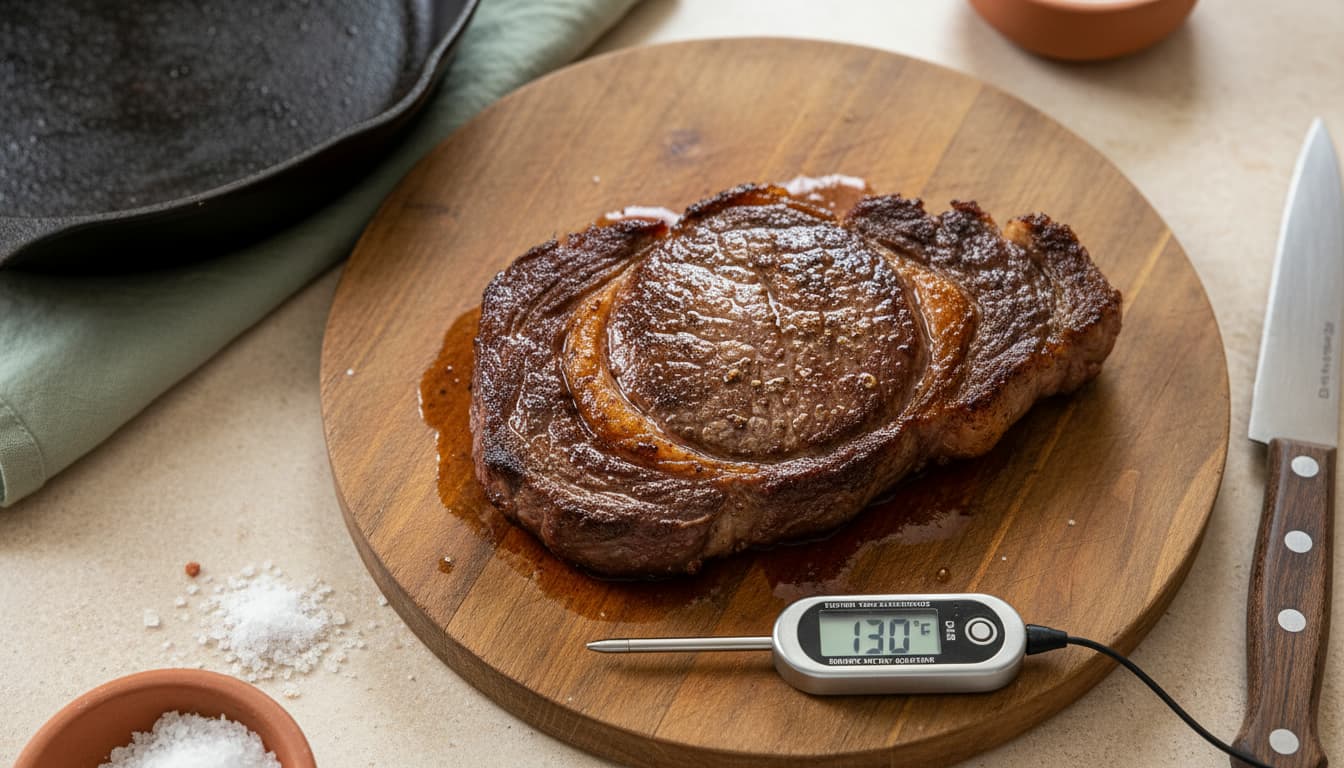
An instant-read thermometer probed into the thickest part from the side, not the top, is the only reliable method. Pull at 120F for rare, 125F for medium rare, 135F for medium, 145F for medium well. Those are pull temperatures, because carryover cooking adds five to ten degrees while the steak rests. The finger-poke test is a party trick that fails across cuts, thicknesses and starting temperatures, and cutting in to look releases the juice you spent an hour trying to keep.
The food-safety number, stated plainly
USDA guidance for whole cuts of beef is 145F internal followed by a three-minute rest, which lands at medium well. Steakhouses and most cooks serve rare to medium rare, at 125F to 135F, and accept a small residual risk on the reasoning that contamination on a whole muscle is a surface phenomenon and searing addresses the surface. That reasoning does not hold for mechanically tenderised, blade-tenderised or needle-injected steak, or for anything minced, and it is not the right risk for pregnancy, young children, older adults or anyone immunocompromised.
Reverse sear for anything over two inches
For a thick steak, a tomahawk or a whole roast, invert the order. Put the salted steak on a rack in a 250F oven until the centre reads 15F below your target, roughly thirty to forty-five minutes, then sear it in a ripping-hot pan for sixty to ninety seconds a side. The slow phase brings the whole interior to an even temperature with almost no grey band, and the dry oven air desiccates the surface so the sear happens faster. It is more precise than pan-only and it needs no rest afterwards.
Rest it, but not as long as people say
Five to ten minutes on a warm plate or a board, loosely tented so steam can escape rather than sealed under foil, which softens the crust you just built. Resting lets the muscle fibres relax and reabsorb liquid that pressure has pushed towards the centre, so less of it runs out on the first cut. Beyond about ten minutes for a steak this size you are simply serving it cold. If you reverse-seared, the rest already happened during the oven phase.
Slice against the grain, and look before you cut
Find the direction the muscle fibres run and cut perpendicular to them, which shortens each fibre and makes the meat measurably more tender in the mouth. On a ribeye the grain changes direction between the eye and the cap, so separate those two muscles first and cut each on its own axis. Slice half an inch thick, fan it on a warm board, scatter flaky salt over the cut faces, and pour the resting juices back over the top.
Deglaze the pan, because the best part is still in it
Tip out the excess fat, put the pan back on medium heat, add a splash of red wine, stock or even water, and scrape the brown residue up with a wooden spoon. Reduce for two minutes, swirl in a knob of cold butter off the heat, and you have a pan sauce in the time the steak is resting. A teaspoon of vinegar or lemon over the sliced meat does the same job with no pan at all, and cutting the fat with acid is what makes a second slice appealing.
Variationen
Substitutionen und Anpassungen folgen mit der Foto-Produktion. Die Methode hält bei den meisten sinnvollen Austauschen.
Aufbewahrung
Kühlschrank: 3 bis 4 Tage, verschlossen. Gefrierfach: bis zu 3 Monate. Abgedeckt aufwärmen, um die Feuchtigkeit zu halten.
Warum wir dieses how to cook steak: salt it early, dry it properly, use a thermometer 3-mal getestet haben.
Jedes wichtige Rezept auf dieser Seite durchläuft vor der Veröffentlichung mindestens drei Testrunden. Wir protokollieren, was sich zwischen den Tests geändert hat, damit Sie die Entwicklung des Rezepts sehen und wir die Fehlschläge nicht stillschweigend weglassen können.
- 01
Test 1
- Was wir versucht haben
- Salted two identical strip steaks, one at fifteen minutes before cooking and one at forty-five, and seared them in the same pan back to back.
- Was passiert ist
- The fifteen-minute steak hissed and released visible liquid for the first ninety seconds and built a patchy, pale crust. The forty-five-minute steak browned evenly from the start.
- Was wir geändert haben
- The recipe now specifies either salting immediately before cooking or at least forty-five minutes ahead, and calls out the five-to-thirty-minute window as the one to avoid.
- 02
Test 2
- Was wir versucht haben
- Cooked one steak with a single flip at the midpoint and an identical one flipped every thirty seconds, both to 125F.
- Was passiert ist
- The single-flip steak took eleven minutes and had a grey band roughly a quarter inch deep under each face. The frequently flipped steak reached the same centre temperature in eight minutes with a visibly thinner band, and the crusts were indistinguishable in a blind look.
- Was wir geändert haben
- Thirty-second flipping is now the default instruction.
- 03
Test 3
- Was wir versucht haben
- Added butter, garlic and thyme at the start of the sear rather than in the final two minutes.
- Was passiert ist
- The milk solids blackened within three minutes, the garlic burned bitter, and the smoke set off the alarm. The crust tasted acrid rather than beefy.
- Was wir geändert haben
- Neutral oil for the sear, butter and aromatics only in the last two minutes.
Häufige Fragen
- What temperature should steak be cooked to?
- Pull the steak off the heat at 120F for rare, 125F for medium rare, 135F for medium and 145F for medium well, measured with an instant-read thermometer probed in from the side into the thickest point. Carryover cooking adds another five to ten degrees during the rest. Note that USDA guidance for whole cuts of beef is 145F with a three-minute rest, which is medium well, and the lower temperatures most cooks use carry a small residual risk.
- Should you salt steak before or after cooking?
- Before, and the timing matters more than the amount. Salt at least forty-five minutes ahead, or overnight on a rack in the fridge, so the drawn-out moisture is reabsorbed as brine and the surface dries. If you have not planned ahead, salt immediately before the steak hits the pan, which gives you seasoning without wet surface. The window to avoid is roughly five to thirty minutes, when the surface is at its wettest and the steak will steam rather than sear.
- How long do you cook a steak on each side?
- For a one-and-a-half-inch steak in a properly preheated cast iron pan, roughly eight to ten minutes in total, flipping every thirty seconds, which comes out at about a minute of accumulated contact per side per flip cycle. But time is a poor proxy: thickness, starting temperature, pan mass and burner output all move it. Use the clock to know when to start checking and the thermometer to know when to stop.
- Do you cook steak in butter or oil?
- Oil to sear, butter to finish. Butter contains milk solids that burn at around 300F, far below the temperature needed to build a crust, so butter used from the start turns black and bitter. Use a refined high-smoke-point oil such as avocado, grapeseed or rice bran for the sear, then add butter with garlic and thyme in the last two minutes and baste continuously. You get the browning benefit of the milk solids without burning them.
- What is the reverse sear method?
- Cooking the steak slowly in a low oven first, around 250F, until the centre is about fifteen degrees below your target, then searing it hard in a hot pan for sixty to ninety seconds a side. It gives a far more even interior with almost no grey band, and the dry oven air desiccates the surface so the crust forms faster. It is the better method for anything two inches or thicker, and it needs no resting afterwards because the meat is already at an even temperature.
- How long should steak rest after cooking?
- Five to ten minutes for a steak of this size, on a warm board or plate, tented loosely rather than wrapped in foil, which traps steam and softens the crust. Resting lets the fibres relax and reabsorb liquid that heat has driven towards the centre, so less runs out when you cut. Longer than ten minutes and you are just serving cold steak. A reverse-seared steak does not need a rest, because the temperature gradient is already flat.
- Should you bring steak to room temperature before cooking?
- It helps less than the internet suggests. A thick steak left on the counter for an hour rises only a few degrees at the centre, because meat is a poor conductor, and an hour at room temperature is time spent in the bacterial danger zone. What genuinely matters is a dry surface, which an uncovered stint in the fridge delivers better than a covered stint on the counter. Take it out while the pan preheats, dry it well, and start cooking.
- Why is my steak tough?
- Usually overcooking, occasionally the cut, and sometimes the knife. Muscle protein contracts and squeezes out water progressively above about 140F, so a steak taken to well done from a lean cut will be dry however good the beef was. Slicing with the grain rather than against it makes any steak chew tougher than it needs to. And a cut with a lot of connective tissue, such as chuck or flank, needs either a braise or a short cook and thin slicing rather than a straight sear.
- How much protein is in a steak?
- Roughly seven grams of protein per ounce of cooked beef, so a six-ounce cooked portion, which is what a twelve-ounce raw steak yields after shrinkage and sharing, delivers about forty-two grams. That is most of a day's requirement for a smaller adult in one sitting. The calorie and saturated fat figures depend heavily on the cut: ribeye carries considerably more intramuscular fat than top sirloin at the same weight, which is also why it tastes better.
Ähnliche Rezepte
Alle ansehen →- Technique
Rührei: niedrige Hitze, ständig rühren, früh vom Herd nehmen
Rührei ist eine Temperaturübung mit acht Minuten Spielraum, den kaum jemand nutzt. Eiweiß gerinnt zwischen 63 und 74 Grad, darüber presst es Wasser heraus und wird gummiartig. Kalte Pfanne, kalte Butter, Salz ins rohe Ei, ununterbrochen rühren und die Pfanne vom Herd nehmen, solange die Masse noch feucht aussieht.
15m19g Eiweiß - Technique
Kartoffelpüree: kalt aufsetzen, Milch erwärmen, niemals mixen
Klebriges Püree ist kein Würzproblem, sondern ein mechanisches. Stärkekörner platzen, sobald man sie schlägt, und danach ist die Textur nicht mehr zu retten. Kartoffeln in kaltem Salzwasser aufsetzen, im Topf trocken dämpfen, durch die Presse drücken und die Butter vor der warmen Milch zugeben.
45m5g Eiweiß - Technique
Linsen kochen: Sorten, Zeiten und wann das Salz dazukommt
Braune, grüne, Beluga- und rote Linsen kochen völlig unterschiedlich. Die Zeiten pro Sorte, warum Einweichen meist überflüssig ist, woher der Salzmythos kommt und wie Linsen bissfest bleiben, statt zu Brei zu zerfallen.
45m18g Eiweiß
Erhalten Sie jeden Sonntag ein getestetes Rezept und eine Nährwert-Notiz in Ihr Postfach.
Ein Rezept pro Woche, fotografiert am selben Dienstag, an dem es getestet wurde. Von einer Ernährungsberaterin geprüft. Keine Werbung, keine Pop-ups, kein Tracking.
Das Clean-Chef-Starter-Kit.
Ein 14-Tage-Plan für entzündungshemmende Ernährung als PDF, Einkaufsliste nach Abteilungen, Makros pro Tag aufsummiert, Sonntags-Vorbereitung. Kostenlos.
Mit der Anmeldung stimmen Sie unserer Datenschutzerklärung zu. Eine ruhige E-Mail pro Woche. Jederzeit abbestellbar.
Wir bauen einen Shop.
Kuratiertes Kochgeschirr, Vorratsbasics, die wir wirklich kaufen, Rezept-Bundle-PDFs. Erfahren Sie als Erste, wann er öffnet.
Wir schreiben Ihnen nur zur Shop-Eröffnung. In jeder E-Mail abbestellbar. Siehe unsere Datenschutzerklärung.