- Kalorien
- 125
- Eiweiß
- 1g
- Ballaststoffe
- 1g
- Ges. Fett
- 2g
- Natrium
- 150mg
- Zugesetzter Zucker
- 0g
Was dieses Rezept für Sie leistet.
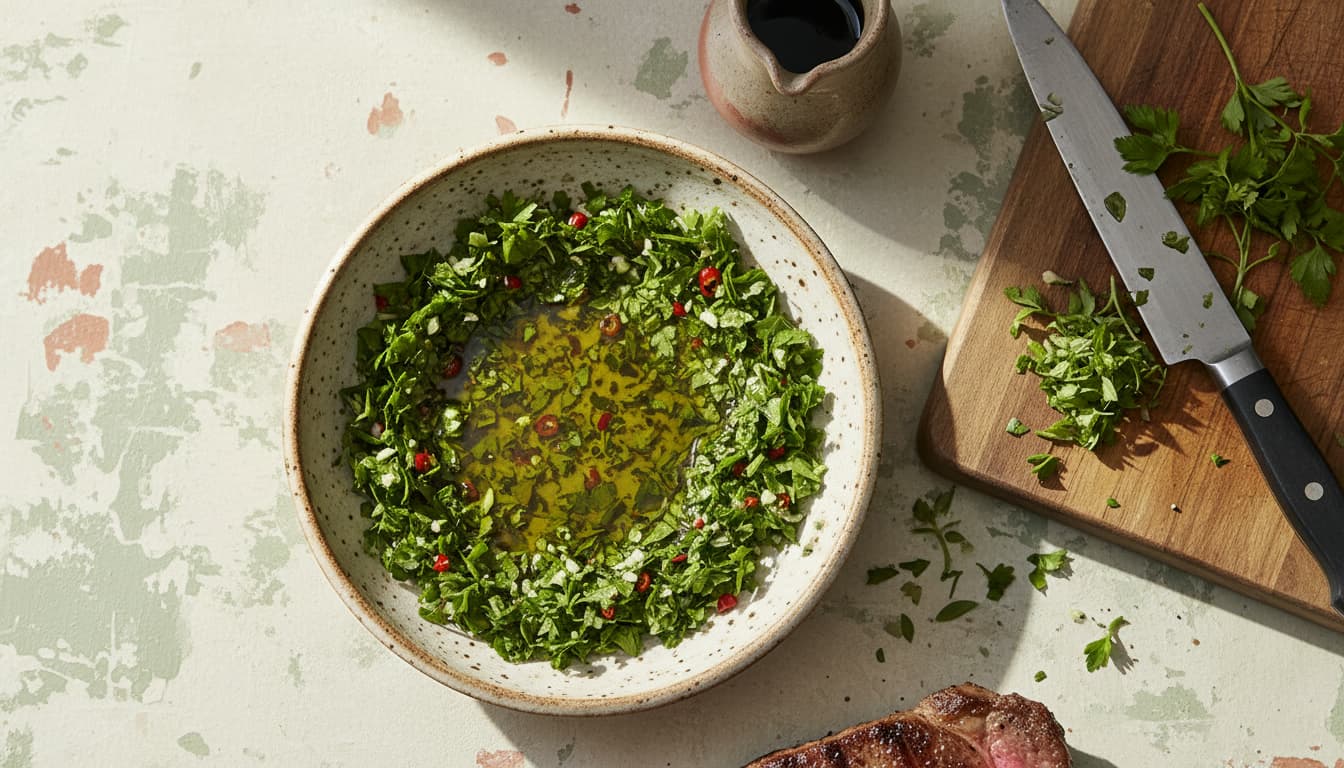
A food processor turns chimichurri into green paint. The sauce you want is loose, spoonable and made of pieces you can see, which means a knife, a board and about fifteen minutes. Salt and vinegar go in before the oil so the herbs season rather than get sealed. Then it rests half an hour, because raw garlic needs that long to stop shouting.
Warum das funktioniert
Jedes Rezept auf dieser Seite kommt mit einer Erklärung der Technik-Entscheidungen: warum erst anbraten, dann schmoren, warum die Säure zum Schluss kommt, warum das Fett vor den Aromaten ausgelassen wird. Die Methode unten besteht aus genau diesen Entscheidungen, der Reihe nach.
Zutaten
8 Portionen- 1 large bunchflat-leaf parsley · about 2 packed cups of leaves and thin stems, washed and dried completely
- 2 tbspfresh oregano leaves · or 2 tsp dried Mexican oregano, crumbled between your palms
- 6 clovesgarlic · minced very fine by hand, not pressed
- 1 wholered chile · a fresno or a red jalapeno, seeded and minced, or 1 tsp red pepper flakes
- 1/2 cupred wine vinegar · a decent one, this is half the flavour of the sauce
- 1 1/4 tspkosher salt · added to the vinegar, not to the oil
- 1 smallshallot · minced, optional, and not traditional in Argentina
- 3/4 cupmild olive oil · not a peppery extra-virgin, it fights the herbs
- 1/2 tspblack pepper · coarsely cracked
- 1 pinchground cumin · optional, about 1/8 tsp, common in the Buenos Aires versions
- 2 tbspwater · cold, to loosen the sauce at the end if it has tightened
Methode
Put the food processor away, and here is the actual reason
Blades bruise. A spinning blade ruptures the cell walls of parsley on a scale that hand-chopping never does, which releases chlorophyll and the bitter compounds that sit with it, and it emulsifies the oil into the water in the leaves. You get a thick, opaque, faintly bitter green paste that pools instead of running. Hand-chopped chimichurri stays loose and translucent, the oil sits separately and clings to whatever you spoon it over, and it tastes of parsley rather than of green. Fifteen minutes with a sharp knife is the whole difference.
Dry the herbs like you mean it
Wash the parsley, spin it, then lay it on a towel for ten minutes while you do everything else. Water left on the leaves does two things, both bad: it dilutes the vinegar so the sauce tastes flat, and it sits under the oil layer in the jar where it shortens the fridge life from two weeks to about four days. If you are in a hurry, spin twice and press the bundle between two towels. Damp herbs are the most common reason a homemade batch goes cloudy overnight.
Use the thin stems, discard the thick ones
The thin stems at the top of a parsley bunch carry more flavour per gram than the leaves and chop down to nothing. The thick lower stems are fibrous and stay stringy no matter how fine your knife work is. Grab the bunch, cut across it about an inch below where the leaves start, and throw the bottom half in the stock bag. You are aiming for roughly two packed cups of usable material, which is one large supermarket bunch or a bit more.
Chop to the size of a match head, and stop there
Gather the parsley into a tight pile, rock a large sharp knife through it, regather, repeat. Three or four passes. You want visible flecks about the size of a match head, not a mince and not a mush. If the board is going wet and dark green under the pile, you are past the point and the knife is dull. A dull knife tears rather than cuts and gives you the same bruising problem as the processor, in slow motion. Sharpen it first if you have any doubt.
Mince the garlic by hand, never through a press
A garlic press ruptures every cell at once, which maximises allicin production and gives you a hot, sulphurous note that dominates the sauce for the first day and turns acrid by the third. Hand-minced garlic releases less of it and mellows properly in the vinegar. Six cloves sounds aggressive and is correct for this volume, because the acid and the rest period take most of the edge off. If you are nervous, use four and add more after the rest.
Salt and vinegar first, oil last, and that order is not arbitrary
Combine the vinegar, salt, garlic, chile, shallot and oregano in the bowl and let them sit for five minutes before anything else happens. Salt dissolves in the vinegar, the garlic and chile start to soften in the acid, and the dried oregano rehydrates. Add the oil first and you coat every particle in fat, the salt never dissolves properly, and you end up with a sauce that tastes simultaneously under-seasoned and gritty. Five minutes of patience here is worth more than any ingredient upgrade.
Mild oil, not your best peppery extra-virgin
A green, grassy, high-polyphenol extra-virgin olive oil is a wonderful thing on bread and the wrong choice here, because its own pepper and bitterness stack on top of the raw garlic and the sauce ends up harsh. Use a mild or light-tasting olive oil, or cut a good extra-virgin half and half with a neutral oil. In Argentina this is often made with plain sunflower oil for exactly this reason. Stir the oil in with a spoon rather than whisking, because you are combining, not emulsifying.
Thirty minutes at room temperature, and no longer than a few hours
Cover the bowl and leave it on the counter for thirty minutes. The garlic rounds out, the salt distributes, the oregano softens, and the parsley gives up a little colour into the oil. Taste before and after and the difference is obvious. Past about four hours at room temperature the parsley starts to dull and the vinegar dominates, so if you are making it in the morning for dinner, refrigerate after the first thirty minutes and pull it out an hour before you eat.
The ratio, and what to change when you taste it
This is roughly one part vinegar to one and a half parts oil, which is sharper than a salad dressing and deliberately so, because the sauce is meant to cut through fat. If it tastes harsh on a spoon it is probably correct on a steak. If it tastes flat, it needs salt rather than more vinegar, nine times out of ten. If it tastes dusty, the dried oregano was old. If it tightens up in the fridge, loosen it with the two tablespoons of cold water rather than more oil.
Chimichurri rojo, if you want the other one
The red version is the same sauce with a tablespoon of sweet paprika or pimenton and a small grated ripe tomato stirred in at the end, and the parsley cut back slightly to make room. It is heavier, sweeter and better on chicken and roasted vegetables than on beef. Make it the same way and in the same order. Do not add the tomato until after the rest period, because it waters down the acid the garlic is supposed to be softening in.
What it goes on, beyond the obvious steak
Grilled or roasted anything with a browned surface, because the acid needs something rich to cut. Skirt and flank steak first, then lamb, then chicken thighs. Spooned over roasted potatoes or charred broccoli it turns a side into the reason for dinner. Stirred through white beans with a little of their cooking liquid it is a whole vegan lunch. It is also very good on a fried egg, and it is compliant as written for whole30 and paleo eating.
Storage, and the two-week honest answer
In a clean jar with the oil covering the solids, refrigerated, this holds two weeks and is at its best between day one and day five. The parsley darkens from bright to olive over that time, which looks worse and tastes fine. Do not freeze it, because the herbs turn to slime on thawing. Never leave it at room temperature overnight: raw garlic in oil is the classic home setting for Clostridium botulinum, and the acid here helps but the fridge is what makes it safe.
Using it as a marinade, and the ninety-minute ceiling
Chimichurri makes an excellent marinade for skirt, flank and hanger steak, and a poor one if you leave it on too long. At roughly one part vinegar to one and a half parts oil it is acidic enough to start denaturing the surface proteins, and past about ninety minutes the outer few millimetres go pale, chalky and slightly mealy in a way that survives the grill. Thirty to sixty minutes at room temperature is the window. Always split the batch first and keep the table portion in a separate jar, because anything that has touched raw meat cannot come back.
Why it separates in the jar, and why that is correct
Within an hour of resting, the oil rises and the herbs settle, and the jar looks like two layers. That is the sauce working as intended: chimichurri is a suspension, not an emulsion, and there is no egg, mustard or starch in it to hold the two phases together. Stir it back with a spoon before every use and it comes straight back. If yours does not separate at all, something is emulsifying it, which usually means it went near a blender, and the texture will confirm it.
Variationen
Substitutionen und Anpassungen folgen mit der Foto-Produktion. Die Methode hält bei den meisten sinnvollen Austauschen.
Aufbewahrung
Kühlschrank: 3 bis 4 Tage, verschlossen. Gefrierfach: bis zu 3 Monate. Abgedeckt aufwärmen, um die Feuchtigkeit zu halten.
Warum wir dieses chimichurri: chopped by hand, rested thirty minutes 3-mal getestet haben.
Jedes wichtige Rezept auf dieser Seite durchläuft vor der Veröffentlichung mindestens drei Testrunden. Wir protokollieren, was sich zwischen den Tests geändert hat, damit Sie die Entwicklung des Rezepts sehen und wir die Fehlschläge nicht stillschweigend weglassen können.
- 01
Test 1
- Was wir versucht haben
- Pulsed everything in a food processor for eight seconds, the way most published recipes suggest.
- Was passiert ist
- Opaque, thick, dark green, with a bitter finish that got worse by day two. It sat on the steak like pesto instead of running into it.
- Was wir geändert haben
- Hand-chopped everything from that point on. Fifteen minutes, and the sauce turned translucent and loose.
- 02
Test 2
- Was wir versucht haben
- Whisked the salt into the oil first, then added vinegar and herbs, in a batch made for eight people.
- Was passiert ist
- The sauce read under-salted on a spoon, then gritty at the bottom of the bowl. The salt had never dissolved.
- Was wir geändert haben
- Salt now goes into the vinegar and rests five minutes before the oil touches anything.
- 03
Test 3
- Was wir versucht haben
- Used a peppery Tuscan extra-virgin olive oil, on the assumption that better oil makes a better sauce.
- Was passiert ist
- The oil's own bitterness stacked with the raw garlic and the whole bowl tasted aggressive rather than bright.
- Was wir geändert haben
- Switched to a mild olive oil. Sunflower oil, which is what a lot of Argentine cooks use, tested nearly as well.
Häufige Fragen
- Can I make chimichurri in a food processor?
- You can, and it will be a different and worse sauce. The blade bruises the parsley, which releases bitterness and turns the mixture into an opaque paste that sits on food rather than running into it. If you have no other option, pulse in two-second bursts with the oil already in the bowl, stop while there are still visible pieces, and expect to use it the same day because the bruised herbs darken fast. Fifteen minutes with a knife genuinely produces a better result.
- How long does chimichurri keep in the fridge?
- Two weeks in a clean sealed jar with the oil covering the solids, and it is at its best in the first five days. The colour goes from bright green to olive over that window, which is oxidation rather than spoilage. Do not store it at room temperature, because raw garlic suspended in oil is a recognised botulism risk and refrigeration is the control. Freezing does not work: the parsley cell walls rupture and you get green slush.
- What is the difference between chimichurri and pesto?
- Pesto is emulsified and enriched, built on basil, cheese, nuts and a lot of oil, and it is a coating. Chimichurri is not emulsified, contains no dairy or nuts, and is built on vinegar, which makes it a cutting sauce rather than a coating one. That is why chimichurri works on rich, browned, fatty things and pesto works on starch. It is also why chimichurri is dairy-free, gluten-free and vegan by default while pesto is not.
- Should I use fresh or dried oregano?
- Dried, if you want the Argentine version, and it is one of the few places where dried genuinely beats fresh. Dried oregano rehydrates in the vinegar and gives the savoury, slightly medicinal back note that defines the sauce. Fresh oregano is greener and softer and makes something closer to a herb salsa, which is pleasant but tastes different. If you use dried, crumble it between your palms first to wake up the oils, and buy Mexican oregano if you can find it.
- Is chimichurri whole30 compliant?
- Yes, exactly as written, provided your red wine vinegar has no added sulfite-carrying wine content you object to and you use a compliant oil. There is no sugar, no dairy, no grain and no legume in it. It is also paleo and vegan as written. That makes it one of the most useful sauces to keep in the fridge during a restrictive month, because it makes plain grilled protein and roasted vegetables taste like a deliberate meal rather than a compromise.
- My chimichurri tastes too sharp. What do I do?
- Check the salt first, because a sauce that reads harsh is usually under-salted rather than over-acidified. Add a quarter teaspoon, stir, wait two minutes and taste again. If it is still too sharp, stir in a tablespoon of oil rather than adding sugar. And taste it on the food it is meant for, not off a spoon. A sauce built to cut through a fatty skirt steak will always taste aggressive on its own, and that is the design working.
- Can I use cilantro instead of parsley?
- You can, and about a third cilantro to two thirds parsley is the ratio that works without the sauce becoming a different dish. All-cilantro chimichurri is closer to a Mexican salsa verde cruda and loses the grassy backbone that stands up to red meat. Cilantro also breaks down faster in acid, so an all-cilantro version wants to be eaten within a day rather than kept for two weeks. Keep the oregano either way, since that is what makes it read as chimichurri.
- How much chimichurri do I need per person?
- Two tablespoons per person as a sauce alongside grilled meat, which is what the nutrition figures here are based on, and this recipe makes about one cup or eight servings. If you are using it as a marinade as well, double the batch and keep the marinating portion separate, because anything that has touched raw meat cannot go back on the table. Marinate for no more than an hour, since the vinegar starts to cure the surface of the meat past that.
Ähnliche Rezepte
Alle ansehen →Gazpacho: reife Tomaten, altes Brot, vier Stunden kalt
Gazpacho ist eine Emulsion, keine kalte Tomatensuppe. Warum eingeweichtes Brot und langsam eingegossenes Olivenöl die Textur machen, wie viel Sherryessig hineingehört und warum kalt immer nachgewürzt werden muss.
270m4g EiweißTabouleh: ein Kräutersalat mit Bulgur, nicht umgekehrt
Echtes Tabouleh besteht zu drei Vierteln aus Petersilie. Warum der Bulgur nur eingeweicht und nicht gekocht wird, warum die Petersilie vollständig trocken sein muss und warum die Tomaten vor dem Mischen abtropfen müssen.
45m4g EiweißCarbonara: keine Sahne, Guanciale, Pfanne runter vom Herd
Rührei statt Sauce entsteht bei zu viel Hitze. Warum Guanciale und nicht Speck, warum Pecorino und nicht Parmesan, wie viel Nudelwasser in die Eier gehört und bei welcher Temperatur die Emulsion bindet statt zu stocken.
30m27g Eiweiß
Erhalten Sie jeden Sonntag ein getestetes Rezept und eine Nährwert-Notiz in Ihr Postfach.
Ein Rezept pro Woche, fotografiert am selben Dienstag, an dem es getestet wurde. Von einer Ernährungsberaterin geprüft. Keine Werbung, keine Pop-ups, kein Tracking.
Das Clean-Chef-Starter-Kit.
Ein 14-Tage-Plan für entzündungshemmende Ernährung als PDF, Einkaufsliste nach Abteilungen, Makros pro Tag aufsummiert, Sonntags-Vorbereitung. Kostenlos.
Mit der Anmeldung stimmen Sie unserer Datenschutzerklärung zu. Eine ruhige E-Mail pro Woche. Jederzeit abbestellbar.
Wir bauen einen Shop.
Kuratiertes Kochgeschirr, Vorratsbasics, die wir wirklich kaufen, Rezept-Bundle-PDFs. Erfahren Sie als Erste, wann er öffnet.
Wir schreiben Ihnen nur zur Shop-Eröffnung. In jeder E-Mail abbestellbar. Siehe unsere Datenschutzerklärung.