- Kalorien
- 620
- Eiweiß
- 27g
- Ballaststoffe
- 3g
- Ges. Fett
- 12g
- Natrium
- 780mg
- Zugesetzter Zucker
- 0g
Was dieses Rezept für Sie leistet.
Carbonara is not a cream sauce and it is not scrambled eggs. It is an emulsion of egg yolk, rendered pork fat, grated sheep cheese and starchy pasta water, held together by heat that stops just short of setting the egg. Everything that goes wrong goes wrong in the last ninety seconds. Thirty minutes, four ingredients, and a pan that comes off the burner before the eggs arrive.
Warum das funktioniert
Jedes Rezept auf dieser Seite kommt mit einer Erklärung der Technik-Entscheidungen: warum erst anbraten, dann schmoren, warum die Säure zum Schluss kommt, warum das Fett vor den Aromaten ausgelassen wird. Die Methode unten besteht aus genau diesen Entscheidungen, der Reihe nach.
Zutaten
4 Portionen- 5 ozguanciale · cured pork jowl, cut into batons about 1/4 inch thick, not thin slices
- 1 lbdried spaghetti or rigatoni · bronze-die if you can find it, the rough surface holds the sauce
- 4 wholeegg yolks · large, at room temperature, cold yolks seize when they hit the pan
- 1 wholewhole egg · large, it adds enough white to make the sauce coat rather than cling in ribbons
- 3 ozPecorino Romano · grated on a microplane to a powder, about 1 1/2 packed cups once grated
- 2 tspblack peppercorns · coarsely cracked in a mortar, toasted dry in the pan, this is the carbon in carbonara
- 1 tbspkosher salt · for the pasta water, and less than you would use for a tomato sauce
- 1 1/2 cupsstarchy pasta water · reserved, and you will use more of it than you expect
Methode
Guanciale, pancetta, bacon: what each one actually does
Guanciale is cured pork jowl. It is fattier than pancetta, the fat renders soft and sweet rather than crisp, and it carries a distinct funk that is most of the dish's character. Pancetta is cured belly and works, with a leaner, saltier result. American bacon is smoked, and smoke is not a carbonara flavour, it takes over the pan. If bacon is what you have, use it and accept you are making something adjacent. Do not buy it pre-diced.
Cut it thick, start it cold, render it slowly
Quarter-inch batons, not thin slices, because thin slices go from raw to brittle with no soft stage in between. Into a cold dry pan, then medium-low heat, and eight to ten minutes while the fat renders out and the lean edges turn gold. You want pieces that are crisp at the corners and still yielding in the middle. Rushing this on high heat leaves unrendered fat inside and gives you rubber. There should be about four tablespoons of clear fat in the pan.
Toast the pepper in that fat, and use twice as much as feels right
Crack the peppercorns coarsely in a mortar, not in a grinder, because you want irregular pieces that crunch. Once the guanciale is rendered, lift it out and drop the pepper into the hot fat for thirty seconds until it blooms and the kitchen smells of it. Pepper is a listed component here rather than a seasoning, and the classic reading of the name points at the black flecks. Two teaspoons for four people is correct, and it will not taste harsh.
Pecorino Romano, grated to a powder, and why not Parmigiano
Pecorino Romano is a hard sheep cheese, sharper and considerably saltier than Parmigiano-Reggiano, and it is the Roman default. Parmigiano is milder and melts more smoothly, which is why many recipes use a blend, and a fifty-fifty split is a legitimate choice if straight Pecorino reads too aggressive to you. What matters more than the ratio is the grind. Coarse shreds do not dissolve, they clump into strings. Microplane it until it looks like snow.
Salt the pasta water less than usual, because the cheese is the salt
A tablespoon of kosher salt in four quarts, roughly half what you would use for a plain tomato sauce. Three ounces of Pecorino carries a serious amount of sodium, and the cured pork carries more. This is the one pasta dish where heavily salted water reliably overshoots. Taste the water. It should be noticeably seasoned rather than aggressively so, and you can always finish with a pinch at the table.
Use less water than the box says, on purpose
Cook the pasta in about three quarts rather than the six a pound of dried pasta usually calls for. Less water means a higher concentration of dissolved starch, and that starch is the emulsifier doing half the work of holding egg fat and pork fat in suspension. Water that looks cloudy and feels faintly slippery between your fingers is what you want. Reserve at least a cup and a half before draining, and reserve it early, in a jug, because everyone forgets.
Build the egg mixture in a bowl first, and temper it
Four yolks plus one whole egg, whisked with the grated Pecorino and half the toasted pepper into a thick paste. It will look far too thick. Now whisk in a few tablespoons of hot pasta water, a little at a time, until it loosens into a pourable cream. This is tempering, and it does two things: it raises the egg temperature gradually so it does not shock in the pan, and it starts dissolving the cheese before the timing gets tight.
Pull the pasta at least two minutes early
The pasta finishes in the pan, not in the pot. Drain it two to three minutes before the box time, when it still has a firm white core, and move it straight into the guanciale fat over low heat with a ladle of pasta water. Toss hard for a minute or two. The pasta absorbs seasoned liquid instead of plain water and releases more starch into the sauce, and it arrives at the egg stage already coated in fat.
The pan comes off the heat before the egg goes in. Every time.
Egg yolk begins to set somewhere around 149F and whole egg is fully coagulated by about 158F. A pan over even a low flame is far above both. Take the pan off the burner entirely, wait thirty seconds, then pour the tempered egg mixture over the pasta and toss continuously and fast. The residual heat in the pan and the pasta is exactly enough. This single instruction is the difference between carbonara and spaghetti with scrambled eggs.
Toss for ninety seconds and keep adding water
Keep the pasta moving with tongs, lifting and folding rather than stirring, and add hot pasta water two tablespoons at a time. The sauce goes through a stage where it looks thin and slightly broken, then it tightens and turns glossy and starts clinging to the strands. That transition is the emulsion forming. If the pan has gone too cool for it to happen, put it back on the lowest heat for ten seconds at a time, never longer.
The double-boiler method, if you have scrambled it twice
Set the bowl of tempered eggs over a pan of barely simmering water, add the drained pasta and the guanciale fat, and toss there instead. The water bath physically cannot exceed 212F and in practice sits well below the pan temperature, so the egg cannot set faster than you can stir. It takes two minutes longer and it is close to foolproof. Restaurants that serve fifty covers a night do it this way for a reason. There is no purity cost.
Why there is no cream in it, and what cream actually does
Cream is not in the Roman dish and it is not needed, because emulsified egg yolk and starch already give you a coating sauce. What cream does is make the dish forgiving: dairy fat and casein buffer the egg against heat, so a cream carbonara is much harder to scramble. That is why the cream version spread. It is also heavier, flatter and mutes the Pecorino. Learn it without, and if you want insurance, use the double boiler rather than cream.
Serve it in warmed bowls, immediately, and do not garnish
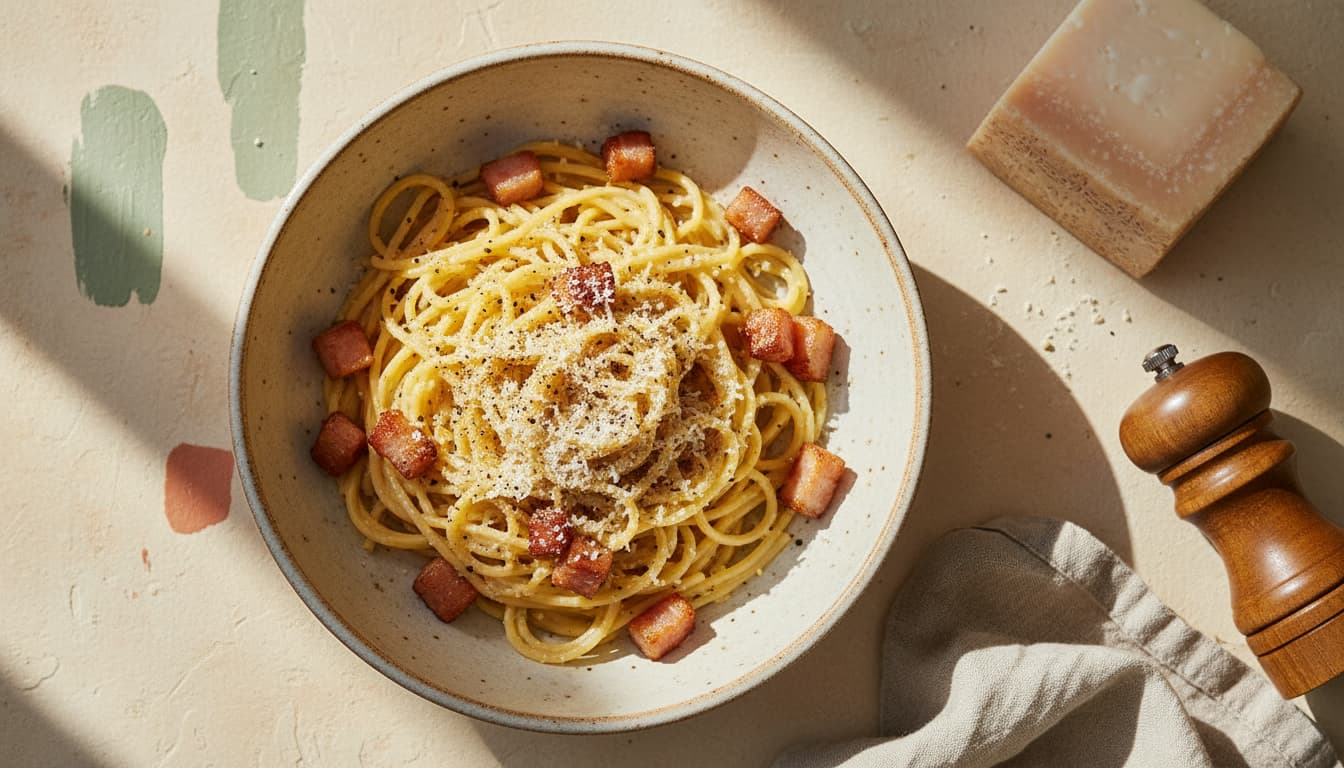
Carbonara has a window of about three minutes. It keeps thickening as it cools and it will go stodgy in a cold bowl faster than you can carry it to the table. Warm the bowls under the hot tap while the pasta cooks. Divide, scatter the reserved crisp guanciale and the rest of the pepper over the top, add a last dusting of Pecorino, and stop. Parsley, garlic, peas, mushrooms and onion all belong to other pasta dishes.
Leftovers, and the honest answer about them
There are no good leftovers. Reheating sets the egg, and every method, microwave, pan or oven, gives you the scrambled texture you spent the whole recipe avoiding. If you have some, eat it cold from the fridge the next day, which is genuinely pleasant, or fry it in a little olive oil into a frittata-style cake and treat that as a different dish. Cook the amount you will eat. This is not a meal prep recipe and no technique makes it one.
Variationen
Substitutionen und Anpassungen folgen mit der Foto-Produktion. Die Methode hält bei den meisten sinnvollen Austauschen.
Aufbewahrung
Kühlschrank: 3 bis 4 Tage, verschlossen. Gefrierfach: bis zu 3 Monate. Abgedeckt aufwärmen, um die Feuchtigkeit zu halten.
Warum wir dieses carbonara: four ingredients, one temperature, no cream 3-mal getestet haben.
Jedes wichtige Rezept auf dieser Seite durchläuft vor der Veröffentlichung mindestens drei Testrunden. Wir protokollieren, was sich zwischen den Tests geändert hat, damit Sie die Entwicklung des Rezepts sehen und wir die Fehlschläge nicht stillschweigend weglassen können.
- 01
Test 1
- Was wir versucht haben
- Added the egg mixture with the pan still over the lowest flame the burner would hold, on the theory that low is low enough.
- Was passiert ist
- The sauce set into visible curds within twenty seconds. It tasted fine and looked like a mistake, which is exactly what it was.
- Was wir geändert haben
- The pan leaves the heat completely and rests thirty seconds before the egg goes anywhere near it.
- 02
Test 2
- Was wir versucht haben
- Grated the Pecorino on the coarse side of a box grater rather than on a microplane, to save washing a second tool.
- Was passiert ist
- The shreds clumped into strings that never dissolved, and the sauce stayed watery around ropes of melted cheese.
- Was wir geändert haben
- Microplane only, ground to a powder, and whisked into the yolks before any liquid is added.
- 03
Test 3
- Was wir versucht haben
- Cooked the pasta in the full six quarts the packet recommends and reserved a cup of that water.
- Was passiert ist
- The water was too dilute to emulsify anything. The sauce broke into fat and liquid and needed a second batch of cheese to recover.
- Was wir geändert haben
- Three quarts of water for a pound of pasta, and a cup and a half of it reserved before draining.
Häufige Fragen
- Does real carbonara have cream in it?
- No. The Roman dish is egg yolk, guanciale, Pecorino Romano, black pepper and pasta water, and the sauce is an emulsion rather than a dairy reduction. Cream appears in later international versions because it makes the dish much harder to ruin: the fat and protein in cream buffer the egg against heat so it does not scramble. It also flattens the flavour and mutes the cheese. If you want the safety, use a double boiler instead.
- Why did my carbonara scramble?
- The pan was too hot when the egg went in. Yolk starts to set around 149F and a pan on even a low flame runs far hotter than that. Take the pan off the burner completely, wait thirty seconds, then add the tempered egg and toss constantly. Tempering matters too: whisk a few tablespoons of hot pasta water into the egg and cheese first so it is warm and loose rather than cold and thick when it hits the pasta.
- Can I use bacon instead of guanciale?
- You can, and you will make something good that is not carbonara. American bacon is smoked, and smoke dominates a dish with only four other components. If bacon is what is in the fridge, buy a thick-cut unsmoked slab if possible, cut it into thick batons rather than using slices, and render it slowly from a cold pan. Pancetta is the much closer substitute: same curing style, leaner than guanciale, no smoke.
- Pecorino or Parmesan for carbonara?
- Pecorino Romano is traditional and correct, a hard sheep cheese that is sharper and saltier than Parmigiano-Reggiano. Straight Pecorino reads aggressive to some palates, and a fifty-fifty blend with Parmigiano is a common and defensible compromise that also melts a little more smoothly. What is not negotiable is the grind. Grate it on a microplane until it is powder, because coarse shreds clump into strings instead of dissolving into the emulsion.
- Whole eggs or just yolks?
- Mostly yolks, with one whole egg for four servings. Yolk carries the lecithin that does the emulsifying and the fat that gives the sauce its body. Egg white is mostly water and protein that sets hard and early, so an all-whole-egg carbonara is both thinner and much more prone to scrambling. All yolks gives a very rich, tight sauce that some people find heavy. Four yolks plus one whole egg is the balance this recipe settled on.
- How much pasta water do I need?
- More than you think, and starchier than usual. Cook a pound of pasta in three quarts rather than six so the water carries a higher starch concentration, and reserve a cup and a half before draining. You will use most of it: some to temper the eggs, some in the pan with the pasta, and the rest two tablespoons at a time while you toss. Water that looks cloudy and feels slightly slippery is doing the emulsifying work.
- What pasta shape is best for carbonara?
- Spaghetti is the classic, rigatoni is the Roman trattoria alternative, and both work for different reasons. Long strands give you more surface for the sauce to cling to. Rigatoni traps sauce and guanciale inside the tubes and is easier to toss without breaking the emulsion. Bucatini is popular and slightly awkward, since the hollow centre fills with water. Buy bronze-die pasta if you can, because the rough matte surface holds sauce that a smooth extruded shape sheds.
- Can you reheat carbonara?
- Not successfully. Any reheating takes the egg past its setting point and you get the curdled texture the whole method exists to avoid. Cold carbonara straight from the fridge is genuinely good, or you can press leftovers into a hot oiled skillet and crisp them into a pasta cake, which is a different and legitimate dish. The practical answer is to cook only what you will eat. This is not a meal prep recipe.
- Is carbonara high in protein?
- Reasonably, at around 27g per serving from the eggs, the cheese and the cured pork, though it is a rich dish rather than a lean one. If you want to shift the ratio, use two ounces of guanciale rather than five and add an extra yolk, which keeps the emulsion intact while cutting fat, or serve smaller portions alongside a sharply dressed green salad. Adding chicken or peas is common and takes the dish somewhere else entirely.
Ähnliche Rezepte
Alle ansehen →Gazpacho: reife Tomaten, altes Brot, vier Stunden kalt
Gazpacho ist eine Emulsion, keine kalte Tomatensuppe. Warum eingeweichtes Brot und langsam eingegossenes Olivenöl die Textur machen, wie viel Sherryessig hineingehört und warum kalt immer nachgewürzt werden muss.
270m4g EiweißTabouleh: ein Kräutersalat mit Bulgur, nicht umgekehrt
Echtes Tabouleh besteht zu drei Vierteln aus Petersilie. Warum der Bulgur nur eingeweicht und nicht gekocht wird, warum die Petersilie vollständig trocken sein muss und warum die Tomaten vor dem Mischen abtropfen müssen.
45m4g EiweißRagù alla Bolognese: drei Stunden, Milch zuerst, kaum Tomate
Bolognese ist ein Fleischragout mit wenig Tomate, keine Tomatensauce mit Hackfleisch. Warum die Milch vor dem Wein kommt, warum das Soffritto zwanzig Minuten braucht und warum Tagliatelle die richtige Nudel ist und Spaghetti nicht.
240m32g Eiweiß
Erhalten Sie jeden Sonntag ein getestetes Rezept und eine Nährwert-Notiz in Ihr Postfach.
Ein Rezept pro Woche, fotografiert am selben Dienstag, an dem es getestet wurde. Von einer Ernährungsberaterin geprüft. Keine Werbung, keine Pop-ups, kein Tracking.
Das Clean-Chef-Starter-Kit.
Ein 14-Tage-Plan für entzündungshemmende Ernährung als PDF, Einkaufsliste nach Abteilungen, Makros pro Tag aufsummiert, Sonntags-Vorbereitung. Kostenlos.
Mit der Anmeldung stimmen Sie unserer Datenschutzerklärung zu. Eine ruhige E-Mail pro Woche. Jederzeit abbestellbar.
Wir bauen einen Shop.
Kuratiertes Kochgeschirr, Vorratsbasics, die wir wirklich kaufen, Rezept-Bundle-PDFs. Erfahren Sie als Erste, wann er öffnet.
Wir schreiben Ihnen nur zur Shop-Eröffnung. In jeder E-Mail abbestellbar. Siehe unsere Datenschutzerklärung.