- Kalorien
- 340
- Eiweiß
- 40g
- Ballaststoffe
- 5g
- Ges. Fett
- 3g
- Natrium
- 620mg
- Zugesetzter Zucker
- 5g
Was dieses Rezept für Sie leistet.
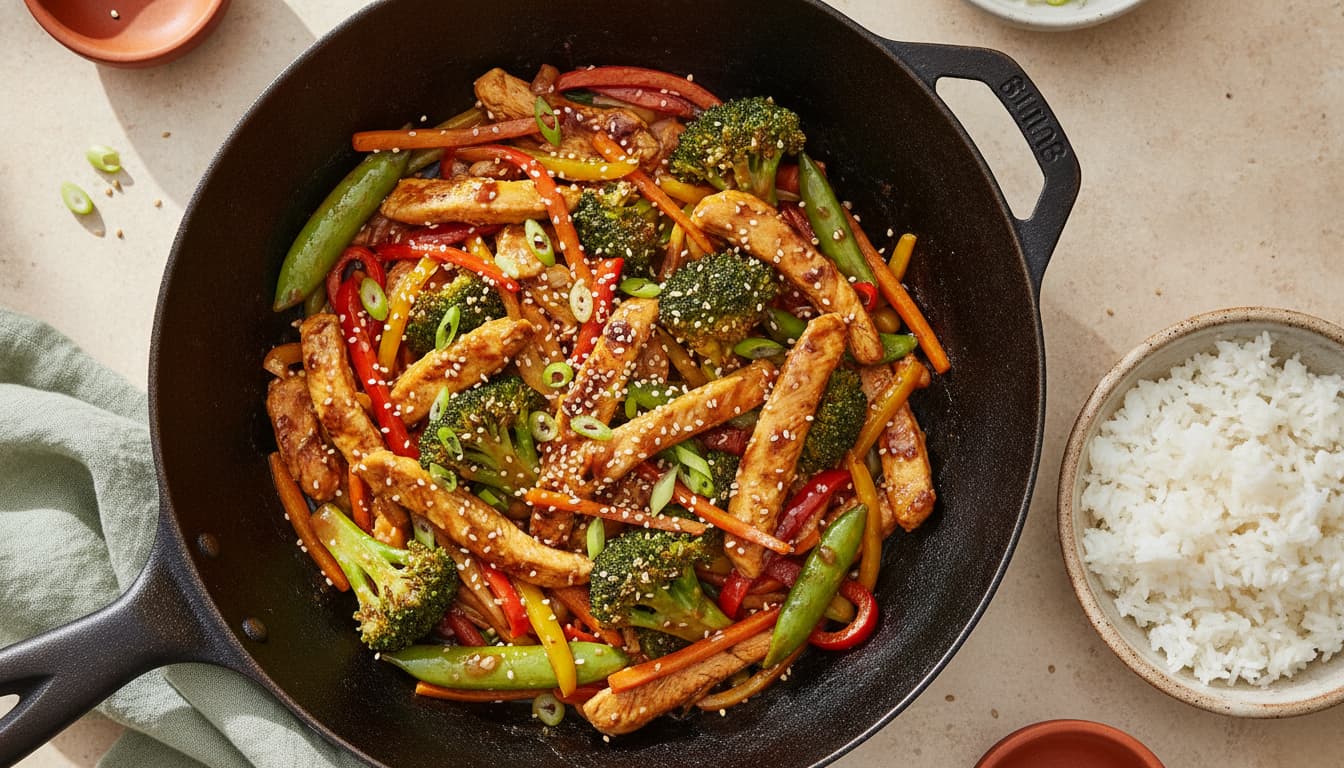
A chicken stir fry that stays crisp and savoury instead of grey and stewed: chicken velveted with a little cornflour for tenderness, seared hard in batches, and tossed through crunchy vegetables in a glossy garlic-ginger sauce that coats rather than pools. 40g protein per serving, 20 minutes, one pan. Why you cook in batches and how a teaspoon of cornflour changes everything.
Warum das funktioniert
Jedes Rezept auf dieser Seite kommt mit einer Erklärung der Technik-Entscheidungen: warum erst anbraten, dann schmoren, warum die Säure zum Schluss kommt, warum das Fett vor den Aromaten ausgelassen wird. Die Methode unten besteht aus genau diesen Entscheidungen, der Reihe nach.
Tamari (gluten-free soy sauce)
The whole backbone of a stir-fry sauce is fermented soy, and tamari gives you that deep, rounded savour while keeping the dish gluten-free, since it is brewed with little or no wheat. It tastes fuller and less harshly salty than a thin, cheap soy sauce, so the sauce reads as savoury rather than just salty. A good naturally brewed soy sauce does the same job if gluten is not a concern. The one to skip is the watery, hydrolysed kind that only brings salt.
Zutaten
4 Portionen- 1.5 lbchicken breast · thinly sliced against the grain
- 1 tbspcornstarch · plus 1 tsp for the sauce
- 3 tbsptamari
- 2 tbspneutral oil
- 1 tbsprice vinegar
- 1 tbspfresh ginger · grated
- 3garlic cloves · grated
- 1 tbsphoney
- 2 cupsbroccoli florets
- 1red bell pepper · sliced
- 2carrots · thinly sliced
- 1 cupsugar snap peas
- 3spring onions · sliced
- 1 tbsptoasted sesame seeds
Methode
Slice the chicken thin and against the grain
Cut chicken breast or thigh into thin, even strips, slicing across the grain rather than along it. Thin pieces cook in the couple of minutes a hot pan gives them, and cutting against the grain shortens the muscle fibres so the meat stays tender instead of stringy. Even thickness means every piece is done at the same moment. This knife work is what lets the chicken cook fast enough to sear rather than stew.
Velvet the chicken with cornflour and soy
Toss the sliced chicken with a teaspoon of cornflour, a splash of soy or tamari, and a little oil, and let it sit while you prep the vegetables. This is velveting, the trick that keeps takeaway chicken so silky. The cornflour forms a thin coat that holds in moisture and gives the sauce something to cling to, so the chicken comes out tender and glossy rather than dry. It takes seconds and it is the single biggest upgrade to a home stir-fry.
Mix the sauce before anything hits the pan
In a small bowl, stir together soy or tamari, a little rice vinegar, grated ginger and garlic, a touch of honey, and a teaspoon of cornflour slaked in a splash of water. A stir-fry moves too fast to measure sauce mid-cook, so it must be ready to pour. The cornflour in the sauce is what makes it turn glossy and cling to the food instead of sitting in a thin puddle at the bottom of the pan. Have it standing by within arm's reach.
Get the pan properly hot and cook the chicken in batches
Heat a wide pan or wok until it is almost smoking, add a little oil, and sear the chicken in two batches rather than all at once. A crowded pan drops in temperature and the chicken releases water and stews grey instead of searing. Cooking in batches keeps the surface hot so each piece browns. Let the chicken sit for a moment before you toss it, take it to just cooked, and lift it out to a plate while you do the vegetables.
Stir-fry the vegetables hard and fast
Add a splash more oil and throw in firm vegetables first, broccoli, peppers, carrots, then quicker ones like snap peas and spring onion after a minute. Keep everything moving over high heat for just two or three minutes so the vegetables stay bright and crisp with a little char. The whole appeal of a stir-fry is crunch against tender chicken, so stop well before they go soft. Cook them in the order of how long they take, hardest first.
Return the chicken and pour in the sauce
Tip the chicken and any resting juices back into the pan with the vegetables, give the sauce a final stir to re-suspend the cornflour, and pour it in. Everything is already nearly cooked at this point, so this stage is quick. Tossing the chicken back with its juices means none of that flavour is lost. Keep the heat high so the sauce comes straight up to a bubble.
Toss until the sauce turns glossy and clings
Keep everything moving for about a minute until the sauce thickens, turns glossy, and coats every piece rather than pooling underneath. This is the moment the cornflour does its work: it goes from cloudy and thin to clear and clinging in seconds. As soon as the sauce sheets off a spoon and clings to the chicken, it is done. Cook it past that and it turns claggy, so pull it off the heat the moment it coats.
Finish with sesame and serve straight away
Off the heat, scatter over toasted sesame seeds and sliced spring onion, and serve immediately over rice or noodles. A stir-fry is at its best the second it leaves the pan, while the vegetables are still crisp and the sauce is glossy; it dulls as it sits. Get everyone to the table first, then cook, not the other way round. Leftovers still make a good lunch, but the texture is never quite as sharp as the first serving.
Variationen
Substitutionen und Anpassungen folgen mit der Foto-Produktion. Die Methode hält bei den meisten sinnvollen Austauschen.
Aufbewahrung
Kühlschrank: 3 bis 4 Tage, verschlossen. Gefrierfach: bis zu 3 Monate. Abgedeckt aufwärmen, um die Feuchtigkeit zu halten.
Häufige Fragen
- How much protein is in a chicken stir fry?
- About 40g per serving as written, from a generous amount of chicken breast spread across four portions. Chicken is one of the cleanest ways to build a high-protein dinner, and because a stir-fry is mostly protein and vegetables with a light sauce, the calories stay moderate at around 340 before rice. For even more protein, use more chicken and bulk the dish with vegetables rather than piling on rice or noodles, which add carbs but little protein.
- What is velveting and do I really need it?
- Velveting is tossing the raw chicken with a little cornflour, soy, and oil before cooking. The cornflour forms a thin protective coat that seals in moisture and gives the sauce something to grip, which is exactly why chicken from a good takeaway is so silky and tender. It takes seconds and no special ingredients, and it is the single biggest thing separating a home stir-fry from a restaurant one. You can skip it, but the chicken will be drier and the sauce will cling less.
- Why does my stir fry go watery and grey?
- You crowded the pan. A wok or pan can only stay hot for so much food at once, and piling everything in drops the temperature so the chicken and vegetables release water and stew rather than sear. Cook the chicken in two batches, get the pan properly hot before each, and keep the vegetables moving over high heat. Slaking a little cornflour into the sauce also tightens up any liquid so the finish is glossy rather than watery.
- Can I make chicken stir fry ahead for meal prep?
- You can, with a caveat: stir-fries are best fresh, when the vegetables are still crisp. For meal prep, slightly undercook the vegetables so they survive reheating with some bite left, cool everything quickly, and store in the fridge for up to three days over cooked rice. Reheat hard and fast in a hot pan rather than a microwave if you can, to bring back some of the sear. The chicken and sauce hold up well; it is the vegetable crunch that softens.
- What vegetables work best in a stir fry?
- Anything that stays crisp over high heat. Broccoli, bell peppers, carrots, snap peas, green beans, baby corn, mushrooms, and spring onion are all reliable. The key is to add them in order of how long they take, firm and dense vegetables first, quick and delicate ones last, so everything finishes crisp at the same time. Use whatever needs eating in the fridge; the technique matters far more than the specific mix.
- How do I keep the stir fry gluten-free?
- Swap regular soy sauce for tamari, which is brewed with little or no wheat and tastes fuller and less sharply salty. Check that your other bottles, such as any oyster or hoisin sauce, are labelled gluten-free too, since these often contain wheat. Cornflour, rice vinegar, ginger, garlic, and honey are all naturally gluten-free, so with tamari in place the whole dish is safe. Serve it over rice or rice noodles rather than wheat noodles.
Ähnliche Rezepte
Alle ansehen →- High-Protein
Boeuf Bourguignon: drei Stunden, ein Topf, richtig angebraten
Das Fleisch muss trocken sein, die Pfanne heiß und der Topf nicht überfüllt, sonst kocht das Rindfleisch, statt zu bräunen. Welches Stück, welcher Wein, warum Speck, Zwiebeln und Pilze getrennt gegart werden und warum es am zweiten Tag besser schmeckt.
240m42g Eiweiß - High-Protein
Tofu zubereiten: pressen, in Stärke wenden, spät marinieren
Tofu wird knusprig, wenn Wasser heraus und Stärke darauf kommt. Welche Festigkeit für welches Gericht, warum Einfrieren die Textur völlig verändert und warum die Marinade erst nach dem Braten dazukommt statt davor.
60m20g Eiweiß - High-Protein
Enchiladas: Tortillas in heißem Öl wenden, Sauce selbst kochen
Matschige Enchiladas entstehen, weil rohe Tortillas direkt in die Sauce kommen. Zwanzig Sekunden in heißem Öl versiegeln sie, die Chilisauce wird aus getrockneten Chilis gekocht statt aus der Dose, und der Auflauf steht nur zwanzig Minuten im Ofen.
95m34g Eiweiß
Erhalten Sie jeden Sonntag ein getestetes Rezept und eine Nährwert-Notiz in Ihr Postfach.
Ein Rezept pro Woche, fotografiert am selben Dienstag, an dem es getestet wurde. Von einer Ernährungsberaterin geprüft. Keine Werbung, keine Pop-ups, kein Tracking.
Das Clean-Chef-Starter-Kit.
Ein 14-Tage-Plan für entzündungshemmende Ernährung als PDF, Einkaufsliste nach Abteilungen, Makros pro Tag aufsummiert, Sonntags-Vorbereitung. Kostenlos.
Mit der Anmeldung stimmen Sie unserer Datenschutzerklärung zu. Eine ruhige E-Mail pro Woche. Jederzeit abbestellbar.
Wir bauen einen Shop.
Kuratiertes Kochgeschirr, Vorratsbasics, die wir wirklich kaufen, Rezept-Bundle-PDFs. Erfahren Sie als Erste, wann er öffnet.
Wir schreiben Ihnen nur zur Shop-Eröffnung. In jeder E-Mail abbestellbar. Siehe unsere Datenschutzerklärung.