- Kalorien
- 480
- Eiweiß
- 34g
- Ballaststoffe
- 6g
- Ges. Fett
- 8g
- Natrium
- 720mg
- Zugesetzter Zucker
- 1g
Was dieses Rezept für Sie leistet.
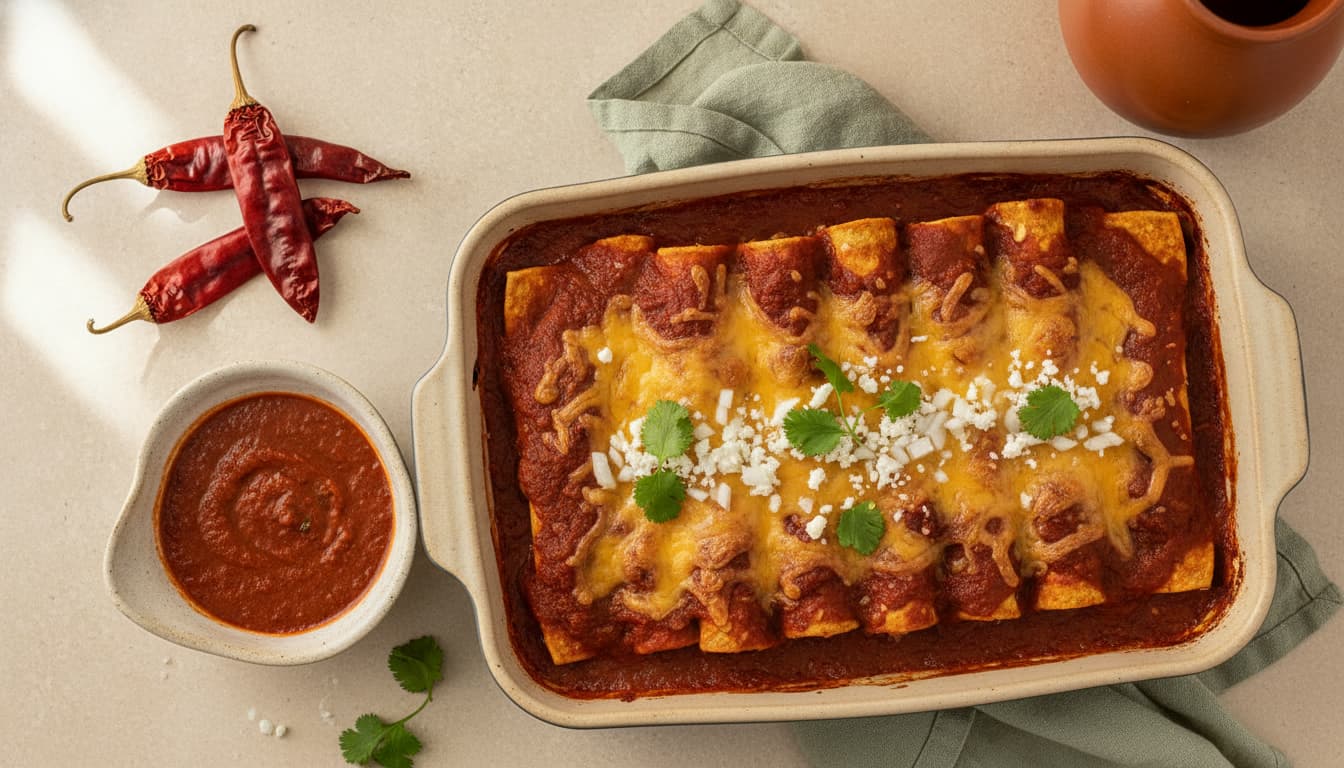
Nearly every bad enchilada is the same enchilada: a raw corn tortilla soaked in canned sauce and baked until the whole tray turns to porridge. Two steps fix it permanently. Pass each tortilla through hot oil for twenty seconds so it waterproofs, and fry the blended chile sauce in fat before it goes anywhere near the pan. Ninety minutes, most of it the sauce, and twenty of it in the oven.
Warum das funktioniert
Jedes Rezept auf dieser Seite kommt mit einer Erklärung der Technik-Entscheidungen: warum erst anbraten, dann schmoren, warum die Säure zum Schluss kommt, warum das Fett vor den Aromaten ausgelassen wird. Die Methode unten besteht aus genau diesen Entscheidungen, der Reihe nach.
Zutaten
6 Portionen- 4 wholedried guajillo chiles · stemmed and seeded, this is the colour and the body of the sauce
- 2 wholedried ancho chiles · stemmed and seeded, this is the sweetness and the raisin note
- 1 wholedried chile de arbol · optional, seeded, this is the only real heat in the pan
- 2 lbboneless chicken thighs · skinless, poached in the chile soaking liquid rather than in plain water
- 18 wholecorn tortillas · 6 inch, the freshest you can buy, flour tortillas will not work here
- 1 largewhite onion · half goes in the sauce, half is diced raw for the top
- 5 clovesgarlic · unpeeled, charred in a dry pan until blackened in patches
- 2 wholeRoma tomatoes · charred alongside the garlic, they round the sauce out
- 1 1/2 tspground cumin · toasted whole and ground if you have thirty spare seconds
- 1 tspdried Mexican oregano · not Mediterranean oregano, it is a different plant and tastes of citrus
- 1 pinchground cinnamon · about 1/8 tsp, it reads as depth rather than as cinnamon
- 3 cupschicken stock · low-sodium, used to loosen the sauce and to poach the chicken
- 1 tbspapple cider vinegar · stirred in at the end, it is what stops the sauce tasting flat
- 1/3 cupneutral oil · avocado or refined peanut, for frying the sauce and passing the tortillas
- 2 tspkosher salt · divided between the poaching liquid and the finished sauce
- 8 ozMonterey Jack · grated from the block, this is the cheese that melts rather than browns
- 2 ozcotija · crumbled over the top after baking, salty and dry, it does not melt
- 1/2 cupMexican crema or full-fat sour cream · thinned with a spoon of lime juice, drizzled at the table
- 1/2 cupcilantro · roughly chopped, leaves and tender stems
- 2 wholelimes · cut into wedges
Methode
Decide which enchilada you are making before you buy anything
Rojas are built on dried red chiles and are the version below. Verdes are built on tomatillos and serranos, blitzed raw or roasted, and they are brighter and faster. Suizas add cream to the green sauce. Mole is a different project entirely and takes a day. All four share the same two mechanical steps, the tortilla pass and the sauce fry, so learning red teaches you the others. What changes is only what goes in the blender.
Dried whole chiles, not chili powder, and this is the whole difference
Chili powder is ground chile cut with cumin, garlic powder, salt and often anticaking agents, and it has been sitting in a jar losing its volatile oils since the day it was ground. Whole dried guajillos and anchos cost about the same per batch and taste like fruit. Guajillo gives you the red and a clean tannic edge. Ancho gives you the raisin sweetness. Chile de arbol gives you heat, and one is plenty for six people.
Toast the chiles for thirty seconds and no longer
Dry skillet over medium, chiles pressed flat with a spatula, fifteen seconds a side. They puff slightly and start to smell like tobacco and dried cherries. That is done. A chile left even twenty seconds past that point goes acrid and bitter, and one burnt guajillo will make three cups of sauce taste like an ashtray with no way back. If you smell sharpness rather than sweetness, throw it out and toast another.
Soak in hot stock, not water, and keep the liquid
Cover the toasted chiles with three cups of hot chicken stock, weigh them down with a small plate, and leave them twenty minutes until they are fully pliable. Soaking in stock rather than water means nothing you have extracted gets poured away, and the soaking liquid becomes both the blender liquid and the chicken poaching liquid. Most recipes tell you to discard it because commercial dried chiles can carry dust, which is what the rinse before toasting is for.
Char the garlic and tomatoes dry, in their skins
While the chiles soak, put unpeeled garlic cloves and whole Roma tomatoes in the same dry skillet over medium-high and leave them until they are blackened in patches, about eight minutes for the garlic and twelve for the tomatoes, turning occasionally. The skins protect the flesh while the exterior takes on smoke. Peel the garlic, leave the tomato skins on, and everything goes into the blender. This is fifteen minutes that buys you a sauce that tastes cooked over fire.
Blend for two full minutes, then push it through a sieve
Chiles, soaking liquid, charred garlic and tomatoes, half the onion, cumin, Mexican oregano and the pinch of cinnamon, blended on high for two minutes rather than the thirty seconds that feels sufficient. Then pass it through a medium sieve, pressing hard with a ladle. Guajillo skins are tough and no domestic blender fully destroys them, and skipping the sieve is why home enchilada sauce so often has a faintly gritty, papery texture.
Fry the blended sauce, which is the step nobody writes down
Heat three tablespoons of oil in a wide pot until it shimmers, then pour the strained puree in all at once and stand back, because it will spit hard for the first thirty seconds. Stir and let it cook at a fast bubble for twelve to fifteen minutes until it darkens, thickens and pulls away from the pan sides. This is the difference between a sauce that tastes like a smoothie of raw chiles and one that tastes like a sauce. Vinegar and salt go in after.
Poach the chicken in the sauce, gently, and never at a boil
Slide the thighs into the finished sauce thinned with a cup of stock, drop the heat until the surface barely moves, and give it eighteen to twenty minutes until they pull apart. A boil tightens the muscle fibres and squeezes out moisture, which is why boiled chicken breast for shredding is always dry. Lift the thighs out, shred them with two forks while warm, and stir a ladle of sauce back through the meat. Season the filling on its own.
Twenty seconds in hot oil per tortilla, and this is not optional
A quarter inch of oil at 350F, one tortilla at a time, ten seconds a side. It should go soft and pliable but not crisp. Drain on a rack, not on paper towel, or the underside steams. What you are doing is sealing the starch surface with fat so the tortilla can sit in wet sauce for twenty minutes without dissolving. Skipping this is the single most common cause of enchiladas that come out of the oven as a tray of paste.
Sauce on the bottom, sauce on top, and nothing swimming in the middle
A thin film of sauce across the base of the dish so nothing sticks. Dip each fried tortilla briefly in warm sauce, fill it with a scant quarter cup of chicken and a little Jack, roll it and lay it seam side down. Pack them tightly, because they hold each other closed. Then ladle sauce over the top and edges only. Enchiladas that are submerged do not bake, they poach, and the tortilla you carefully sealed gives up anyway.
Cheese: one that melts, one that salts, and never pre-shredded
Monterey Jack, Chihuahua or Oaxaca melt into strands and stay glossy. Pre-shredded bags are coated in potato starch or cellulose to stop clumping, and that coating is exactly why bagged cheese breaks into an oily film instead of melting. Grate from the block, it takes ninety seconds. Cotija goes on after baking because it is a dry aged cheese that will not melt and simply dries out further in the oven. Cheddar browns hard and goes greasy here.
Twenty minutes at 375F, uncovered, and pull them early
Everything in the dish is already cooked. The oven is only there to melt the cheese and marry the sauce to the tortillas. Twenty minutes uncovered at 375F, and if the cheese is not browned enough for you, ninety seconds under the broiler while you watch it. Forty minutes at 350F, which a lot of recipes give, is long enough for the tortillas to break down no matter how carefully you fried them. Set a timer for eighteen and look.
Ten minutes of rest before you cut into them
Out of the oven, the sauce is thin and the cheese is molten, and a spatula at that moment gives you a plate of debris. Ten minutes on the counter lets the starch in the tortillas reabsorb liquid and the cheese set enough to hold a shape. Then the cold garnishes go on: raw diced onion, cotija, cilantro, thinned crema and lime. The contrast between the hot baked dish and the cold sharp top is most of what makes this good.
The make-ahead plan, which is better than the same-day plan
The sauce keeps five days refrigerated and three months frozen, and it improves after a night. The chicken can be poached and shredded a day ahead. What does not hold is an assembled unbaked tray, because the tortillas start absorbing sauce immediately and by morning you have lasagna. Assemble and bake, then refrigerate the baked dish up to four days and reheat covered at 325F for twenty-five minutes, which is a legitimate meal prep move for a weeknight.
Variationen
Substitutionen und Anpassungen folgen mit der Foto-Produktion. Die Methode hält bei den meisten sinnvollen Austauschen.
Aufbewahrung
Kühlschrank: 3 bis 4 Tage, verschlossen. Gefrierfach: bis zu 3 Monate. Abgedeckt aufwärmen, um die Feuchtigkeit zu halten.
Warum wir dieses enchiladas: fry the tortillas, fry the sauce, bake them briefly 3-mal getestet haben.
Jedes wichtige Rezept auf dieser Seite durchläuft vor der Veröffentlichung mindestens drei Testrunden. Wir protokollieren, was sich zwischen den Tests geändert hat, damit Sie die Entwicklung des Rezepts sehen und wir die Fehlschläge nicht stillschweigend weglassen können.
- 01
Test 1
- Was wir versucht haben
- Skipped the oil pass and warmed the tortillas in the microwave under a damp towel instead, which is the shortcut most weeknight recipes give.
- Was passiert ist
- They were pliable enough to roll, but after twenty minutes in the oven the bottom third of the tray had no distinguishable tortillas left in it.
- Was wir geändert haben
- Every tortilla goes through 350F oil for ten seconds a side. It adds seven minutes and it is the difference between the dish working and not.
- 02
Test 2
- Was wir versucht haben
- Poured the strained chile puree straight into the dish without frying it, to save a pot and fifteen minutes.
- Was passiert ist
- The sauce tasted raw and sharply tannic, thin in the mouth, and it stayed that way through the bake. Salt and sugar did not fix it.
- Was wir geändert haben
- The puree is fried hard in oil for twelve to fifteen minutes until it darkens and thickens before anything else happens.
- 03
Test 3
- Was wir versucht haben
- Assembled a tray the night before and refrigerated it unbaked, expecting a make-ahead win.
- Was passiert ist
- By morning the tortillas had absorbed most of the sauce and fused into layers. It baked into something closer to a casserole than enchiladas.
- Was wir geändert haben
- Sauce and filling are made ahead separately. Assembly and baking happen together, and leftovers are reheated after baking, not before.
Häufige Fragen
- Why are my enchiladas soggy?
- Because the tortillas went into the dish raw and because there was too much sauce in the middle. A corn tortilla is mostly starch and it will absorb any liquid it touches until it disintegrates. Passing each one through 350F oil for ten seconds a side seals the surface with fat and buys you the twenty minutes in the oven you need. The second fix is to sauce only the base and the top, never to submerge the rolls.
- Should I use corn or flour tortillas for enchiladas?
- Corn, and this is one of the few places where the traditional answer is also the technical one. Corn tortillas are made from nixtamalised masa, they hold their structure once sealed in oil, and their flavour is a real part of the dish. Flour tortillas contain gluten and fat, they go gummy and slick rather than tender when baked in sauce, and they will not hold a roll. Corn also keeps the whole dish gluten-free, which flour does not.
- Can I use canned enchilada sauce?
- You can, and the dish will be fine rather than good. Canned sauce is thin, heavily salted, usually built on tomato with chili powder rather than on whole chiles, and it needs help. If you are using it, fry it in a spoon of oil for five minutes, add a charred garlic clove and a splash of vinegar, and reduce it slightly. The homemade version takes forty-five minutes, most of which is unattended soaking, and it freezes for three months.
- How spicy are enchiladas rojas?
- As written, barely. Guajillo and ancho are both mild fruity chiles rated well under 3,000 Scoville, and almost all of the perceived heat in this recipe comes from the single chile de arbol. Leave it out and the sauce is not spicy at all, which is how most children eat it. For real heat, add two or three arbols, or a chipotle in adobo for heat plus smoke. Adjust before the sauce goes in the pan, not after.
- Can I make enchiladas ahead of time?
- Make the components ahead, not the assembled tray. Sauce keeps five days in the fridge and three months in the freezer and genuinely improves overnight. Poached shredded chicken keeps three days. An assembled unbaked tray, however, turns to mush within a few hours because the tortillas keep drinking sauce. If you need a finished dish waiting, bake it fully, refrigerate up to four days, and reheat covered at 325F for twenty-five minutes.
- Can you freeze enchiladas?
- Yes, baked and cooled, wrapped tightly, for up to three months. Freeze them in a dish you can go straight from freezer to oven, and reheat from frozen covered with foil at 350F for about an hour, uncovering for the last ten minutes. Freezing an unbaked tray does not work for the same reason refrigerating one does not. The sauce alone freezes best of all, in flat bags, and thaws in twenty minutes under running water.
- What is the difference between enchiladas and burritos?
- An enchilada is a corn tortilla dipped in chile sauce, filled lightly, rolled, sauced again and baked, and it is eaten with a fork. A burrito is a large flour tortilla wrapped tightly around a much larger volume of filling, including rice and beans, and it is eaten in the hand and not sauced on the outside. The name enchilada literally describes the sauce step, so a rolled tortilla with no chile on it is not one.
- What do you serve with enchiladas?
- Something with acid and something plain. Black beans cooked with a bay leaf and a little of the enchilada sauce, cilantro-lime rice, and a cabbage slaw dressed with lime and salt rather than a creamy dressing. Avocado or guacamole covers the fat and cooling role that sour cream does. A tray of enchiladas is rich and uniformly soft, so everything alongside it should be sharp, crunchy or both. Skip anything else baked and cheesy.
- Are enchiladas gluten-free?
- This version is, as long as the corn tortillas are made from corn masa with no wheat blended in, which is worth checking on the bag because some supermarket brands add wheat flour for pliability. The sauce here is thickened by reduction rather than by flour. The other place gluten hides is the chicken stock, particularly in bouillon cubes and concentrates. Use certified corn tortillas and a clean stock and the whole dish is gluten-free.
Ähnliche Rezepte
Alle ansehen →- High-Protein
Boeuf Bourguignon: drei Stunden, ein Topf, richtig angebraten
Das Fleisch muss trocken sein, die Pfanne heiß und der Topf nicht überfüllt, sonst kocht das Rindfleisch, statt zu bräunen. Welches Stück, welcher Wein, warum Speck, Zwiebeln und Pilze getrennt gegart werden und warum es am zweiten Tag besser schmeckt.
240m42g Eiweiß - High-Protein
Tofu zubereiten: pressen, in Stärke wenden, spät marinieren
Tofu wird knusprig, wenn Wasser heraus und Stärke darauf kommt. Welche Festigkeit für welches Gericht, warum Einfrieren die Textur völlig verändert und warum die Marinade erst nach dem Braten dazukommt statt davor.
60m20g Eiweiß - High-Protein
Hähnchen Parmigiana: dünn klopfen, backen statt frittieren
Die Panade wird matschig, wenn zu viel Sauce zu früh darauf kommt. Gleichmäßig dünn klopfen, in Panko und Parmesan backen statt frittieren, Sauce nur in die Mitte und den Käse erst unter dem Grill schmelzen.
55m52g Eiweiß
Erhalten Sie jeden Sonntag ein getestetes Rezept und eine Nährwert-Notiz in Ihr Postfach.
Ein Rezept pro Woche, fotografiert am selben Dienstag, an dem es getestet wurde. Von einer Ernährungsberaterin geprüft. Keine Werbung, keine Pop-ups, kein Tracking.
Das Clean-Chef-Starter-Kit.
Ein 14-Tage-Plan für entzündungshemmende Ernährung als PDF, Einkaufsliste nach Abteilungen, Makros pro Tag aufsummiert, Sonntags-Vorbereitung. Kostenlos.
Mit der Anmeldung stimmen Sie unserer Datenschutzerklärung zu. Eine ruhige E-Mail pro Woche. Jederzeit abbestellbar.
Wir bauen einen Shop.
Kuratiertes Kochgeschirr, Vorratsbasics, die wir wirklich kaufen, Rezept-Bundle-PDFs. Erfahren Sie als Erste, wann er öffnet.
Wir schreiben Ihnen nur zur Shop-Eröffnung. In jeder E-Mail abbestellbar. Siehe unsere Datenschutzerklärung.