- Kalorien
- 330
- Eiweiß
- 34g
- Ballaststoffe
- 2g
- Ges. Fett
- 7g
- Natrium
- 560mg
- Zugesetzter Zucker
- 3g
Was dieses Rezept für Sie leistet.
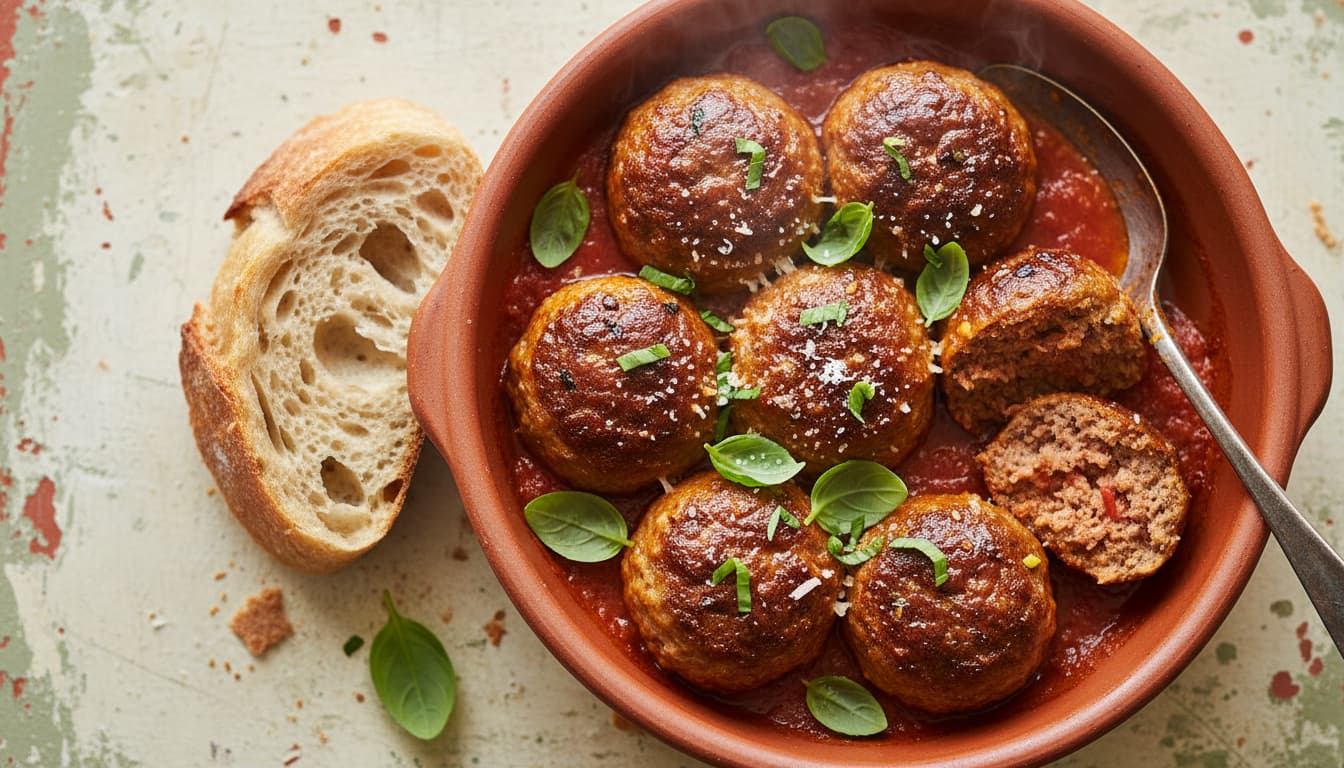
Meatballs that come out tender and juicy instead of dense little rubber bullets: a milk-and-oat panade for softness, grated onion worked through the mix, a light hand on the rolling, and a hot bake on a rack so the fat drips away. 34g protein per serving, gluten-free, and they freeze beautifully. The one step that keeps them tender and why you should never pack the mix tight.
Warum das funktioniert
Jedes Rezept auf dieser Seite kommt mit einer Erklärung der Technik-Entscheidungen: warum erst anbraten, dann schmoren, warum die Säure zum Schluss kommt, warum das Fett vor den Aromaten ausgelassen wird. Die Methode unten besteht aus genau diesen Entscheidungen, der Reihe nach.
Whole milk for the panade
The single thing that separates a tender meatball from a dense one is a panade, a paste of starch soaked in milk that you work into the meat before anything else. Whole milk brings a little fat and richness that skimmed does not, and it soaks the oats into a soft paste that holds moisture through the bake so the meatballs stay juicy instead of tightening into rubber. Any full-fat dairy or even a splash of unsweetened plant milk does the same job; the point is the soak, not the brand. Skip the panade and no amount of careful cooking will save the texture.
Zutaten
4 Portionen- 1.5 lbground beef · 90% lean
- 1/3 cuprolled oats · for the panade
- 1/4 cupwhole milk
- 1onion · grated
- 2garlic cloves · grated
- 1large egg
- 1/3 cupparmesan · grated
- 2 tbspflat-leaf parsley · chopped
- 1 tbspolive oil
- kosher salt · to taste
- black pepper · to taste
- 1.5 cupstomato sauce · for finishing, optional
Methode
Make a panade before you touch the meat
Stir a handful of fine rolled oats into a few tablespoons of milk and let it sit for five minutes until it swells into a soft paste. This panade is the whole secret to a tender meatball: the soaked starch traps moisture and physically gets between the meat proteins so they cannot bind into a tight, bouncy mass as they cook. Blitz the oats fine first if you want a smoother crumb, or leave them for a rustic texture. Do this step first so it has time to soften while you prep everything else.
Use a meat with some fat, not the leanest mince
Reach for 85 to 90 percent lean ground beef, or a mix of beef and pork, rather than the leanest mince you can find. A meatball needs a little fat to stay juicy and carry flavour through a bake, and the very lean stuff dries into pellets. If you want a leaner, lighter meatball, ground turkey thigh works, but keep the panade generous to make up for the missing fat. The fat is what makes them taste of something; do not fear a bit of it.
Grate the onion and garlic, do not chop
Grate the onion on the coarse side of a box grater and microplane the garlic straight into the bowl, juice and all. Chopped onion stays in firm little pieces that steam and leave hollow pockets, and worse, it can stop the meatball holding together. Grated onion melts into the mix, seasons every bite evenly, and adds moisture. It is a small change that makes the meatballs taste seasoned all the way through rather than in patches.
Season hard and fry a test piece
Add salt, black pepper, an egg, grated parmesan, and whatever herbs you like, then fry a tiny nugget of the mix in a pan and taste it before you roll the rest. Raw meat always tastes under-seasoned, and a bland meatball is the most common disappointment. The test piece is thirty seconds that tells you exactly whether to add more salt or herb while you still can. Season more boldly than feels right; the starch and egg dilute it.
Mix with a light hand and stop early
Combine everything with your fingertips just until it comes together, then stop. Overworking the mix, or squashing it in a machine, develops the proteins and gives you tight, springy meatballs no matter how good the panade is. You want the mixture loose and a little tacky, barely holding. Treat it like you would a burger: the less you handle it, the more tender it stays. If it feels dense and paste-like in the bowl, you have gone too far.
Portion evenly and roll gently
Use a scoop or a spoon to portion the mix into even balls, roughly golf-ball sized, and roll each one just enough to round it off with a light touch. Even sizing means they all cook through at the same moment rather than some being raw while others dry out. Wet your hands to stop the mix sticking. Do not compress them into hard spheres; a loosely rolled ball bakes up far more tender than one packed tight like a snowball.
Bake hot on a rack, do not shallow-fry
Sit the meatballs on a wire rack over a lined tray and bake at 220C for eighteen to twenty minutes until browned and cooked through. The rack lets the fat drip away and hot air circulate all round, so they brown on every side without the constant turning and splatter of frying, and they come out lighter. A hot oven gives you real colour, which is flavour. Check one is 74C in the middle and pull the tray; they carry on cooking a touch as they rest.
Rest, then finish in sauce or serve straight
Let the meatballs sit for five minutes, then either serve them as they are or slip them into a simmering tomato sauce for a few minutes to soak up flavour. Resting lets the juices settle back through so they do not bleed out at the first bite. If you are saucing them, do it briefly and off a hard boil so they do not toughen. They keep in the fridge for three days and freeze cooked for three months, which makes a double batch the easiest high-protein meal prep going.
Variationen
Substitutionen und Anpassungen folgen mit der Foto-Produktion. Die Methode hält bei den meisten sinnvollen Austauschen.
Aufbewahrung
Kühlschrank: 3 bis 4 Tage, verschlossen. Gefrierfach: bis zu 3 Monate. Abgedeckt aufwärmen, um die Feuchtigkeit zu halten.
Häufige Fragen
- How much protein is in these meatballs?
- About 34g per serving as written, from the ground beef and the egg and parmesan in the mix, across four portions of roughly five meatballs each. Ground meat is one of the most protein-dense things you can build a dinner around, and baking rather than frying keeps the calories moderate at around 330 before any sauce or pasta. For even more protein, use extra-lean meat and a little more parmesan, or serve them over lentils or beans rather than white pasta.
- Why do my meatballs turn out dense and rubbery?
- Two usual culprits: no panade, and overmixing. Without a milk-soaked starch worked in, the meat proteins bind tightly and cook into bouncy little rubber balls, and squashing or over-kneading the mix makes it worse. Add a proper panade, mix only until it just comes together with a light hand, and roll the balls loosely rather than packing them hard. Do those three things and even lean meat comes out tender. Overcooking is the third cause, so pull them the moment they hit temperature.
- Should I use beef, turkey, or a mix?
- All work, and it comes down to what you want. An 85 to 90 percent lean beef gives the richest, most classic flavour; a beef and pork mix is the Italian standard and stays especially juicy. Ground turkey thigh makes a lighter, leaner meatball but needs a generous panade and bold seasoning so it does not turn bland and dry. Whichever you choose, avoid the very leanest mince on its own, as it has too little fat to stay tender through a bake.
- Can I make meatballs ahead or freeze them?
- Yes, and they are superb meal prep. You can roll them raw and chill for a day before baking, or bake them off, cool completely, and freeze in a single layer before bagging them up for up to three months. Reheat from frozen in a hot oven or straight in simmering sauce until piping hot in the middle. Cooked and frozen meatballs turn a jar of tomato sauce into a fast dinner on a weeknight, which is the main reason to make a double batch.
- How do I keep the meatballs gluten-free?
- Use rolled oats for the panade instead of breadcrumbs, blitzed fine if you want a smoother texture, and check they are certified gluten-free if you are coeliac, since oats are often cross-contaminated. Everything else in the mix, the meat, egg, onion, garlic, cheese, and herbs, is naturally gluten-free. Serve them over rice, polenta, or courgette noodles, or with a gluten-free pasta, and check any jarred sauce is gluten-free too. The oat panade actually keeps them just as tender as a bread one.
- What should I serve with meatballs?
- The classic is a simple tomato sauce over pasta, but they are far more versatile than that. Pile them over creamy polenta or mashed potato, tuck them into a sub with melted cheese, or serve them Mediterranean-style with a lemony yogurt sauce, warm flatbread, and a crunchy salad. For a lighter, higher-protein plate, sit them on a bed of lentils or roasted vegetables. A sharp green salad and something to mop up the sauce is all any version really needs.
Ähnliche Rezepte
Alle ansehen →- High-Protein
Boeuf Bourguignon: drei Stunden, ein Topf, richtig angebraten
Das Fleisch muss trocken sein, die Pfanne heiß und der Topf nicht überfüllt, sonst kocht das Rindfleisch, statt zu bräunen. Welches Stück, welcher Wein, warum Speck, Zwiebeln und Pilze getrennt gegart werden und warum es am zweiten Tag besser schmeckt.
240m42g Eiweiß - High-Protein
Tofu zubereiten: pressen, in Stärke wenden, spät marinieren
Tofu wird knusprig, wenn Wasser heraus und Stärke darauf kommt. Welche Festigkeit für welches Gericht, warum Einfrieren die Textur völlig verändert und warum die Marinade erst nach dem Braten dazukommt statt davor.
60m20g Eiweiß - High-Protein
Enchiladas: Tortillas in heißem Öl wenden, Sauce selbst kochen
Matschige Enchiladas entstehen, weil rohe Tortillas direkt in die Sauce kommen. Zwanzig Sekunden in heißem Öl versiegeln sie, die Chilisauce wird aus getrockneten Chilis gekocht statt aus der Dose, und der Auflauf steht nur zwanzig Minuten im Ofen.
95m34g Eiweiß
Erhalten Sie jeden Sonntag ein getestetes Rezept und eine Nährwert-Notiz in Ihr Postfach.
Ein Rezept pro Woche, fotografiert am selben Dienstag, an dem es getestet wurde. Von einer Ernährungsberaterin geprüft. Keine Werbung, keine Pop-ups, kein Tracking.
Das Clean-Chef-Starter-Kit.
Ein 14-Tage-Plan für entzündungshemmende Ernährung als PDF, Einkaufsliste nach Abteilungen, Makros pro Tag aufsummiert, Sonntags-Vorbereitung. Kostenlos.
Mit der Anmeldung stimmen Sie unserer Datenschutzerklärung zu. Eine ruhige E-Mail pro Woche. Jederzeit abbestellbar.
Wir bauen einen Shop.
Kuratiertes Kochgeschirr, Vorratsbasics, die wir wirklich kaufen, Rezept-Bundle-PDFs. Erfahren Sie als Erste, wann er öffnet.
Wir schreiben Ihnen nur zur Shop-Eröffnung. In jeder E-Mail abbestellbar. Siehe unsere Datenschutzerklärung.