- Kalorien
- 430
- Eiweiß
- 22g
- Ballaststoffe
- 3g
- Ges. Fett
- 3g
- Natrium
- 690mg
- Zugesetzter Zucker
- 1g
Was dieses Rezept für Sie leistet.
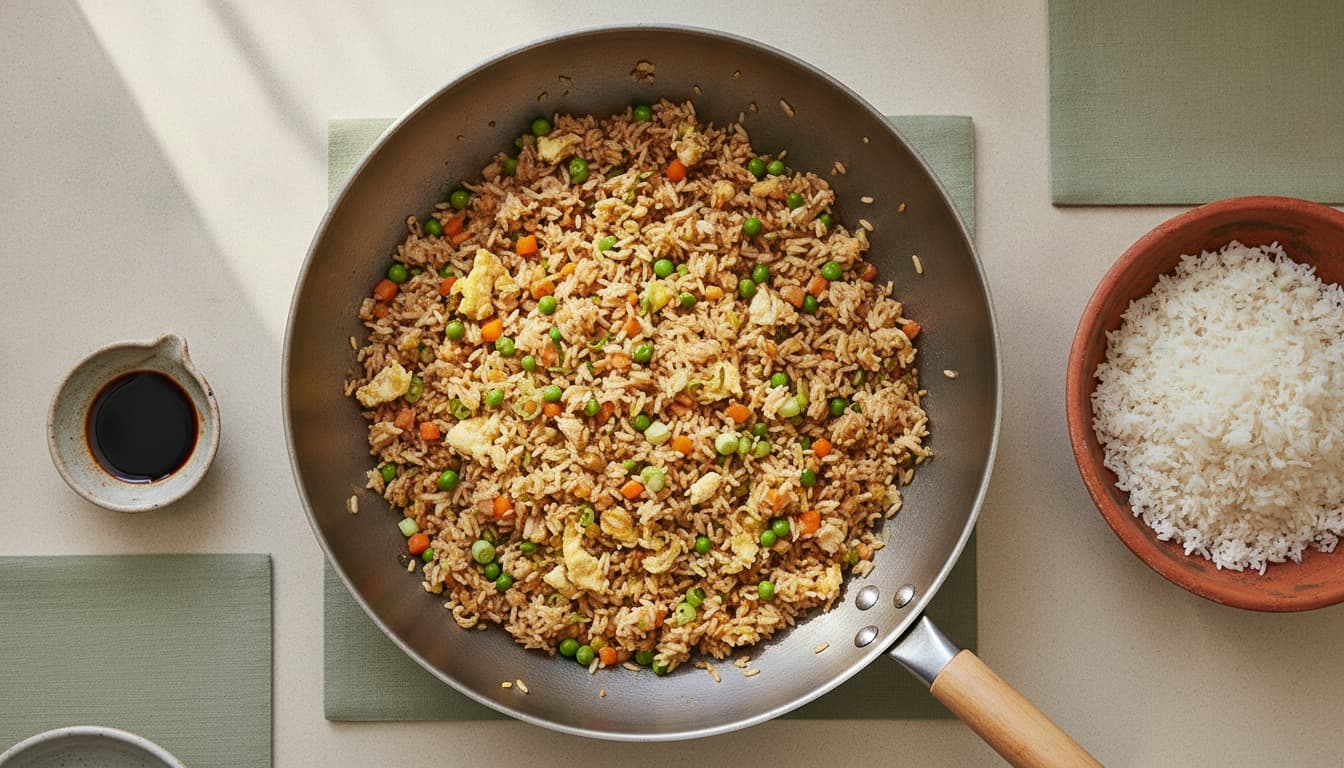
Fried rice is a moisture-management problem wearing a stir-fry costume. Freshly cooked rice is saturated and its starch is still gelatinised, so it clumps and steams. Rice that has spent a night uncovered in the fridge has lost surface water and retrograded, and it separates into individual grains in a hot pan. Twenty-five minutes of cooking, and one decision made the day before.
Warum das funktioniert
Jedes Rezept auf dieser Seite kommt mit einer Erklärung der Technik-Entscheidungen: warum erst anbraten, dann schmoren, warum die Säure zum Schluss kommt, warum das Fett vor den Aromaten ausgelassen wird. Die Methode unten besteht aus genau diesen Entscheidungen, der Reihe nach.
Zutaten
4 Portionen- 4 cupscooked jasmine rice · cooked the day before, spread on a tray and refrigerated uncovered overnight
- 3 largeeggs · beaten with a pinch of salt, scrambled first and set aside
- 3 tbspneutral oil · peanut, avocado or rice bran, split across the egg and the two rice batches
- 4 wholescallions · whites sliced thin for the pan, greens sliced on a bias for the finish
- 3 clovesgarlic · minced, added late so it does not burn
- 1 tbspfresh ginger · minced or grated on a microplane
- 1 cupfrozen peas and diced carrots · used straight from frozen, no thawing, no blanching
- 8 ozcooked protein · diced Chinese sausage, leftover roast chicken, shrimp or pressed tofu, all optional
- 2 1/2 tbsplight soy sauce · or tamari for a gluten-free version, poured down the hot side of the pan
- 1 tspdark soy sauce · optional, for colour rather than salt, it is thicker and barely salty
- 1 tbspShaoxing wine · or dry sherry, splashed in just before the soy
- 1 1/2 tsptoasted sesame oil · off the heat at the very end, never in the pan while it is cooking
- 1/2 tspwhite pepper · ground, and it is not interchangeable with black here
- 1/2 tspkosher salt · adjusted at the end after the soy has gone in
- 1 tbspchili crisp · optional, at the table
Methode
The rice has to be cold, and here is the actual reason
When rice cooks, starch granules absorb water and swell, and the surface is sticky and saturated. Chilled overnight, some of that starch retrogrades into a firmer crystalline structure and the surface loses water to the fridge air. A cold grain has somewhere to put the heat other than into evaporating its own moisture, so it fries. Warm rice in a hot pan releases steam, and steam plus starch is paste. This is the whole recipe in one paragraph.
Spread it on a tray, uncovered, and do not stack it in a tub
Straight after cooking, tip the rice onto a rimmed sheet pan and rake it into a thin even layer with a fork. Cool it on the counter for twenty minutes, then refrigerate uncovered overnight. A sealed container traps the moisture you are trying to lose and the grains at the bottom stay wet and compacted. If the fridge smell worries you, a loose sheet of paper towel over the tray is fine. Four cups cooked is about a cup and a third raw.
The same-day version, if you did not plan ahead
Cook the rice with about fifteen percent less water than usual, spread it on a tray, and put it in the freezer for forty-five minutes, raking it twice. It gets you most of the way there. Failing that, spread it out and point a fan at it for half an hour. What does not work is running cooked rice under cold water, which adds back exactly the surface moisture you need to remove. The overnight version is meaningfully better.
Long-grain, and why leftover takeout rice is the best of all
Jasmine is the standard and has the right balance of fragrance and firmness. Any long-grain white rice works. Basmati is drier and gives a looser, more separate result that some people prefer. Short-grain and sushi rice are bred to be sticky and will clump no matter what you do. Brown rice works and needs a minute longer in the pan. A container of day-old takeout rice is genuinely ideal, and it is what most home cooks should be using.
Prep everything before the pan goes on, because you get eight minutes
Once the heat is up, this cooks in under ten minutes and there is no point at which you can stop to chop garlic. Everything diced, the sauces measured into one small bowl, the eggs beaten, the rice broken up with your hands into individual grains and clumps crushed. Set it all beside the stove in the order it goes in. A stir-fry that stalls while you look for the sesame oil becomes a braise.
Break the cold rice up with wet hands before it goes near heat
Cold rice comes out of the fridge in a slab. Wet your hands slightly, take handfuls, and crumble it until there are no lumps bigger than a pea. Doing this in the pan does not work, because you are pressing clumps against hot metal and the outside scorches while the inside stays compressed. Two minutes at the counter. A fork works but hands are faster and you can feel the lumps you would otherwise miss.
Cook the eggs first, separately, and take them out
A tablespoon of oil, high heat, beaten eggs poured in and left for ten seconds before you push them around with a spatula. Twenty-five seconds total, pulled out while they are still glossy and slightly underdone, because they go back into a screaming hot pan later. Eggs scrambled into the rice at the end coat the grains in a film and make everything soft. Eggs cooked separately stay as distinct golden curds, which is what you want.
Two batches, and this is not negotiable on a home stove
A restaurant wok burner puts out over 100,000 BTU. A good home range gives you maybe 18,000. Four cups of cold rice dropped into a home pan at once drops the surface temperature below the point where anything fries, and you get warm steamed rice with soy on it. Two batches of two cups each, two minutes apart, keeps the pan hot. It takes four extra minutes and it is the difference between fried rice and reheated rice.
Use the widest heavy pan you own, and preheat it dry
A flat-bottomed carbon steel wok is best, a twelve-inch cast iron or carbon steel skillet is close behind, and a nonstick pan is the worst option because most cannot be safely taken to the temperature this needs. Heat the empty pan until a drop of water skitters and evaporates in about a second, then add the oil and swirl. Adding oil to a cold pan and heating them together gives you a lower final temperature and food that sticks.
Frozen vegetables straight from the bag, and nothing watery
Frozen peas and carrots go in frozen. They are blanched before freezing, they thaw in thirty seconds in a hot pan, and they carry far less water than fresh vegetables cooked from raw. Thawing them first just gives you a wet handful. What to avoid entirely is anything with high water content and a long cook time: courgette, mushrooms, fresh tomato and bell pepper all flood the pan. Frozen corn and edamame are both excellent additions.
Soy sauce goes down the side of the pan, never into the middle
Pour the soy in a thin stream around the hot rim of the pan so it hits bare metal and sizzles for a second before it reaches the rice. That brief contact with a very hot surface caramelises the sugars and amino acids in it, which is where the deep savoury note in restaurant fried rice comes from. Poured into the centre it simply pools, wets the rice underneath and steams. Same volume, entirely different result.
Restraint on liquid: two and a half tablespoons for four servings
Fried rice should be seasoned, not brown. Every extra tablespoon of soy is a tablespoon of water going into grains you spent a night drying out. Two and a half tablespoons of light soy for four servings, a teaspoon of dark soy if you want the colour without more salt, and a splash of Shaoxing for aroma. Taste and add salt rather than more soy if it needs seasoning. White pepper does most of the remaining work.
Sesame oil and scallion greens off the heat, always
Toasted sesame oil has a low smoke point and its aroma compounds are volatile, so anything more than residual pan heat drives them off and leaves a faintly bitter oiliness. Kill the heat, add a teaspoon and a half, toss twice, and add the sliced scallion greens so they wilt rather than cook. The same applies to chili crisp and to a squeeze of lime if you use one. Everything aromatic goes in after the flame is out.
Storage, reheating and the thing fried rice is genuinely for
Cooked rice should not sit at room temperature for more than an hour, because Bacillus cereus spores survive cooking and multiply in the warm zone. Cool it fast on a tray and refrigerate within an hour, keep it four days, and reheat it hard in a pan rather than gently in a microwave. As meal prep it holds better than almost anything else on this site, and the point of the dish is that it turns Sunday rice and Wednesday leftovers into Thursday dinner.
Variationen
Substitutionen und Anpassungen folgen mit der Foto-Produktion. Die Methode hält bei den meisten sinnvollen Austauschen.
Aufbewahrung
Kühlschrank: 3 bis 4 Tage, verschlossen. Gefrierfach: bis zu 3 Monate. Abgedeckt aufwärmen, um die Feuchtigkeit zu halten.
Warum wir dieses fried rice: cold rice, hot pan, and soy down the side 3-mal getestet haben.
Jedes wichtige Rezept auf dieser Seite durchläuft vor der Veröffentlichung mindestens drei Testrunden. Wir protokollieren, was sich zwischen den Tests geändert hat, damit Sie die Entwicklung des Rezepts sehen und wir die Fehlschläge nicht stillschweigend weglassen können.
- 01
Test 1
- Was wir versucht haben
- Cooked fresh jasmine rice, cooled it for twenty minutes on the counter, and fried it immediately.
- Was passiert ist
- It clumped into pellets, released visible steam for the full cook, and never separated. The finished dish was gummy and pale.
- Was wir geändert haben
- Rice is spread on a tray and refrigerated uncovered overnight, or frozen on a tray for forty-five minutes as the emergency version.
- 02
Test 2
- Was wir versucht haben
- Fried all four cups of rice in one batch in a twelve-inch skillet on the highest home burner setting.
- Was passiert ist
- The pan temperature crashed and stayed down. Ten minutes later the rice was hot and soft with no browning and no distinct grains.
- Was wir geändert haben
- Two batches of two cups, with the pan given a minute to recover between them.
- 03
Test 3
- Was wir versucht haben
- Poured the soy sauce straight into the middle of the rice, as most written recipes suggest.
- Was passiert ist
- It pooled, the rice underneath went wet and dark, and the seasoning was uneven with salty patches and bland patches.
- Was wir geändert haben
- Soy goes in a thin stream around the hot rim of the pan so it caramelises on bare metal before it reaches the rice.
Häufige Fragen
- Why does my fried rice come out mushy?
- The rice was too fresh and the pan was too crowded. Freshly cooked rice is saturated with water and its starch is still fully gelatinised, so it clumps and steams instead of frying. Use rice cooked the day before and chilled uncovered on a tray. Then cook it in two batches rather than one, because a home burner cannot keep four cups of cold rice above frying temperature and a pan that drops below it starts steaming.
- Can I make fried rice with freshly cooked rice?
- Not well, but you can get close in an hour. Cook the rice with about fifteen percent less water than normal, spread it in a thin layer on a sheet pan, and put it in the freezer for forty-five minutes, raking it twice. That removes enough surface moisture to fry. What does not work is rinsing cooked rice under cold water, which puts back exactly the water you are trying to lose, or cooling it in a sealed container.
- What kind of rice is best for fried rice?
- Long-grain white rice, with jasmine as the default because it has the right firmness and a light fragrance. Basmati is drier and gives an even more separate grain. Brown rice works fine and needs an extra minute. Avoid short-grain, sushi and arborio rice, which are bred for stickiness and will clump regardless of how long you chill them. Leftover takeout rice is close to ideal and is what most people should be using.
- Why does restaurant fried rice taste different?
- Heat, mostly. A commercial wok burner runs several times hotter than any home range, which produces the scorched aromatic quality Cantonese cooks call wok hei, and it lets a chef cook a full portion in one batch without the pan temperature dropping. You cannot replicate that at home, but you can get most of the way there with a preheated carbon steel pan, cooking in two batches, and pouring the soy down the hot side of the pan.
- Do I need a wok to make fried rice?
- No. A flat-bottomed carbon steel wok is the best tool, but a twelve-inch cast iron or carbon steel skillet performs nearly as well on a domestic burner, because a round-bottomed wok on a flat electric or gas ring only heats in a small central patch anyway. What you should not use is nonstick, since most coatings are not rated for the temperature this needs and a pan you cannot get properly hot cannot fry rice.
- Is fried rice healthy?
- It depends almost entirely on the oil and the soy. This version lands around 430 calories and 22g of protein per serving with three tablespoons of oil across four portions, which is reasonable for a full dinner. Takeout versions often use three or four times the oil and considerably more soy sauce, which pushes sodium well past 1,500mg a serving. Adding a cup of frozen edamame or an extra egg is the cheapest way to improve the ratio.
- Can I make fried rice gluten-free?
- Yes. Swap the light soy sauce for tamari or a certified gluten-free soy sauce, and check the Shaoxing wine, which is usually made with wheat, replacing it with dry sherry. Dark soy sauce is also frequently wheat-based, so skip it or find a certified version. Everything else in the dish, including the rice, eggs and vegetables, is naturally gluten-free. Chinese sausage and many chili crisps also need checking if you use them.
- How long does fried rice keep, and is leftover rice safe?
- Four days refrigerated. The real safety issue is not the frying but the cooling: Bacillus cereus spores survive cooking, and if cooked rice sits at room temperature for hours they germinate and produce a heat-stable toxin that reheating does not destroy. Cool cooked rice fast by spreading it on a tray, refrigerate within an hour, and reheat it hard in a pan until it is steaming throughout rather than warming it gently.
- What protein should I put in fried rice?
- Anything already cooked. Chinese sausage is the traditional and best choice because it renders its own fat and seasons the pan. Leftover roast chicken, diced ham, shrimp cooked for ninety seconds and set aside, or pressed and pan-crisped tofu all work. What does not work is raw meat added to the rice stage, because it releases liquid at exactly the moment you need the pan dry. Cook it separately and fold it in at the end.
Ähnliche Rezepte
Alle ansehen →- Meal Types
Apple Crumble: zwei Apfelsorten, kalte Butter, größere Streusel
Wässriger Crumble kommt von den falschen Äpfeln und von zu wenig Zeit im Ofen. Welche zwei Sorten gemischt gehören, warum Haferflocken in die Streusel kommen und warum der Crumble fünfundvierzig Minuten braucht statt dreißig.
75m3g Eiweiß - Meal Types
Krautsalat: salzen, ausdrücken, erst dann anmachen
Krautsalat wird wässrig, weil ungesalzener Kohl direkt ins Dressing kommt. Dreißig Minuten Salzen ziehen das Wasser heraus, das Dressing bleibt dick, und der Salat hält drei Tage statt drei Stunden. Mit einer Essigvariante ohne Mayonnaise.
50m3g Eiweiß - Meal Types
Carnitas: knusprige Ränder ohne Fritteuse, 34 g Protein
Carnitas aus dem Ofen: Schweineschulter über Nacht gesalzen, drei Stunden bei niedriger Hitze geschmort, das Fett abgeschöpft und zum Schluss unter dem Grill knusprig gebräunt. Für 8 Portionen.
215m34g Eiweiß
Erhalten Sie jeden Sonntag ein getestetes Rezept und eine Nährwert-Notiz in Ihr Postfach.
Ein Rezept pro Woche, fotografiert am selben Dienstag, an dem es getestet wurde. Von einer Ernährungsberaterin geprüft. Keine Werbung, keine Pop-ups, kein Tracking.
Das Clean-Chef-Starter-Kit.
Ein 14-Tage-Plan für entzündungshemmende Ernährung als PDF, Einkaufsliste nach Abteilungen, Makros pro Tag aufsummiert, Sonntags-Vorbereitung. Kostenlos.
Mit der Anmeldung stimmen Sie unserer Datenschutzerklärung zu. Eine ruhige E-Mail pro Woche. Jederzeit abbestellbar.
Wir bauen einen Shop.
Kuratiertes Kochgeschirr, Vorratsbasics, die wir wirklich kaufen, Rezept-Bundle-PDFs. Erfahren Sie als Erste, wann er öffnet.
Wir schreiben Ihnen nur zur Shop-Eröffnung. In jeder E-Mail abbestellbar. Siehe unsere Datenschutzerklärung.