- Kalorien
- 290
- Eiweiß
- 3g
- Ballaststoffe
- 5g
- Ges. Fett
- 6g
- Natrium
- 95mg
- Zugesetzter Zucker
- 14g
Was dieses Rezept für Sie leistet.
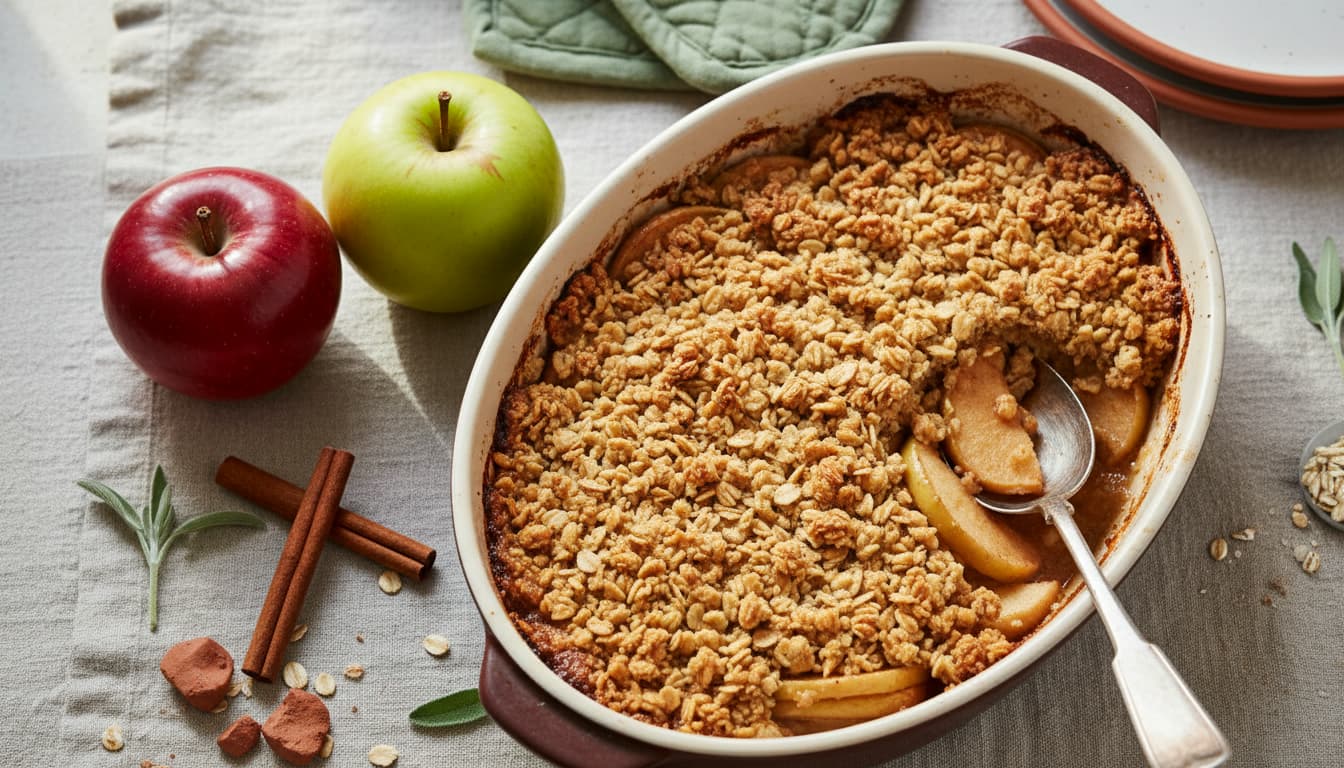
A watery apple crisp is not a topping problem. It is an apple problem and a time problem. One variety of apple gives you either mush or raw wedges, and thirty minutes is long enough to brown a topping but not long enough to cook fruit through and drive off its water. Two varieties, a spoon of cornstarch, coarse oat topping made with cold butter, and forty-five minutes at 375F. Seventy-five minutes total, and it wants twenty of them to rest.
Warum das funktioniert
Jedes Rezept auf dieser Seite kommt mit einer Erklärung der Technik-Entscheidungen: warum erst anbraten, dann schmoren, warum die Säure zum Schluss kommt, warum das Fett vor den Aromaten ausgelassen wird. Die Methode unten besteht aus genau diesen Entscheidungen, der Reihe nach.
Zutaten
8 Portionen- 1 1/2 lbGranny Smith apples · about 3 large, peeled and cut into 3/4 inch wedges, these hold their shape
- 1 1/2 lbHoneycrisp or Braeburn apples · about 3 large, same cut, these break down into the sauce
- 2 tbsplemon juice · fresh, tossed through the apples immediately after cutting
- 1/3 cuplight brown sugar · for the fruit, packed
- 1 tbspcornstarch · tossed with the apples, this is what binds the juice into a syrup
- 1 1/4 tspground cinnamon · split between the fruit and the topping
- 1/4 tspfreshly grated nutmeg · in the fruit
- 1/2 tspkosher salt · split between fruit and topping, and it matters more than the sugar does
- 1 tspvanilla extract · in the fruit
- 1 cupold-fashioned rolled oats · not quick oats, not steel-cut, the flake size is the texture
- 3/4 cupall-purpose flour · or a cup-for-cup gluten-free blend, or almond flour for a lower-carb version
- 1/2 cuplight brown sugar · for the topping, packed
- 2 tbspgranulated sugar · in the topping, it crisps where brown sugar chews
- 8 tbspcold unsalted butter · 1 stick, cut into 1/2 inch cubes and kept in the fridge until the moment it is used
- 3/4 cuppecans or walnuts · roughly chopped, optional but they are most of the crunch
- 1 pinchground cardamom · about 1/8 tsp, optional, in the topping
Methode
Use two kinds of apple, and this is the whole difference
A firm tart apple like Granny Smith holds its shape through fifty minutes and gives you distinct pieces. A softer sweet apple like Honeycrisp, Braeburn or Golden Delicious collapses into a thick sauce that binds everything together. One variety alone gives you either a dish of separate wedges swimming in liquid or a uniform puree. Half and half by weight, cut the same size, and you get both textures in the same spoonful. This is not fussiness, it is the fix.
What not to use: Red Delicious, and anything mealy
Red Delicious has thick skin, low acid and a flesh structure that goes grainy and cottony under heat, and no amount of sugar rescues it. McIntosh dissolves entirely, which is fine as your soft half but useless on its own. Gala and Fuji are middling, sweet and a bit flat, usable if that is what is in the bowl. If you can only buy one apple, buy Granny Smith and accept a firmer crisp, because tart and firm is the more forgiving failure.
Peel them, cut them thick, and do not slice them thin
Peel. Apple skin does not soften in fifty minutes and it separates into leathery curls that catch on the fork. Cut into three-quarter inch wedges rather than the quarter-inch slices most recipes call for, because thin slices have far more surface area, release far more water, and collapse into sauce before the topping is done. Six apples sounds like a lot for an eight-inch dish and it is correct, because apples lose about a third of their volume.
Lemon juice first, before anything else touches them
Toss the wedges with lemon juice as you cut, not at the end. It stops the browning, which is cosmetic, and it does something more useful: apples are low in acid and cooked apple without added acid tastes flat and one-dimensionally sweet. Two tablespoons across three pounds is not enough to taste as lemon. It is enough to make the apples taste more like apples, which is the same principle behind salting fruit.
A tablespoon of cornstarch, and why not flour
Apples are about eighty-five percent water and a good portion of it comes out in the oven. Cornstarch binds it into a glossy syrup that clings to the fruit. Flour also thickens but it needs more of it and it goes cloudy and slightly pasty. Tapioca starch is the other good choice and gives the clearest result. One tablespoon per three pounds of fruit is right. Two makes it gluey, and none gives you a puddle in the bottom of the dish.
Salt in the fruit, not only in the topping
A quarter teaspoon of kosher salt tossed through the apples does more for the finished dish than the last two tablespoons of sugar do. It suppresses bitterness, sharpens the perception of sweetness, and makes the cinnamon and nutmeg read as distinct spices rather than as generic warmth. Unsalted fruit fillings taste muffled, and the usual response is to add more sugar, which makes them cloying instead of vivid. Salt the fruit and you can use less sugar.
The topping wants cold butter, cut in, not melted
Melted butter coats every particle of flour evenly and bakes into a uniform sandy layer. Cold butter cut into the dry mix with your fingertips leaves pea-sized lumps that melt in the oven and leave air pockets behind, which is what makes a crisp topping crisp rather than dense. Work fast, stop while there are still visible flakes of butter, and if the kitchen is warm put the bowl in the freezer for ten minutes before it goes on the fruit.
Squeeze it into clumps and scatter, do not spread it flat
Once the butter is cut in, take handfuls and squeeze them so the mixture holds together, then break those into pieces roughly the size of a hazelnut and scatter them over the fruit. Leave gaps. A topping pressed into a smooth even layer seals the fruit underneath, traps steam, and the layer touching the apples goes soft. Gaps let steam escape and let hot air reach the sides of each clump, which is where the browning happens.
Rolled oats, and what quick oats do instead
Old-fashioned rolled oats are pressed whole groats, and they stay as recognisable flakes with chew and crunch. Quick oats are cut smaller and rolled thinner so they hydrate faster, which in a crisp means they absorb butter and fruit steam and turn into a soft porridge layer. Steel-cut oats never soften at all and stay gritty. This is one of the few recipes where the oat format genuinely determines the outcome, so read the tube.
Crisp, crumble, cobbler, brown betty: what you are actually making
A crisp has oats in the topping. A crumble, in British usage, is the same thing without oats, just flour, butter and sugar. A cobbler has a biscuit or batter topping dropped in rounds. A brown betty layers buttered breadcrumbs through the fruit. A pandowdy has a pastry lid pressed down into the juices partway through baking. The names get used interchangeably in the United States, which is why half the recipes online for one are the other.
375F for forty-five to fifty minutes, and the visual test
Bake on the middle rack with a sheet pan underneath to catch drips. Thirty minutes gets you a brown topping and crunchy apples, which is where most disappointing crisps stop. It is done when the juices are bubbling thickly around the edges and, more importantly, up through the middle, and when a paring knife slides into an apple with no resistance. That is usually forty-five to fifty minutes. If the topping browns first, tent it loosely with foil.
Twenty minutes of rest, or you will be eating soup
Fruit fillings thicken as they cool, because the starch only fully sets below boiling. Straight out of the oven the juices are thin and the first spoonful floods the plate. Twenty to thirty minutes on a rack and the syrup tightens around the fruit while the dish is still comfortably warm. This is also when the topping crisps up, since it is still shedding steam at the moment you take it out. Serve it warm, not hot.
The sugar question, answered honestly
This recipe has 14g of added sugar per serving, most of it in the topping, and it is a dessert. You can cut the fruit sugar to two tablespoons if your apples are sweet, and you can drop the granulated sugar in the topping, which costs you some crispness. What does not work is replacing it all with dates or maple syrup, both of which add liquid and make the topping soft. It is worth making a good one occasionally rather than a compromised one weekly.
Make-ahead, freezing, and what to do with leftovers
The topping can be made and refrigerated up to five days, or frozen in a bag for three months and used straight from frozen with five extra minutes of baking. The assembled unbaked dish holds two hours at most before the apples start weeping. A baked crisp keeps three days covered at room temperature or four refrigerated, and it reheats properly only in an oven, twenty minutes at 350F uncovered. A microwave steams the topping into paste.
Variationen
Substitutionen und Anpassungen folgen mit der Foto-Produktion. Die Methode hält bei den meisten sinnvollen Austauschen.
Aufbewahrung
Kühlschrank: 3 bis 4 Tage, verschlossen. Gefrierfach: bis zu 3 Monate. Abgedeckt aufwärmen, um die Feuchtigkeit zu halten.
Warum wir dieses apple crisp: two varieties, cold butter, forty-five minutes 3-mal getestet haben.
Jedes wichtige Rezept auf dieser Seite durchläuft vor der Veröffentlichung mindestens drei Testrunden. Wir protokollieren, was sich zwischen den Tests geändert hat, damit Sie die Entwicklung des Rezepts sehen und wir die Fehlschläge nicht stillschweigend weglassen können.
- 01
Test 1
- Was wir versucht haben
- Made it with Granny Smith alone, cut into quarter-inch slices, and baked thirty-five minutes as most recipes specify.
- Was passiert ist
- The slices collapsed into a thin sauce and the whole dish ran when spooned. The topping was browned but the fruit tasted underdone and sharp.
- Was wir geändert haben
- Half firm tart apples and half soft sweet apples, cut into three-quarter inch wedges, and forty-five to fifty minutes in the oven.
- 02
Test 2
- Was wir versucht haben
- Used melted butter in the topping, stirred through, because it is faster and easier to distribute.
- Was passiert ist
- The topping baked into a single flat sandy sheet with no clumps and very little crunch, and the underside was soft against the fruit.
- Was wir geändert haben
- Cold cubed butter cut in by hand to pea-sized lumps, squeezed into clumps and scattered with gaps between them.
- 03
Test 3
- Was wir versucht haben
- Served it straight from the oven, five minutes after it came out.
- Was passiert ist
- The juices were thin and flooded the plate, and the topping was still soft from steam it had not finished releasing.
- Was wir geändert haben
- Twenty to thirty minutes of rest on a wire rack before serving, which sets the starch and crisps the top.
Häufige Fragen
- What are the best apples for apple crisp?
- A mix. Use half firm tart apples that hold their shape, meaning Granny Smith, Northern Spy or Braeburn, and half softer sweet apples that break down into sauce, meaning Honeycrisp, Golden Delicious or McIntosh. That combination gives you distinct pieces suspended in a thick apple puree. A single variety gives you either separate wedges in a puddle or a uniform mush. Avoid Red Delicious entirely, since it goes mealy and cottony under heat.
- Why is my apple crisp watery?
- Three likely causes, usually together. The apples were sliced too thin, so they shed more water and collapsed. There was no starch in the fruit to bind the juice. And it did not bake long enough for the liquid to reduce and the starch to activate. Cut three-quarter inch wedges, toss them with a tablespoon of cornstarch per three pounds, and bake until the juices bubble thickly in the centre, not just at the edges.
- What is the difference between apple crisp and apple crumble?
- In the strictest usage, a crisp has oats in the topping and a crumble does not, being just flour, butter and sugar rubbed together, which is the standard British version. In practice the two words are used interchangeably across North America, and plenty of recipes labelled crumble contain oats. A cobbler is a different thing again, with a biscuit or scone topping dropped over the fruit in rounds rather than a rubbed crumb.
- Do I have to peel the apples?
- Yes, for this. Apple skin does not break down over fifty minutes and it separates from the flesh into tough curls that are unpleasant on the fork. The nutritional argument for leaving skins on is real but small, roughly a gram of fiber across the whole dish, and this version already lands at 5g of fiber per serving from the oats, nuts and fruit flesh. Peel them, and put the peels in a pot with water and cinnamon if you want.
- Can I make apple crisp ahead of time?
- Make the topping ahead rather than the whole dish. It keeps five days in the fridge and three months in the freezer, and it bakes from frozen with five extra minutes. An assembled unbaked crisp starts weeping within a couple of hours as the sugar draws water out of the apples, so it is not a good overnight prep. A fully baked crisp holds three days covered at room temperature and reheats well in a 350F oven for twenty minutes.
- Can I freeze apple crisp?
- Yes, both ways. Freeze the baked and cooled crisp for up to three months, then reheat from frozen covered at 350F for about forty-five minutes, uncovering for the last fifteen. Or freeze it assembled and unbaked, which works better than refrigerating it unbaked does, and bake from frozen at 375F for about seventy minutes. The topping alone freezes best of all and is the version worth keeping in a bag for a fast dessert.
- How do I make apple crisp gluten-free?
- Swap the all-purpose flour for a cup-for-cup gluten-free blend, or use almond flour, which gives a slightly denser and richer topping with more browning. Certified gluten-free rolled oats are essential, since standard oats are usually processed on shared equipment with wheat. Everything else in the recipe is already gluten-free. The nuts help, because they carry a good part of the crunch that the flour would otherwise be providing.
- Can I use less sugar in apple crisp?
- Some. Cut the brown sugar in the fruit from a third of a cup to two tablespoons and you will barely notice, particularly with sweet apples, and the quarter teaspoon of salt does more for perceived sweetness than that sugar did. The topping is less flexible, because sugar is structural there and cutting it produces a soft, pale crumb. Replacing sugar with maple syrup or date paste adds liquid and makes the topping soggy rather than crisp.
- What do you serve with apple crisp?
- Vanilla ice cream, cold, against warm fruit, which is the standard for good reason. Lightly whipped cream with no sugar in it, creme fraiche, or plain Greek yogurt all work and the acidity of the last two is genuinely better against a sweet filling than sweetened cream is. A splash of cold heavy cream poured straight over the top is the old-fashioned version and takes thirty seconds.
Ähnliche Rezepte
Alle ansehen →- Meal Types
Gebratener Reis: kalter Reis vom Vortag, heiße Pfanne, wenig Sauce
Frisch gekochter Reis wird in der Pfanne zu Brei. Warum der Reis über Nacht offen in den Kühlschrank muss, warum in zwei Chargen gebraten wird und warum die Sojasauce an den Pfannenrand kommt und nicht in die Mitte.
25m22g Eiweiß - Meal Types
Krautsalat: salzen, ausdrücken, erst dann anmachen
Krautsalat wird wässrig, weil ungesalzener Kohl direkt ins Dressing kommt. Dreißig Minuten Salzen ziehen das Wasser heraus, das Dressing bleibt dick, und der Salat hält drei Tage statt drei Stunden. Mit einer Essigvariante ohne Mayonnaise.
50m3g Eiweiß - Meal Types
Carnitas: knusprige Ränder ohne Fritteuse, 34 g Protein
Carnitas aus dem Ofen: Schweineschulter über Nacht gesalzen, drei Stunden bei niedriger Hitze geschmort, das Fett abgeschöpft und zum Schluss unter dem Grill knusprig gebräunt. Für 8 Portionen.
215m34g Eiweiß
Erhalten Sie jeden Sonntag ein getestetes Rezept und eine Nährwert-Notiz in Ihr Postfach.
Ein Rezept pro Woche, fotografiert am selben Dienstag, an dem es getestet wurde. Von einer Ernährungsberaterin geprüft. Keine Werbung, keine Pop-ups, kein Tracking.
Das Clean-Chef-Starter-Kit.
Ein 14-Tage-Plan für entzündungshemmende Ernährung als PDF, Einkaufsliste nach Abteilungen, Makros pro Tag aufsummiert, Sonntags-Vorbereitung. Kostenlos.
Mit der Anmeldung stimmen Sie unserer Datenschutzerklärung zu. Eine ruhige E-Mail pro Woche. Jederzeit abbestellbar.
Wir bauen einen Shop.
Kuratiertes Kochgeschirr, Vorratsbasics, die wir wirklich kaufen, Rezept-Bundle-PDFs. Erfahren Sie als Erste, wann er öffnet.
Wir schreiben Ihnen nur zur Shop-Eröffnung. In jeder E-Mail abbestellbar. Siehe unsere Datenschutzerklärung.