Whole30 vs paleo
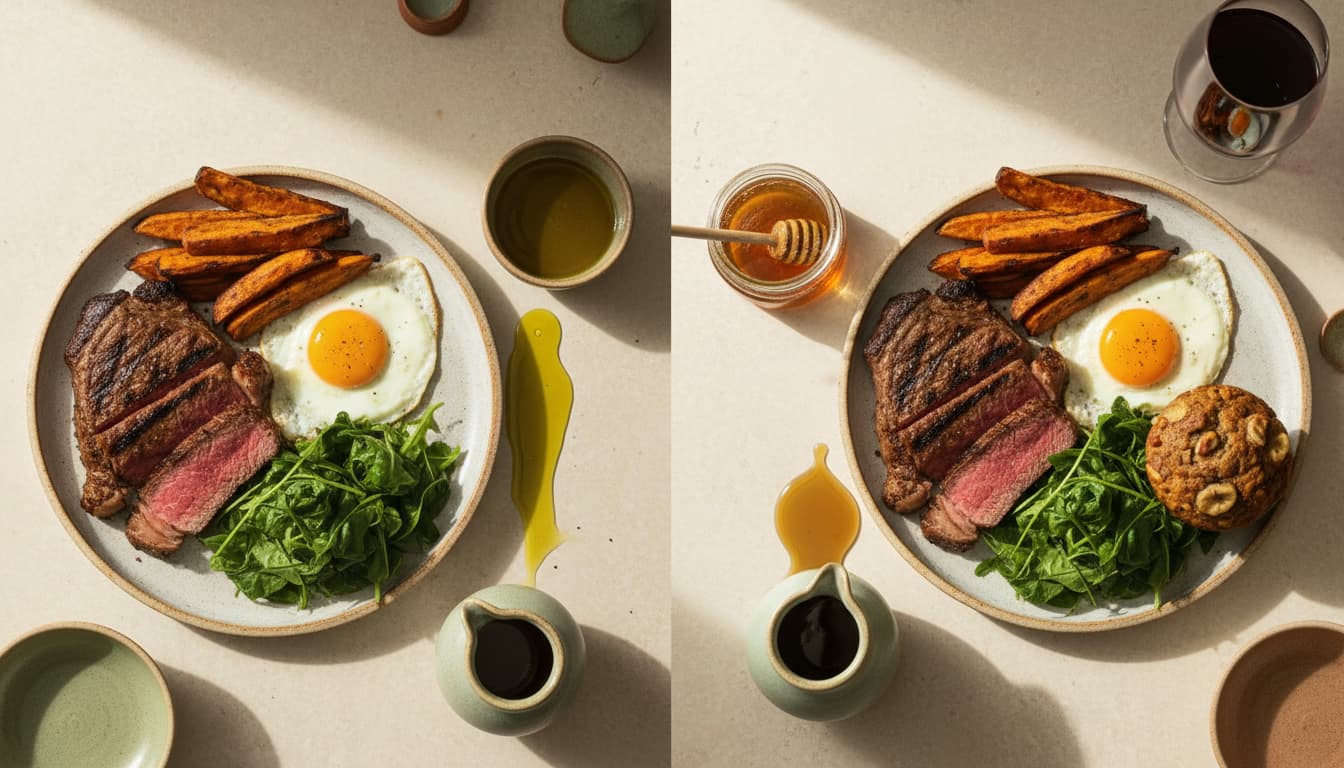
Two patterns with almost the same shopping list and completely different intentions. The three divergences that actually change what you cook (natural sweeteners, paleo baking, alcohol), the shared exclusions people get wrong, the four Whole30-only rules that have nothing to do with food, and which one to pick for which job.
Von Die ThatCleanChef-Küche · Aktualisiert 26. August 2026 · 11 Min. Lesezeit
The differences that actually change your cooking.
- 01
The shared base, which is most of it
Both remove grains, legumes including peanuts and soy, dairy with a ghee exception, added sugar in its refined forms, and industrial seed oils in practice if not always by rule. Both are built on meat, fish, eggs, vegetables, fruit, nuts, seeds and cooking fats. If you looked in two shopping trolleys you would not reliably be able to tell them apart, which is why so much of the internet treats them as the same diet.
- 02
Divergence one, honey and maple syrup
Paleo permits honey, maple syrup and date sugar as natural sweeteners. Whole30 permits no added sweetener of any kind, natural or otherwise, for thirty days. This is the difference you feel first at the stove, because it removes glazes, most marinades, salad dressings that lean sweet, and every bar and snack in the paleo aisle. It also removes a lot of shop-bought sauces that a paleo eater treats as compliant.
- 03
Divergence two, paleo baking exists and Whole30 baking does not
Almond-flour pancakes, coconut-flour muffins, paleo brownies and cauliflower pizza are staples of paleo cooking and explicitly banned on Whole30 under what the program calls the pancake rule. The ingredients are compliant, the food is not, because the point is to interrupt the habit rather than to recreate it with different flour. This is the rule that annoys people most, and it is also the one doing the most work.
- 04
Divergence three, alcohol
Whole30 excludes all alcohol for thirty days, including as a cooking ingredient. Paleo has no consistent position, and most practitioners treat dry wine, tequila and hard cider as acceptable. Practically this changes your restaurant behaviour more than your cooking, and it is the reason a lot of people find Whole30 socially harder than paleo despite the food overlapping by roughly ninety percent.
- 05
The Whole30 rules that are not about food at all
No weighing yourself and no body measurements for thirty days, except on day zero and day thirty-one. No calorie counting. No treat versions of off-plan food. And thirty days meaning thirty consecutive days, with a restart if you break it. None of these appear in paleo in any form. They are behavioural rules attached to a food protocol, and whether that appeals to you is genuinely the deciding factor between the two.
- 06
Duration is the other real difference
Paleo is a diet you can eat for years, and plenty of people do. Whole30 is a thirty-day elimination protocol followed by a structured reintroduction, and the program is explicit that it is not meant to be a permanent way of eating. Anyone doing Whole30 back to back for six months has misunderstood it, and has usually skipped the reintroduction phase, which is the part that generates the actual information.
- 07
The small exceptions worth knowing
Green beans, snow peas and sugar snap peas are legumes but are permitted on Whole30 because they are eaten as pods. Ghee and clarified butter are allowed on both. Vinegar is fine on both except malt vinegar, which is grain-derived. Salt containing dextrose is explicitly permitted on Whole30 because it is unavoidable. Paleo has no central authority, so its edge cases vary by whichever book you read.
- 08
Which one to pick, for which job
Pick Whole30 if you want a defined, finite experiment with a reintroduction protocol at the end, and if you suspect a specific food group is causing you trouble. Pick paleo if you want a sustainable long-term pattern with room for honey, the occasional almond-flour cake and a glass of wine. A common and sensible sequence is thirty days of Whole30 to get a clean baseline, then paleo or a broader whole-food pattern informed by what reintroduction told you.
How this recipe was tested
- Times we tested
- Every recipe on this site runs through a home kitchen at least three times before it publishes. We note what failed, what we adjusted, and what equipment mattered.
- Home kitchen equipment used
- Home gas range, 10-inch carbon steel or cast iron, 6-quart Dutch oven, half-sheet pan, Vitamix, digital thermometer, kitchen scale. No restaurant shortcuts.
- Nutrition verified against USDA
- Every Nutrition Ledger value comes from USDA FoodData Central per-serving calculations, not packaging labels or AI estimates. Sodium includes added salt.
- Where technique notes come from
- Serious Eats, Cook's Illustrated, Salt Fat Acid Heat, Six Seasons, and peer-reviewed food-science when a claim needs backing. Cited at the end of each recipe.
What people ask us most.
- Is Whole30 just a stricter paleo?
- Close, but the framing matters. Whole30 is a thirty-day elimination protocol with behavioural rules and a reintroduction phase; paleo is an ongoing dietary pattern with an ancestral rationale. The food lists overlap heavily, but Whole30 additionally bans natural sweeteners, alcohol, paleo-ified baked goods, the scale and calorie counting, and then asks you to stop after thirty days. Same groceries, different purpose.
- Can you have honey on Whole30?
- No. All added sweeteners are out for the thirty days, including honey, maple syrup, coconut sugar, date syrup and agave, and including any sweetener used as an ingredient in something else. This is one of the clearest lines between the two patterns, since paleo treats honey and maple as acceptable. Whole fruit and dates eaten as fruit are fine; dates blended into a base for a dessert-shaped thing are not.
- Which is easier to stick to?
- Paleo is easier day to day because of the sweetener and baking allowances and because there is no clock running. Whole30 is easier psychologically for some people precisely because it ends, and because the rules leave no room for negotiation, which removes the daily decision. The honest answer is that thirty finite days of a hard rule beats an indefinite soft rule for a lot of people, and the reverse is true for everyone else.
- Are both diets dairy-free?
- Effectively yes, with the same exception. Milk, cream, cheese, yogurt and butter are out on both, while ghee and clarified butter are permitted on both because the milk solids have been removed. Some paleo practitioners include grass-fed butter or raw dairy under a primal label, which is a departure from strict paleo rather than a rule of it. Whole30 has no such flexibility for the thirty days.
- What do you eat after Whole30 ends?
- The reintroduction schedule first, one food group at a time with two or three compliant days between tests, in the order of legumes, non-gluten grains, dairy, then gluten. What you land on afterwards is the personalised version, and for a lot of people it looks like paleo plus rice, plus yogurt, plus whatever else came back clean. Resuming your old diet on day thirty-one wastes the only useful output of the month.
New chef-tested reformulations, a better version of the Our Pick that ships at the same price, or a disclosed recipe change from a brand that drops a certification. We'll update this page within a week and note what changed and why.
Woher die Technik stammt
Über die ThatCleanChef-Küche
Ein kleines Team aus Rezeptentwicklerinnen und Foodfotografen, das Rezepte in Privatküchen mit haushaltsüblichem Equipment testet. Jede Nährwertkarte ist USDA-FoodData-Central-belegt und wird geprüft von Lena Marsh, RDN, MS. Wir geben nicht vor, ein einzelner Küchenchef zu sein, wir sind die Menschen hinter den Tellern. Das ganze Team kennenlernen →
Ähnliche Beiträge
Magnesiumreiche Lebensmittel: Kürbiskerne schlagen Spinat
Eine Handvoll Kürbiskerne liefert rund 156 mg Magnesium, mehr als eine Tasse gekochter Spinat und etwa das Fünffache einer Banane. Etwa die Hälfte der Erwachsenen bleibt unter dem geschätzten Bedarf, und der größte einzelne Grund ist die Ausmahlung von Getreide, die dem Weizen rund achtzig Prozent seines Magnesiums nimmt.
Kaliumreiche Lebensmittel: mehr als Bananen, mit echten Zahlen
Die Banane steht nicht einmal unter den ersten zwanzig. Welche Lebensmittel wirklich viel Kalium liefern, wie Kochen und Wässern den Gehalt senken, und warum Kalium ohne weniger Natrium nur die halbe Rechnung ist.
Vegetarische Rezepte: Protein, Röstaromen und echte Abendessen
Vegetarisch kochen scheitert selten an Ideen und fast immer an zwei Dingen: zu wenig Protein und zu wenig Bräunung. Woher das Protein kommt, welche Nährstoffe wirklich Aufmerksamkeit brauchen und wie eine Woche Abendessen konkret aussieht.
Das Clean-Chef-Starter-Kit.
Ein 14-Tage-Plan für entzündungshemmende Ernährung als PDF, Einkaufsliste nach Abteilungen, Makros pro Tag aufsummiert, Sonntags-Vorbereitung. Kostenlos.
Mit der Anmeldung stimmen Sie unserer Datenschutzerklärung zu. Eine ruhige E-Mail pro Woche. Jederzeit abbestellbar.