Magnesium-rich foods
Von Die ThatCleanChef-Küche · Aktualisiert 10. September 2026 · 13 Min. Lesezeit
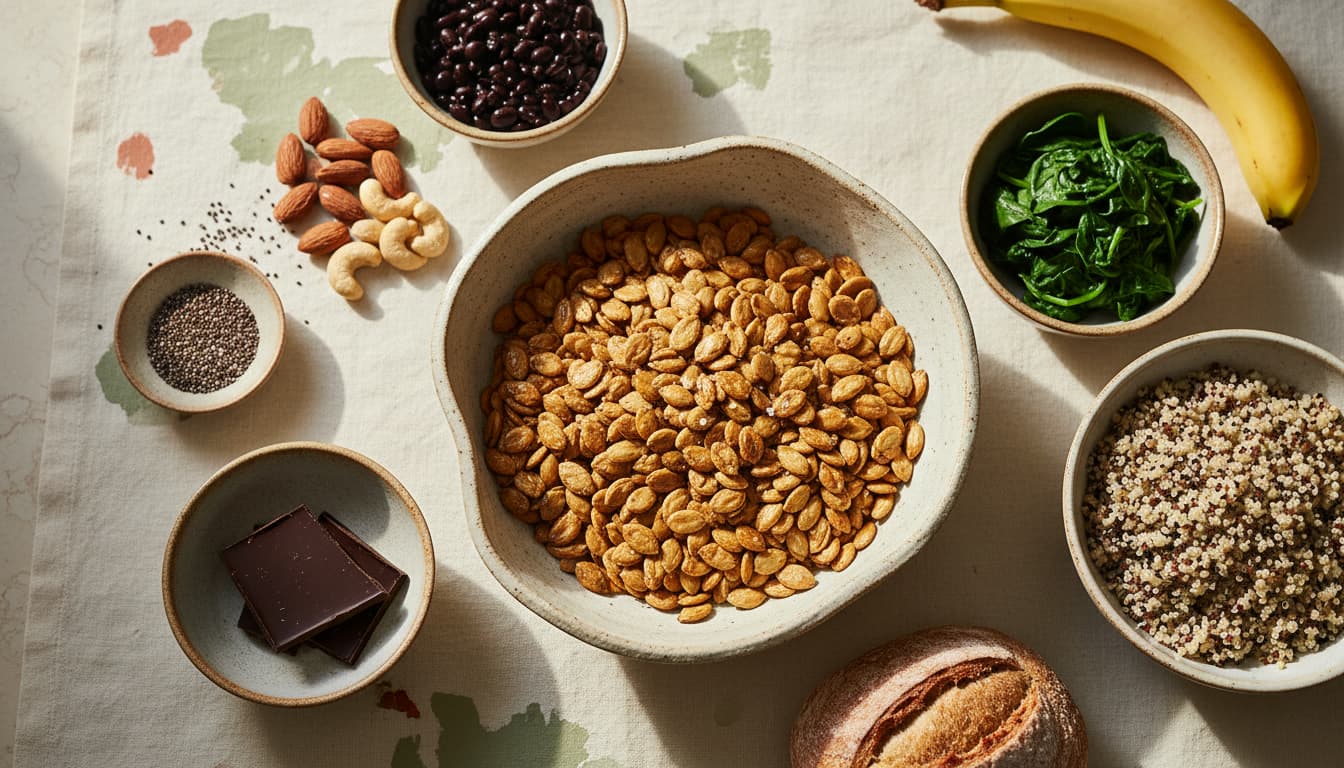
An ounce of pumpkin seeds carries about 156mg of magnesium, which is more than a cup of cooked spinach and roughly five times what a banana delivers. Around half of adults in national survey data take in less than the estimated requirement, and the largest single reason is grain refining, which strips about eighty percent of the magnesium out of wheat before it reaches a loaf.
- 01
The target is 320mg for women and 420mg for men, and about half of adults miss it
The United States Recommended Dietary Allowance is 310 to 320mg a day for adult women and 400 to 420mg for adult men, with higher figures in pregnancy. National survey data has repeatedly found that a large share of adults, on the order of half, take in less than the estimated average requirement from food. This is not a dramatic deficiency in the clinical sense. It is a persistent shortfall, and it sits in an unusual position: widespread, easy to close with food, and almost never measured.
- 02
Pumpkin seeds are the densest thing you can put in a shopping trolley
A single ounce of pumpkin seeds, which is a small handful, carries roughly 156mg, close to half the daily requirement for a woman. Nothing else in a normal shop comes close per gram. They are also the easiest to deploy: a spoonful on a salad, folded into the granola on this site, stirred through yogurt, or eaten as they are. If you only change one thing after reading this page, buy a bag of pumpkin seeds and keep it next to the salt.
- 03
The real ranking by realistic serving
Pumpkin seeds around 156mg an ounce, cooked spinach around 157mg a cup, chia seeds around 111mg an ounce, black beans around 120mg a cooked cup, edamame around 99mg a cup, brown rice around 86mg a cooked cup, almonds around 80mg an ounce, cashews around 74mg an ounce, dark chocolate at seventy percent or above around 65mg an ounce, avocado around 58mg each, peanut butter around 49mg for two tablespoons, plain yogurt around 42mg a cup and a banana around 32mg.
- 04
Magnesium sits in the middle of chlorophyll, which tells you where to look
The magnesium ion is the atom at the centre of every chlorophyll molecule, which is why dark green leaves are a reliable source and why the greener the leaf the better the odds. Spinach, chard, beet greens and kale all qualify. As with potassium, the volume trick applies: a cup of raw spinach carries about 24mg and a cup of cooked spinach around 157mg, because cooking collapses roughly ten cups of leaves into one. Nothing is created, you simply eat far more of it.
- 05
Refining grain removes about eighty percent of it, and that is the story
Magnesium in wheat is concentrated in the bran and the germ, both of which are removed when white flour is milled. The loss is roughly eighty percent, and unlike iron and several B vitamins, magnesium is not added back under standard enrichment. A slice of wholemeal bread carries around 23mg and a slice of white around 6mg. Multiply that across bread, pasta, rice and breakfast cereal in a typical week and the refining choice alone accounts for a large part of the national shortfall.
- 06
Nuts, seeds and legumes are the three shelves that matter
Almost every high-magnesium food falls into one of these groups, and all three are also high in fibre, plant protein and potassium, which is why the same dietary advice keeps appearing under different nutrient headings. A cup of black beans, an ounce of almonds and a spoonful of pumpkin seeds together deliver around 356mg, which is a full day for most women, and they cost very little. The dense bean salad and the hummus on this site are both essentially magnesium delivery systems.
- 07
Dark chocolate is on the list legitimately, with a caveat about portion
An ounce of seventy to eighty-five percent dark chocolate carries about 65mg, which is genuinely useful and is not a technicality. It also carries around 170 calories and twelve grams of fat, so it is a contributor rather than a strategy. Milk chocolate has roughly a quarter as much because the cocoa solids have been diluted with sugar and milk. Cocoa powder is the concentrated version: two tablespoons of unsweetened cocoa carry around 50mg with almost no calories.
- 08
Hard water contributes, and it is not a rounding error
Drinking water containing dissolved magnesium and calcium salts, which is what hard water means, can contribute a meaningful fraction of daily intake in some regions, in the range of ten percent. Softened water has had the magnesium exchanged out. Reverse-osmosis and distilled water contain essentially none. This is not a reason to change your plumbing, but it does mean two people eating identical diets in different towns can have measurably different intakes, and it is one reason population studies on this nutrient are messy.
- 09
Phytate reduces absorption, and soaking helps a little
Whole grains, legumes, nuts and seeds all contain phytic acid, which binds minerals including magnesium and reduces how much you absorb. Absorption from a mixed diet runs somewhere between thirty and forty percent. Soaking, sprouting and fermenting all break down some phytate, which is one reason sourdough bread delivers more available magnesium than a fast-risen loaf from the same flour. The practical conclusion is not to avoid these foods, since they are the richest sources by a wide margin, but to eat more of them.
- 10
Boiling leaches it, the same as it does potassium
Magnesium is water-soluble, so cut vegetables boiled in a large volume of water lose a meaningful share of it into liquid most people pour away. Steaming, roasting, microwaving and stir-frying all retain far more. If you do boil, use the liquid, which is exactly what a soup, a stew or a braise does automatically. Draining pasta is the common exception where the loss is unavoidable, and it is a further argument for wholemeal pasta, which starts with more.
- 11
Magnesium and vitamin D are interdependent, which surprises people
The enzymes that convert vitamin D into its active form require magnesium as a cofactor, and a randomised trial found that magnesium status influenced how vitamin D was metabolised, with the effect depending on where a person started. In practical terms this means a vitamin D supplement taken against a background of low magnesium intake may do less than expected. It is a good argument for closing the gap with food before adding a second supplement to fix the first one.
- 12
Blood pressure, and what the evidence actually supports
A meta-analysis of randomised double-blind placebo-controlled trials found that magnesium supplementation produced a small but statistically significant reduction in both systolic and diastolic blood pressure. Small is the operative word: this is a few millimetres of mercury, not a substitute for treatment. The more useful reading is that magnesium is one of several minerals, alongside potassium and calcium, that the DASH pattern raises simultaneously, and the pattern outperforms any single nutrient given in isolation.
- 13
A serum test will not tell you much
Less than one percent of the body's magnesium is in blood serum, with the rest in bone and inside cells, and the body defends the serum figure tightly by pulling from bone. That means a normal serum magnesium result is entirely compatible with a long-term dietary shortfall, which is why this nutrient is under-diagnosed. Red blood cell magnesium and magnesium loading tests exist and are rarely ordered. For most people the practical answer is dietary rather than diagnostic.
- 14
Supplements: the form decides whether it works or whether it is a laxative
Magnesium oxide is the cheapest and the most common in shops, and it is poorly absorbed, which is precisely why it is also sold as a laxative. Citrate, glycinate, malate and lactate are all substantially better absorbed, with glycinate the usual recommendation when the gastrointestinal effect is unwanted. The Tolerable Upper Intake Level of 350mg a day applies to supplemental magnesium only, not to food, and it exists because the first sign of too much from a pill is diarrhoea.
- 15
Medications and conditions that deplete it
Long-term proton pump inhibitor use is associated with low magnesium, and the FDA has issued specific guidance on it. Loop and thiazide diuretics increase urinary loss. Poorly controlled type 2 diabetes increases excretion. Chronic alcohol use, coeliac disease, Crohn's and any condition causing chronic diarrhoea all reduce absorption or increase loss. If any of those apply, this is a conversation with a clinician rather than a page on a recipe site, and a supplement may be genuinely indicated rather than optional.
- 16
A day that clears 400mg without any special shopping
Breakfast: oats made with milk, a tablespoon of chia and a spoonful of pumpkin seeds, around 180mg. Lunch: a bowl of the dense bean salad on this site with spinach folded in, around 190mg. Snack: an ounce of almonds and a square of dark chocolate, around 100mg. Dinner: salmon with brown rice and a large pile of chard, around 160mg. That is roughly 630mg, comfortably over the target for either sex, from food nobody would describe as unusual.
What people ask us next.
- What food has the most magnesium?
- Pumpkin seeds, by a clear margin per gram: about 156mg in a single ounce, which is close to half a woman's daily requirement in a small handful. Cooked spinach matches that per cup, at around 157mg, but a cup of cooked spinach is roughly ten cups of raw leaves. After those two come chia seeds, black beans, edamame, brown rice, almonds, cashews and dark chocolate. Per realistic serving rather than per 100g is the only ranking that helps in a kitchen.
- How much magnesium do I need per day?
- The United States Recommended Dietary Allowance is 310 to 320mg a day for adult women and 400 to 420mg for adult men, with the exact figure depending on age, and higher amounts recommended in pregnancy. Requirements rise for people taking certain diuretics or proton pump inhibitors, and for anyone with a condition causing chronic diarrhoea or malabsorption. National survey data consistently shows a substantial share of adults taking in less than the estimated average requirement.
- What are the signs of low magnesium?
- Early shortfall is usually silent. As it deepens, reported signs include muscle cramps and twitching, fatigue, weakness, nausea, loss of appetite and, in severe cases, abnormal heart rhythms and seizures. The difficulty is that all of those have many other causes, and a standard serum magnesium test is a poor detector because less than one percent of body magnesium is in blood. Persistent symptoms are a reason to see a clinician rather than to self-diagnose from a symptom list.
- Which magnesium supplement is best absorbed?
- Citrate, glycinate, malate and lactate are all considerably better absorbed than magnesium oxide, which is the cheapest and most widely sold form and is poorly absorbed enough that it is also marketed as a laxative. Glycinate is the usual choice when gastrointestinal effects are the concern. The Tolerable Upper Intake Level for supplemental magnesium is 350mg a day; that limit does not apply to magnesium from food, which healthy kidneys clear without difficulty.
- Does magnesium help with sleep?
- The evidence is thinner than the marketing. There is a plausible mechanism, since magnesium is involved in GABA receptor function and in regulating the nervous system, and some small trials in older adults with insomnia have reported modest improvements. Larger, better-controlled evidence is limited. If your intake is low, closing the gap with food is worth doing on its own merits. If your intake is already adequate, a supplement is unlikely to be the reason your sleep changes.
- Can you get too much magnesium?
- Not realistically from food, because healthy kidneys excrete the surplus and there is no upper limit set for dietary magnesium. From supplements yes, and the first sign is diarrhoea, which is why the upper limit of 350mg a day applies to supplemental forms only. Serious hypermagnesemia is rare and occurs mainly in people with impaired kidney function or those taking very large doses of magnesium-containing laxatives and antacids over time.
- Does coffee deplete magnesium?
- Slightly, and much less than is usually claimed. Caffeine has a mild diuretic effect that modestly increases urinary magnesium loss, but the size of that effect in normal consumption is small relative to what a single handful of pumpkin seeds provides. Alcohol is the far more significant depleter, and chronic heavy drinking is a well-documented cause of magnesium deficiency. Coffee is not the reason most people fall short; refined grain is.
- Do magnesium supplements help leg cramps?
- For most people, probably not. Systematic reviews of magnesium for nocturnal leg cramps in older adults have generally found no meaningful benefit over placebo, despite the intuition and the widespread recommendation. The evidence is somewhat more favourable for cramps in pregnancy, though still mixed. If cramps are persistent, worth investigating are hydration, electrolytes generally, medication side effects and circulation, rather than assuming a single mineral is the cause.
- Which diets tend to be low in magnesium?
- Any pattern built mainly on refined grain, since milling removes about eighty percent of the magnesium and enrichment does not add it back. Very low-carbohydrate and strict keto patterns are the other common case, because they remove legumes, whole grains and most fruit at once, and low magnesium alongside low potassium and sodium is part of what people describe as keto flu. A diet centred on packaged and restaurant food runs low for the same refining reason.
Woher die Technik stammt
- USDA FoodData Central, reference magnesium values per food and portion.
- NIH Office of Dietary Supplements, magnesium fact sheet for health professionals.
- Rosanoff A, Weaver CM, Rude RK. Suboptimal magnesium status in the United States: are the health consequences underestimated? Nutr Rev. 2012.
- Zhang X, Li Y, Del Gobbo LC, et al. Effects of magnesium supplementation on blood pressure: a meta-analysis of randomized double-blind placebo-controlled trials. Hypertension. 2016.
- Dai Q, Zhu X, Manson JE, et al. Magnesium status and supplementation influence vitamin D status and metabolism: results from a randomized trial. Am J Clin Nutr. 2018.
- Harvard T.H. Chan School of Public Health, The Nutrition Source, on magnesium.
Über die ThatCleanChef-Küche
Ein kleines Team aus Rezeptentwicklerinnen und Foodfotografen, das Rezepte in Privatküchen mit haushaltsüblichem Equipment testet. Jede Nährwertkarte ist USDA-FoodData-Central-belegt und wird geprüft von Lena Marsh, RDN, MS. Wir geben nicht vor, ein einzelner Küchenchef zu sein, wir sind die Menschen hinter den Tellern. Das ganze Team kennenlernen →
Ähnliche Beiträge
Kaliumreiche Lebensmittel: mehr als Bananen, mit echten Zahlen
Die Banane steht nicht einmal unter den ersten zwanzig. Welche Lebensmittel wirklich viel Kalium liefern, wie Kochen und Wässern den Gehalt senken, und warum Kalium ohne weniger Natrium nur die halbe Rechnung ist.
Vegetarische Rezepte: Protein, Röstaromen und echte Abendessen
Vegetarisch kochen scheitert selten an Ideen und fast immer an zwei Dingen: zu wenig Protein und zu wenig Bräunung. Woher das Protein kommt, welche Nährstoffe wirklich Aufmerksamkeit brauchen und wie eine Woche Abendessen konkret aussieht.
Eisenhaltige Lebensmittel: Häm, Nicht-Häm und was die Aufnahme steuert
Nicht die Eisenmenge auf der Nährwerttabelle entscheidet, sondern wie viel davon aufgenommen wird. Der Unterschied zwischen Häm- und Nicht-Häm-Eisen, warum Vitamin C die Aufnahme vervielfacht und welche Getränke sie blockieren.
Das Clean-Chef-Starter-Kit.
Ein 14-Tage-Plan für entzündungshemmende Ernährung als PDF, Einkaufsliste nach Abteilungen, Makros pro Tag aufsummiert, Sonntags-Vorbereitung. Kostenlos.
Mit der Anmeldung stimmen Sie unserer Datenschutzerklärung zu. Eine ruhige E-Mail pro Woche. Jederzeit abbestellbar.