- Kalorien
- 415
- Eiweiß
- 45g
- Ballaststoffe
- 1g
- Ges. Fett
- 8g
- Natrium
- 700mg
- Zugesetzter Zucker
- 0g
Was dieses Rezept für Sie leistet.
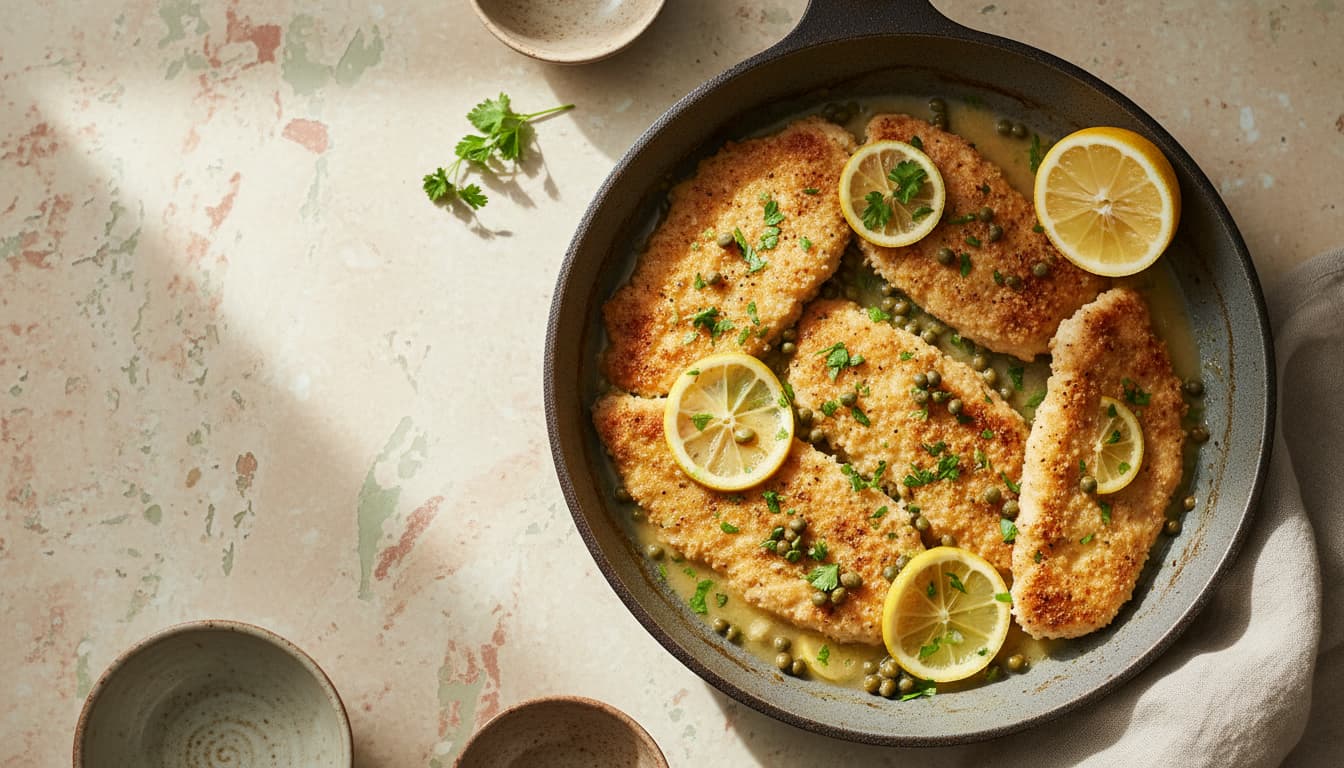
Two things separate a good piccata from a greasy one, and neither is the lemon. Cutlets pounded to an even half inch, so they cook in three minutes a side and never dry out. And cold butter beaten into the reduced pan juices off the heat, which emulsifies into a glossy sauce instead of splitting into a slick. Capers and lemon land last.
Warum das funktioniert
Jedes Rezept auf dieser Seite kommt mit einer Erklärung der Technik-Entscheidungen: warum erst anbraten, dann schmoren, warum die Säure zum Schluss kommt, warum das Fett vor den Aromaten ausgelassen wird. Die Methode unten besteht aus genau diesen Entscheidungen, der Reihe nach.
Zutaten
4 Portionen- 1 1/2 lbboneless skinless chicken breast · 2 large breasts, halved horizontally into 4 cutlets
- 1/3 cupall-purpose flour · or a fine gluten-free blend, both dredge identically
- 1 1/4 tspkosher salt · seasoned onto the chicken itself, not stirred into the flour
- 1/2 tspblack pepper · freshly ground
- 3 tbspextra-virgin olive oil
- 4 tbspcold unsalted butter · cubed, straight from the fridge when the sauce is off the heat
- 1 largeshallot · finely diced
- 2 clovesgarlic · thinly sliced rather than minced, so it does not burn
- 1/2 cupdry white wine · or an extra half cup of stock plus 2 tsp white wine vinegar
- 3/4 cuplow-sodium chicken stock · low-sodium matters here, the capers do the salting
- 3 tbspcapers · rinsed and drained, brine reserved
- 1 wholelemon · juiced, about 3 tbsp, plus a few thin slices for the pan
- 1/4 cupflat-leaf parsley · chopped, stirred in off the heat
Methode
Cutlets, not breasts, and half an inch is the number
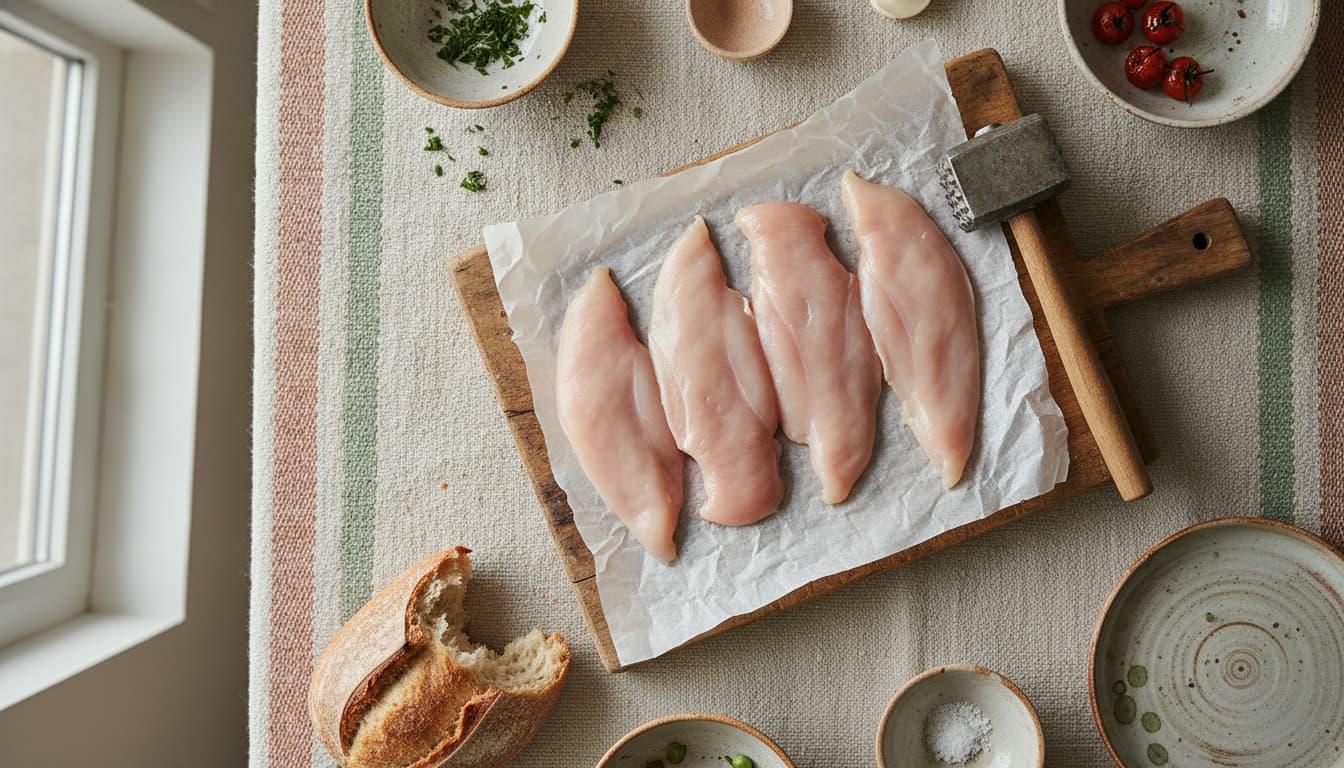
Lay a breast flat, put your palm on top and run a knife horizontally through it to make two thin pieces. Then put each between two sheets of parchment and hit it with the flat of a pan or a rolling pin until it is an even half inch, working from the middle outward. Even thickness is the whole point: a tapered cutlet has a thin end that is leather by the time the thick end is done. Four cutlets, four minutes of work.
Salt the chicken, then flour the chicken, in that order
Season the cutlets on both sides with kosher salt and pepper and let them sit for ten minutes while you prep everything else. Salt in the flour mostly ends up in the pan and then in the sauce, where you cannot control it. Salt on the meat draws moisture to the surface, dissolves, and is drawn back in, which seasons the chicken itself. Ten minutes is enough at this thickness and it makes a difference you can taste.
Dredge thin and shake hard
Drag each cutlet through the flour and then shake it firmly, so what is left is a barely visible film rather than a coating. The flour is there for two reasons: it dries the surface so it browns, and it carries just enough starch into the pan to help the sauce thicken later. Too much and you get a gluey, pasty sauce and a crust that goes soggy. Flour at the last moment, not in advance, or it turns to paste on the meat.
Three minutes a side in a hot pan, two cutlets at a time
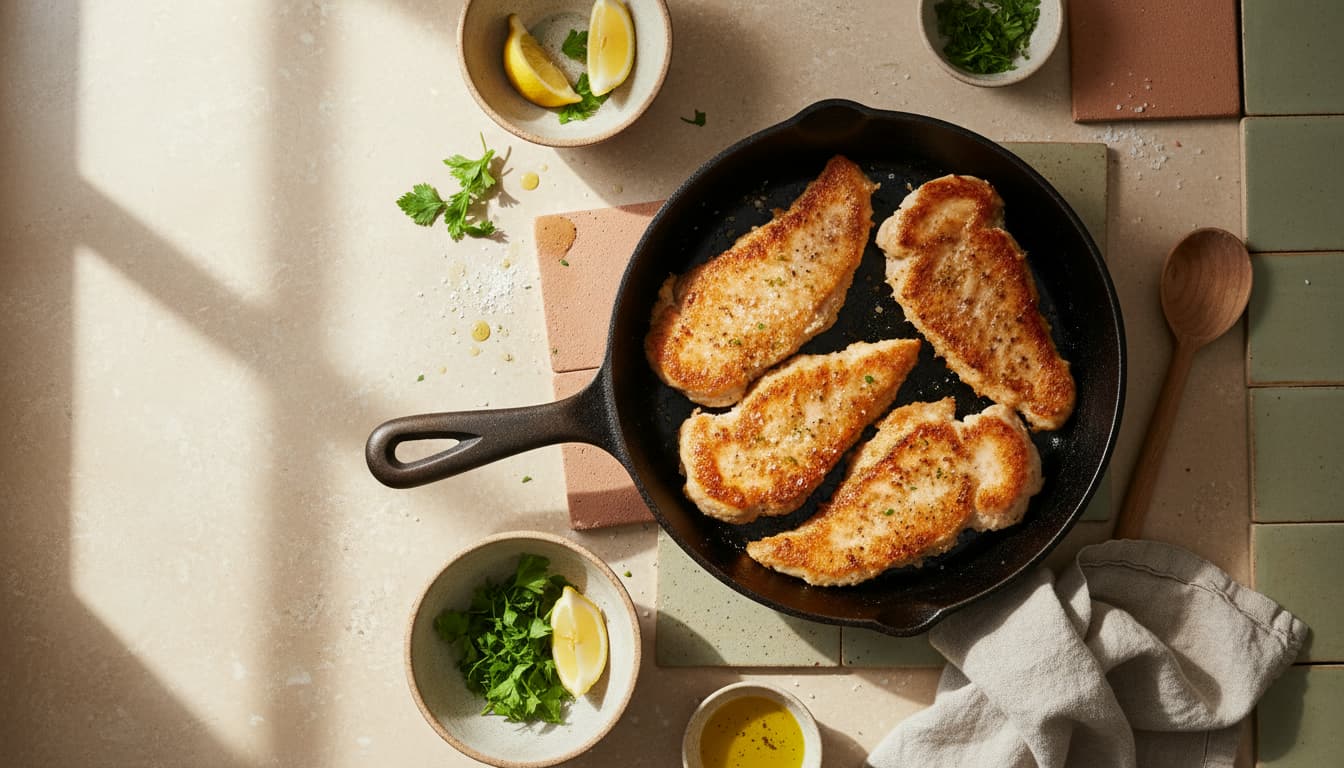
Heat the olive oil in a wide skillet until it shimmers, then add two cutlets with space between them. Three minutes without touching them, turn once, two to three minutes more. Four in the pan at once drops the temperature and they steam. Pull them at 160F in the thickest part and rest them on a plate: carryover takes them to the 165F the USDA sets for poultry while you build the sauce, and pulling later is how piccata gets dry.
Build the sauce in the fond, and do not wipe the pan
Those brown flecks stuck to the base are most of the flavour. Turn the heat down, add the shallot to the same pan and cook for two minutes, then the sliced garlic for thirty seconds. Pour in the wine and scrape the base clean with a wooden spoon while it bubbles. Let the wine reduce until the pan is almost dry before the stock goes in, otherwise the sauce tastes raw and sharp rather than rounded.
Reduce first, then mount the butter off the heat
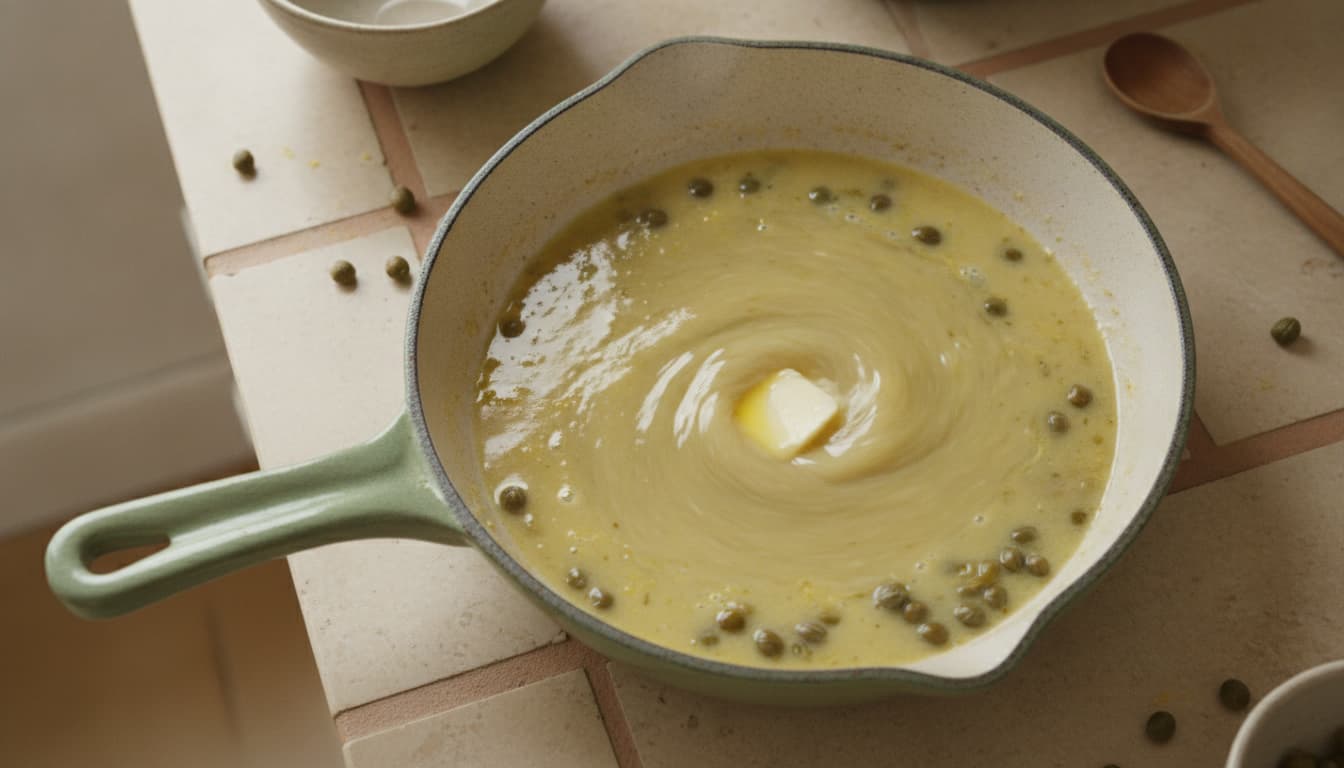
Add the stock and the lemon slices and let it reduce by about half, until it just coats a spoon, roughly four minutes. Now take the pan off the burner completely and wait fifteen seconds. Beat in the cold butter a cube at a time, swirling the pan, and watch it turn from thin and separated to glossy and slightly thick. Butter melted into a boiling sauce splits into oil and water, and that greasy slick is the single most common failure in this dish.
Capers, lemon juice and a splash of the brine at the very end
Stir in the rinsed capers, the lemon juice and the parsley with the pan off the heat. Taste, and if it needs sharpening rather than salting, add a teaspoon of the caper brine, which brings acidity and salt together. Fresh lemon juice cooked for more than a few seconds turns dull and slightly bitter, which is why so many restaurant piccatas taste flat. Return the chicken and any juices on the plate to the pan, turn once to coat, and serve.
The gluten-free version, and what actually changes
A fine gluten-free flour blend dredges and browns almost identically, so the swap is nearly invisible. Two small differences: rice-based blends brown slightly faster, so watch the first cutlet, and they thicken the sauce a touch less, so reduce the stock for an extra minute before the butter goes in. Check the stock label too, since many concentrates contain wheat. Everything else in the recipe is naturally gluten-free as written.
In pictures
Variationen
Substitutionen und Anpassungen folgen mit der Foto-Produktion. Die Methode hält bei den meisten sinnvollen Austauschen.
Aufbewahrung
Kühlschrank: 3 bis 4 Tage, verschlossen. Gefrierfach: bis zu 3 Monate. Abgedeckt aufwärmen, um die Feuchtigkeit zu halten.
Häufige Fragen
- What does piccata actually mean?
- In Italian it describes meat that has been sliced thin, dredged, sauteed and finished in a sauce, and the lemon-and-caper version most people mean by the word is really piccata alla milanese in the American idiom. Veal is the traditional protein. What defines it is the technique rather than the ingredient list: thin cutlet, quick sear, pan sauce built in the fond, acid and butter at the end.
- Can I make chicken piccata without wine?
- Yes, and it is a straightforward swap. Use an extra half cup of chicken stock in place of the wine, plus two teaspoons of white wine vinegar or an additional tablespoon of lemon juice added at the same stage. The wine is contributing acidity and a bit of complexity, not alcohol, and without something acidic at that stage the sauce reads heavy. Reduce it just as hard as you would the wine before the stock goes in.
- Why did my piccata sauce split into a greasy slick?
- The butter went into a sauce that was too hot. An emulsion of butterfat in a water-based sauce holds together below roughly 190F and breaks above it, releasing the fat as a separate layer. Take the pan off the heat, wait fifteen seconds, then beat in cold butter a cube at a time. If it has already split, add a tablespoon of cold stock off the heat and whisk hard, which will usually bring it back.
- Can I use chicken thighs instead of breast?
- Yes, and they are more forgiving, though the dish changes character. Use boneless skinless thighs, open them out flat and pound them lightly to an even thickness, and cook four to five minutes a side rather than three, to 175F rather than 165F, because thigh meat is better with the connective tissue fully rendered. The sauce is the same. Expect a richer, slightly heavier plate and about 4g more fat per serving.
- What should I serve with chicken piccata?
- Something that will take up the sauce, since there is not a lot of it and it is the best thing on the plate. Angel hair or linguine, buttered new potatoes crushed lightly with a fork, or good bread. On the vegetable side, blanched green beans, wilted spinach with garlic, or a simple bitter leaf salad with a sharp vinaigrette that echoes the lemon. Avoid anything else creamy, which competes rather than complements.
- Can I make it dairy-free?
- Partly. The butter is doing structural work, not just adding flavour, so removing it costs you the emulsion. The best available substitute is to finish with three tablespoons of good extra-virgin olive oil whisked in vigorously off the heat, plus a teaspoon of the reserved caper brine, which gives you a lighter but still cohesive sauce. It will be thinner and sharper than the classic. Vegan butter blocks with a high fat content also work reasonably well.
Ähnliche Rezepte
Alle ansehen →- High-Protein
Boeuf Bourguignon: drei Stunden, ein Topf, richtig angebraten
Das Fleisch muss trocken sein, die Pfanne heiß und der Topf nicht überfüllt, sonst kocht das Rindfleisch, statt zu bräunen. Welches Stück, welcher Wein, warum Speck, Zwiebeln und Pilze getrennt gegart werden und warum es am zweiten Tag besser schmeckt.
240m42g Eiweiß - High-Protein
Tofu zubereiten: pressen, in Stärke wenden, spät marinieren
Tofu wird knusprig, wenn Wasser heraus und Stärke darauf kommt. Welche Festigkeit für welches Gericht, warum Einfrieren die Textur völlig verändert und warum die Marinade erst nach dem Braten dazukommt statt davor.
60m20g Eiweiß - High-Protein
Enchiladas: Tortillas in heißem Öl wenden, Sauce selbst kochen
Matschige Enchiladas entstehen, weil rohe Tortillas direkt in die Sauce kommen. Zwanzig Sekunden in heißem Öl versiegeln sie, die Chilisauce wird aus getrockneten Chilis gekocht statt aus der Dose, und der Auflauf steht nur zwanzig Minuten im Ofen.
95m34g Eiweiß
Erhalten Sie jeden Sonntag ein getestetes Rezept und eine Nährwert-Notiz in Ihr Postfach.
Ein Rezept pro Woche, fotografiert am selben Dienstag, an dem es getestet wurde. Von einer Ernährungsberaterin geprüft. Keine Werbung, keine Pop-ups, kein Tracking.
Das Clean-Chef-Starter-Kit.
Ein 14-Tage-Plan für entzündungshemmende Ernährung als PDF, Einkaufsliste nach Abteilungen, Makros pro Tag aufsummiert, Sonntags-Vorbereitung. Kostenlos.
Mit der Anmeldung stimmen Sie unserer Datenschutzerklärung zu. Eine ruhige E-Mail pro Woche. Jederzeit abbestellbar.
Wir bauen einen Shop.
Kuratiertes Kochgeschirr, Vorratsbasics, die wir wirklich kaufen, Rezept-Bundle-PDFs. Erfahren Sie als Erste, wann er öffnet.
Wir schreiben Ihnen nur zur Shop-Eröffnung. In jeder E-Mail abbestellbar. Siehe unsere Datenschutzerklärung.