- Kalorien
- 310
- Eiweiß
- 36g
- Ballaststoffe
- 1g
- Ges. Fett
- 6g
- Natrium
- 470mg
- Zugesetzter Zucker
- 3g
Was dieses Rezept für Sie leistet.
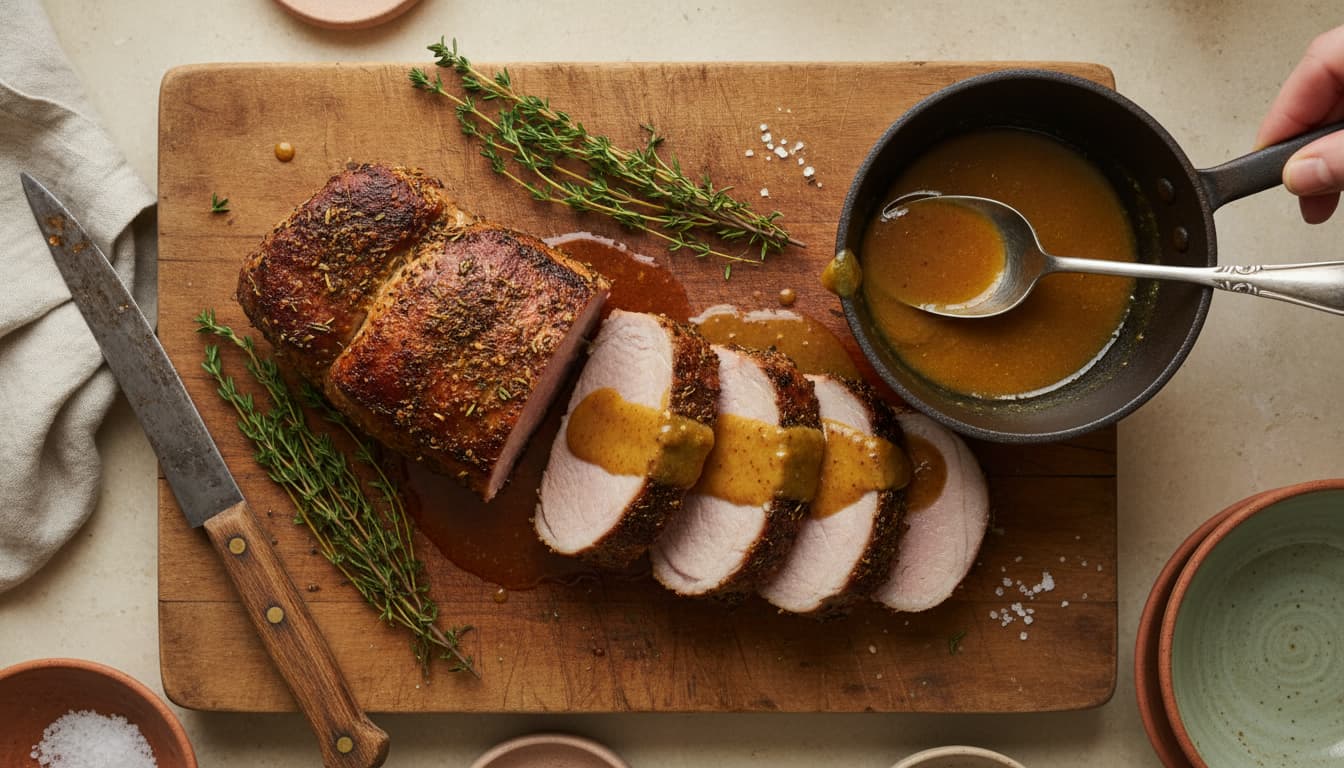
Pork tenderloin is a lean muscle with almost no fat to protect it, so the entire recipe is about temperature control. A thirty-minute dry brine, a hard sear in a skillet, a finish in the oven to exactly 145F, and a ten-minute rest that is not optional. The pan sauce is mustard, cider vinegar and cold butter, built in the same pan in four minutes.
Warum das funktioniert
Jedes Rezept auf dieser Seite kommt mit einer Erklärung der Technik-Entscheidungen: warum erst anbraten, dann schmoren, warum die Säure zum Schluss kommt, warum das Fett vor den Aromaten ausgelassen wird. Die Methode unten besteht aus genau diesen Entscheidungen, der Reihe nach.
Zutaten
4 Portionen- 1 1/2 lbpork tenderloin · silverskin trimmed off, patted dry
- 1 1/4 tspkosher salt · applied 30 minutes ahead
- 1/2 tspblack pepper · cracked
- 1 tspsmoked paprika
- 1 tbspavocado oil · or another high-smoke-point fat
- 3 clovesgarlic · smashed, skin on
- 3 sprigsthyme
- 1 tbspDijon mustard
- 2 tbspapple cider vinegar
- 1 tbspmaple syrup
- 1/3 cuplow-sodium chicken broth
- 2 tbspunsalted butter · cold, whisked in off the heat
Methode
The 75 minutes, accounted for honestly
Ten minutes of trimming and salting, thirty minutes of dry brine you are not in the kitchen for, twenty-five minutes of actual cooking, ten minutes of rest, and the washing up. If you are short, skip the dry brine and salt it just before it hits the pan for a 45-minute version. The pork will be good rather than very good, and that trade is a fair one on a Tuesday.
Trim the silverskin, it will not render
That opaque white membrane running along one side is connective tissue that does not break down at 145F, so it tightens and bows the tenderloin into a curve as it cooks and then reads as chewy on the plate. Slide a thin knife under one end, grip the flap with a paper towel, and pull it away against the blade. It takes ninety seconds and it is the difference between a straight roast and a banana.
Salt thirty minutes ahead, not at the pan
Salt on the surface draws moisture out, dissolves into it, and that concentrated brine is then reabsorbed into the muscle, seasoning it a few millimetres deep and helping it hold water under heat. Thirty minutes is enough for a piece this size. Salting immediately before cooking seasons only the crust, and salting a lean cut after cooking seasons nothing at all.
Sear it in a skillet, then move the whole pan to the oven
Oven to 400F while you sear. Get the skillet properly hot, oil shimmering, and give the tenderloin two to three minutes per side on three or four sides, so roughly eight to ten minutes to build a real crust. Add the garlic and thyme in the last minute. Then the whole skillet goes into the oven for eight to twelve minutes. One pan, one crust, no transferring anything.
145F is the number, and you need a thermometer
The USDA lowered the guidance for whole cuts of pork to 145F with a three-minute rest years ago, and pork at 145F is faintly pink in the centre, tender, and entirely safe. At 160F it is grey and dry, and there is no technique that undoes that. Pull it from the oven at 140F because it will carry over about five degrees while it rests. Guessing on a lean cut with a fifteen-degree window is not a plan.
Rest it ten minutes, on a board, uncovered
Ten minutes lets the muscle fibres relax and reabsorb the liquid they pushed out under heat. Cut it at minute two and that liquid runs onto the board, taking the difference between juicy and merely cooked with it. Do not tent it tightly with foil, which steams the crust you just spent ten minutes building. A loose sheet is fine if your kitchen is cold.
Build the pan sauce while it rests
Pour off any excess fat, keep the fond. Deglaze with the cider vinegar over medium heat, scraping, then add the broth, the Dijon and the maple and reduce for two to three minutes until it coats a spoon. Off the heat, whisk in the cold butter a cube at a time so it emulsifies rather than splitting. Any juice on the resting board goes in at the end. Four minutes, and it is what makes the plate.
Slice thick, across the grain
Three quarters of an inch, cut straight across the muscle. Thin slices lose heat and moisture immediately and read as dry no matter how well you cooked them. Angle the knife slightly for wider medallions if you want it to look better. Fan them over the sauce rather than pouring the sauce over the slices, so the crust stays a crust.
What to put next to it
Anything that can roast at 400F on a second tray while the pork is in: halved baby potatoes started twenty minutes earlier, green beans, or Brussels sprouts. A sharp green salad with mustard vinaigrette also works, since the sauce is already rich. Leftovers slice cold into sandwiches and salads for two days and should not be reheated in a microwave, which takes a lean cut straight past done.
Variationen
Substitutionen und Anpassungen folgen mit der Foto-Produktion. Die Methode hält bei den meisten sinnvollen Austauschen.
Aufbewahrung
Kühlschrank: 3 bis 4 Tage, verschlossen. Gefrierfach: bis zu 3 Monate. Abgedeckt aufwärmen, um die Feuchtigkeit zu halten.
Häufige Fragen
- Is pork tenderloin supposed to be pink?
- Slightly, yes. The USDA safe minimum for whole cuts of pork is 145F followed by a three-minute rest, and at that temperature the centre is faintly rosy. That is the correct result, not undercooked pork. The grey, firm pork most people grew up with was cooked to 160F or beyond under older guidance, and on a cut with this little intramuscular fat that is well past the point of no return.
- What is the difference between pork tenderloin and pork loin?
- They are different cuts and they are not interchangeable. Tenderloin is a small, narrow muscle of about a pound and a quarter that cooks in twenty to twenty-five minutes total. Pork loin is a much larger, wider roast that takes an hour or more and often has a fat cap. If you buy a loin and cook it by this recipe you will get a raw centre; if you buy tenderloin and cook it like a loin you will get sawdust.
- Can I cook pork tenderloin without a thermometer?
- You can, but on a lean cut with a fifteen-degree window between excellent and ruined it is genuinely the wrong place to economise. If you have no thermometer, use the firmness test against the fleshy base of your thumb and pull it when it feels springy rather than firm, then rest it longer, twelve to fifteen minutes, and accept some variance. An instant-read thermometer costs less than the pork does.
- How do I keep it from drying out?
- Four things, in order of impact. Trim the silverskin so it does not seize. Dry brine thirty minutes ahead so the muscle holds water. Pull it at 140F and let carryover take it to 145F. And rest it a full ten minutes before cutting. Marinades and bacon wrapping are working around the problem rather than solving it; temperature control is the solution.
- Can I make this on the grill?
- Yes, and it suits the cut. Set up two zones, sear it over direct heat for two minutes a side to build colour, then move it to the indirect side with the lid down until it reads 140F, usually another eight to twelve minutes. Same dry brine, same rest. You lose the fond for the pan sauce, so make the sauce in a small pan on the side burner or serve it with a herb salsa verde instead.
Ähnliche Rezepte
Alle ansehen →- High-Protein
Boeuf Bourguignon: drei Stunden, ein Topf, richtig angebraten
Das Fleisch muss trocken sein, die Pfanne heiß und der Topf nicht überfüllt, sonst kocht das Rindfleisch, statt zu bräunen. Welches Stück, welcher Wein, warum Speck, Zwiebeln und Pilze getrennt gegart werden und warum es am zweiten Tag besser schmeckt.
240m42g Eiweiß - High-Protein
Tofu zubereiten: pressen, in Stärke wenden, spät marinieren
Tofu wird knusprig, wenn Wasser heraus und Stärke darauf kommt. Welche Festigkeit für welches Gericht, warum Einfrieren die Textur völlig verändert und warum die Marinade erst nach dem Braten dazukommt statt davor.
60m20g Eiweiß - High-Protein
Enchiladas: Tortillas in heißem Öl wenden, Sauce selbst kochen
Matschige Enchiladas entstehen, weil rohe Tortillas direkt in die Sauce kommen. Zwanzig Sekunden in heißem Öl versiegeln sie, die Chilisauce wird aus getrockneten Chilis gekocht statt aus der Dose, und der Auflauf steht nur zwanzig Minuten im Ofen.
95m34g Eiweiß
Erhalten Sie jeden Sonntag ein getestetes Rezept und eine Nährwert-Notiz in Ihr Postfach.
Ein Rezept pro Woche, fotografiert am selben Dienstag, an dem es getestet wurde. Von einer Ernährungsberaterin geprüft. Keine Werbung, keine Pop-ups, kein Tracking.
Das Clean-Chef-Starter-Kit.
Ein 14-Tage-Plan für entzündungshemmende Ernährung als PDF, Einkaufsliste nach Abteilungen, Makros pro Tag aufsummiert, Sonntags-Vorbereitung. Kostenlos.
Mit der Anmeldung stimmen Sie unserer Datenschutzerklärung zu. Eine ruhige E-Mail pro Woche. Jederzeit abbestellbar.
Wir bauen einen Shop.
Kuratiertes Kochgeschirr, Vorratsbasics, die wir wirklich kaufen, Rezept-Bundle-PDFs. Erfahren Sie als Erste, wann er öffnet.
Wir schreiben Ihnen nur zur Shop-Eröffnung. In jeder E-Mail abbestellbar. Siehe unsere Datenschutzerklärung.