- Calories
- 310
- Protein
- 36g
- Fiber
- 1g
- Sat. fat
- 6g
- Sodium
- 470mg
- Added sugar
- 3g
What this recipe does for you.
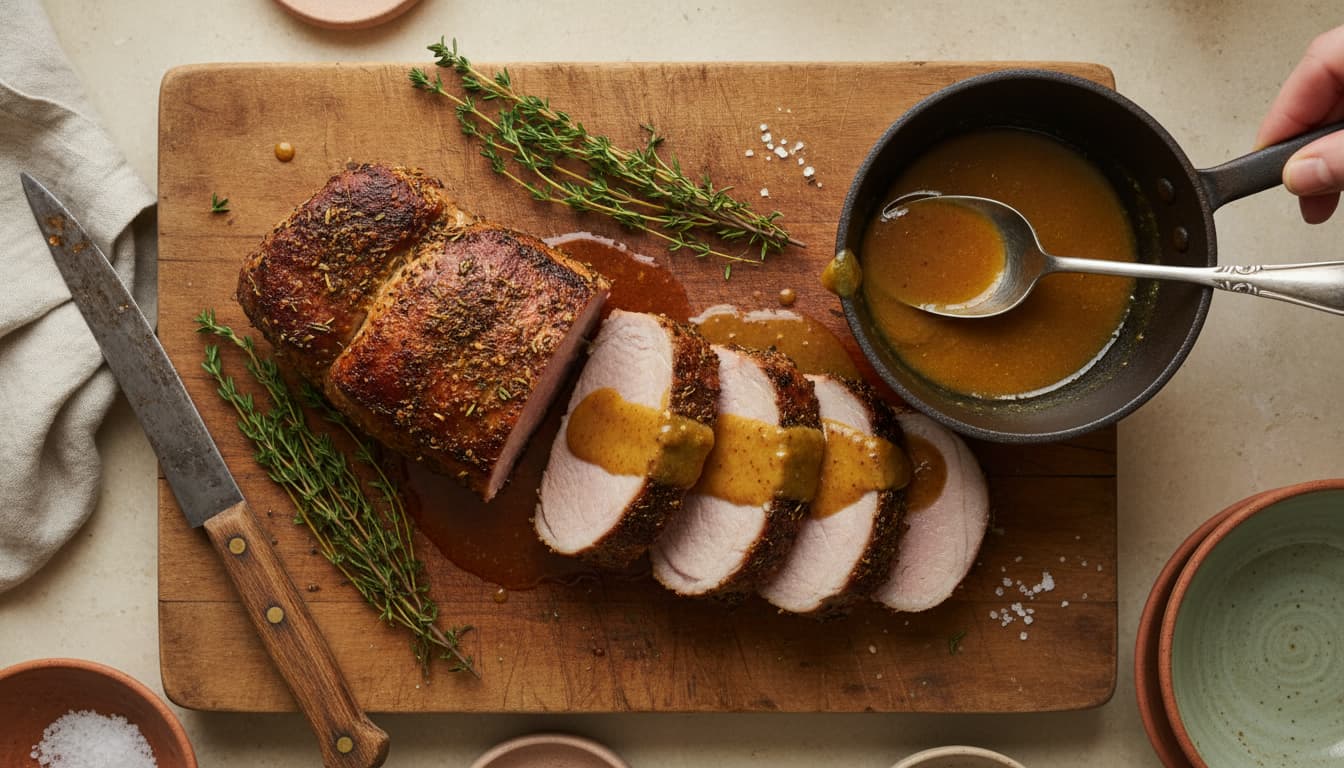
Pork tenderloin is a lean muscle with almost no fat to protect it, so the entire recipe is about temperature control. A thirty-minute dry brine, a hard sear in a skillet, a finish in the oven to exactly 145F, and a ten-minute rest that is not optional. The pan sauce is mustard, cider vinegar and cold butter, built in the same pan in four minutes.
Why this works
Every recipe on this site ships with an explanation of the technique decisions, why sear then braise, why the acid goes in at the end, why the fat renders before the aromatics. The method below is those decisions, in order.
Ingredients
Serves 4- 1 1/2 lbpork tenderloin · silverskin trimmed off, patted dry
- 1 1/4 tspkosher salt · applied 30 minutes ahead
- 1/2 tspblack pepper · cracked
- 1 tspsmoked paprika
- 1 tbspavocado oil · or another high-smoke-point fat
- 3 clovesgarlic · smashed, skin on
- 3 sprigsthyme
- 1 tbspDijon mustard
- 2 tbspapple cider vinegar
- 1 tbspmaple syrup
- 1/3 cuplow-sodium chicken broth
- 2 tbspunsalted butter · cold, whisked in off the heat
Method
The 75 minutes, accounted for honestly
Ten minutes of trimming and salting, thirty minutes of dry brine you are not in the kitchen for, twenty-five minutes of actual cooking, ten minutes of rest, and the washing up. If you are short, skip the dry brine and salt it just before it hits the pan for a 45-minute version. The pork will be good rather than very good, and that trade is a fair one on a Tuesday.
Trim the silverskin, it will not render
That opaque white membrane running along one side is connective tissue that does not break down at 145F, so it tightens and bows the tenderloin into a curve as it cooks and then reads as chewy on the plate. Slide a thin knife under one end, grip the flap with a paper towel, and pull it away against the blade. It takes ninety seconds and it is the difference between a straight roast and a banana.
Salt thirty minutes ahead, not at the pan
Salt on the surface draws moisture out, dissolves into it, and that concentrated brine is then reabsorbed into the muscle, seasoning it a few millimetres deep and helping it hold water under heat. Thirty minutes is enough for a piece this size. Salting immediately before cooking seasons only the crust, and salting a lean cut after cooking seasons nothing at all.
Sear it in a skillet, then move the whole pan to the oven
Oven to 400F while you sear. Get the skillet properly hot, oil shimmering, and give the tenderloin two to three minutes per side on three or four sides, so roughly eight to ten minutes to build a real crust. Add the garlic and thyme in the last minute. Then the whole skillet goes into the oven for eight to twelve minutes. One pan, one crust, no transferring anything.
145F is the number, and you need a thermometer
The USDA lowered the guidance for whole cuts of pork to 145F with a three-minute rest years ago, and pork at 145F is faintly pink in the centre, tender, and entirely safe. At 160F it is grey and dry, and there is no technique that undoes that. Pull it from the oven at 140F because it will carry over about five degrees while it rests. Guessing on a lean cut with a fifteen-degree window is not a plan.
Rest it ten minutes, on a board, uncovered
Ten minutes lets the muscle fibres relax and reabsorb the liquid they pushed out under heat. Cut it at minute two and that liquid runs onto the board, taking the difference between juicy and merely cooked with it. Do not tent it tightly with foil, which steams the crust you just spent ten minutes building. A loose sheet is fine if your kitchen is cold.
Build the pan sauce while it rests
Pour off any excess fat, keep the fond. Deglaze with the cider vinegar over medium heat, scraping, then add the broth, the Dijon and the maple and reduce for two to three minutes until it coats a spoon. Off the heat, whisk in the cold butter a cube at a time so it emulsifies rather than splitting. Any juice on the resting board goes in at the end. Four minutes, and it is what makes the plate.
Slice thick, across the grain
Three quarters of an inch, cut straight across the muscle. Thin slices lose heat and moisture immediately and read as dry no matter how well you cooked them. Angle the knife slightly for wider medallions if you want it to look better. Fan them over the sauce rather than pouring the sauce over the slices, so the crust stays a crust.
What to put next to it
Anything that can roast at 400F on a second tray while the pork is in: halved baby potatoes started twenty minutes earlier, green beans, or Brussels sprouts. A sharp green salad with mustard vinaigrette also works, since the sauce is already rich. Leftovers slice cold into sandwiches and salads for two days and should not be reheated in a microwave, which takes a lean cut straight past done.
Variations
Substitutions and adaptations land with the photography shoot. The method holds across most reasonable swaps.
Storage
Refrigerator: 3 to 4 days, sealed. Freezer: up to 3 months. Reheat covered to retain moisture.
Frequently asked
- Is pork tenderloin supposed to be pink?
- Slightly, yes. The USDA safe minimum for whole cuts of pork is 145F followed by a three-minute rest, and at that temperature the centre is faintly rosy. That is the correct result, not undercooked pork. The grey, firm pork most people grew up with was cooked to 160F or beyond under older guidance, and on a cut with this little intramuscular fat that is well past the point of no return.
- What is the difference between pork tenderloin and pork loin?
- They are different cuts and they are not interchangeable. Tenderloin is a small, narrow muscle of about a pound and a quarter that cooks in twenty to twenty-five minutes total. Pork loin is a much larger, wider roast that takes an hour or more and often has a fat cap. If you buy a loin and cook it by this recipe you will get a raw centre; if you buy tenderloin and cook it like a loin you will get sawdust.
- Can I cook pork tenderloin without a thermometer?
- You can, but on a lean cut with a fifteen-degree window between excellent and ruined it is genuinely the wrong place to economise. If you have no thermometer, use the firmness test against the fleshy base of your thumb and pull it when it feels springy rather than firm, then rest it longer, twelve to fifteen minutes, and accept some variance. An instant-read thermometer costs less than the pork does.
- How do I keep it from drying out?
- Four things, in order of impact. Trim the silverskin so it does not seize. Dry brine thirty minutes ahead so the muscle holds water. Pull it at 140F and let carryover take it to 145F. And rest it a full ten minutes before cutting. Marinades and bacon wrapping are working around the problem rather than solving it; temperature control is the solution.
- Can I make this on the grill?
- Yes, and it suits the cut. Set up two zones, sear it over direct heat for two minutes a side to build colour, then move it to the indirect side with the lid down until it reads 140F, usually another eight to twelve minutes. Same dry brine, same rest. You lose the fond for the pan sauce, so make the sauce in a small pan on the side burner or serve it with a herb salsa verde instead.
Related recipes
See all →- High-Protein
Beef Bourguignon: Dry the Meat, Crowd Nothing, Wait a Day
This is a braise that fails at the first step or not at all. Wet beef in a crowded pot steams, and a stew built on steamed beef cannot be rescued later by wine, stock or time. Dry the cubes, brown them in three batches, cook the garnish separately, and give it three hours at 325F. Then, ideally, put it in the fridge overnight, because the second day is a different dish.
240m42g Protein - High-Protein
How to Cook Tofu: Press It, Coat It in Starch, Sauce It Last
Tofu is bland and soggy for two mechanical reasons, and both are fixable. It is packed in water, so the surface cannot brown until that water is gone, and it is a set protein gel with no internal channels, so marinade does not penetrate it no matter how long you wait. Press it, coat it in cornstarch, fry it hard, and sauce it after it is crisp. An hour, most of it pressing.
60m20g Protein - High-Protein
Enchiladas: Fry the Tortillas, Fry the Sauce, Bake Them Briefly
Nearly every bad enchilada is the same enchilada: a raw corn tortilla soaked in canned sauce and baked until the whole tray turns to porridge. Two steps fix it permanently. Pass each tortilla through hot oil for twenty seconds so it waterproofs, and fry the blended chile sauce in fat before it goes anywhere near the pan. Ninety minutes, most of it the sauce, and twenty of it in the oven.
95m34g Protein
Get a tested recipe + a nutritional note in your inbox each Sunday.
One recipe a week, photographed on the same Tuesday it tested. Reviewed by an RD. No promotions, no pop-ups, no tracking.
The Clean Chef Starter Kit.
A 14-day anti-inflammatory meal plan PDF, grocery list by section, macros totaled per day, Sunday prep sequence. Free.
By subscribing, you agree to our Privacy Policy. One calm email a week. Unsubscribe anytime.
We're building a shop.
Curated cookware, pantry staples we actually buy, recipe-bundle PDFs. Be the first to know when it opens.
We'll only email you about the shop opening. Unsubscribe in any email. See our Privacy Policy.