- Kalorien
- 190
- Eiweiß
- 4g
- Ballaststoffe
- 7g
- Ges. Fett
- 2g
- Natrium
- 300mg
- Zugesetzter Zucker
- 6g
Was dieses Rezept für Sie leistet.
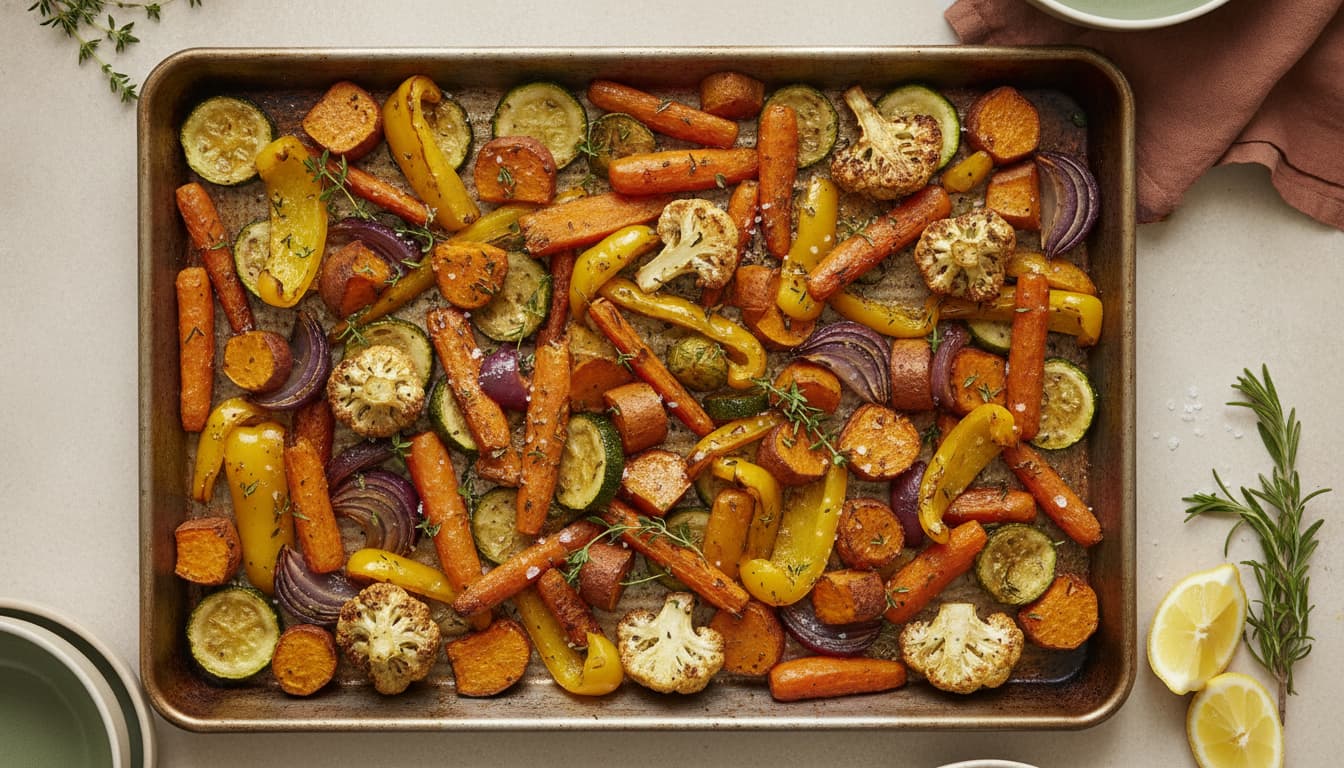
Roasted vegetables that come out browned and caramelised instead of pale and soggy: cut to match their cooking times, spread in a single uncrowded layer on a screaming-hot tray, and roasted hard until the edges catch. Naturally vegan, gluten-free, Whole30 and paleo friendly. The two mistakes that steam vegetables grey, and the order you add them to the tray.
Warum das funktioniert
Jedes Rezept auf dieser Seite kommt mit einer Erklärung der Technik-Entscheidungen: warum erst anbraten, dann schmoren, warum die Säure zum Schluss kommt, warum das Fett vor den Aromaten ausgelassen wird. Die Methode unten besteht aus genau diesen Entscheidungen, der Reihe nach.
A heavy rimmed sheet pan
Roasting is about contact with hot metal, and a thin, flimsy tray warps and holds heat poorly, so vegetables sit and steam in their own moisture instead of browning. A heavy, light-coloured rimmed sheet pan holds a strong, even heat and gives you the caramelised edges that make roasted vegetables worth eating. Preheating it before the vegetables go on matters even more than the pan itself. Any sturdy commercial half-sheet pan does the job for years.
Zutaten
4 Portionen- 12 ozbaby potatoes · halved
- 2carrots · cut into batons
- 1zucchini · cut in large chunks
- 1red bell pepper · cut in large chunks
- 1red onion · cut in wedges
- 3 tbspolive oil
- 1 tspdried thyme or rosemary
- 1/2lemon · juiced, to finish
- 2 tbspflat-leaf parsley · chopped, to finish
- kosher salt · to taste
- black pepper · to taste
Methode
Preheat the oven and the tray properly hot
Set the oven to 220C and slide the empty tray in to heat while it comes up. Roasting needs real heat: at a timid temperature vegetables release their water faster than it can evaporate and they steam grey instead of browning. A properly hot oven and, crucially, a preheated tray mean the vegetables start searing the instant they land. This one step does more for colour and flavour than any seasoning.
Cut vegetables to match their cooking times
Cut dense, slow vegetables like carrots, potatoes, and squash smaller, and quicker ones like courgette, peppers, and red onion larger, so everything finishes together. The classic mistake is cutting everything the same size and pulling out a tray where the potatoes are raw and the courgette is mush. Matching the cut to the density is how you roast a mix on one tray. Even pieces within each type also brown evenly rather than in patches.
Dry the vegetables before they meet the oil
Pat the cut vegetables dry with a clean towel, especially anything washed or watery. Surface water is the enemy of browning: it has to boil off before the vegetable can start to caramelise, and while it does, everything steams. A few seconds with a towel means the oil coats properly and the vegetables brown from the start. This is the quiet step almost everyone skips and then wonders why the tray came out pale.
Toss with just enough oil and season boldly
Toss the vegetables with enough olive oil to coat every piece with a light sheen, no more, plus salt, pepper, and any hardy herbs or spices. Too little oil and they dry out and scorch; too much and they fry greasy and sit in a slick. Salt now, not just at the end, so it works into the surface as they roast. Coat them evenly, because a bare patch stays pale while an oiled one browns.
Spread in a single layer with space between
Tip the vegetables onto the hot tray and spread them in a single layer with a little space around each piece, using two trays if you need to. This is the rule that matters most: crowded vegetables trap steam between them and stew, while spaced ones roast. If they are piled up or touching all over, they will never brown no matter how long you leave them. Give them room, even at the cost of a second tray.
Add quick-cooking vegetables partway through
If you are roasting a mix with very different timings, start the dense vegetables alone and add delicate ones like cherry tomatoes, asparagus, or courgette after ten or fifteen minutes. Staggering the tray this way means nothing is either raw or burnt to a crisp. It is the same idea as cutting to match times, taken one step further for vegetables that cook very fast. A little planning here is what gets a whole tray perfectly done at once.
Roast hard and turn only once
Roast for twenty-five to thirty-five minutes, turning the vegetables just once about two-thirds of the way through. Resist the urge to stir constantly: every time you toss them you interrupt the browning and let heat out of the oven. Leaving them alone lets a proper caramelised crust form on the underside. Turn once so both sides colour, then leave them again. They are done when the edges are deeply browned and a knife slides through the densest piece.
Finish with acid and something fresh
Straight out of the oven, hit the vegetables with a squeeze of lemon or a splash of good vinegar and a scatter of fresh herbs. Roasting concentrates sweetness, and a little acid at the end balances it so the tray tastes bright rather than flat and jammy. This finish is what lifts plain roasted vegetables into something you want to eat on its own. Serve them hot as a side, or fold cold leftovers through a grain bowl or salad the next day.
Variationen
Substitutionen und Anpassungen folgen mit der Foto-Produktion. Die Methode hält bei den meisten sinnvollen Austauschen.
Aufbewahrung
Kühlschrank: 3 bis 4 Tage, verschlossen. Gefrierfach: bis zu 3 Monate. Abgedeckt aufwärmen, um die Feuchtigkeit zu halten.
Häufige Fragen
- What temperature is best for roasting vegetables?
- Hot, around 200 to 220C. Roasting is about driving off surface moisture fast so the vegetables can brown and caramelise, and a lower oven just steams them soft and grey. A high temperature, a preheated tray, and a single uncrowded layer are the three things that get you deeply browned edges. If your oven runs hot or you are roasting delicate vegetables, 200C is safer; for dense roots and a good char, push to 220C.
- Why do my roasted vegetables come out soggy?
- Almost always because the tray was crowded or the vegetables were wet. Piled-up or touching vegetables trap steam between them and stew instead of roasting, and surface water has to boil off before browning can even start. Spread them in a single layer with space around each piece, use a second tray if you need to, and pat them dry before oiling. A preheated tray and a hot oven do the rest.
- How do I roast different vegetables on one tray?
- Match the cut to the cooking time, and stagger when they go in. Cut dense, slow vegetables like carrots and potatoes smaller and quick ones like courgette larger so they finish together, or start the slow ones first and add delicate ones like tomatoes and asparagus partway through. That way you avoid the classic tray where the roots are still hard and the soft vegetables have collapsed. A little planning lets a whole mixed tray finish at once.
- Can I roast vegetables ahead and reheat them?
- Yes, and they are excellent meal prep and batch cooking. Roast them fully, cool, and keep in the fridge for up to four days. To bring back the crisp edges, reheat them in a hot oven or a dry pan rather than the microwave, which turns them soft. Roasted vegetables are also brilliant cold or at room temperature folded through a grain bowl, tossed into a salad, or blended into a soup, so a big tray rarely goes to waste.
- Which vegetables are best for roasting?
- Almost all of them, but the reliable stars are dense ones that caramelise well: carrots, potatoes, sweet potato, squash, beetroot, cauliflower, broccoli, red onion, and peppers. Softer vegetables like courgette, tomatoes, and asparagus roast beautifully too but cook faster, so add them later. The trick is grouping by density rather than throwing everything on at once. Use whatever is in season and needs using; the method carries any mix.
- How do I add protein to roasted vegetables?
- Roasted vegetables are a side by nature, so build a meal around them. Roast a tray of chickpeas alongside for plant protein and crunch, or add white beans in the last ten minutes. To turn them into a full plate, fold the vegetables through cooked quinoa or lentils, top with a fried or poached egg, or serve them next to roast chicken or fish. A spoon of tahini or a dollop of Greek yogurt on top adds protein and richness at once.
Ähnliche Rezepte
Alle ansehen →- Diet-Specific
Magnesiumreiche Lebensmittel: Kürbiskerne schlagen Spinat
Eine Handvoll Kürbiskerne liefert rund 156 mg Magnesium, mehr als eine Tasse gekochter Spinat und etwa das Fünffache einer Banane. Etwa die Hälfte der Erwachsenen bleibt unter dem geschätzten Bedarf, und der größte einzelne Grund ist die Ausmahlung von Getreide, die dem Weizen rund achtzig Prozent seines Magnesiums nimmt.
- Diet-Specific
Kaliumreiche Lebensmittel: mehr als Bananen, mit echten Zahlen
Die Banane steht nicht einmal unter den ersten zwanzig. Welche Lebensmittel wirklich viel Kalium liefern, wie Kochen und Wässern den Gehalt senken, und warum Kalium ohne weniger Natrium nur die halbe Rechnung ist.
- Diet-Specific
Vegetarische Rezepte: Protein, Röstaromen und echte Abendessen
Vegetarisch kochen scheitert selten an Ideen und fast immer an zwei Dingen: zu wenig Protein und zu wenig Bräunung. Woher das Protein kommt, welche Nährstoffe wirklich Aufmerksamkeit brauchen und wie eine Woche Abendessen konkret aussieht.
Erhalten Sie jeden Sonntag ein getestetes Rezept und eine Nährwert-Notiz in Ihr Postfach.
Ein Rezept pro Woche, fotografiert am selben Dienstag, an dem es getestet wurde. Von einer Ernährungsberaterin geprüft. Keine Werbung, keine Pop-ups, kein Tracking.
Das Clean-Chef-Starter-Kit.
Ein 14-Tage-Plan für entzündungshemmende Ernährung als PDF, Einkaufsliste nach Abteilungen, Makros pro Tag aufsummiert, Sonntags-Vorbereitung. Kostenlos.
Mit der Anmeldung stimmen Sie unserer Datenschutzerklärung zu. Eine ruhige E-Mail pro Woche. Jederzeit abbestellbar.
Wir bauen einen Shop.
Kuratiertes Kochgeschirr, Vorratsbasics, die wir wirklich kaufen, Rezept-Bundle-PDFs. Erfahren Sie als Erste, wann er öffnet.
Wir schreiben Ihnen nur zur Shop-Eröffnung. In jeder E-Mail abbestellbar. Siehe unsere Datenschutzerklärung.