- Kalorien
- 540
- Eiweiß
- 42g
- Ballaststoffe
- 9g
- Ges. Fett
- 6g
- Natrium
- 610mg
- Zugesetzter Zucker
- 2g
Was dieses Rezept für Sie leistet.
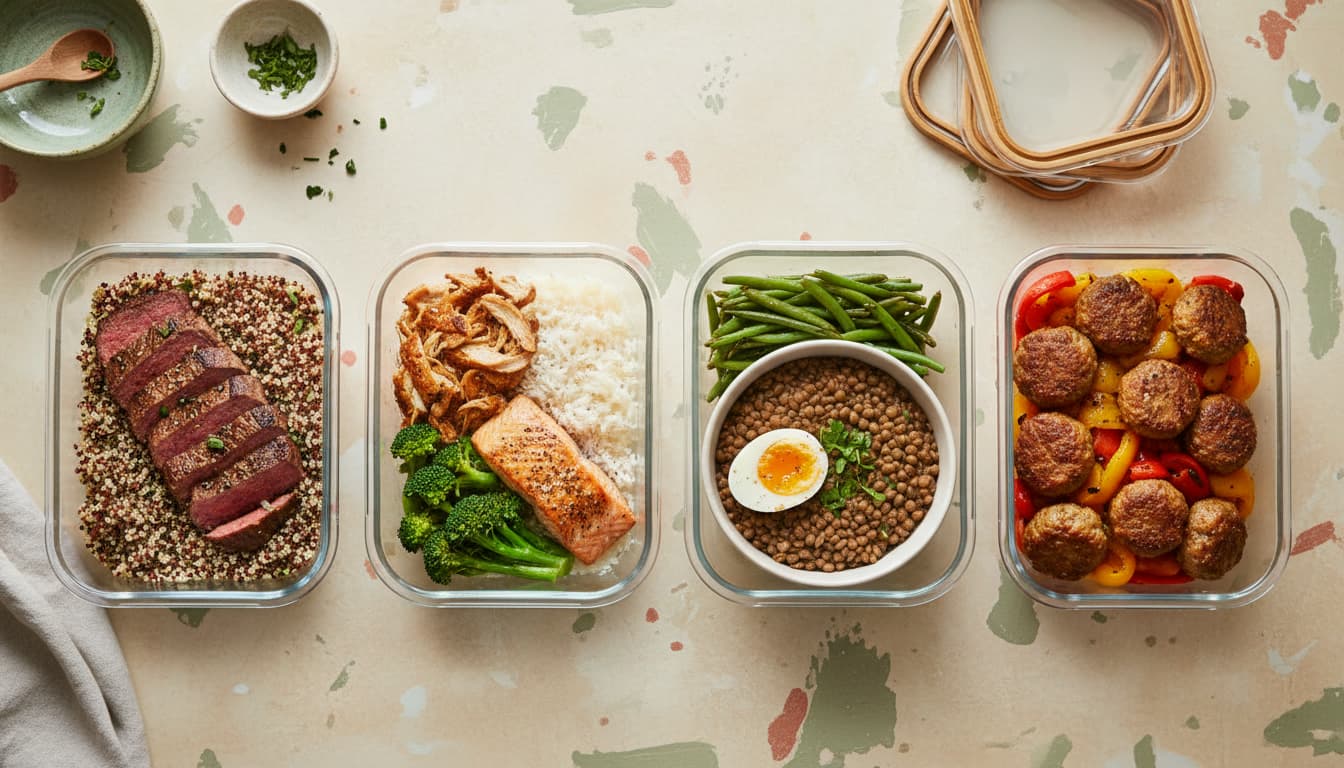
Forty grams of protein per container from real food, not a scoop stirred into oats. Which proteins survive a reheat and which turn to rubber, the two-tray plus one-pot sequence that gets five lunches done in ninety minutes, how to hit the number without eating chicken breast five days running, and the arithmetic so you can check the claim yourself.
Warum das funktioniert
Jedes Rezept auf dieser Seite kommt mit einer Erklärung der Technik-Entscheidungen: warum erst anbraten, dann schmoren, warum die Säure zum Schluss kommt, warum das Fett vor den Aromaten ausgelassen wird. Die Methode unten besteht aus genau diesen Entscheidungen, der Reihe nach.
Zutaten
- Vollständige Zutatenliste folgt mit der Foto-Produktion
Methode
Do the arithmetic before you cook, not after
Forty grams is roughly six ounces of cooked chicken thigh, or five ounces of salmon plus a half cup of Greek yogurt in the sauce, or a cup of lentils plus four ounces of chicken, or three eggs plus a cup of cottage cheese. Weigh the raw protein once and you will never need to again, because you will know what six ounces looks like. Guessing is how a 40g container turns out to hold 24g.
Pick proteins that survive reheating
Chicken thighs, pork shoulder, braised beef, salmon, meatballs, lentils, beans, and eggs baked into bites all reheat well. Chicken breast, shrimp, and white fish do not, they go from cooked to rubbery in about ninety seconds of microwave. If you want breast meat in the rotation, cook it to 160F and slice it cold into salads rather than reheating it. Fat and connective tissue are what buy you forgiveness on day three.
Two trays, one pot, one sauce, ninety minutes
Oven to 425F. Tray one is the protein, chicken thighs or meatballs or salmon added later. Tray two is vegetables, broccoli and peppers and red onion. The pot is grains or lentils. The sauce is whisked while both trays are in. Everything cools on a rack for fifteen minutes before it is boxed. That sequence, including the washing up, is ninety minutes for five containers, and most of it is waiting.
Stack two protein sources instead of doubling one
Forty grams from a single animal protein means a very large portion. Two sources gets you there more pleasantly: chicken plus a yogurt sauce, salmon plus edamame, beef plus lentils, eggs plus cottage cheese. The second source also adds fiber if you make it a pulse, which is the difference between a container that keeps you full until dinner and one that does not.
Build the container in the right order
Grains or pulses on the bottom, protein in the middle, vegetables on top, sauce in a separate jar, anything crunchy or fresh in a small bag. Bottom-up assembly keeps the vegetables from sitting in whatever liquid the protein releases. If the container will be eaten cold, the same order still applies, it just holds together better on the fork.
Prep two breakfasts too, or the day starts at a deficit
Most people miss the protein target before ten in the morning and then chase it at dinner. Six egg bites or a tray of baked oats with Greek yogurt folded in adds thirty grams to the front of the day and takes twenty minutes while the trays are already running. Cottage cheese and overnight oats need no cooking at all and hold four days in the fridge.
Cool properly, then hold to four days
Spread hot food on a sheet pan for fifteen minutes before it goes in a sealed box, then refrigerate. USDA guidance puts cooked leftovers at three to four days, and high-protein food is not an exception to that. Cook Sunday, eat Monday through Thursday, and freeze anything meant for Friday on the day you cook it rather than the day before you eat it.
Reheat protein gently, at half power
The microwave on full power drives water out of muscle fibre and that is what makes reheated chicken squeak. Half power for twice as long, with the lid ajar and a spoon of stock or water in the container, keeps it tender. Salmon and meatballs do better still in a covered pan over low heat for three minutes. This is the difference between eating the prep and quietly buying lunch.
Variationen
Substitutionen und Anpassungen folgen mit der Foto-Produktion. Die Methode hält bei den meisten sinnvollen Austauschen.
Aufbewahrung
Kühlschrank: 3 bis 4 Tage, verschlossen. Gefrierfach: bis zu 3 Monate. Abgedeckt aufwärmen, um die Feuchtigkeit zu halten.
Häufige Fragen
- How much protein should each meal prep container have?
- Aim for 30g to 40g per main meal if you are eating three meals a day and targeting roughly 1.2 to 1.6 grams of protein per kilogram of body weight, which is the range most of the resistance-training literature lands on. For a 70kg adult that is about 85g to 110g a day, so three 35g meals plus a snack covers it. Building the container to 40g gives you room for a light breakfast without falling short.
- Which proteins hold up best for four days in the fridge?
- Chicken thighs, braised or slow-cooked beef and pork, salmon, meatballs, hard-boiled eggs, baked egg bites, lentils, and beans. All of them have either enough fat or enough structure to survive cooling and reheating. Chicken breast, shrimp, and delicate white fish are the ones that turn rubbery, so cook those the day you eat them or plan to eat them cold and sliced into a salad.
- Can I hit 40g of protein without meat?
- Yes, but it takes stacking. A cup of cooked lentils gives about 18g, a cup of cottage cheese about 25g, a cup of Greek yogurt about 20g, three eggs about 18g, a cup of edamame about 17g, and 100g of firm tofu about 17g. Combine any two and you are at or near 40g. The catch is volume, plant sources bring more bulk per gram of protein, so the container is fuller and the fiber is higher, which most people find is a fair trade.
- How long does high-protein meal prep take on a Sunday?
- Ninety minutes for five lunches, honestly counted, including chopping, roasting, cooling, boxing, and the washing up. Add twenty minutes if you are also prepping breakfasts. That assumes shopping is already done and that you run the oven first so the trays cook while you work on everything else. Anyone quoting thirty minutes is timing the knife work and ignoring the oven.
Ähnliche Rezepte
Alle ansehen →- High-Protein
Boeuf Bourguignon: drei Stunden, ein Topf, richtig angebraten
Das Fleisch muss trocken sein, die Pfanne heiß und der Topf nicht überfüllt, sonst kocht das Rindfleisch, statt zu bräunen. Welches Stück, welcher Wein, warum Speck, Zwiebeln und Pilze getrennt gegart werden und warum es am zweiten Tag besser schmeckt.
240m42g Eiweiß - High-Protein
Tofu zubereiten: pressen, in Stärke wenden, spät marinieren
Tofu wird knusprig, wenn Wasser heraus und Stärke darauf kommt. Welche Festigkeit für welches Gericht, warum Einfrieren die Textur völlig verändert und warum die Marinade erst nach dem Braten dazukommt statt davor.
60m20g Eiweiß - High-Protein
Enchiladas: Tortillas in heißem Öl wenden, Sauce selbst kochen
Matschige Enchiladas entstehen, weil rohe Tortillas direkt in die Sauce kommen. Zwanzig Sekunden in heißem Öl versiegeln sie, die Chilisauce wird aus getrockneten Chilis gekocht statt aus der Dose, und der Auflauf steht nur zwanzig Minuten im Ofen.
95m34g Eiweiß
Erhalten Sie jeden Sonntag ein getestetes Rezept und eine Nährwert-Notiz in Ihr Postfach.
Ein Rezept pro Woche, fotografiert am selben Dienstag, an dem es getestet wurde. Von einer Ernährungsberaterin geprüft. Keine Werbung, keine Pop-ups, kein Tracking.
Das Clean-Chef-Starter-Kit.
Ein 14-Tage-Plan für entzündungshemmende Ernährung als PDF, Einkaufsliste nach Abteilungen, Makros pro Tag aufsummiert, Sonntags-Vorbereitung. Kostenlos.
Mit der Anmeldung stimmen Sie unserer Datenschutzerklärung zu. Eine ruhige E-Mail pro Woche. Jederzeit abbestellbar.
Wir bauen einen Shop.
Kuratiertes Kochgeschirr, Vorratsbasics, die wir wirklich kaufen, Rezept-Bundle-PDFs. Erfahren Sie als Erste, wann er öffnet.
Wir schreiben Ihnen nur zur Shop-Eröffnung. In jeder E-Mail abbestellbar. Siehe unsere Datenschutzerklärung.