Air fryer recipes
Von Die ThatCleanChef-Küche · Aktualisiert 31. August 2026 · 11 Min. Lesezeit
It is a small convection oven with an aggressive fan, which tells you almost everything about what it does well and what it does badly. Crisp surfaces on small pieces of food, yes. Anything wet, battered, or bigger than the basket, no. The temperature translation from a normal oven, the half-empty basket rule, and the dishes worth cooking in it.
Lieber beantworten wir die Frage, die Sie tatsächlich gestellt haben, schon im ersten Absatz, und gewinnen Ihr Vertrauen, indem wir die Küchennotizen zeigen.
Worauf es wirklich ankommt, der Reihe nach.
- 01
It is a convection oven the size of a bread bin, and that is the whole explanation
There is no frying happening. A heating element sits above a fan, the fan moves hot air fast past food that is suspended on a perforated basket, and moisture leaves the surface quickly enough that the surface browns before the interior overcooks. Every quirk of the machine follows from that. It is fast because the chamber is tiny and the air moves hard. It is limited because the chamber is tiny. Once you stop thinking of it as a fryer, you stop being disappointed by it.
- 02
The basket has to be half empty, and this is the rule people break
Air has to reach every surface. Pile the basket and the food in the middle steams in the moisture coming off the food around it, which is why the first batch is crisp and the doubled batch is grey and limp. A single layer with visible gaps between pieces is the standard. For a five-quart basket that is roughly a pound of chicken pieces or twelve ounces of chips, and two batches of eight minutes beats one batch of sixteen every time.
- 03
Translating an oven recipe: drop 25F, cut a quarter off the time
A conventional oven recipe at 425F becomes roughly 400F in the air fryer, and 20 minutes becomes roughly 15. Then check early, because basket size and wattage vary enough between machines that the first time you cook anything is a test. Write the real number on the recipe afterwards. Two or three passes and you have a personal conversion table for the six things you actually cook, which is worth more than any manufacturer chart.
- 04
Where it genuinely beats the oven
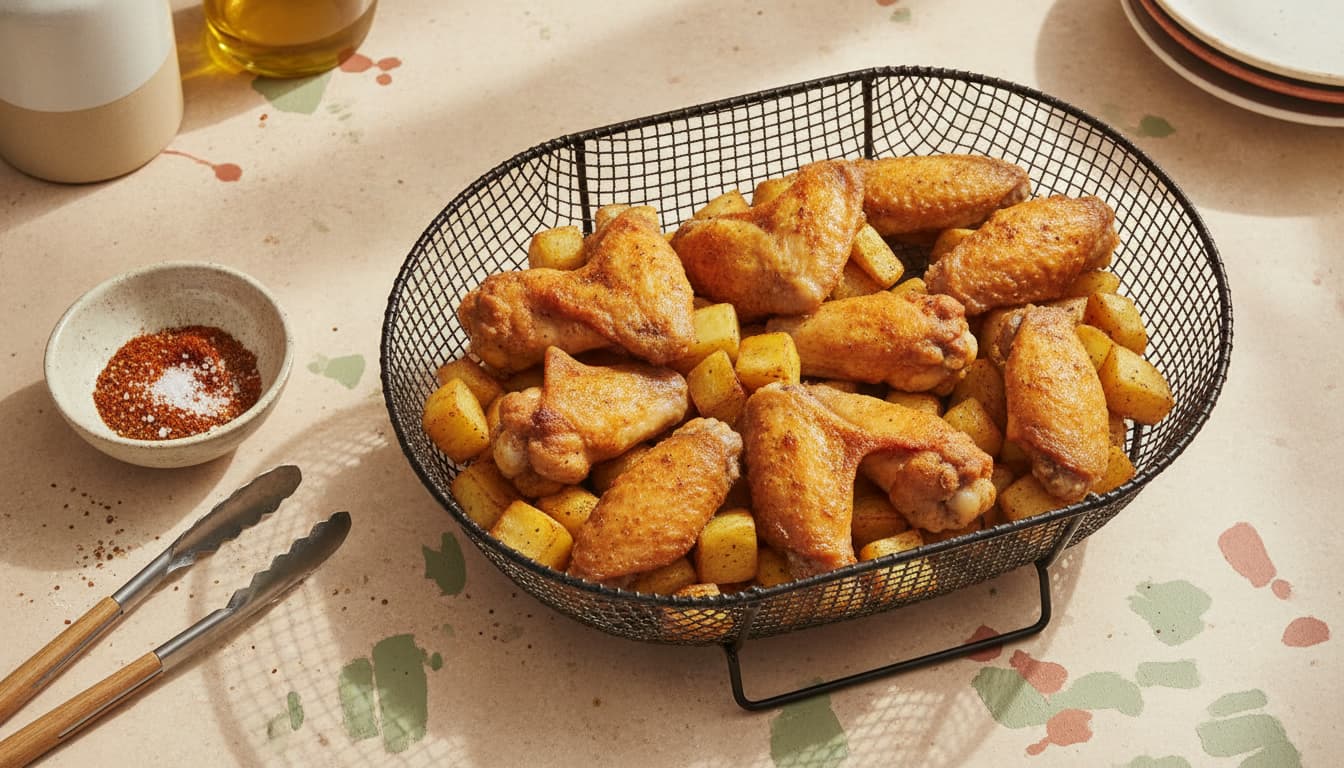
Small pieces of protein with a dry surface: chicken thighs, wings, meatballs, salmon fillets, halloumi, tofu that has been pressed. Vegetables cut to bite size: broccoli florets, brussels sprouts halved, cauliflower, carrots, potato cubes. Anything you want reheated rather than microwaved, above all pizza, roast potatoes and fried chicken, where it restores the crust that a microwave destroys. And frozen food, which is engineered for exactly this kind of dry, fast heat.
- 05
Where it is worse, and you should stop trying
Wet batter blows off in the fan and welds itself to the element. Cheese-topped anything slides through the basket. Leafy greens become confetti. A whole chicken over four pounds does not fit in most baskets and cooks unevenly in the ones it does. Rice, pasta, soups and braises are the wrong physics entirely. And large roasts and sheet-pan dinners for four are simply faster in the oven, because you will be running three batches.
- 06
Fat: a teaspoon, not a tablespoon, and it goes on the food
Oil is for conducting heat into the surface and carrying seasoning, not for frying. A teaspoon tossed through a pound of vegetables is enough, and it should be on the food rather than in the basket, where it smokes. Use a high-smoke-point fat, avocado or refined olive, because the surface temperature in the basket exceeds what extra-virgin olive oil is comfortable with. Skip aerosol sprays, which contain lecithin emulsifiers that build a sticky varnish on the non-stick coating.
- 07
Five starting points that work in every machine
Chicken thighs, boneless and skin on, 400F for 18 minutes turned once, which comes out at 175F and juicier than the oven version. Salmon fillets, 390F for 9 minutes for a 1-inch fillet. Brussels sprouts halved and oiled, 380F for 14 minutes, shaken twice. Potato cubes soaked 20 minutes, dried hard, 400F for 20 minutes. And crispy chickpeas, drained, dried on a towel for 10 minutes and cooked at 390F for 14, which is the best high-protein snack the machine makes.
- 08
It is genuinely useful for meal prep, and this is the one it is best at
The machine is at its most valuable on Wednesday, not Sunday. Batch-cook the protein and the grains for the week's meal prep conventionally, then use the air fryer to bring one portion of it back to life at 370F for 4 minutes rather than microwaving it into a uniform soft mass. Roasted vegetables in particular reheat almost perfectly this way. That single habit is why the machine stays on the counter after the novelty passes.
- 09
Cleaning, and the part everyone skips
The basket is easy and the element above it is not, and that is where the smoke comes from three months in. Once a month, unplug it, tip it on its back and wipe the heating element and the fan guard with a damp cloth and a little bicarbonate paste. Never put a cold basket into a hot machine or the non-stick coating crazes. And if the coating has started flaking, replace the basket rather than cooking on it.
Die Fragen, die Köche uns stellen.
- Do I need to preheat an air fryer?
- For anything you want a crust on, yes, three minutes at the cooking temperature. Putting food into a cold chamber means the first several minutes are spent heating metal and driving moisture off, which is exactly the condition that produces a pale, leathery surface. For things you are simply cooking through, such as a tray of vegetables or reheating a portion of stew in a dish, preheating changes very little and you can skip it.
- Can I put foil or parchment in an air fryer?
- Parchment yes, foil with caution, and neither of them empty. A perforated parchment liner under wet or sticky food is fine and saves you scrubbing. Never put either in while the machine preheats with nothing on top, because the fan will lift it into the element, and that is a real fire. And do not line the whole base, because you have just blocked the airflow that the machine works by, which turns it into a slow, bad toaster oven.
- Is air-fried food healthier than deep-fried?
- It uses far less fat, which is a real difference in calories rather than a health claim, and it produces less of the oxidised fat that repeated deep-frying generates. It does not make food nutritionally different in any other way. High-heat dry cooking of starchy foods still produces acrylamide, and the mitigation is the same as for oven roasting: cook potatoes to golden rather than deep brown, and soak cut potatoes before cooking. It is a cooking method, not an intervention.
- Why is my air fryer food not crispy?
- Four causes, in order of frequency. The basket is too full, so the food is steaming. The food went in wet, so the first six minutes are spent evaporating surface water. There was no fat at all, so nothing conducted heat into the surface. Or the temperature is too low, and 350F is a common default that browns nothing. Dry the food on a towel, oil it lightly, cook in a single layer at 390F or above, and three of the four disappear.
- What size air fryer should I buy?
- Cook for one or two and a four to five quart basket is right and will fit on a counter. Cook for a family of four and you want six quarts or a dual-basket model, otherwise you are running three batches and the oven would have been quicker. Basket shape matters more than the number on the box: a wide, shallow basket has more usable single-layer area than a tall one of the same nominal volume, and single-layer area is the only capacity that counts.
- Can I cook frozen chicken in an air fryer?
- Frozen breaded products, yes, they are designed for it. Raw frozen chicken, technically yes but poorly: the outside overcooks long before the middle reaches the 165F that the USDA sets for poultry, and you cannot season a frozen surface. Thaw it. If you are truly stuck, cook at a lower temperature, around 350F, for roughly half again the usual time and check the thickest part with a thermometer rather than trusting a chart.
Woher die Technik stammt
Über die ThatCleanChef-Küche
Ein kleines Team aus Rezeptentwicklerinnen und Foodfotografen, das Rezepte in Privatküchen mit haushaltsüblichem Equipment testet. Jede Nährwertkarte ist USDA-FoodData-Central-belegt und wird geprüft von Lena Marsh, RDN, MS. Wir geben nicht vor, ein einzelner Küchenchef zu sein, wir sind die Menschen hinter den Tellern. Das ganze Team kennenlernen →
Ähnliche Beiträge
Steak braten: früh salzen, trocken tupfen, Kerntemperatur messen
Ein Steak hat vier Variablen, und die Pfanne gehört nicht dazu. Die Dicke bestimmt die Methode, die Oberflächenfeuchte entscheidet über Kruste oder Dampf, die Kerntemperatur über den Garpunkt. Mindestens 45 Minuten vorher salzen, alle 30 Sekunden wenden und nach Thermometer garen statt nach Uhr.
Rührei: niedrige Hitze, ständig rühren, früh vom Herd nehmen
Rührei ist eine Temperaturübung mit acht Minuten Spielraum, den kaum jemand nutzt. Eiweiß gerinnt zwischen 63 und 74 Grad, darüber presst es Wasser heraus und wird gummiartig. Kalte Pfanne, kalte Butter, Salz ins rohe Ei, ununterbrochen rühren und die Pfanne vom Herd nehmen, solange die Masse noch feucht aussieht.
Kartoffelpüree: kalt aufsetzen, Milch erwärmen, niemals mixen
Klebriges Püree ist kein Würzproblem, sondern ein mechanisches. Stärkekörner platzen, sobald man sie schlägt, und danach ist die Textur nicht mehr zu retten. Kartoffeln in kaltem Salzwasser aufsetzen, im Topf trocken dämpfen, durch die Presse drücken und die Butter vor der warmen Milch zugeben.
Das Clean-Chef-Starter-Kit.
Ein 14-Tage-Plan für entzündungshemmende Ernährung als PDF, Einkaufsliste nach Abteilungen, Makros pro Tag aufsummiert, Sonntags-Vorbereitung. Kostenlos.
Mit der Anmeldung stimmen Sie unserer Datenschutzerklärung zu. Eine ruhige E-Mail pro Woche. Jederzeit abbestellbar.