- Kalorien
- 110
- Eiweiß
- 7g
- Ballaststoffe
- 0g
- Ges. Fett
- 2g
- Natrium
- 185mg
- Zugesetzter Zucker
- 0g
Was dieses Rezept für Sie leistet.
Grainy filling is the thing that separates a homemade deviled egg from a good one, and a fine-mesh sieve fixes it in ninety seconds. Past that it is a ratio problem: enough acid to keep the yolk from tasting like a paste, enough salt to carry it, and a filling loose enough to pipe but stiff enough to hold an edge. Twelve eggs, twenty-four halves, and seventy-five minutes including the chill.
Warum das funktioniert
Jedes Rezept auf dieser Seite kommt mit einer Erklärung der Technik-Entscheidungen: warum erst anbraten, dann schmoren, warum die Säure zum Schluss kommt, warum das Fett vor den Aromaten ausgelassen wird. Die Methode unten besteht aus genau diesen Entscheidungen, der Reihe nach.
Zutaten
12 Portionen- 12 wholelarge eggs · 7 to 10 days old, which peel far more cleanly than fresh ones
- 1/3 cupmayonnaise · full fat, a good one, this is most of the flavour
- 2 tbspplain Greek yogurt · full fat, it lightens the filling and adds a little tang
- 2 tspDijon mustard · smooth, not grainy, for the emulsion
- 1/2 tspyellow mustard · for the colour and the vinegar edge, optional but traditional
- 2 tspdistilled white vinegar · or the brine from a jar of cornichons
- 1/2 tspkosher salt · plus more to taste, yolks take more salt than you expect
- 1/4 tspblack pepper · finely ground so it does not read as grit
- 1 pinchcayenne pepper · about 1/8 tsp, this is the devil in deviled
- 1 tbspcornichon or dill pickle · minced very fine, optional
- 2 tspsmoked paprika · for dusting at the very end, not stirred in
- 2 tbspchives · sliced thin, for the finish
Methode
Buy the eggs a week early, because peeling decides how this looks
A torn white is a deviled egg you cannot serve, and the cause is nearly always egg age rather than technique. Egg white pH rises over the first week as carbon dioxide escapes through the shell, and the bond to the inner membrane weakens with it. Ten-day-old supermarket eggs peel in two pieces. Farm eggs bought the day they were laid will shred no matter what you do. Buy the carton at the start of the week and boil it at the end.
Boil eleven minutes from a boiling-water start, then ice for fifteen
Lower cold eggs into water that is already at a rolling boil, drop the heat to a bare simmer, and run eleven minutes on a timer for a fully set yolk that still crumbles rather than chalks. Then straight into a bath with as much ice as water for fifteen minutes. The shock stops carryover cooking, which is what prevents the grey ring, and it contracts the contents away from the shell so the peel lifts cleanly. Both halves of that matter here.
Peel under running water, and boil two spare eggs
Crack at the fat end where the air cell sits, roll the egg under your palm until the shell is crazed all over, then peel under a thin run of cold water so the membrane releases and the fragments wash away. Even with everything right, one egg in a dozen tears. Boil fourteen and plan to serve twenty-four halves from twelve good ones. The spares also give you two extra yolks, which makes the filling generous enough to mound properly.
Wipe the knife between every cut
Halve the eggs lengthwise with a thin sharp knife and run it under hot water and wipe it dry every two or three eggs. Yolk builds up on the blade and drags across the cut face of the white, leaving a yellow smear that no amount of piping hides. Pop the yolks out into a bowl with your thumb rather than a spoon, which is less likely to tear the rim, and lay the whites cut side up on the tray you will serve them on.
Push the yolks through a fine-mesh sieve, and this is the whole recipe
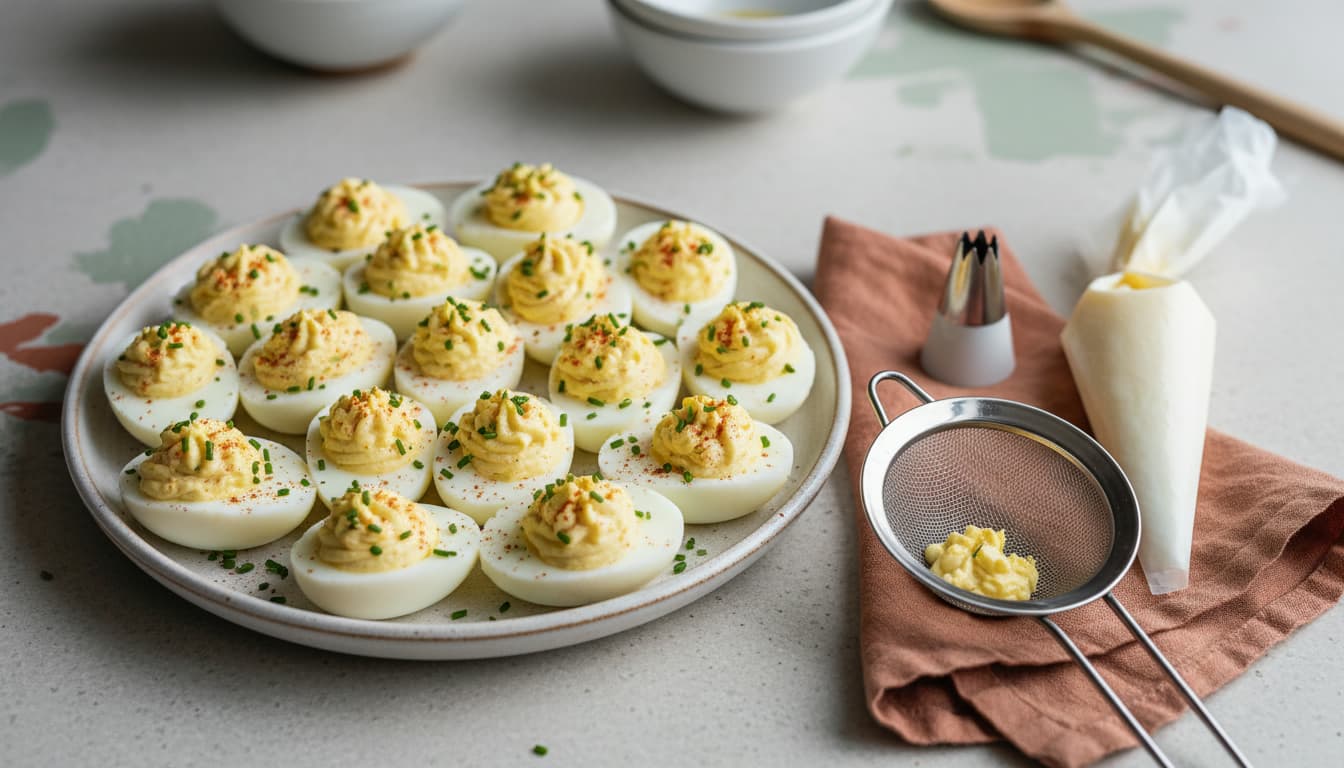
Set a fine-mesh sieve over the mixing bowl and press the yolks through with the back of a rubber spatula. It takes ninety seconds and it is the difference between a filling that is silky and one that is sandy. Mashing with a fork leaves lumps that never fully break down no matter how long you stir, and a food processor gives you a gummy paste because it works the yolk fat. The sieve is the only method that produces a genuinely smooth result.
Fat, acid, salt, in that order, and taste between each
Mayonnaise and yogurt into the sieved yolks first and stir until uniform, then both mustards, then the vinegar, then the salt, pepper and cayenne. Taste after the acid and again after the salt. Yolks are bland and fatty and swallow far more of both than seems reasonable, and the single most common fault in a homemade deviled egg is an under-seasoned filling that tastes like rich nothing. If it tastes flat, it wants salt. If it tastes heavy, it wants vinegar.
Greek yogurt for a third of the mayonnaise, and why not all of it
Swapping two tablespoons of the mayonnaise for full-fat Greek yogurt lightens the filling, adds a clean lactic tang and takes about 30 calories and 3g of fat off the plate across the batch. Going all the way to yogurt does not work: mayonnaise is an emulsion of oil and egg that carries flavour and holds a piped shape, and a yogurt-only filling weeps liquid within an hour on the tray. A third is the point where you get the lift without the leak.
The texture target, and how to correct it in either direction
You want a filling that holds a soft peak on a spoon, roughly the consistency of thick frosting. Too stiff and it tears the whites as you pipe and reads dry in the mouth. Too loose and it slumps flat within twenty minutes on the tray. Loosen with a teaspoon of yogurt or a teaspoon of the pickle brine, never with water. Tighten by putting the bowl in the fridge for fifteen minutes rather than by adding more yolk, which throws the seasoning out.
Pipe them, and a zip bag with a corner cut off is fine
A piping bag with a large star tip gives the ridged classic look and takes about four minutes for twenty-four halves. A zip-top bag with half an inch cut off one corner gives a smooth mound and takes three. Both beat two spoons, which leaves a dented lump and yolk smeared on the rim of the white. Fill the bag, twist the top closed, and work from the outside of each half inward so the filling anchors against the rim.
Chill thirty minutes, dust at the last moment
Refrigerate the filled eggs uncovered for at least thirty minutes so the filling firms and the seasoning settles, which measurably changes how they taste. The smoked paprika, the chives and any flaky salt go on immediately before serving, never before the chill. Paprika dusted early absorbs moisture from the filling and goes from a bright dusting to damp orange streaks, and chives wilt and darken. This is a two-minute step that decides whether the tray looks made or made-earlier.
Four variations that are worth the trouble
Smoked trout and dill: fold in 2oz of flaked hot-smoked trout and a tablespoon of dill, and skip the cayenne. Everything bagel: dust with the seasoning mix rather than paprika and add a teaspoon of the pickle brine. Curried: half a teaspoon of good curry powder bloomed in a teaspoon of warm oil first, plus a little mango chutney. Bacon and chive: two rashers cooked crisp and crumbled on at the last second, never stirred in, where they go soft.
Make-ahead, transport, and the food-safety limit
Boil, peel and halve the eggs and make the filling up to two days ahead, keeping the whites and the filling separately covered in the fridge. Assemble within three hours of serving. Filled eggs hold two days refrigerated but the whites weep and the filling crusts after about twelve hours. On a table, cooked eggs should not sit above 40F for more than two hours, or one hour if the room is above 90F, so set the tray over a shallow bed of ice at any outdoor event.
Scaling to four dozen, and the assembly line that makes it possible
Past about two dozen halves this stops being a recipe and becomes a production line, and treating it that way cuts the time by half. Boil in two pots rather than one crowded one, so nothing sits stacked. Peel everything before you cut anything. Cut all the whites in one pass, wiping the knife every third egg, and lay them straight onto the serving trays rather than a holding plate. Sieve all the yolks together in one bowl and season the whole batch at once, because seasoning four small batches to taste never lands in the same place twice.
Trim the base, and the two-minute fix for a sliding tray
Take a paper-thin slice off the rounded underside of each white so it sits flat. It costs nothing, it uses the same knife you already have out, and it removes the single most annoying failure mode of a deviled egg tray, which is twenty-four halves sliding into each other the moment somebody picks one up. For transport, line a rimmed sheet with a damp paper towel, which grips the whites, and invert a second sheet over the top rather than stretching film across the filling.
Variationen
Substitutionen und Anpassungen folgen mit der Foto-Produktion. Die Methode hält bei den meisten sinnvollen Austauschen.
Aufbewahrung
Kühlschrank: 3 bis 4 Tage, verschlossen. Gefrierfach: bis zu 3 Monate. Abgedeckt aufwärmen, um die Feuchtigkeit zu halten.
Warum wir dieses deviled eggs: push the yolks through a sieve 3-mal getestet haben.
Jedes wichtige Rezept auf dieser Seite durchläuft vor der Veröffentlichung mindestens drei Testrunden. Wir protokollieren, was sich zwischen den Tests geändert hat, damit Sie die Entwicklung des Rezepts sehen und wir die Fehlschläge nicht stillschweigend weglassen können.
- 01
Test 1
- Was wir versucht haben
- Mashed the yolks with a fork, thoroughly, for a full two minutes before adding anything.
- Was passiert ist
- Visible lumps survived into the finished filling and the texture read sandy on the tongue even after piping.
- Was wir geändert haben
- Yolks now go through a fine-mesh sieve. Ninety seconds, and the filling turns genuinely silky.
- 02
Test 2
- Was wir versucht haben
- Replaced all the mayonnaise with full-fat Greek yogurt to cut the fat.
- Was passiert ist
- The filling tasted clean but thin, and by forty minutes on the tray it had wept a ring of liquid around each mound.
- Was wir geändert haben
- Two thirds mayonnaise, one third yogurt. Lighter than all-mayo, and stable for a couple of hours.
- 03
Test 3
- Was wir versucht haben
- Dusted the paprika on straight after piping, three hours before the eggs were served.
- Was passiert ist
- The paprika drew moisture out of the filling and turned into damp orange streaks. The eggs looked hours old, which they were.
- Was wir geändert haben
- Paprika and chives go on within two minutes of the tray leaving the fridge.
Häufige Fragen
- Why is my deviled egg filling grainy?
- Because the yolks were mashed rather than sieved. Cooked yolk is made of protein-bound fat globules that a fork flattens but does not break apart, so the lumps persist through any amount of stirring and show up as grit on the tongue. Press the yolks through a fine-mesh sieve with a rubber spatula before you add anything else. It takes ninety seconds. A food processor is not a substitute, because it overworks the fat and gives you a gummy paste.
- How far in advance can I make deviled eggs?
- Prep two days ahead, assemble the same day. Boil, peel and halve the eggs and mix the filling up to forty-eight hours in advance, stored separately and covered in the fridge. Pipe within about three hours of serving and dust with paprika right before the tray goes out. Fully assembled eggs are technically safe for two days, but the whites weep, the filling develops a skin and the paprika goes streaky after roughly twelve hours.
- Can I make deviled eggs without mayonnaise?
- Partly. Swapping a third of the mayonnaise for full-fat Greek yogurt works well and lightens the filling. Going to all yogurt does not, because mayonnaise is a stable oil-in-egg emulsion that both carries flavour and holds a piped shape, and yogurt-only filling weeps within the hour. If you avoid mayonnaise entirely, mashed avocado with lime is a genuinely good alternative filling, though it browns and needs to be assembled within thirty minutes of serving.
- How many deviled eggs per person should I make?
- Two halves per person as part of a spread with other food, three to four halves each if they are one of only a couple of things on the table. This recipe makes twenty-four halves from a dozen eggs, which covers twelve people comfortably at a party and six people who like them. They disappear faster than almost anything else on a buffet, so if you are choosing between under and over, make the extra dozen.
- How do I keep deviled eggs from sliding on the plate?
- Cut a very thin slice off the rounded bottom of each white so it sits flat, which costs nothing and solves it completely. A deviled egg tray with moulded wells is the other answer if you make them often. For transport, a rimmed baking sheet lined with a damp paper towel stops the whites sliding, and a second inverted sheet taped over the top keeps them from touching each other in the car.
- Are deviled eggs keto and gluten-free?
- Yes to both as written. A serving of two halves is around 110 calories with 7g of protein and under 1g of carbohydrate, which makes them one of the more useful things on a keto or low-carb table. The only gluten risk is a mustard or a seasoning blend with a wheat-derived thickener, which is rare but worth a label check. Skip the sugar that some published recipes add to the filling and it stays under a gram of carbohydrate.
- What is the best vinegar for deviled eggs?
- Plain distilled white vinegar, because it is sharp and neutral and lets the mustard and yolk read clearly. Cider vinegar works and is slightly sweeter. The best option if you have a jar in the fridge is the brine from cornichons or dill pickles, which brings acid, salt and a little dill at once. Avoid balsamic and red wine vinegar, both of which discolour the filling and bring a fruitiness that fights the egg.
- Why did my egg yolks turn green?
- Iron in the yolk reacted with sulphur compounds in the white, which happens when eggs cook too long or cool too slowly. It is harmless and it tastes faintly chalky, but the grey-green rim also shows through a pale filling. The fix is on the stove rather than in the bowl: eleven minutes at a bare simmer rather than a rolling boil, and straight into a heavy ice bath for fifteen minutes the moment the timer goes.
Ähnliche Rezepte
Alle ansehen →- High-Protein
Boeuf Bourguignon: drei Stunden, ein Topf, richtig angebraten
Das Fleisch muss trocken sein, die Pfanne heiß und der Topf nicht überfüllt, sonst kocht das Rindfleisch, statt zu bräunen. Welches Stück, welcher Wein, warum Speck, Zwiebeln und Pilze getrennt gegart werden und warum es am zweiten Tag besser schmeckt.
240m42g Eiweiß - High-Protein
Tofu zubereiten: pressen, in Stärke wenden, spät marinieren
Tofu wird knusprig, wenn Wasser heraus und Stärke darauf kommt. Welche Festigkeit für welches Gericht, warum Einfrieren die Textur völlig verändert und warum die Marinade erst nach dem Braten dazukommt statt davor.
60m20g Eiweiß - High-Protein
Enchiladas: Tortillas in heißem Öl wenden, Sauce selbst kochen
Matschige Enchiladas entstehen, weil rohe Tortillas direkt in die Sauce kommen. Zwanzig Sekunden in heißem Öl versiegeln sie, die Chilisauce wird aus getrockneten Chilis gekocht statt aus der Dose, und der Auflauf steht nur zwanzig Minuten im Ofen.
95m34g Eiweiß
Erhalten Sie jeden Sonntag ein getestetes Rezept und eine Nährwert-Notiz in Ihr Postfach.
Ein Rezept pro Woche, fotografiert am selben Dienstag, an dem es getestet wurde. Von einer Ernährungsberaterin geprüft. Keine Werbung, keine Pop-ups, kein Tracking.
Das Clean-Chef-Starter-Kit.
Ein 14-Tage-Plan für entzündungshemmende Ernährung als PDF, Einkaufsliste nach Abteilungen, Makros pro Tag aufsummiert, Sonntags-Vorbereitung. Kostenlos.
Mit der Anmeldung stimmen Sie unserer Datenschutzerklärung zu. Eine ruhige E-Mail pro Woche. Jederzeit abbestellbar.
Wir bauen einen Shop.
Kuratiertes Kochgeschirr, Vorratsbasics, die wir wirklich kaufen, Rezept-Bundle-PDFs. Erfahren Sie als Erste, wann er öffnet.
Wir schreiben Ihnen nur zur Shop-Eröffnung. In jeder E-Mail abbestellbar. Siehe unsere Datenschutzerklärung.