- Kalorien
- 265
- Eiweiß
- 34g
- Ballaststoffe
- 3g
- Ges. Fett
- 1g
- Natrium
- 560mg
- Zugesetzter Zucker
- 0g
Was dieses Rezept für Sie leistet.
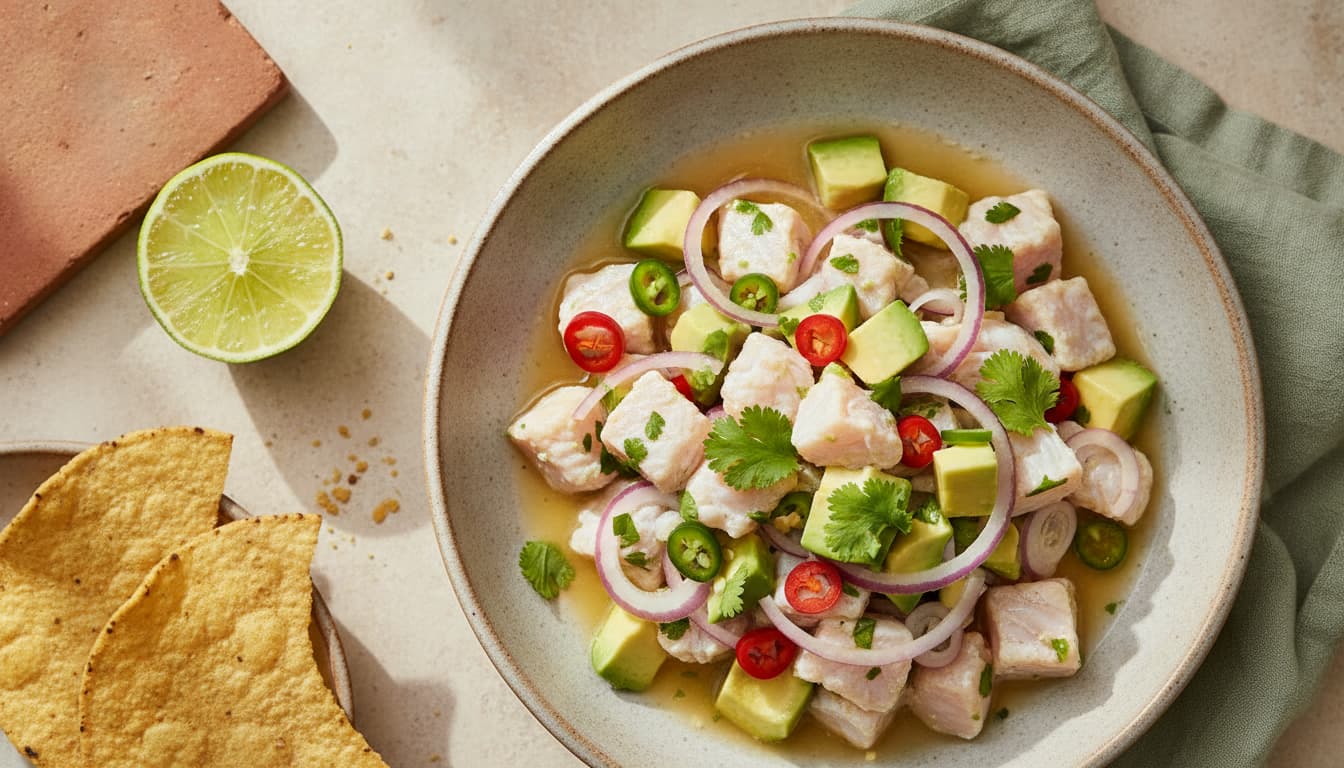
The lime is doing the cooking and it finishes far earlier than most recipes admit. Fifteen to twenty minutes and the fish is opaque at the edge and faintly translucent in the middle, which is exactly where you want it. Buy the fish the morning you serve it, keep everything at fridge temperature, and salt the leche de tigre until it tastes like something you would drink.
Warum das funktioniert
Jedes Rezept auf dieser Seite kommt mit einer Erklärung der Technik-Entscheidungen: warum erst anbraten, dann schmoren, warum die Säure zum Schluss kommt, warum das Fett vor den Aromaten ausgelassen wird. Die Methode unten besteht aus genau diesen Entscheidungen, der Reihe nach.
Zutaten
4 Portionen- 1 1/2 lbsea bass fillet · or corvina, halibut or fluke, skinned and pin-boned, bought the same day
- 3/4 cupfresh lime juice · about 8 limes, squeezed within the hour, never bottled
- 1 1/2 tspkosher salt · plus more to taste at the end
- 1 smallred onion · sliced paper thin, rinsed in cold water for 10 minutes
- 1 wholeaji amarillo chile · or a serrano, seeded and finely minced
- 1 clovegarlic · grated on a microplane, a small clove
- 1 inchfresh ginger · grated, optional but it lifts the lime
- 2 tbspcelery · very finely chopped, it goes into the leche de tigre
- 1/2 cupcilantro leaves · roughly torn, stems reserved for the leche de tigre
- 1 smallsweet potato · boiled whole, cooled and cut into rounds, served alongside
- 1/2 cupcancha or toasted corn · for crunch, or leave it out
- 1/4 tspblack pepper · freshly ground
Methode
The fish is the recipe, so buy it the day you serve it
You want a firm, lean, white-fleshed fish that will hold its shape in acid: sea bass, corvina, halibut, fluke, snapper or grouper. It has to smell of the sea and nothing else, and the flesh should spring back when pressed. Tell the counter it is for ceviche and ask what came in that morning. Salmon and tuna work but behave differently, going soft rather than firm, and oily fish such as mackerel turn unpleasantly metallic in lime.
Freezing is a safety step, not a compromise
Acid firms protein but it does not reliably kill parasites, so the FDA recommendation for fish eaten raw or lightly cured is that it has been frozen to minus 4F for seven days or blast frozen to minus 31F. Most fish sold as sushi grade has been through that, and a good counter will tell you. Previously frozen fish is often the safer choice here rather than the lesser one, and once thawed slowly in the fridge it behaves identically in the bowl.
Everything stays cold, including the bowl
Put your mixing bowl in the freezer for ten minutes before you start. Keep the fish in the fridge until the moment you cut it, work quickly, and return the cubes to the fridge while you build the leche de tigre. Warm fish in acid goes mushy at the edges while the middle is still raw, which is the texture problem most home ceviche has. This is twenty minutes of prep, and the fish should never be out of refrigeration for more than about ten of them.
Half-inch cubes, cut against the grain
Trim any dark bloodline, then cut the fillet into cubes of about half an inch, slicing across the muscle fibers rather than along them. Uniformity matters more than size here, because the cure works from the outside in and mixed cube sizes give you some pieces chalky and some raw in the same bowl. A very sharp knife and a single clean stroke per cut, because sawing tears the flesh and it will fall apart in the lime.
Build the leche de tigre first and taste it before the fish goes near it
Blitz or whisk the lime juice with the grated garlic, ginger, chopped celery, the cilantro stems, the chile and the salt, then strain it. It should taste sharp, salty and slightly hot, and it should be genuinely good to drink on its own. If it is only sour, it needs salt. This is the seasoning of the entire dish and there is no chance to correct it later, because once the fish is in, the clock is running.
Rinse the onion or it bullies everything else
Slice the red onion as thinly as you can manage, ideally on a mandoline, then leave it in a bowl of cold water for ten minutes and drain it hard. That pulls out the harsh sulphur compounds and leaves the sweetness and the color. Unrinsed raw red onion is the flavour that dominates most bad ceviche and stays on your breath for the rest of the day. Do this while the fish is still in the fridge and it costs no extra time.
Fifteen to twenty minutes, and set an actual timer
Combine the fish and the leche de tigre in the cold bowl, stir once, and put it back in the fridge. At fifteen minutes the cubes are opaque outside and just translucent at the center, which is the texture you want. At forty minutes they are firm all the way through and starting to go chalky. At two hours they are cotton wool. The old instruction to marinate for several hours comes from a time when nobody trusted the fish, and it is why so much ceviche is dry.
Add the onion, chile and cilantro at the finish, not at the start
The rinsed onion, the torn cilantro leaves and any extra sliced chile go in during the last minute, off the timer. Everything added earlier gets cured too, loses its snap and turns the same pale color as the fish. Taste one more time for salt, because the fish absorbs a surprising amount of it during the cure and the bowl almost always wants a final pinch just before it goes to the table.
Serve within the hour, and drink what is left in the bowl
Spoon it into cold bowls with the sweet potato rounds and the toasted corn, and get it to the table immediately, because it keeps curing on the plate. The leftover leche de tigre in the bottom of the bowl is the best part and is traditionally drunk from a small glass. There are no leftovers with ceviche: what is not eaten within an hour should be cooked into a soup or thrown away. It is whole30 compliant exactly as written.
Variationen
Substitutionen und Anpassungen folgen mit der Foto-Produktion. Die Methode hält bei den meisten sinnvollen Austauschen.
Aufbewahrung
Kühlschrank: 3 bis 4 Tage, verschlossen. Gefrierfach: bis zu 3 Monate. Abgedeckt aufwärmen, um die Feuchtigkeit zu halten.
Häufige Fragen
- Is ceviche raw, and is it safe to eat?
- It is raw in the sense that no heat is involved. The citric acid denatures the surface proteins, which changes the texture and appearance in the same way heat does, but it does not reliably kill parasites or bacteria the way cooking does. Buy from a counter you trust, ask for fish that has been frozen to the FDA parasite-destruction guideline, keep everything cold, and serve within the hour. People who are pregnant, immunocompromised or elderly should skip raw fish entirely.
- What is the best fish for ceviche?
- Firm, lean and white. Sea bass and corvina are the Peruvian standards, and halibut, fluke, snapper, grouper and striped bass all work. What matters is that the flesh is dense enough to hold its shape when the acid firms it. Avoid soft, flaky fish such as cod and sole, which disintegrate, and avoid oily fish such as mackerel and bluefish, which turn metallic. Shrimp and scallops are excellent but want a shorter cure, around ten minutes.
- How long should ceviche marinate?
- Fifteen to twenty minutes for half-inch cubes of firm white fish, and set a timer rather than guessing. You are looking for opaque edges and a faintly translucent center. Smaller pieces cure faster, thicker pieces slower, and scallops and shrimp want closer to ten minutes. The long marinades you see, an hour or three hours, produce fish that is firm all the way through and dry, which is a different and worse dish.
- Can I make ceviche ahead of time?
- You can prepare every component ahead and assemble at the last minute, which is the way restaurants do it. Cut the fish and keep it covered in the fridge, make and strain the leche de tigre, rinse the onion, boil the sweet potato. All of that holds for several hours. What you cannot do is combine them early, because the cure does not pause. Twenty minutes before you want to eat, mix, and that is the whole assembly.
- Can I use bottled lime juice?
- No, and this is the one substitution that ruins the dish outright. Bottled juice is pasteurised and usually contains preservatives, which flattens the aroma and leaves a bitter metallic edge that has nowhere to hide in a dish with six ingredients. It also has a different and less consistent acidity, so the cure time stops being predictable. Eight limes squeezed within the hour is the requirement, and rolling them hard on the counter first gets more juice out.
- Can I use frozen fish for ceviche?
- Yes, and frequently you should. Fish frozen at sea and thawed slowly in the fridge is often fresher than what is sitting on ice at the counter, and freezing to the FDA guideline is the recommended parasite control for fish eaten raw. Thaw it overnight in the fridge still in its packaging, then open it, pat it completely dry and keep it cold. Do not thaw in water, which waterlogs the flesh and gives you a diluted cure.
Ähnliche Rezepte
Alle ansehen →- High-Protein
Boeuf Bourguignon: drei Stunden, ein Topf, richtig angebraten
Das Fleisch muss trocken sein, die Pfanne heiß und der Topf nicht überfüllt, sonst kocht das Rindfleisch, statt zu bräunen. Welches Stück, welcher Wein, warum Speck, Zwiebeln und Pilze getrennt gegart werden und warum es am zweiten Tag besser schmeckt.
240m42g Eiweiß - High-Protein
Tofu zubereiten: pressen, in Stärke wenden, spät marinieren
Tofu wird knusprig, wenn Wasser heraus und Stärke darauf kommt. Welche Festigkeit für welches Gericht, warum Einfrieren die Textur völlig verändert und warum die Marinade erst nach dem Braten dazukommt statt davor.
60m20g Eiweiß - High-Protein
Enchiladas: Tortillas in heißem Öl wenden, Sauce selbst kochen
Matschige Enchiladas entstehen, weil rohe Tortillas direkt in die Sauce kommen. Zwanzig Sekunden in heißem Öl versiegeln sie, die Chilisauce wird aus getrockneten Chilis gekocht statt aus der Dose, und der Auflauf steht nur zwanzig Minuten im Ofen.
95m34g Eiweiß
Erhalten Sie jeden Sonntag ein getestetes Rezept und eine Nährwert-Notiz in Ihr Postfach.
Ein Rezept pro Woche, fotografiert am selben Dienstag, an dem es getestet wurde. Von einer Ernährungsberaterin geprüft. Keine Werbung, keine Pop-ups, kein Tracking.
Das Clean-Chef-Starter-Kit.
Ein 14-Tage-Plan für entzündungshemmende Ernährung als PDF, Einkaufsliste nach Abteilungen, Makros pro Tag aufsummiert, Sonntags-Vorbereitung. Kostenlos.
Mit der Anmeldung stimmen Sie unserer Datenschutzerklärung zu. Eine ruhige E-Mail pro Woche. Jederzeit abbestellbar.
Wir bauen einen Shop.
Kuratiertes Kochgeschirr, Vorratsbasics, die wir wirklich kaufen, Rezept-Bundle-PDFs. Erfahren Sie als Erste, wann er öffnet.
Wir schreiben Ihnen nur zur Shop-Eröffnung. In jeder E-Mail abbestellbar. Siehe unsere Datenschutzerklärung.