- Kalorien
- 540
- Eiweiß
- 38g
- Ballaststoffe
- 4g
- Ges. Fett
- 4g
- Natrium
- 720mg
- Zugesetzter Zucker
- 0g
Was dieses Rezept für Sie leistet.
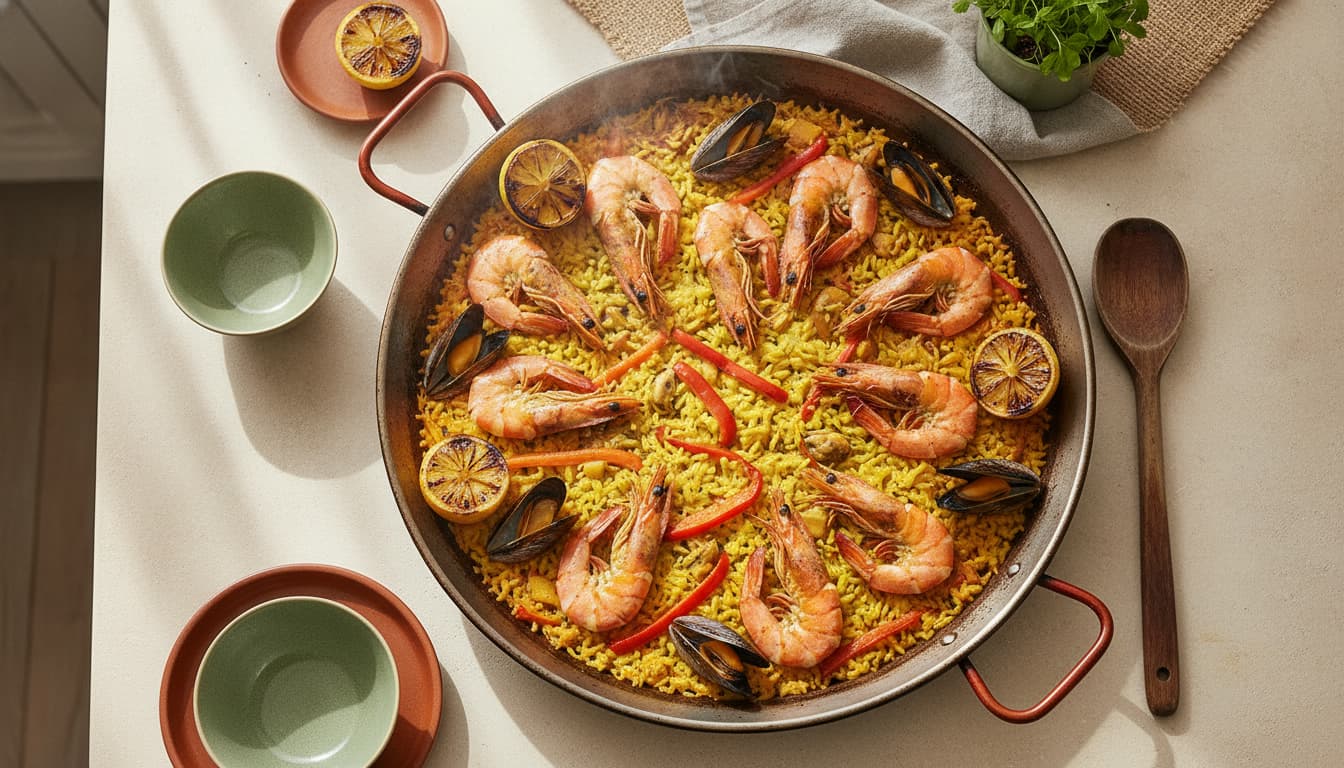
The crust on the bottom of the pan is the entire point, and you get it by doing less rather than more. A thin layer of rice, a properly reduced sofrito, saffron bloomed in warm stock, and no spoon after the liquid goes in. Six servings, thirty-five minutes on the heat, and ten of rest under a towel.
Warum das funktioniert
Jedes Rezept auf dieser Seite kommt mit einer Erklärung der Technik-Entscheidungen: warum erst anbraten, dann schmoren, warum die Säure zum Schluss kommt, warum das Fett vor den Aromaten ausgelassen wird. Die Methode unten besteht aus genau diesen Entscheidungen, der Reihe nach.
Zutaten
6 Portionen- 2 cupsbomba rice · or Calasparra, do not substitute long-grain or arborio
- 6 cupschicken stock · kept hot in a separate pan
- 1 large pinchsaffron threads · about 1/4 tsp, crumbled into the hot stock
- 1 1/4 lbboneless chicken thighs · cut into 2 inch pieces
- 1 lblarge shrimp · shell on if you can get them
- 1 lbmussels · scrubbed, any that stay open discarded
- 1/4 cupextra-virgin olive oil
- 1 wholeonion · finely chopped
- 4 clovesgarlic · minced
- 2 wholeripe tomatoes · grated on a box grater, skins discarded
- 2 tspsweet paprika · pimenton dulce
- 6 ozflat green beans · cut into 2 inch lengths, or runner beans
- 1 wholeroasted red pepper · sliced into strips, piquillo if available
- 1 1/2 tspkosher salt · adjust to how salty your stock is
- 1 wholelemon · cut into wedges
- 1/4 cupflat-leaf parsley · chopped, to finish
Methode
The pan decides the dish
Paella needs a wide, shallow, thin pan so the rice sits in a layer no more than half an inch deep and every grain is in contact with heat. A proper paella pan is ideal; a fourteen-inch carbon steel or cast iron skillet is the workable substitute. What does not work is a Dutch oven or a deep saute pan, where the rice piles up, steams, and you get a risotto texture with no crust. If your only pan is small, make four servings rather than six.
Build the sofrito until it darkens, which takes longer than you think
Onion in the olive oil over medium heat until genuinely soft, eight minutes, then garlic for one, then the grated tomato and the paprika. Now reduce the tomato until it goes from bright red and loose to brick-coloured and jammy and the oil separates out at the edges, another eight to ten minutes. That is the flavour base and there is no shortcut for it. Stopping at the point where it still looks like chopped tomato is the most common reason home paella tastes thin.
Saffron goes into the hot stock, not into the pan
Saffron's flavour and colour compounds are water-soluble and need time and warmth to release. Crumble the threads between your fingers into the pan of hot stock and let them sit for at least ten minutes while you do everything else. Thrown in dry with the rice, they stay as red threads in a pale dish and you have wasted the most expensive ingredient in the recipe. Do not buy powdered saffron, which is frequently adulterated.
Measure the stock, three to one
Bomba rice takes about three parts liquid to one part rice by volume, which is more than most rice because the grain is unusually absorbent while staying intact. Two cups of rice, six cups of hot stock. Measure it rather than adding by eye, because you get exactly one chance: too little and the rice is chalky, too much and there is no crust, and you cannot correct either one halfway through without stirring. Arborio takes less and turns creamy, which is the wrong texture here.
Brown the chicken, then spread the rice and stop touching it
Season and brown the chicken pieces in the pan before the sofrito goes in, then set them aside and return them once the rice is spread. Stir the dry rice into the sofrito for one minute so every grain is coated, then pour in the hot saffron stock, add the beans and the salt, distribute everything evenly, and put the spoon in the sink. From this moment there is no stirring. Stirring releases starch and starch gives you creaminess, which is exactly what you are trying to avoid.
Medium high for ten minutes, low for eight, and the shellfish goes on top
Bring it to a strong simmer over medium-high for the first ten minutes, which sets the rice, then drop to low for eight more as the liquid falls below the surface. Push the shrimp and the mussels into the top layer at the eight-minutes-remaining mark, hinge-side down for the mussels so they open into the rice. Lay the roasted pepper strips over the top. The shellfish steams in the rising vapour, which is why it goes on late and on top rather than in.
The socarrat is done by ear and by smell
When the surface liquid is gone and the rice is just tender, turn the heat up to medium-high for sixty to ninety seconds. Listen: you want a distinct crackle, like light rain on a window. Smell: toasted, nutty, and the second you catch anything acrid you are done, immediately. That is the socarrat, the caramelised crust on the bottom, and it is why paella is served straight from the pan and scraped up rather than plated from a serving spoon.
Ten minutes of rest under a towel
Off the heat, cover the pan loosely with a clean tea towel and leave it alone for ten minutes. The grains at the top are still slightly firm and there is residual moisture in the pan that redistributes during the rest, which is the same principle as resting rice or resting meat. It also lets the crust firm rather than steaming soft under a tight lid, which is why a towel and not foil. Then lemon, parsley, and eat it out of the pan.
What is in the 540 calories, and what paella is not
Rice and protein, mostly, with a quarter cup of olive oil across six servings doing the flavour work. There is no chorizo in this, and not because of the calories: cured pork paprika dominates saffron and turns the dish into something else. There are no peas, no yellow food colouring, and no cream. What you get is 38g of protein a serving from three different sources and a dish that costs less per head than most people assume.
Variationen
Substitutionen und Anpassungen folgen mit der Foto-Produktion. Die Methode hält bei den meisten sinnvollen Austauschen.
Aufbewahrung
Kühlschrank: 3 bis 4 Tage, verschlossen. Gefrierfach: bis zu 3 Monate. Abgedeckt aufwärmen, um die Feuchtigkeit zu halten.
Häufige Fragen
- What rice do I need for paella?
- Bomba or Calasparra, both short-grain Spanish varieties bred to absorb around three times their volume in liquid while keeping their shape and staying separate. Arborio and carnaroli absorb less and release far more starch, which gives you a creamy risotto texture, and long-grain rice will not absorb enough flavour. Bomba is the one substitution in this recipe that genuinely cannot be made. It keeps for years in the cupboard, so buying a bag is not a commitment.
- How do I get a socarrat?
- Four conditions have to be true at once: a thin layer of rice in a wide thin-bottomed pan, enough oil in the sofrito, no stirring after the stock goes in, and a final sixty to ninety seconds on higher heat once the surface liquid has gone. Judge it by sound and smell rather than by looking, because you cannot see the bottom. A crackle means it is forming, an acrid smell means stop. If you get no crust at all, the usual cause is too much liquid or too deep a pan.
- Should paella have chorizo in it?
- No traditional Valencian paella contains chorizo, and the reason is culinary rather than dogmatic: cured paprika-heavy pork sausage releases a lot of fat and a dominant flavour that flattens the saffron you just paid for. If you want a smoky note, use a good sweet paprika in the sofrito, which is already in this recipe. If you want chorizo for dinner, it is excellent, just make a rice dish and call it something else.
- Can I make paella on a regular stove?
- Yes, with one adjustment. A paella pan is wider than a home burner, so the centre cooks faster than the edges. Move the pan around every few minutes during the first ten-minute stage, rotating it a quarter turn, or straddle two burners on medium if your stove allows it. The alternative, and it works well, is to start it on the stove and move the pan into a 400F oven for the middle stage, then back to the stove for the socarrat.
- Can I make paella ahead or reheat it?
- Not well, and this is one dish worth being honest about. The socarrat softens within an hour and the rice keeps absorbing, so reheated paella is a decent rice dish and not paella. If you have leftovers, the best use is arroz al horno the next day: spread it in a dish with a beaten egg over the top and bake at 400F for fifteen minutes, which gives you a new crust instead of mourning the old one.
Ähnliche Rezepte
Alle ansehen →Gazpacho: reife Tomaten, altes Brot, vier Stunden kalt
Gazpacho ist eine Emulsion, keine kalte Tomatensuppe. Warum eingeweichtes Brot und langsam eingegossenes Olivenöl die Textur machen, wie viel Sherryessig hineingehört und warum kalt immer nachgewürzt werden muss.
270m4g EiweißTabouleh: ein Kräutersalat mit Bulgur, nicht umgekehrt
Echtes Tabouleh besteht zu drei Vierteln aus Petersilie. Warum der Bulgur nur eingeweicht und nicht gekocht wird, warum die Petersilie vollständig trocken sein muss und warum die Tomaten vor dem Mischen abtropfen müssen.
45m4g EiweißCarbonara: keine Sahne, Guanciale, Pfanne runter vom Herd
Rührei statt Sauce entsteht bei zu viel Hitze. Warum Guanciale und nicht Speck, warum Pecorino und nicht Parmesan, wie viel Nudelwasser in die Eier gehört und bei welcher Temperatur die Emulsion bindet statt zu stocken.
30m27g Eiweiß
Erhalten Sie jeden Sonntag ein getestetes Rezept und eine Nährwert-Notiz in Ihr Postfach.
Ein Rezept pro Woche, fotografiert am selben Dienstag, an dem es getestet wurde. Von einer Ernährungsberaterin geprüft. Keine Werbung, keine Pop-ups, kein Tracking.
Das Clean-Chef-Starter-Kit.
Ein 14-Tage-Plan für entzündungshemmende Ernährung als PDF, Einkaufsliste nach Abteilungen, Makros pro Tag aufsummiert, Sonntags-Vorbereitung. Kostenlos.
Mit der Anmeldung stimmen Sie unserer Datenschutzerklärung zu. Eine ruhige E-Mail pro Woche. Jederzeit abbestellbar.
Wir bauen einen Shop.
Kuratiertes Kochgeschirr, Vorratsbasics, die wir wirklich kaufen, Rezept-Bundle-PDFs. Erfahren Sie als Erste, wann er öffnet.
Wir schreiben Ihnen nur zur Shop-Eröffnung. In jeder E-Mail abbestellbar. Siehe unsere Datenschutzerklärung.