- Kalorien
- 290
- Eiweiß
- 34g
- Ballaststoffe
- 2g
- Ges. Fett
- 3g
- Natrium
- 420mg
- Zugesetzter Zucker
- 0g
Was dieses Rezept für Sie leistet.
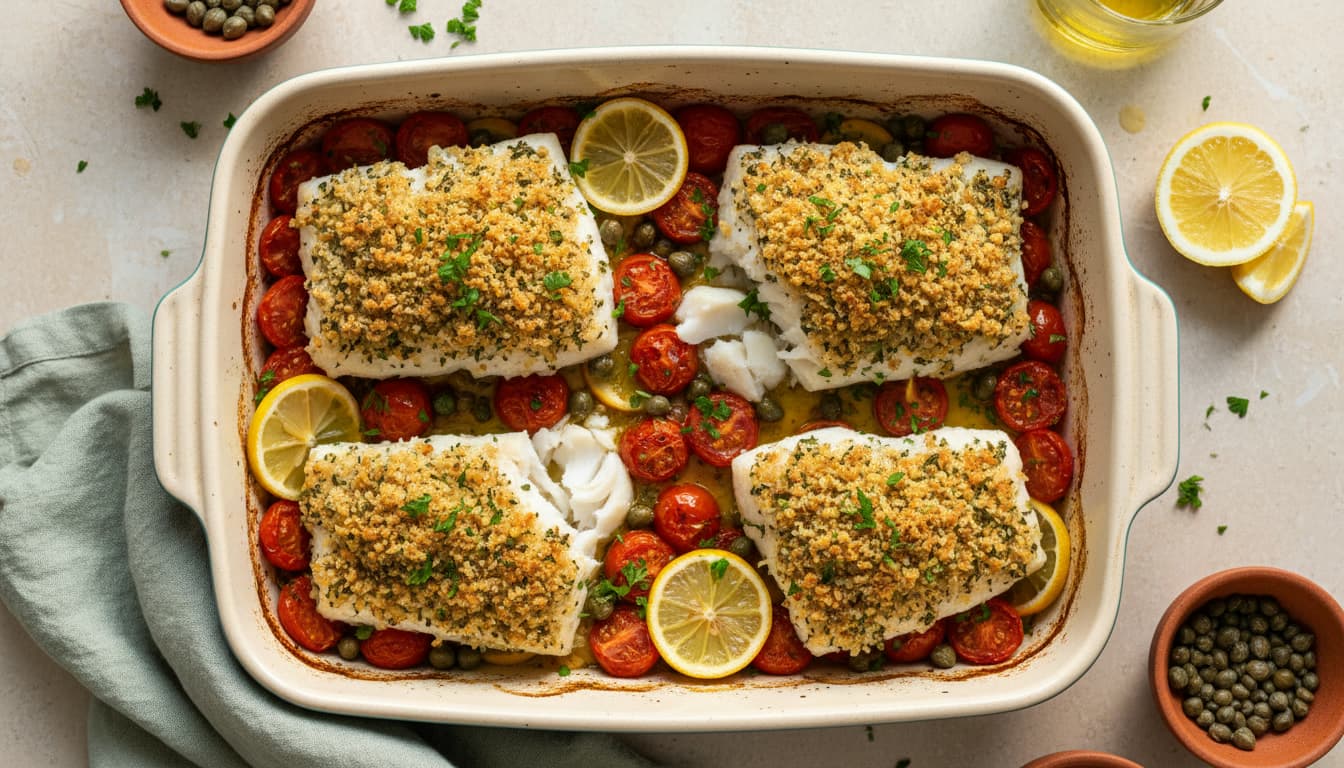
Cod goes from perfect to chalky in about ninety seconds, which is why most home cod is disappointing. The fixes are a ten-minute salt cure, a hotter oven than you expect, and pulling it at 130F so carryover heat finishes the job. Cherry tomatoes and capers make the pan sauce while it cooks. Four servings, 290 calories.
Warum das funktioniert
Jedes Rezept auf dieser Seite kommt mit einer Erklärung der Technik-Entscheidungen: warum erst anbraten, dann schmoren, warum die Säure zum Schluss kommt, warum das Fett vor den Aromaten ausgelassen wird. Die Methode unten besteht aus genau diesen Entscheidungen, der Reihe nach.
Zutaten
4 Portionen- 4 piecescod loin · 6 oz each, at least 1 inch thick, thawed if frozen
- 1 tspkosher salt · for the 10 minute cure, plus more for the vegetables
- 2 tbspextra-virgin olive oil · divided
- 1 tbspunsalted butter · melted, for the crumb
- 1/3 cuppanko breadcrumbs · or almond flour for a gluten-free crust
- 2 clovesgarlic · finely grated
- 1 wholelemon · zest into the crumb, juice at the end
- 10 ozcherry tomatoes · halved
- 2 tbspcapers · rinsed and drained
- 1/4 tspchili flakes
- 1/4 tspblack pepper · coarsely ground
- 3 tbspflat-leaf parsley · chopped, half in the crumb and half to finish
Methode
Buy loin, not tail, and know why
A cod fillet tapers from a thick loin end to a thin tail, and a whole fillet cooked as one piece gives you an overcooked tail and an underdone middle every time. Ask for loin portions, or cut a large fillet into pieces and fold the thin tail end under itself to double its thickness. One inch minimum. Cod is a lean, large-flaked fish with very little fat to protect it, which is precisely why even thickness matters more here than with salmon.
Frozen is fine, wet is not
Most cod in a US supermarket was frozen at sea and is better than the fresh-labelled fish that has been in transit for five days. Thaw it overnight in the fridge on a rack over a plate, never in warm water, and then pat it genuinely dry on all sides with paper towel. Surface water is the enemy of both browning and the crumb topping, and a fillet that goes into the oven wet steams itself pale. If it is weeping liquid, it was thawed too fast.
The ten-minute salt cure firms the flesh
Salt the fillets on all sides and leave them on a rack for ten minutes while the oven heats. Salt draws surface moisture out, then that brine gets reabsorbed, which seasons the fish past the surface and firms the protein so it holds together instead of collapsing into wet flakes. Pat off any beads of liquid before the fish goes in the pan. Ten minutes is the window: an hour and you are into a cure, which changes the texture in a way you do not want here.
400F, and roughly ten minutes per inch
Lower ovens sound gentler and are worse for lean white fish, because a long slow bake gives the muscle time to squeeze out its water and go cottony. At 400F a one-inch loin takes twelve to fourteen minutes and a one-and-a-half-inch piece about eighteen. The heat sets the exterior quickly, the interior stays juicy, and the crumb gets a chance to brown. Start checking at ten minutes regardless of what the arithmetic says.
The tomatoes and capers go in first and make the sauce
Toss the halved cherry tomatoes with a tablespoon of the olive oil, salt and the chili flakes and give them a five-minute head start in the hot oven, then nestle the fish among them. The tomatoes collapse and release their juice, the capers season it, and by the time the fish is done you have a pan sauce without making one. Rinse the capers, because unrinsed brine plus the salt cure plus the crumb pushes the dish over on sodium.
The crumb goes on dry, with the fat brushed over the top
Mix the panko with the grated garlic, lemon zest, half the parsley and a pinch of salt, press it onto the top of each fillet, then brush or drizzle the melted butter over the crumb rather than mixing it in. Mixed in, the fat coats every crumb and you get a greasy paste. Brushed over, the top layer browns and the layer underneath stays crisp. Almond flour behaves the same way and browns slightly faster, so watch it at the end.
Pull it at 130F and let carryover do the rest
An instant-read thermometer into the thickest part is the only reliable way. Take it out at 130 to 133F and it will coast to about 140F while it rests three minutes, which is where cod is juicy and just barely translucent at the very centre. FDA guidance for fish is 145F, so if you are cooking for someone pregnant, immunocompromised or elderly, take it there and accept a firmer flake. What you must not do is aim for 145F and then leave it in another two minutes.
How to judge it without a thermometer
Press the top of the thickest part with a finger: raw cod is soft and slightly springy, done cod is firm and gives slightly with a hint of separation. Then slide a paring knife into the centre and open it a little. You want the flakes to separate cleanly but the very middle to still look faintly translucent, not opaque white throughout. Opaque all the way through means you are already past it. Lemon juice and the remaining parsley go on after it leaves the oven, not before.
Variationen
Substitutionen und Anpassungen folgen mit der Foto-Produktion. Die Methode hält bei den meisten sinnvollen Austauschen.
Aufbewahrung
Kühlschrank: 3 bis 4 Tage, verschlossen. Gefrierfach: bis zu 3 Monate. Abgedeckt aufwärmen, um die Feuchtigkeit zu halten.
Häufige Fragen
- How long do you bake cod at 400F?
- Roughly ten minutes per inch of thickness at the thickest point, so twelve to fourteen minutes for a standard one-inch loin portion and about eighteen for a thick centre-cut piece. Add two minutes if the fish went into the oven straight from the fridge rather than after the ten-minute salt cure at room temperature. Thickness is what matters, not weight, which is why two six-ounce portions of different shapes can differ by five minutes.
- Why is my baked cod rubbery or chalky?
- It is overcooked, almost certainly by less than two minutes. Cod is very lean, so once the muscle proteins contract past about 145F they squeeze out the water that was making it juicy and you get that dry, cottony, slightly squeaky texture. Use a thermometer and pull at 130 to 133F. The second cause is a fillet of uneven thickness, where the thin end hits 160F while the middle is still coming up. Fold the tail under or buy loin portions.
- Should I bake cod covered or uncovered?
- Uncovered. Covering traps steam, which prevents any browning, turns the crumb topping to mush, and effectively poaches the fish, so you lose both texture and the concentrated pan sauce from the tomatoes. There is a legitimate covered method, which is baking cod in parchment with vegetables and a splash of wine, but that is a different dish with a different result: soft, clean and gently steamed rather than browned.
- Do I need to thaw frozen cod before baking?
- Yes, if you want the crumb topping and the salt cure to work, because both need a dry surface. Thaw overnight in the fridge on a rack so it drains, which takes about twelve hours for six-ounce portions. Cooking from frozen is possible, at 425F for roughly double the time with no topping, and the texture is noticeably wetter. Never thaw fish at room temperature or under warm running water, which pushes the surface into the bacterial danger zone while the centre is still solid.
- What can I use instead of cod?
- Any thick, lean white fish behaves the same way and takes the same timing: haddock, pollock, halibut, hake or striped bass. Haddock is the closest match and often cheaper. Halibut is firmer, more expensive, and even less forgiving of overcooking, so the thermometer matters more. Thin fish such as sole, tilapia or flounder will not work with this method, they cook in six minutes and the crumb never browns; give those a hot pan instead of an oven.
Ähnliche Rezepte
Alle ansehen →- High-Protein
Boeuf Bourguignon: drei Stunden, ein Topf, richtig angebraten
Das Fleisch muss trocken sein, die Pfanne heiß und der Topf nicht überfüllt, sonst kocht das Rindfleisch, statt zu bräunen. Welches Stück, welcher Wein, warum Speck, Zwiebeln und Pilze getrennt gegart werden und warum es am zweiten Tag besser schmeckt.
240m42g Eiweiß - High-Protein
Tofu zubereiten: pressen, in Stärke wenden, spät marinieren
Tofu wird knusprig, wenn Wasser heraus und Stärke darauf kommt. Welche Festigkeit für welches Gericht, warum Einfrieren die Textur völlig verändert und warum die Marinade erst nach dem Braten dazukommt statt davor.
60m20g Eiweiß - High-Protein
Enchiladas: Tortillas in heißem Öl wenden, Sauce selbst kochen
Matschige Enchiladas entstehen, weil rohe Tortillas direkt in die Sauce kommen. Zwanzig Sekunden in heißem Öl versiegeln sie, die Chilisauce wird aus getrockneten Chilis gekocht statt aus der Dose, und der Auflauf steht nur zwanzig Minuten im Ofen.
95m34g Eiweiß
Erhalten Sie jeden Sonntag ein getestetes Rezept und eine Nährwert-Notiz in Ihr Postfach.
Ein Rezept pro Woche, fotografiert am selben Dienstag, an dem es getestet wurde. Von einer Ernährungsberaterin geprüft. Keine Werbung, keine Pop-ups, kein Tracking.
Das Clean-Chef-Starter-Kit.
Ein 14-Tage-Plan für entzündungshemmende Ernährung als PDF, Einkaufsliste nach Abteilungen, Makros pro Tag aufsummiert, Sonntags-Vorbereitung. Kostenlos.
Mit der Anmeldung stimmen Sie unserer Datenschutzerklärung zu. Eine ruhige E-Mail pro Woche. Jederzeit abbestellbar.
Wir bauen einen Shop.
Kuratiertes Kochgeschirr, Vorratsbasics, die wir wirklich kaufen, Rezept-Bundle-PDFs. Erfahren Sie als Erste, wann er öffnet.
Wir schreiben Ihnen nur zur Shop-Eröffnung. In jeder E-Mail abbestellbar. Siehe unsere Datenschutzerklärung.