Mediterranean diet grocery list
Von Die ThatCleanChef-Küche · Aktualisiert 24. August 2026 · 10 Min. Lesezeit
A shopping list ordered the way a store is, with quantities for two people for seven days and a rough total. Produce first, then fish and meat, then dairy, then the pantry aisles, then the one-time pantry build you only buy once. Includes what to skip, where paying more is worth it, and how the list changes if you are cooking for four.
- 01
Produce, the largest section of the cart
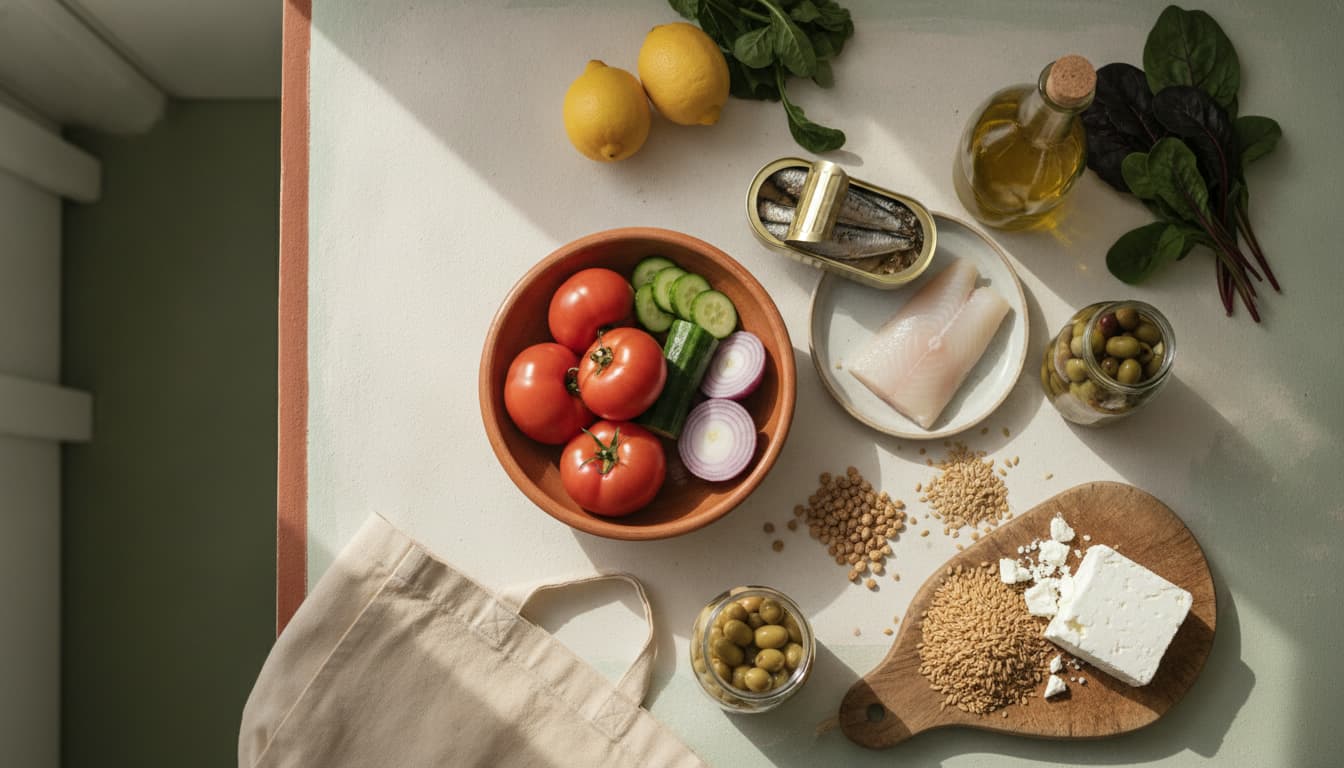
For two people for a week: two heads of broccoli or cauliflower, two zucchini, one eggplant, three bell peppers, two pints of cherry tomatoes, four large tomatoes, two cucumbers, two red onions, two yellow onions, two heads of garlic, one bag of spinach, one bunch of kale or chard, four lemons, and two bunches of soft herbs (parsley and dill or mint). Produce should be roughly half the cart by volume. Frozen spinach and frozen peas belong here too and cost less.
- 02
Fish counter, two meals plus the tins
Two salmon fillets or one pound of cod for the week's fresh fish meal, and a bag of frozen shrimp that lives in the freezer for a fast second one. Then the tins: sardines in olive oil, anchovies, and good tuna. Frozen fillets are honestly fine and often better than the fresh counter at an inland supermarket, since they were frozen at sea. Two fish meals a week is the target the pattern is built on.
- 03
Meat and poultry, the small part
One pack of chicken thighs, bone-in or boneless, covering two dinners. Eggs, one dozen. That is it for most weeks. Red meat appears a few times a month rather than weekly, so it is not a standing item on this list. Buying less meat is where the budget for the good olive oil and the fish comes from, and the arithmetic works out close to even.
- 04
Dairy, fermented and full-fat
A large tub of plain full-fat Greek yogurt, a block of feta in brine (not the pre-crumbled dry kind, it is worth the extra step), and a wedge of Parmesan or pecorino. Plain, never flavored, since flavored yogurt runs to twenty grams of added sugar per pot. The yogurt covers breakfasts and doubles as the base for every sauce in the rotation.
- 05
Legumes and grains, mostly tinned and dried
Two tins of chickpeas, two tins of cannellini or butter beans, a bag of dried brown or green lentils, and one whole grain: farro, bulgur, brown rice, or whole-wheat couscous. Add a loaf of whole-grain sourdough. This is the cheapest section of the cart and the one that carries the fiber, so do not shrink it. Dried lentils need no soaking and cook in twenty-five minutes.
- 06
The pantry build you buy once, not weekly
Extra-virgin olive oil in two bottles, one for cooking and a better one for finishing. Red wine vinegar, tinned crushed tomatoes, tomato paste, olives, capers, tahini, dried oregano, chili flakes, cumin, smoked paprika, walnuts, and almonds. Roughly sixty to seventy dollars the first time at mid-2026 US averages, and they drift by shop and season. After that the weekly shop drops sharply because most of the flavour is already in the cupboard.
- 07
Where paying more is worth it, and where it is not
Worth it: the finishing olive oil, feta in brine, tinned sardines, and Parmesan. Not worth it: the cooking olive oil, tinned tomatoes beyond a decent mid-range brand, frozen vegetables, dried pulses, and any product with a Mediterranean logo on the packaging. The pattern is defined by the cooking, and a premium jar of pre-made sauce is a packaged food with a nice label.
- 08
What is not on this list
No sugary drinks, no packaged snack foods, no breakfast cereal, no processed meat beyond an occasional piece, no low-fat dressings, and no butter or seed oils for cooking. Not a moral position, just a cart that mirrors the pattern. If a shelf-stable snack is needed, it is nuts, olives, or fruit, and those are all already in the cart.
- 09
Scaling for four, and what the week costs
Double the produce, the fish, and the chicken; increase the pantry items by about half rather than doubling, since oil, vinegar, and spices stretch. A week for two lands somewhere around eighty-five to a hundred and ten dollars excluding the one-time pantry build, and for four around a hundred and fifty to a hundred and eighty. Those are mid-2026 US averages and they drift by shop and season.
What people ask us next.
- What should be on a Mediterranean diet grocery list?
- Vegetables in quantity, fruit, extra-virgin olive oil, tinned and dried legumes, a whole grain, oily fish including tinned sardines and anchovies, plain full-fat Greek yogurt and feta, eggs and a little poultry, nuts, lemons, garlic, onions, and fresh herbs. Red meat and sweets appear occasionally rather than weekly. Roughly half the cart by volume should be produce, and the pantry items are a one-time build rather than a weekly cost.
- How much does a Mediterranean week cost?
- Around eighty-five to a hundred and ten dollars for two people for seven days, excluding the initial pantry build of roughly sixty to seventy dollars. Those are mid-2026 US averages and they drift by shop and season. It usually comes out at or below a meat-centered week, because the biggest line item, red meat, largely leaves the cart and is replaced by pulses and grains. The two costs that go up are olive oil and fish.
- Which olive oil should I buy?
- Two bottles. A large, reasonably priced extra-virgin for cooking, where the subtleties are lost to heat anyway, and a smaller, better bottle for finishing salads, soup, beans and bread. Look for a harvest date on the label rather than only a best-before, buy dark glass or tin, and store it away from the stove. Anything labelled light or pure olive oil is refined and not what the pattern means.
- Can I do this shop at a discount supermarket?
- Yes, and it is often cheaper for exactly the categories that matter here: tinned tomatoes, tinned pulses, dried lentils, frozen vegetables, nuts, and olive oil. The places a budget store can fall short are the fish counter and the feta, so buy frozen fish and check whether the feta is in brine. Nothing on this list requires a specialty shop.
Woher die Technik stammt
Über die ThatCleanChef-Küche
Ein kleines Team aus Rezeptentwicklerinnen und Foodfotografen, das Rezepte in Privatküchen mit haushaltsüblichem Equipment testet. Jede Nährwertkarte ist USDA-FoodData-Central-belegt und wird geprüft von Lena Marsh, RDN, MS. Wir geben nicht vor, ein einzelner Küchenchef zu sein, wir sind die Menschen hinter den Tellern. Das ganze Team kennenlernen →
Ähnliche Beiträge
Gazpacho: reife Tomaten, altes Brot, vier Stunden kalt
Gazpacho ist eine Emulsion, keine kalte Tomatensuppe. Warum eingeweichtes Brot und langsam eingegossenes Olivenöl die Textur machen, wie viel Sherryessig hineingehört und warum kalt immer nachgewürzt werden muss.
Tabouleh: ein Kräutersalat mit Bulgur, nicht umgekehrt
Echtes Tabouleh besteht zu drei Vierteln aus Petersilie. Warum der Bulgur nur eingeweicht und nicht gekocht wird, warum die Petersilie vollständig trocken sein muss und warum die Tomaten vor dem Mischen abtropfen müssen.
Carbonara: keine Sahne, Guanciale, Pfanne runter vom Herd
Rührei statt Sauce entsteht bei zu viel Hitze. Warum Guanciale und nicht Speck, warum Pecorino und nicht Parmesan, wie viel Nudelwasser in die Eier gehört und bei welcher Temperatur die Emulsion bindet statt zu stocken.
Das Clean-Chef-Starter-Kit.
Ein 14-Tage-Plan für entzündungshemmende Ernährung als PDF, Einkaufsliste nach Abteilungen, Makros pro Tag aufsummiert, Sonntags-Vorbereitung. Kostenlos.
Mit der Anmeldung stimmen Sie unserer Datenschutzerklärung zu. Eine ruhige E-Mail pro Woche. Jederzeit abbestellbar.