Iron-rich foods
Von Die ThatCleanChef-Küche · Aktualisiert 4. September 2026 · 12 Min. Lesezeit
Spinach has more iron per gram than steak and you absorb a fraction of it. That gap between the milligrams printed on a label and the milligrams that actually cross your gut wall is what this page is about. Which foods carry which kind of iron, the four things that block absorption, the one that multiplies it, and how to cook accordingly.
- 01
Two kinds of iron, and the difference is roughly five-fold
Heme iron comes bound inside hemoglobin and myoglobin, so it exists only in meat, poultry, fish and shellfish, and the gut absorbs roughly fifteen to thirty-five percent of it regardless of what else is on the plate. Non-heme iron is the mineral form found in plants, eggs and fortified foods, and absorption runs from about two to twenty percent depending entirely on what it is eaten with. That range is the reason a food list sorted by milligrams is close to useless on its own.
- 02
What you actually need, and why the vegetarian number is different
Adult men and postmenopausal women need 8mg a day. Menstruating women need 18mg. Pregnancy raises it to 27mg. Vegetarians and vegans are advised to target roughly 1.8 times those numbers, not because plant iron is inferior in kind but because the absorbed fraction is so much lower. That puts a vegetarian woman of reproductive age near 32mg a day on paper, which is difficult through food alone and is the reason absorption technique matters more than food choice here.
- 03
The animal sources, ranked by what you will actually eat
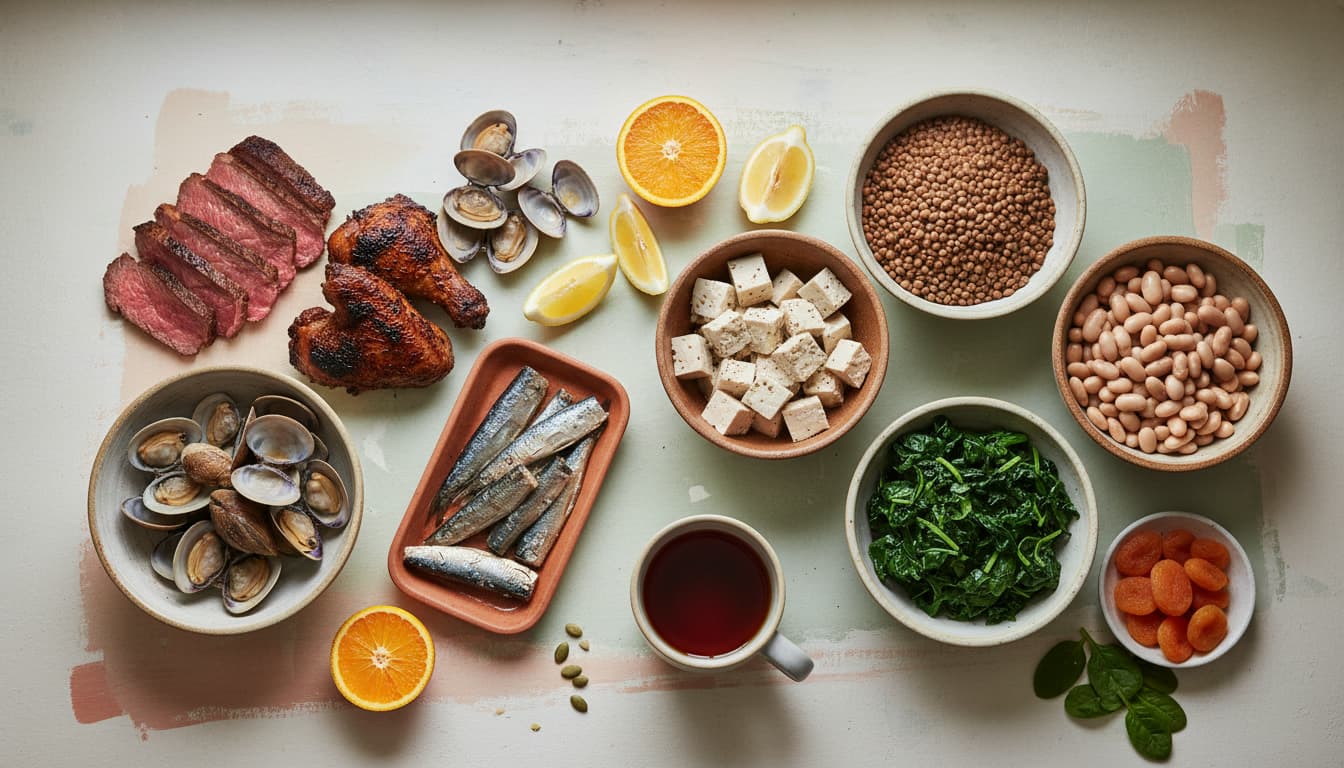
Per typical serving: clams are extraordinary at around 24mg per 3oz, beef liver about 5mg, oysters about 6mg, mussels about 6mg, and sardines about 2.5mg per tin. Beef chuck sits near 2.5mg per 4oz, dark chicken meat about 1.1mg, and turkey thigh about 1.4mg. Chicken breast and white fish are low, near 0.5mg. Note that clams, mussels and sardines outperform red meat, cost less, and rarely appear on any list of iron-rich foods.
- 04
The plant sources, with the absorption caveat attached
Per serving: cooked lentils about 6.6mg a cup, white beans 8mg, chickpeas 4.7mg, tofu around 3.4mg per half cup, pumpkin seeds 2.5mg per ounce, cooked spinach 6.4mg a cup, blackstrap molasses 3.5mg a tablespoon, and fortified breakfast cereals anywhere from 4 to 18mg a bowl. Those milligram figures are real. Multiply them by roughly 0.05 to 0.1 for what you absorb without help, and by considerably more once vitamin C is on the plate.
- 05
Vitamin C is the lever, and the effect size is large
Ascorbic acid reduces ferric iron to the ferrous form the gut transports, and it holds it in solution past the point in the small intestine where it would otherwise precipitate. Roughly 75mg of vitamin C, which is one orange, half a red pepper or a good squeeze of lemon over the whole dish, can raise non-heme absorption several-fold from the same meal. It has to be in the same meal, not later in the day. This is the single highest-return habit on this page.
- 06
The MFP factor, or why a little meat helps the beans
Meat, fish and poultry raise the absorption of non-heme iron eaten alongside them, through a mechanism that is still not fully explained and is not simply the protein content. Practically it means chili with a small amount of beef absorbs more of its bean iron than the same chili without, and a tin of sardines alongside a lentil salad does more than its own iron content suggests. For anyone not avoiding meat entirely, small amounts used as seasoning are an efficient move.
- 07
Tea and coffee are the biggest blockers, and timing fixes them
Polyphenols in tea and coffee bind non-heme iron in the gut and can cut absorption from a meal by half or more, with black tea the worst offender and even herbal infusions having some effect. This is not a reason to stop drinking them. It is a reason to move them an hour either side of an iron-focused meal. For someone with low ferritin who drinks tea with every meal, this one change is frequently more effective than any food substitution.
- 08
Phytate, calcium and the rest of the inhibitor list
Phytic acid in whole grains, legumes, nuts and seeds binds iron, which is the awkward reality that the highest plant iron foods carry their own inhibitor. Soaking, sprouting, fermenting and long cooking all reduce it meaningfully, which is why sourdough bread and soaked beans are better iron sources than their raw equivalents. Calcium interferes with both heme and non-heme iron, so a large glass of milk or a dairy-heavy dessert is worth moving away from the iron meal. Eggs contain phosvitin, which binds iron in the yolk.
- 09
Spinach, and the myth that will not die
Cooked spinach genuinely carries about 6.4mg of iron a cup, which is a real number. It also carries a great deal of oxalate, which binds that iron tightly, and measured absorption from spinach is among the lowest of any food tested, in the region of two percent. The popular story about a misplaced decimal point in a nineteenth-century paper is itself largely a myth. Spinach is a good food. It is not a practical iron strategy, and lentils with lemon beat it comfortably.
- 10
The cast iron pan effect is real but modest
Cooking acidic, wet foods in bare cast iron does transfer measurable iron into the food, with tomato sauce simmered for an hour showing the largest increases in the published work. The effect is smaller with dry cooking, smaller in a well-seasoned pan, and negligible in enamelled cast iron or stainless steel. Treat it as a free small bonus on the days you make a long tomato braise, not as a plan. The specialised iron ingots sold for the purpose have better evidence than the pan does.
- 11
Four meals built for absorption rather than for milligrams
Lentil soup finished with a hard squeeze of lemon and served with roasted red peppers. A chili of black beans and a small amount of beef, with tomato, bell pepper and lime. Sardines on sourdough with tomato and parsley. Tofu and broccoli stir-fry with a citrus-forward sauce, eaten with water rather than tea. Each pairs a non-heme source with 75mg or more of vitamin C, and each keeps dairy and tannins off the same plate.
- 12
Who is actually at risk, and what the symptoms look like
Iron deficiency is the most common nutritional deficiency worldwide. The higher-risk groups are menstruating women, particularly with heavy periods, pregnant women, infants and toddlers, frequent blood donors, endurance athletes, people with coeliac disease or inflammatory bowel disease, and anyone after bariatric surgery. Symptoms are unglamorous and easy to attribute elsewhere: fatigue, breathlessness on stairs, cold hands, brittle nails, hair shedding, poor concentration, and sometimes a craving for ice or dirt, which is called pica.
- 13
Get tested before you supplement, and here is the specific reason
Fatigue has dozens of causes and iron is only one of them, so guessing wastes months. Ask for ferritin alongside a full blood count, because hemoglobin falls late and ferritin is the storage marker that moves first. It matters in the other direction too: iron supplements taken without deficiency are pointless, cause constipation and nausea, and in the small group with hereditary hemochromatosis are actively harmful. Iron is one of the few nutrients where more is not neutral. Take supplements only on advice from the clinician who ordered the test.
- 14
If you are supplementing, the practical notes
Absorption is better on an empty stomach, better with vitamin C, and worse with food, calcium, tea and coffee. Alternate-day dosing outperforms daily dosing in several trials, because a large dose raises hepcidin and blunts absorption for the following day or so. Repletion of stores takes months rather than weeks, so a follow-up ferritin test at three months is the checkpoint that tells you whether it worked. All of that is a conversation with your clinician rather than a decision to make from a food page.
What people ask us next.
- What foods are highest in iron?
- By absorbed iron rather than by label milligrams: clams, oysters, mussels, beef liver, sardines and red meat lead, because they carry heme iron absorbed at fifteen to thirty-five percent. Among plants, cooked lentils at 6.6mg a cup, white beans at 8mg, tofu, pumpkin seeds and fortified cereals are the highest, though you absorb a much smaller fraction unless vitamin C is on the same plate. Shellfish is the most consistently overlooked category, and it is usually cheaper than steak.
- What is the difference between heme and non-heme iron?
- Heme iron is bound inside hemoglobin and myoglobin and exists only in animal flesh, so meat, poultry, fish and shellfish. The gut absorbs fifteen to thirty-five percent of it through a dedicated pathway that mostly ignores what else is in the meal. Non-heme iron is the mineral form in plants, eggs, dairy and fortified foods, and absorption swings between about two and twenty percent depending on the vitamin C, tannins, phytate and calcium present. This is why plant-based eaters are advised to target higher intakes.
- How can I increase iron absorption from food?
- Four moves, in order of effect. Put 75mg of vitamin C in the same meal, which is one orange, half a red pepper, or a hard squeeze of lemon over the dish. Move tea and coffee an hour away from the meal, since their polyphenols can halve absorption. Keep large dairy servings off the same plate, because calcium competes. And soak, sprout or ferment legumes and grains to cut phytate, which is why sourdough and soaked beans outperform their raw equivalents.
- Is spinach actually a good source of iron?
- It is a good food and a poor iron strategy. Cooked spinach carries around 6.4mg a cup, which is genuinely high, but it also carries a lot of oxalate, which binds the iron so tightly that measured absorption is among the lowest recorded for any food, in the region of two percent. Lentils with lemon deliver far more absorbed iron for the same effort. Keep eating spinach for its folate, potassium and vitamin K, and get your iron somewhere else.
- Can vegetarians and vegans get enough iron?
- Yes, though it takes more attention than most people give it. The advice is to target roughly 1.8 times the standard requirement, which is a high number, so absorption technique carries most of the load. Build around lentils, white beans, chickpeas, tofu and pumpkin seeds, put vitamin C in every one of those meals, soak your legumes, and move tea and coffee away from mealtimes. If ferritin is still low after a few months of that, it is a conversation with a clinician rather than a cooking problem.
- Does cooking in a cast iron pan increase iron intake?
- A little, and mainly with wet acidic food cooked for a long time. Tomato sauce simmered for an hour in a bare cast iron pan shows the largest measured increases; a quick dry sear in a well-seasoned pan transfers very little, and enamelled cast iron transfers none. It is a reasonable free bonus rather than a plan. If you specifically want this effect, the purpose-made iron ingots designed to be simmered in a pot have better supporting evidence than the pan itself.
- What are the symptoms of low iron?
- Fatigue that sleep does not fix, breathlessness climbing stairs, unusually cold hands and feet, pale skin, brittle or spoon-shaped nails, hair shedding, headaches, poor concentration, restless legs, and sometimes a craving to chew ice or other non-food items. All of those have other causes too, which is why the answer is a blood test rather than a guess. Ask for ferritin alongside a full blood count, since hemoglobin falls only after stores are already depleted.
- Should I take an iron supplement?
- Only if a blood test shows you need one and the clinician who ordered it says so. Iron is one of the few nutrients where extra is not harmless: supplements cause constipation and nausea in a large share of people, and in those with hereditary hemochromatosis, which is not rare, they accelerate real organ damage. If you are supplementing, note that alternate-day dosing outperformed daily dosing in several trials, and that a follow-up ferritin test at three months is what tells you whether it worked.
- Does coffee really block iron absorption?
- Yes, substantially. Polyphenols in coffee and tea bind non-heme iron in the gut, and studies have measured reductions of roughly half or more when the drink is taken with the meal, with strong black tea the worst case. The fix is timing rather than abstinence: keep tea and coffee to an hour either side of meals where iron matters. For someone with low ferritin who drinks tea with every meal, this single adjustment often does more than changing what is on the plate.
Woher die Technik stammt
- NIH Office of Dietary Supplements, iron fact sheet for health professionals.
- Harvard T.H. Chan School of Public Health, The Nutrition Source, on iron and absorption enhancers.
- USDA FoodData Central, reference database for iron content by food.
- The American Journal of Clinical Nutrition, absorption and dosing literature.
- Dietary Guidelines for Americans 2020-2025, nutrients of public health concern.
Über die ThatCleanChef-Küche
Ein kleines Team aus Rezeptentwicklerinnen und Foodfotografen, das Rezepte in Privatküchen mit haushaltsüblichem Equipment testet. Jede Nährwertkarte ist USDA-FoodData-Central-belegt und wird geprüft von Lena Marsh, RDN, MS. Wir geben nicht vor, ein einzelner Küchenchef zu sein, wir sind die Menschen hinter den Tellern. Das ganze Team kennenlernen →
Ähnliche Beiträge
Magnesiumreiche Lebensmittel: Kürbiskerne schlagen Spinat
Eine Handvoll Kürbiskerne liefert rund 156 mg Magnesium, mehr als eine Tasse gekochter Spinat und etwa das Fünffache einer Banane. Etwa die Hälfte der Erwachsenen bleibt unter dem geschätzten Bedarf, und der größte einzelne Grund ist die Ausmahlung von Getreide, die dem Weizen rund achtzig Prozent seines Magnesiums nimmt.
Kaliumreiche Lebensmittel: mehr als Bananen, mit echten Zahlen
Die Banane steht nicht einmal unter den ersten zwanzig. Welche Lebensmittel wirklich viel Kalium liefern, wie Kochen und Wässern den Gehalt senken, und warum Kalium ohne weniger Natrium nur die halbe Rechnung ist.
Vegetarische Rezepte: Protein, Röstaromen und echte Abendessen
Vegetarisch kochen scheitert selten an Ideen und fast immer an zwei Dingen: zu wenig Protein und zu wenig Bräunung. Woher das Protein kommt, welche Nährstoffe wirklich Aufmerksamkeit brauchen und wie eine Woche Abendessen konkret aussieht.
Das Clean-Chef-Starter-Kit.
Ein 14-Tage-Plan für entzündungshemmende Ernährung als PDF, Einkaufsliste nach Abteilungen, Makros pro Tag aufsummiert, Sonntags-Vorbereitung. Kostenlos.
Mit der Anmeldung stimmen Sie unserer Datenschutzerklärung zu. Eine ruhige E-Mail pro Woche. Jederzeit abbestellbar.