- Calories
- 180
- Protein
- 4g
- Fiber
- 5g
- Sat. fat
- 1g
- Sodium
- 290mg
- Added sugar
- 0g
What this recipe does for you.
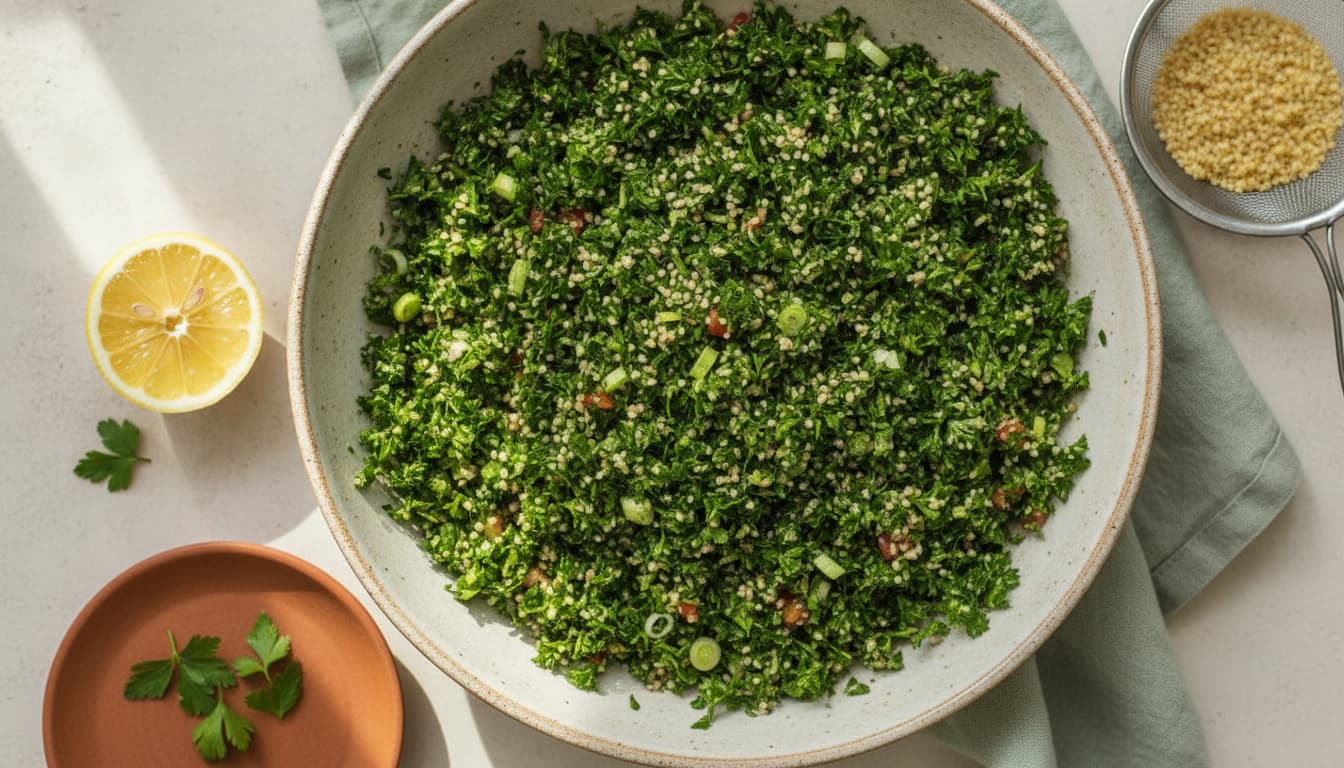
Almost every tabbouleh sold outside the Levant has the ratio backwards: a bowl of wet bulgur with parsley stirred through. The Lebanese version is three quarters herbs by volume, with fine bulgur used the way you would use breadcrumbs, soaked in tomato juice rather than boiled. Forty-five minutes, no cooking at all, and most of the work is drying parsley and chopping it properly.
Why this works
Every recipe on this site ships with an explanation of the technique decisions, why sear then braise, why the acid goes in at the end, why the fat renders before the aromatics. The method below is those decisions, in order.
Ingredients
Serves 6- 1/3 cupfine bulgur wheat · #1 grade, the finest available, and never coarse or medium
- 4 largebunches flat-leaf parsley · about 8 packed cups once picked and chopped, and yes that is the correct amount
- 1 cupfresh mint leaves · packed, roughly 1 large bunch, leaves only
- 4 mediumripe tomatoes · Roma or vine, diced small, seeds and juice separated and reserved
- 4 wholescallions · very thinly sliced, or 1/2 small white onion diced as fine as you can manage
- 1/3 cuplemon juice · fresh, from about 2 large lemons, and bottled will not do here
- 1/2 cupextra-virgin olive oil · the good bottle, since it is one of five things you can taste
- 1 1/4 tspkosher salt · added at the very end, in two stages, tasting between them
- 1/4 tspground allspice · or cinnamon, the traditional Levantine warm note, optional but characteristic
- 1/2 tspblack pepper · freshly ground
- 1 wholePersian cucumber · optional, diced small and salted separately, not traditional in Lebanon but common elsewhere
- 1 headbaby gem or romaine lettuce · leaves separated, for scooping, which is how it is eaten
Method
The ratio, which is the thing everyone gets wrong
Lebanese tabbouleh is roughly three quarters parsley by volume, with bulgur as a minor textural component in the same way breadcrumbs are minor in a meatball. A third of a cup of dry bulgur for four large bunches of parsley is not a typo. The grain-heavy version sold in supermarket delis is closer to a bulgur salad and it tastes of wet wheat. If your finished bowl looks predominantly green, you have made it correctly.
Fine bulgur, number one grade, and never the coarse stuff
Bulgur is parboiled cracked wheat sold in four grades. Number one is the finest and is the only one that belongs here, because it hydrates fully in twenty minutes at room temperature in nothing but tomato juice and lemon. Coarse bulgur, grades three and four, needs boiling or a long soak in hot water and stays chewy and distinct, which is what you want in a kibbeh or a pilaf and not in a herb salad.
Soak the bulgur in tomato juice and lemon, not in water
Squeeze the seeds and juice from the diced tomatoes into a bowl, add the bulgur and half the lemon juice, and leave it twenty minutes. The grain plumps in something flavoured instead of in plain water, and nothing gets drained away. It should be tender with a very slight bite and completely free of standing liquid at the end. If there is liquid left, you used too much or your tomatoes were unusually wet, so drain it.
The parsley has to be bone dry before it meets the knife
Wash it well, because parsley is grown in sandy soil and grit ruins the dish. Then dry it completely: salad spinner, then spread on a tea towel for twenty minutes, or overnight in the fridge wrapped loosely in paper towel. Wet parsley bruises under the blade instead of cutting, turns dark and slimy at the edges, and puts water into a salad that has nowhere to lose it. This is the least glamorous step and the one that most affects the result.
Chop it, do not process it, and use a sharp knife
Gather the dried parsley into a tight bundle, hold it firmly, and slice across it with a very sharp chef's knife, then run through it a few times. Fine but not minced. A food processor tears the leaf, releases the cell contents, and gives you a damp green paste that stains everything. A dull knife does the same thing more slowly. If your board is bright green and wet after chopping, the knife needs sharpening.
Stems: use the tender ones, discard the thick ones
Parsley stems carry a good amount of the flavour and it is wasteful to strip every leaf. Cut off the thick woody lower third of each bunch and chop the rest, tender upper stems included. Mint is the opposite: mint stems are fibrous and bitter all the way up, so pick the leaves. Four large bunches sounds like an enormous amount of picking and chopping and it takes about twenty minutes, which is most of the active time in this recipe.
Dice the tomatoes small, and drain them separately
Quarter-inch dice, and cut them over a bowl so you catch the juice for the bulgur. Then let the diced flesh sit in a sieve for ten minutes while you chop the herbs. Tomatoes keep releasing water for as long as they are cut, and adding them undrained is the second most common cause of a puddle in the bottom of the bowl. Use ripe tomatoes with actual flavour, since underripe supermarket tomatoes contribute water and nothing else.
Scallions or onion, sliced thin enough to disappear
Scallions are milder and more forgiving and are what most Lebanese home cooks use now. Half a white onion, diced as fine as you can and rubbed with a little salt and lemon for five minutes to take the harsh edge off, is the older version and gives more depth. Either way it needs to be very small, because a chunk of raw onion in a delicate herb salad dominates every forkful it lands in.
Salt goes in last, and in two stages
Salt draws water out of parsley, tomato and onion within minutes, and a tabbouleh salted at the start of assembly is already weeping by the time it reaches the table. Combine everything else first, dress it, then add three quarters of the salt, toss, taste, and add the rest if it needs it. If you are making it ahead, hold the salt entirely and add it just before serving. This applies to the lemon in the dressing too.
One to one and a half, lemon to oil, and taste it on a leaf
A third of a cup of lemon juice to half a cup of olive oil, which is far more acidic than a standard vinaigrette and correct for a salad that is mostly herb. Whisk them with the allspice and pepper. To check the seasoning, dip a single parsley sprig rather than tasting the dressing on a spoon, because dressing tasted alone always reads too sharp. Use olive oil you would put on bread, since there is nowhere for a poor one to hide.
Allspice or cinnamon, and why it does not taste like dessert
A quarter teaspoon of ground allspice across six servings is the classic Levantine warm note, and Lebanese seven-spice is the traditional version of it. It is far below the threshold at which anyone would identify it, and what it does is give the lemon and parsley a bottom end they otherwise lack. Cinnamon works the same way. Leave it out and the salad is cleaner and slightly thinner. Double it and it does taste like dessert, so measure.
Assemble in the last fifteen minutes, and dress at the table if you can
Everything can be prepped hours ahead and held separately: bulgur soaked, herbs chopped and refrigerated in a container lined with paper towel, tomatoes drained, dressing whisked. The moment they combine, the clock starts. Fifteen to twenty minutes of sitting is ideal, letting the bulgur take on the dressing while the parsley stays bright. Two hours in and it has darkened and slumped. This is a salad that punishes being early.
It is eaten with lettuce, not with a fork
Tabbouleh is traditionally scooped with baby gem or romaine leaves, or with cabbage leaves, and served as part of a mezze spread rather than as a side salad. That is not a garnish, it is the utensil, and it changes the experience: a cold crisp leaf against a soft acidic herb mixture. Put a bowl of separated leaves alongside it. Vine leaves are used in some households, and flatbread is the fallback where lettuce is not the custom.
Gluten-free versions, and the ones that actually work
Bulgur is wheat, so tabbouleh is not gluten-free. Quinoa is the common substitute and it works, though cooked quinoa is wetter and heavier than soaked fine bulgur, so cook it dry, cool it completely, and use two thirds the volume. Cauliflower pulsed to rice and squeezed dry is the low-carb option and is genuinely good. Millet is the closest in texture. What does not work is couscous, which is also wheat and goes to paste.
Variations
Substitutions and adaptations land with the photography shoot. The method holds across most reasonable swaps.
Storage
Refrigerator: 3 to 4 days, sealed. Freezer: up to 3 months. Reheat covered to retain moisture.
Why we tested this tabbouleh: a parsley salad with bulgur in it, not the reverse 3 times.
Every flagship recipe on this site goes through at least three rounds of kitchen testing before publication. We log what changed between tests so you can see the recipe's evolution, and so we can't quietly drop the failures.
- 01
Test 1
- What we tried
- Used a cup of coarse bulgur soaked in boiling water, which is the ratio and method most English-language recipes give.
- What happened
- The result was a wet grain salad with herbs in it. The parsley was undetectable as a flavour and the bulgur stayed chewy and bland.
- What we changed
- A third of a cup of fine grade 1 bulgur, soaked cold in reserved tomato juice and lemon, against four large bunches of parsley.
- 02
Test 2
- What we tried
- Chopped the parsley in a food processor to save the twenty minutes of knife work.
- What happened
- It came out as a damp bruised paste that had already darkened before assembly, and it made the finished salad look and taste stewed.
- What we changed
- Parsley is dried completely and cut with a sharp knife in tight bundles, never processed.
- 03
Test 3
- What we tried
- Salted and dressed the whole bowl an hour before serving so the flavours could combine.
- What happened
- There was a quarter inch of liquid in the base, the parsley had gone olive-coloured, and the whole thing had slumped by half.
- What we changed
- Components are held separately and combined fifteen to twenty minutes before serving, with the salt added last.
Frequently asked
- What is the correct ratio of parsley to bulgur in tabbouleh?
- Overwhelmingly parsley. In the Lebanese original the salad is roughly three quarters herbs by volume and the bulgur is a minor textural element, so a third of a cup of dry fine bulgur against four large bunches of parsley is about right for six servings. The grain-heavy version common in supermarket delis and many English-language recipes inverts that and produces a bulgur salad. If the finished bowl reads as green rather than beige, the ratio is right.
- Do you cook the bulgur for tabbouleh?
- No, not if you are using fine grade 1 bulgur, which is already parboiled and cracked and rehydrates fully in about twenty minutes at room temperature. Soak it in the juice and seeds squeezed from the tomatoes plus half the lemon juice, so it takes on flavour instead of water. Boiling fine bulgur turns it to mush. Coarse bulgur does need cooking, which is one of several reasons not to use it here.
- Why is my tabbouleh watery?
- Three usual causes. The parsley was still wet when it was chopped, so it carried water into the bowl. The tomatoes went in undrained and kept releasing liquid. Or it was salted and dressed too early, and salt pulled water out of everything over the following hour. Dry the herbs completely, drain the diced tomato in a sieve for ten minutes, and add the salt in the last few minutes before serving.
- Can I make tabbouleh ahead of time?
- Prep ahead, assemble late. The bulgur can soak, the herbs can be chopped and kept in a container lined with paper towel, the tomatoes can drain and the dressing can be whisked, all up to a day in advance. Combined and dressed, the salad is at its best for about twenty minutes and visibly tired after two hours as the parsley darkens and the whole bowl slumps. Leftovers keep two days and are still perfectly good to eat.
- Can I make tabbouleh gluten-free?
- Bulgur is wheat, so the traditional version is not gluten-free. Cooked and thoroughly cooled quinoa is the usual substitute and works well at about two thirds the volume, since it is wetter and heavier than soaked fine bulgur. Cauliflower pulsed to rice and squeezed dry in a towel is the low-carb option and is genuinely good. Millet is the closest textural match. Couscous is not a substitute, because it is also wheat and goes pasty.
- What is the difference between tabbouleh and fattoush?
- Both are Levantine salads with parsley and lemon, and that is where the similarity ends. Tabbouleh is herb-dominant with fine bulgur, no lettuce in the mixture and no bread. Fattoush is a chopped vegetable salad built on cucumber, tomato, radish and lettuce, dressed with sumac and pomegranate molasses, with pieces of toasted or fried flatbread through it. Fattoush is a substantial salad; tabbouleh is closer to a herb condiment eaten in quantity.
- Should tabbouleh have cucumber in it?
- Not in Lebanon, where the canonical version is parsley, mint, tomato, onion, bulgur, lemon, olive oil and salt. Cucumber is common in Syrian, Palestinian and diaspora versions and plenty of people prefer it. If you add it, use Persian or Lebanese cucumbers, dice them small, salt them separately for ten minutes and squeeze, because cucumber is ninety-five percent water and adding it raw is a reliable way to end up with a puddle.
- How do you eat tabbouleh?
- Scooped with crisp lettuce leaves, usually baby gem or the inner leaves of romaine, and eaten as part of a mezze spread alongside hummus, baba ganoush, labneh and grilled meat. Cabbage leaves and vine leaves are both used. The leaf is the utensil rather than a garnish, and the contrast between a cold crunchy leaf and the soft acidic herb mixture is part of the dish. Flatbread is the practical alternative.
- Is tabbouleh healthy?
- Unusually so for something this good. A serving here is about 180 calories, 5g of fiber and a substantial amount of vitamin K and vitamin C from the parsley, with the calories coming almost entirely from olive oil. It is naturally vegan, dairy-free and fits a Mediterranean diet pattern directly. The main caveat is sodium if you are buying it prepared, since deli versions are often heavily salted to compensate for a thin herb ratio.
Related recipes
See all →Gazpacho: An Emulsion, Not a Cold Tomato Soup
The Andalusian version is thick, orange-pink and creamy without any dairy in it, and the two things that get it there are stale bread and olive oil poured in slowly at the end. Watery red gazpacho is a blender-order problem. It needs genuinely ripe tomatoes, sherry vinegar rather than any other kind, and four hours in the fridge, which the time on this page includes.
270m4g ProteinCarbonara: Four Ingredients, One Temperature, No Cream
Carbonara is not a cream sauce and it is not scrambled eggs. It is an emulsion of egg yolk, rendered pork fat, grated sheep cheese and starchy pasta water, held together by heat that stops just short of setting the egg. Everything that goes wrong goes wrong in the last ninety seconds. Thirty minutes, four ingredients, and a pan that comes off the burner before the eggs arrive.
30m27g ProteinBolognese: A Meat Sauce With Milk in It, and Almost No Tomato
The sauce most people call bolognese is a tomato sauce with ground beef stirred through it. The Bolognese ragu is the opposite: a large amount of meat, a small amount of tomato, milk simmered in before the wine, and three hours at a heat so low the surface barely moves. It is not a weeknight sauce and it does not benefit from being rushed. What it does benefit from is a wide pan and a Sunday.
240m32g Protein
Get a tested recipe + a nutritional note in your inbox each Sunday.
One recipe a week, photographed on the same Tuesday it tested. Reviewed by an RD. No promotions, no pop-ups, no tracking.
The Clean Chef Starter Kit.
A 14-day anti-inflammatory meal plan PDF, grocery list by section, macros totaled per day, Sunday prep sequence. Free.
By subscribing, you agree to our Privacy Policy. One calm email a week. Unsubscribe anytime.
We're building a shop.
Curated cookware, pantry staples we actually buy, recipe-bundle PDFs. Be the first to know when it opens.
We'll only email you about the shop opening. Unsubscribe in any email. See our Privacy Policy.