- Calories
- 185
- Protein
- 4g
- Fiber
- 4g
- Sat. fat
- 2g
- Sodium
- 420mg
- Added sugar
- 0g
What this recipe does for you.
The Andalusian version is thick, orange-pink and creamy without any dairy in it, and the two things that get it there are stale bread and olive oil poured in slowly at the end. Watery red gazpacho is a blender-order problem. It needs genuinely ripe tomatoes, sherry vinegar rather than any other kind, and four hours in the fridge, which the time on this page includes.
Why this works
Every recipe on this site ships with an explanation of the technique decisions, why sear then braise, why the acid goes in at the end, why the fat renders before the aromatics. The method below is those decisions, in order.
Ingredients
Serves 6- 3 lbvery ripe tomatoes · soft to the squeeze and heavy for their size, height of season only
- 3 ozstale white bread · crustless, a day-old baguette or country loaf, torn into pieces
- 1 wholecucumber · about 8 oz, peeled, seeds scraped out with a spoon
- 1 wholegreen Italian pepper · or half a green bell pepper, which is sharper
- 1 clovegarlic · small, and one is genuinely enough for this volume
- 1/2 cupextra-virgin olive oil · a good fruity one, poured in slowly at the end
- 3 tbspsherry vinegar · Jerez, and no other vinegar is a real substitute
- 2 tspkosher salt · plus a good deal more after chilling, taste again cold
- 1/2 cupice water · only if the tomatoes were not juicy enough
- 2 tbspcucumber · extra, finely diced, for the garnish
- 2 tbspgreen pepper · extra, finely diced, for the garnish
- 1 tbspextra-virgin olive oil · to pour over each bowl at the table
Method
This only works in tomato season, and there is no way around it
Gazpacho is a raw dish with six ingredients and nowhere for a bad tomato to hide. You need tomatoes that give under gentle pressure, smell of tomato at the stem, and feel heavy for their size. Winter supermarket tomatoes make pink water no matter what technique you apply. If it is February and you want this anyway, good tinned San Marzano tomatoes drained of their packing liquid beat fresh hard ones, which is not a compromise most cooks expect.
The bread is structural, not filler
Three ounces of stale crustless white bread soaked in a little water and squeezed out gives gazpacho the body that separates it from a smoothie. Bread starch stabilises the emulsion that the olive oil forms, which is why a proper Andalusian gazpacho is opaque and creamy with no dairy in it. Fresh bread turns gluey. Sourdough brings its own acidity and fights the vinegar. For a gluten-free version, a small boiled potato or two tablespoons of raw almonds do the same structural job.
Peel the cucumber and scrape the seeds out
Cucumber skin is bitter and does not blend to nothing, so it leaves green specks and a background bitterness that builds over a few spoonfuls. The seed core is mostly water and it thins the soup. Peel it, halve it lengthwise, run a teaspoon down the middle, and use only the flesh. This is a two-minute job that does more for the finished texture than any equipment decision, and it is where most home gazpacho quietly goes wrong.
One clove of garlic, and blanch it if you are worried
Raw garlic keeps developing in an uncooked soup that then sits in the fridge for four hours, so what tastes balanced at the blender tastes aggressive at the table. One small clove for three pounds of tomatoes. If your garlic is old and has a green germ down the centre, pull it out, because that is where the harshness concentrates. Dropping the clove into boiling water for thirty seconds takes the edge off entirely without cooking it.
Salt the tomatoes and let them sit for twenty minutes
Core and roughly chop the tomatoes, toss them with the salt in a bowl, and leave them while you prep everything else. The salt pulls juice out by osmosis, which both seasons the flesh from the inside and gives you a pool of tomato liquid to soak the bread in instead of water. It is a twenty-minute step that happens while you are doing other things, and it means you almost never need to add the ice water at the end.
Blend the solids first, the oil last, and slowly
Everything except the olive oil goes into the blender and runs on high for two full minutes until it is completely smooth. Then, with the motor on low, pour the oil in a thin steady stream over about forty-five seconds. This forms an emulsion, and the soup visibly lightens from red to orange-pink and thickens as it goes. Dumping the oil in at the start gives you a thin red liquid with an oil slick on top, which is the difference between the two versions people describe.
Two minutes of blending, not thirty seconds
Most blenders need a genuine two minutes on the highest setting to break tomato skins and pepper flesh down to nothing. Short blending leaves fibrous flecks that no amount of straining fully removes and that read as grit. A high-powered blender does it faster, and a food processor will not really do it at all, because the wide bowl never builds a proper vortex. If your blender heats the soup up, that is fine, it is going in the fridge for four hours anyway.
Strain or do not, but know what you are choosing
Passing the soup through a fine-mesh sieve gives you the silky restaurant texture and costs you about a cup of volume and most of the fiber. Leaving it unstrained gives you a rustic soup with 4g of fiber a bowl and a slightly rougher mouthfeel. Straining is worth it if your tomatoes had tough skins or your blender is weak. If you strain, push the pulp through with a ladle rather than letting it drip, or you will lose a third of the batch.
Sherry vinegar, and why the others do not work
Vinagre de Jerez is aged in oak and carries a nutty, oxidised depth that is a specific part of what gazpacho tastes like. Red wine vinegar is sharper and flatter and reads as sourness rather than as flavour. Balsamic is sweet and muddies the colour. Cider vinegar brings apple. Three tablespoons for this volume sounds like a lot on paper and is correct, because cold blunts acid perception just as it blunts salt.
Four hours in the fridge, and it is not just about temperature
Cover and refrigerate at least four hours, ideally overnight. Gazpacho served at room temperature tastes like tomato puree. Beyond the chill, the resting time lets the garlic mellow, the bread finish absorbing, and the emulsion set. It should be genuinely cold, around 40F, not merely cool. Do not chill it with ice cubes in the soup, which dilutes it as they melt. If you are short on time, chill the bowls and set the container in an ice bath.
Season again after chilling, and expect to add real salt
Cold suppresses the perception of salt, acid and sweetness substantially, which is why a soup that tasted perfect warm from the blender tastes flat four hours later. Taste it cold, straight from the fridge, and expect to add another half teaspoon of salt and often another splash of vinegar. This is the step that separates good homemade gazpacho from the version people politely finish. Season the cold soup, not the warm one.
Serve it in the right bowl with the right things on top
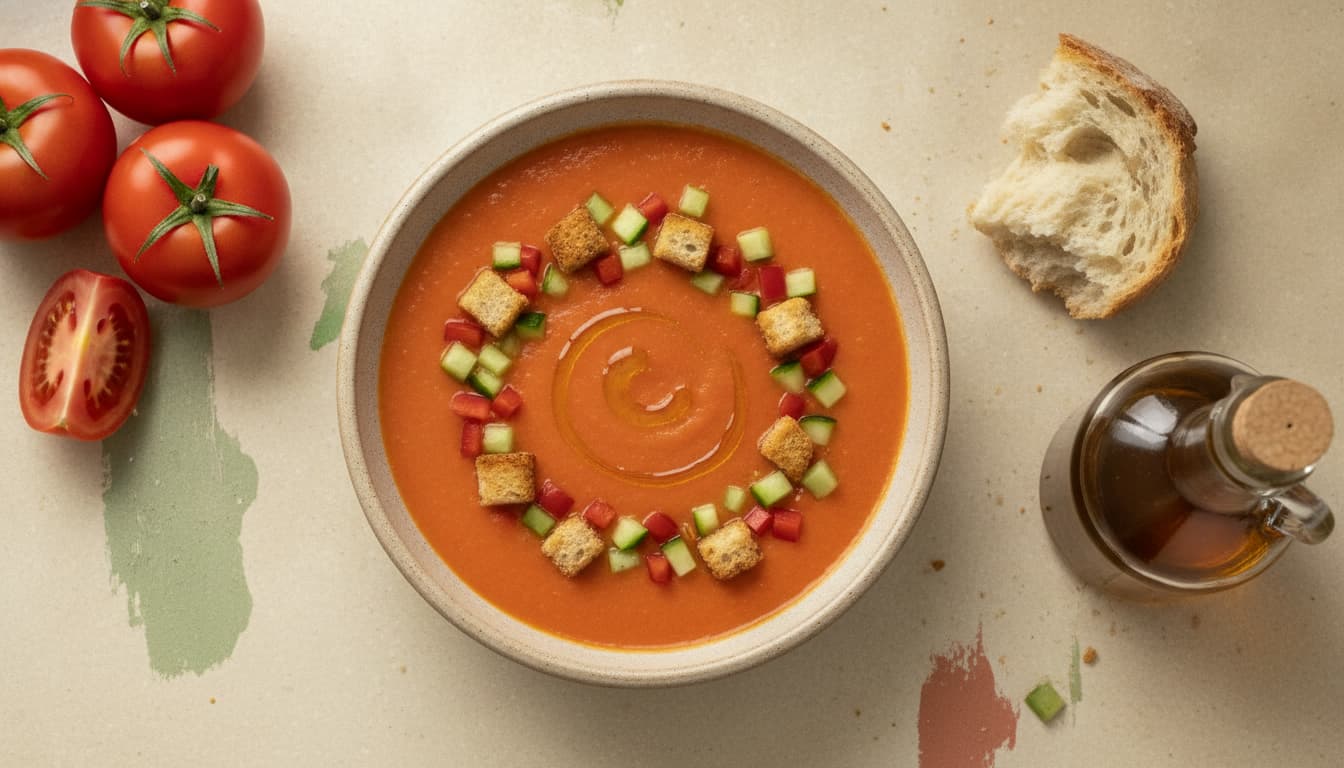
Chilled bowls, a hard pour of good olive oil over the surface, a spoonful of finely diced cucumber and green pepper, and cracked black pepper. In Spain it is often drunk from a glass, which is worth trying. Croutons fried in olive oil, diced hard-boiled egg, jamon or a few cooked prawns turn it from a starter into lunch. It keeps three days refrigerated, separates slightly on standing, and comes straight back with a whisk.
The variations worth making, and the one that is not
Watermelon gazpacho, with a pound of the tomato swapped for watermelon, is genuinely good and needs an extra tablespoon of vinegar to stop it reading as a drink. Green gazpacho built on cucumber, green grape, almond and a little avocado is a different dish and an excellent one. Ajoblanco, made with almonds, bread, garlic and no tomato at all, is the version to make in a bad tomato year. The one to skip is the chunky salsa-style version, which is a good tomato salad and not this.
Blender capacity, and the mistake people make doubling it
Three pounds of tomatoes plus bread and vegetables comes close to filling a standard 64oz jug before the oil goes anywhere near it, and an overfull blender cannot form the vortex that gets you a smooth result in two minutes. Doubling this means blending in two complete batches, oil and all, then combining and whisking, rather than blending double the solids and streaming double the oil into an overloaded jug. The second approach reliably breaks the emulsion and it is the usual reason a party-sized batch comes out thin.
Variations
Substitutions and adaptations land with the photography shoot. The method holds across most reasonable swaps.
Storage
Refrigerator: 3 to 4 days, sealed. Freezer: up to 3 months. Reheat covered to retain moisture.
Why we tested this gazpacho: an emulsion, not a cold tomato soup 3 times.
Every flagship recipe on this site goes through at least three rounds of kitchen testing before publication. We log what changed between tests so you can see the recipe's evolution, and so we can't quietly drop the failures.
- 01
Test 1
- What we tried
- Added the olive oil with everything else at the start of the blend, which is how most published recipes write it.
- What happened
- The soup stayed thin and red with a visible oil layer that reformed on the surface within a minute of pouring.
- What we changed
- Oil goes in last, in a thin stream, with the motor on low. The soup lightens to orange-pink and thickens as it emulsifies.
- 02
Test 2
- What we tried
- Skipped the bread entirely to keep it lower in carbohydrate.
- What happened
- It tasted fine and had the body of a juice. It also separated in the fridge inside an hour and needed re-whisking per bowl.
- What we changed
- Bread stays. A boiled potato or two tablespoons of raw almonds work as gluten-free structural substitutes.
- 03
Test 3
- What we tried
- Seasoned to taste at the blender and served it four hours later without tasting again.
- What happened
- Flat and slightly sweet at the table. Cold had knocked back both the salt and the vinegar noticeably.
- What we changed
- Final seasoning happens cold, straight from the fridge, and usually takes another half teaspoon of salt.
Frequently asked
- What is the difference between gazpacho and salmorejo?
- Salmorejo is thicker, from Cordoba, and contains only tomato, bread, garlic, olive oil and salt, with no cucumber, pepper or vinegar. It uses far more bread and oil, so it comes out as a dense orange cream usually served with jamon and chopped egg. Gazpacho is thinner, includes cucumber and green pepper, and is sharpened with sherry vinegar. Both are emulsified rather than merely blended, and both are served properly cold.
- Why is my gazpacho watery?
- Three likely causes. The olive oil went in at the start rather than being poured in slowly at the end, so the soup never emulsified. You left out the bread, which is the structural element rather than a filler. Or you added water to a batch made with tomatoes that were already low on flavour. Fix the blending order first, since that is the one that transforms the texture, and only add ice water if the mixture will genuinely not move in the blender.
- Can I make gazpacho without bread?
- You can, and it becomes a thinner drink that separates in the fridge. If you need it gluten-free, a small boiled and cooled potato or two tablespoons of raw blanched almonds provide the same starch structure and blend invisibly. Almonds also nudge the soup toward ajoblanco, which is no bad thing. Simply omitting the bread with no substitute gives you a tomato juice that needs whisking before every bowl.
- How long does gazpacho keep in the fridge?
- Three days in a sealed container, and it is at its best on day one and day two. It will separate slightly as it stands, which is normal for an emulsion and comes back with thirty seconds of whisking. The garlic continues to develop over that time and becomes more assertive, so a batch made for Monday will taste sharper by Wednesday. Do not freeze it, since the emulsion breaks permanently and the texture never recovers.
- Do I have to peel the tomatoes for gazpacho?
- No, if your blender is decent and you run it for a full two minutes. Tomato skin breaks down completely at that point and it carries fiber and lycopene worth keeping. If your tomatoes have tough skins, or you want the silky restaurant texture, either blanch and peel them or push the finished soup through a fine-mesh sieve. Straining is the easier route and costs you about a cup of volume and most of the fiber.
- What can I use instead of sherry vinegar?
- Nothing is a true match, since the oak-aged nuttiness of vinagre de Jerez is part of what defines the flavour. If you have none, red wine vinegar is the nearest, used at about two thirds the quantity because it is sharper, with a quarter teaspoon of sherry or dry white wine added to fill the gap. Avoid balsamic, which is sweet and turns the colour brown, and avoid cider vinegar, which brings a distinct apple note.
- Is gazpacho actually healthy?
- It is one of the better things you can eat in August. A bowl here is about 185 calories with 4g of fiber, built almost entirely on raw vegetables and extra-virgin olive oil, which is close to the archetype of a mediterranean diet plate. Raw tomatoes carry lycopene and vitamin C, and the olive oil improves absorption of the fat-soluble carotenoids among them. The sodium is worth watching if you are on a low-sodium plan, since the salt is doing real seasoning work.
- Can I make gazpacho with canned tomatoes?
- Yes, and out of season it is the better choice. Use good whole peeled San Marzano tomatoes, drain off the packing liquid, and expect to add a pinch of sugar to counter the slight tinny acidity that canning brings. The result is genuinely good, if a little flatter and less perfumed than a peak-season fresh batch. It is certainly better than the same recipe made with hard pink February tomatoes, which no technique can rescue.
Related recipes
See all →Tabbouleh: A Parsley Salad With Bulgur In It, Not the Reverse
Almost every tabbouleh sold outside the Levant has the ratio backwards: a bowl of wet bulgur with parsley stirred through. The Lebanese version is three quarters herbs by volume, with fine bulgur used the way you would use breadcrumbs, soaked in tomato juice rather than boiled. Forty-five minutes, no cooking at all, and most of the work is drying parsley and chopping it properly.
45m4g ProteinCarbonara: Four Ingredients, One Temperature, No Cream
Carbonara is not a cream sauce and it is not scrambled eggs. It is an emulsion of egg yolk, rendered pork fat, grated sheep cheese and starchy pasta water, held together by heat that stops just short of setting the egg. Everything that goes wrong goes wrong in the last ninety seconds. Thirty minutes, four ingredients, and a pan that comes off the burner before the eggs arrive.
30m27g ProteinBolognese: A Meat Sauce With Milk in It, and Almost No Tomato
The sauce most people call bolognese is a tomato sauce with ground beef stirred through it. The Bolognese ragu is the opposite: a large amount of meat, a small amount of tomato, milk simmered in before the wine, and three hours at a heat so low the surface barely moves. It is not a weeknight sauce and it does not benefit from being rushed. What it does benefit from is a wide pan and a Sunday.
240m32g Protein
Get a tested recipe + a nutritional note in your inbox each Sunday.
One recipe a week, photographed on the same Tuesday it tested. Reviewed by an RD. No promotions, no pop-ups, no tracking.
The Clean Chef Starter Kit.
A 14-day anti-inflammatory meal plan PDF, grocery list by section, macros totaled per day, Sunday prep sequence. Free.
By subscribing, you agree to our Privacy Policy. One calm email a week. Unsubscribe anytime.
We're building a shop.
Curated cookware, pantry staples we actually buy, recipe-bundle PDFs. Be the first to know when it opens.
We'll only email you about the shop opening. Unsubscribe in any email. See our Privacy Policy.