- Calories
- 520
- Protein
- 32g
- Fiber
- 4g
- Sat. fat
- 10g
- Sodium
- 640mg
- Added sugar
- 2g
What this recipe does for you.
The sauce most people call bolognese is a tomato sauce with ground beef stirred through it. The Bolognese ragu is the opposite: a large amount of meat, a small amount of tomato, milk simmered in before the wine, and three hours at a heat so low the surface barely moves. It is not a weeknight sauce and it does not benefit from being rushed. What it does benefit from is a wide pan and a Sunday.
Why this works
Every recipe on this site ships with an explanation of the technique decisions, why sear then braise, why the acid goes in at the end, why the fat renders before the aromatics. The method below is those decisions, in order.
Ingredients
Serves 6- 1 lbground beef chuck · 80/20, coarsely ground if your butcher will do it, not lean mince
- 12 ozground pork · shoulder, it brings fat and a sweetness beef does not have
- 4 ozpancetta · finely chopped by hand, or pulsed in a food processor to a paste
- 1 mediumonion · diced as finely as you can manage, about 1 cup
- 2 mediumcarrots · diced to the same size as the onion, about 3/4 cup
- 2 ribscelery · diced to the same size, about 3/4 cup, strings pulled off first
- 1 1/2 cupswhole milk · warmed, added before the wine, and this is not optional
- 1 cupdry white wine · a Pignoletto or any dry unoaked white, red is the Northern-Italian minority view
- 2 tbsptomato paste · cooked out until it darkens
- 1 cupcanned whole tomatoes · crushed by hand, and yes, that really is all the tomato in it
- 2 cupsbeef or chicken stock · low-sodium, warm, added in stages across the three hours
- 1 pinchfreshly grated nutmeg · about 1/8 tsp, the classic Emilian note
- 2 tbspunsalted butter · with the olive oil at the start, and a knob stirred in at the end
- 2 tbspextra-virgin olive oil · for the soffritto
- 1 1/2 tspkosher salt · added in stages, tasting each time
- 1/2 tspblack pepper · freshly ground
- 1 lbfresh egg tagliatelle · or dried tagliatelle or pappardelle, and not spaghetti
- 1 cupParmigiano-Reggiano · finely grated, half stirred through, half at the table
Method
What the sauce actually is, and what it is not
The ragu registered by the Accademia Italiana della Cucina in Bologna is a meat sauce with a supporting amount of tomato, enriched with milk, thickened only by reduction, and served on fresh egg tagliatelle. Volume-wise it is roughly two parts meat to one part everything else. The dish sold worldwide as spaghetti bolognese inverts that ratio and swaps the pasta. Both can be dinner. Only one of them is what this page is about, and the difference is not snobbery, it is a different sauce.
Two meats, ground coarse, and one of them is pork
Beef chuck at eighty percent lean brings the flavour and the collagen. Ground pork shoulder brings fat that stays soft over three hours and a mild sweetness that keeps the sauce from reading one-note. Skip the pork and the ragu tastes flatter and drier, no matter how long you cook it. Ask for a coarse grind if you can, because fine supermarket mince packs into pellets in the pan. Lean ground beef is the wrong choice here in every respect.
Pancetta chopped to a paste, not diced
Four ounces of pancetta, chopped by hand until it is nearly a paste or pulsed in a processor, goes into the pot first and melts almost completely into the soffritto. Cut into cubes it stays as identifiable chewy bits, which belongs in an amatriciana rather than here. What you want is its fat and its cured depth distributed invisibly through three hours of sauce. Rendered slowly over medium-low for five minutes before the vegetables go in.
The soffritto takes twenty minutes and there is no shortcut
Equal-ish parts onion, carrot and celery, all diced to the same small size so they cook at the same rate, into the pancetta fat with the butter and olive oil over medium-low. Twenty minutes, stirring occasionally, until everything is soft, translucent and just beginning to take colour at the edges. Vegetables that are still crunchy at this stage never dissolve later, and you end up with a sauce that has bits in it rather than a sauce with body.
Brown the meat properly, and do it in two batches
Push the soffritto aside or lift it out, raise the heat, and add half the meat in a single layer. Leave it alone for four minutes before breaking it up, so at least one surface actually browns. A crowded pan releases water, the temperature drops below the Maillard range, and the meat greys and boils. Repeat with the second half. Grey mince is the most common reason a home ragu tastes thin after three hours of cooking, and no amount of time fixes it.
Milk before wine, which is the step that surprises people
Warm milk goes in over the browned meat and soffritto, and it simmers gently until it has almost completely evaporated, about twenty-five minutes. Do it in this order. Milk added after an acidic liquid curdles visibly, and while a curdled ragu still tastes fine it looks wrong. Added first, the milk proteins coat the meat, tenderise it, and take the hard edge off the beef. The sauce that comes out three hours later is rounder in a way that is hard to attribute until you cook it without.
Then the wine, reduced hard until the sharpness is gone
A cup of dry white, scraping the pan base, simmered until it has nearly disappeared, about fifteen minutes. White is the Bologna standard and gives a cleaner sauce. Red is used across parts of Emilia-Romagna and makes something darker and more tannic, which is a legitimate variation rather than an error. What matters is reducing it properly. Wine left half-reduced stays sharp and thin through the whole cook, and three hours will not soften it.
One cup of tomato, and that really is all
Two tablespoons of tomato paste cooked out for two minutes until it darkens to brick, then one cup of hand-crushed canned whole tomatoes. That is the entire tomato content for six servings. The point of the tomato here is acidity and a little colour, not the body of the sauce. A whole can, which is what most recipes call for, turns the ragu into a tomato sauce with meat in it and washes out everything the milk and the long reduction were for.
Three hours at a bare blip, uncovered or barely covered
Add a cup of warm stock, bring it to a simmer, then drop the heat until a bubble breaks the surface every few seconds and no faster. Leave the lid ajar. Three hours minimum, four is better, adding warm stock half a cup at a time whenever the surface looks dry. What you are doing is converting connective tissue to gelatin and reducing water, and both need time rather than heat. A rolling simmer gives you tough meat in a watery sauce.
How to tell when it is done, which is not by the clock
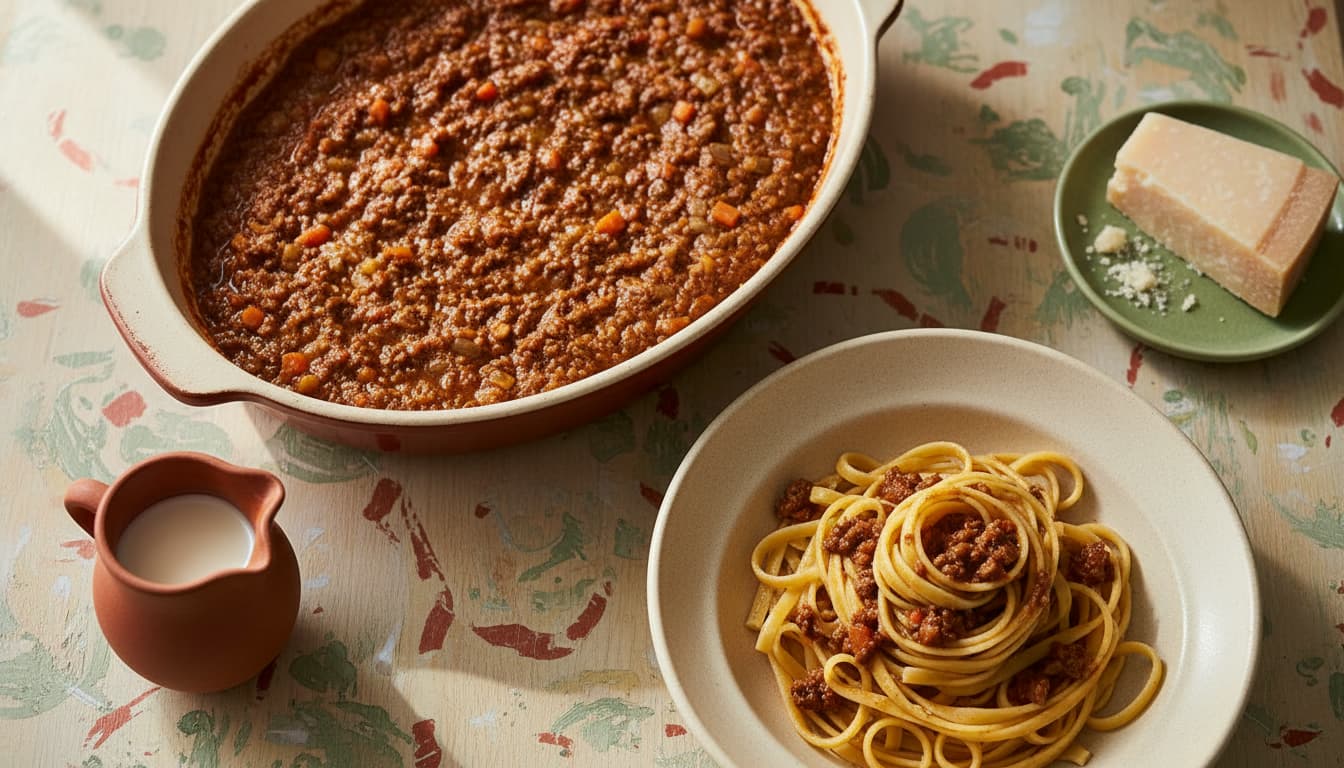
Finished ragu is thick enough that a spoon dragged across the pan base leaves a channel that fills in slowly. The fat has separated and sits in orange pools on the surface, which is a sign of success rather than a fault, and it emulsifies back in when you stir. The meat should be soft enough to crush against the side of the pan. If it is still firm and the sauce still watery at three hours, it needs another forty minutes, not more flour or paste.
Salt in stages, taste every time, and the nutmeg goes in late
Season lightly at the soffritto, again after the meat browns, and adjust twice during the simmer. A sauce that reduces by half concentrates whatever salt is already in it, so salting to taste at the start guarantees an oversalted result at the end. The pinch of nutmeg goes in during the last thirty minutes, because it is volatile and three hours of simmering drives it off. Grate it fresh. Pre-ground nutmeg tastes of dust.
Tagliatelle, and the reason spaghetti is wrong
Bolognese is a heavy, chunky, fat-rich sauce, and it needs a wide flat noodle with a porous surface to hold it. Fresh egg tagliatelle is the traditional pairing and pappardelle works equally well. Round smooth spaghetti sheds the sauce, which is why a plate of spaghetti bolognese always ends with a pool of meat at the bottom of the bowl. If dried is what you have, buy bronze-die tagliatelle or use rigatoni, whose tubes trap the sauce instead.
Finish the pasta in the sauce, with butter and a splash of water
Drain the tagliatelle a minute short, and never rinse it. Move it straight into a wide pan with enough ragu to coat and a ladle of pasta water, add a knob of butter, and toss over low heat for a minute until the sauce clings and glosses. Then half the Parmigiano off the heat. Sauce spooned on top of a mound of drained pasta is the other reason a home version disappoints. The pasta has to be dressed, not garnished.
It is better on day two, and it freezes as well as anything
Cool it, refrigerate it, eat it tomorrow. The fat sets and can be lifted or stirred back, the meat reabsorbs seasoned liquid, and the whole thing integrates. It keeps four days refrigerated and three months frozen, and it portions well into flat freezer bags, which makes it one of the few genuine meal prep sauces that loses nothing. Reheat gently with a splash of stock or water. This is also the sauce for a proper lasagna, layered with bechamel.
Variations
Substitutions and adaptations land with the photography shoot. The method holds across most reasonable swaps.
Storage
Refrigerator: 3 to 4 days, sealed. Freezer: up to 3 months. Reheat covered to retain moisture.
Why we tested this bolognese: a meat sauce with milk in it, and almost no tomato 3 times.
Every flagship recipe on this site goes through at least three rounds of kitchen testing before publication. We log what changed between tests so you can see the recipe's evolution, and so we can't quietly drop the failures.
- 01
Test 1
- What we tried
- Added the wine before the milk, on the assumption the order was arbitrary.
- What happened
- The milk hit an acidic pan and split immediately into visible curds. The finished sauce tasted acceptable and looked grainy throughout.
- What we changed
- Milk goes in first and reduces away completely before any wine or tomato touches the pot.
- 02
Test 2
- What we tried
- Used a full 28oz can of tomatoes, which is what most English-language recipes call for.
- What happened
- Three hours later it was a good tomato sauce with meat in it. The milk, the pancetta and the long reduction were undetectable.
- What we changed
- One cup of crushed tomatoes plus two tablespoons of paste, for six servings, and no more.
- 03
Test 3
- What we tried
- Simmered at a visible bubble to get it done in ninety minutes for a weeknight test.
- What happened
- The liquid reduced on schedule but the meat stayed firm and slightly chalky, and the sauce never developed the gelatinous cling.
- What we changed
- Lowest possible heat, lid ajar, three hours minimum, with warm stock added whenever the surface looks dry.
Frequently asked
- What is the difference between bolognese and spaghetti bolognese?
- Ragu alla bolognese is a meat-dominant sauce with about a cup of tomato in it, enriched with milk, simmered for three hours and served on fresh egg tagliatelle. Spaghetti bolognese, which is a British and American dish rather than an Italian one, is a tomato-dominant sauce with ground beef, usually cooked in under an hour and served on spaghetti. They are different sauces on different pasta. Both are worth cooking; only one is what Bologna serves.
- Why do you put milk in bolognese?
- Milk proteins tenderise the meat and round off the harsh edges of the beef, and the lactose adds a faint sweetness that balances the wine and tomato acidity. It is a defining feature of the Emilian ragu rather than an optional enrichment. It must go in before the wine and tomato, because milk added to an acidic pan curdles. Add it warm, let it simmer until it has almost entirely evaporated, then move on.
- Can I make bolognese in less than three hours?
- You can make a good quick meat sauce in an hour, but it will not be this. Three hours is what converts the connective tissue in the chuck into gelatin and reduces the liquid to the point where the sauce clings. A pressure cooker gets you closer than a fast stovetop simmer does, at about forty-five minutes at high pressure with the liquid reduced afterwards in a wide pan, and it is the only shortcut worth the trade.
- White wine or red wine in bolognese?
- White is the Bologna standard and gives a cleaner, lighter sauce that lets the milk and meat come forward. Red is common elsewhere in Emilia-Romagna and further south, and produces something darker and more tannic. Neither is wrong. What matters is that it is dry, unoaked and reduced properly. Half-reduced wine of either colour stays sharp for the entire three hours, and nothing you add later will soften it.
- What pasta should I serve with bolognese?
- Fresh egg tagliatelle, traditionally, or pappardelle. Both are wide, flat and porous, and a heavy meat sauce clings to them. Rigatoni is the good short-shape alternative because the tubes trap sauce. Spaghetti sheds it, which is why the classic plate ends with meat at the bottom of the bowl and naked pasta on the fork. Whatever you use, finish the pasta in the pan with the sauce and a splash of pasta water rather than spooning it on top.
- Why is my bolognese watery?
- Almost always because the lid was on and the heat was too high. A covered pot returns condensed steam to the sauce, so it never reduces no matter how long it cooks, and a fast simmer boils rather than reduces. Cook with the lid ajar or off, at a heat where a bubble breaks every few seconds. If it is still thin at three hours, take the lid fully off and give it another forty minutes rather than adding a thickener.
- Can you freeze bolognese?
- Yes, and it is one of the best sauces to freeze. Cool it fully, portion it into flat freezer bags, and it keeps three months with no meaningful loss. It also improves in the fridge overnight, so making a double batch and freezing half is the sensible way to spend three hours. Reheat gently from frozen or thawed with a splash of stock or water, and finish the pasta in the reheated sauce rather than pouring it over.
- Do you put garlic and herbs in bolognese?
- The registered Bologna recipe contains neither garlic nor basil nor oregano, and the only aromatic beyond the soffritto is a little nutmeg. That is not a rule you have to follow, but it is worth cooking once as written before deciding. Garlic and dried herbs push the sauce toward a generic Italian-American register and away from the milk-and-meat character that makes this specific. A bay leaf during the simmer is a common and unobjectionable addition.
- Can I make bolognese with just beef?
- You can, and it will be noticeably drier and flatter. Pork shoulder contributes fat that stays soft through a long simmer and a sweetness beef lacks, and the pancetta contributes cured depth. If pork is off the table, use a fattier beef grind, add an extra tablespoon of butter at the end, and accept a slightly one-dimensional result. Veal in place of pork is the traditional third meat in some versions and works well.
Related recipes
See all →Gazpacho: An Emulsion, Not a Cold Tomato Soup
The Andalusian version is thick, orange-pink and creamy without any dairy in it, and the two things that get it there are stale bread and olive oil poured in slowly at the end. Watery red gazpacho is a blender-order problem. It needs genuinely ripe tomatoes, sherry vinegar rather than any other kind, and four hours in the fridge, which the time on this page includes.
270m4g ProteinTabbouleh: A Parsley Salad With Bulgur In It, Not the Reverse
Almost every tabbouleh sold outside the Levant has the ratio backwards: a bowl of wet bulgur with parsley stirred through. The Lebanese version is three quarters herbs by volume, with fine bulgur used the way you would use breadcrumbs, soaked in tomato juice rather than boiled. Forty-five minutes, no cooking at all, and most of the work is drying parsley and chopping it properly.
45m4g ProteinCarbonara: Four Ingredients, One Temperature, No Cream
Carbonara is not a cream sauce and it is not scrambled eggs. It is an emulsion of egg yolk, rendered pork fat, grated sheep cheese and starchy pasta water, held together by heat that stops just short of setting the egg. Everything that goes wrong goes wrong in the last ninety seconds. Thirty minutes, four ingredients, and a pan that comes off the burner before the eggs arrive.
30m27g Protein
Get a tested recipe + a nutritional note in your inbox each Sunday.
One recipe a week, photographed on the same Tuesday it tested. Reviewed by an RD. No promotions, no pop-ups, no tracking.
The Clean Chef Starter Kit.
A 14-day anti-inflammatory meal plan PDF, grocery list by section, macros totaled per day, Sunday prep sequence. Free.
By subscribing, you agree to our Privacy Policy. One calm email a week. Unsubscribe anytime.
We're building a shop.
Curated cookware, pantry staples we actually buy, recipe-bundle PDFs. Be the first to know when it opens.
We'll only email you about the shop opening. Unsubscribe in any email. See our Privacy Policy.