- Calories
- 250
- Protein
- 20g
- Fiber
- 2g
- Sat. fat
- 2g
- Sodium
- 480mg
- Added sugar
- 2g
What this recipe does for you.
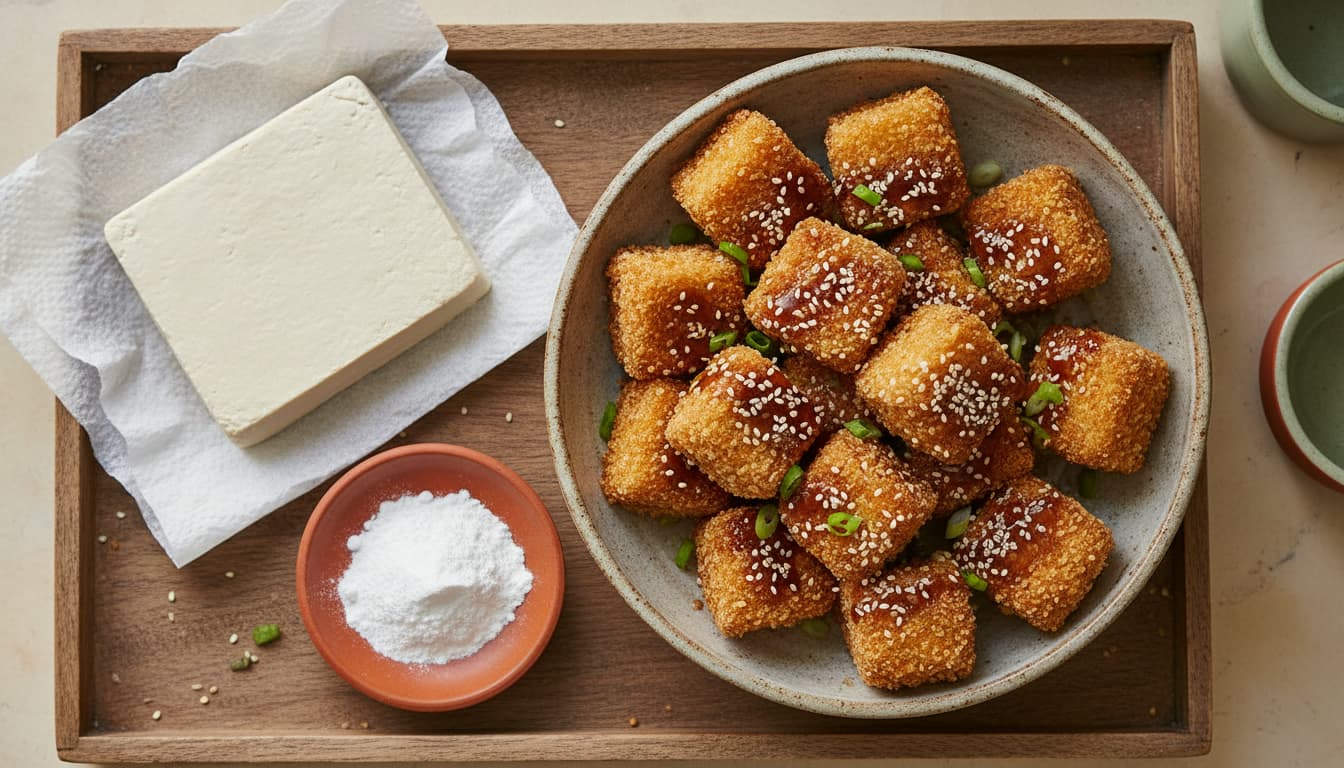
Tofu is bland and soggy for two mechanical reasons, and both are fixable. It is packed in water, so the surface cannot brown until that water is gone, and it is a set protein gel with no internal channels, so marinade does not penetrate it no matter how long you wait. Press it, coat it in cornstarch, fry it hard, and sauce it after it is crisp. An hour, most of it pressing.
Why this works
Every recipe on this site ships with an explanation of the technique decisions, why sear then braise, why the acid goes in at the end, why the fat renders before the aromatics. The method below is those decisions, in order.
Ingredients
Serves 4- 2 blocksextra-firm tofu · 14 oz each, water-packed, and not silken or the shelf-stable aseptic type
- 3 tbspcornstarch · or potato starch, which crisps slightly harder, tossed on immediately before frying
- 3/4 tspkosher salt · tossed with the starch, because seasoning the surface is the only seasoning that reaches you
- 3 tbspneutral high-smoke-point oil · avocado, refined peanut or rice bran, and enough to film the pan properly
- 3 tbspsoy sauce · or tamari for a gluten-free version, in the finishing sauce and not in a marinade
- 1 tbsprice vinegar · unseasoned
- 2 tspmaple syrup · it balances the soy and helps the sauce cling and gloss
- 3 clovesgarlic · minced, added to the pan in the last thirty seconds
- 1 tbspfresh ginger · grated on a microplane
- 1 tsptoasted sesame oil · off the heat, at the end
- 2 tspcornstarch · slaked in 2 tbsp cold water, to thicken the sauce in about fifteen seconds
- 3 wholescallions · sliced on a bias, for the finish
- 1 tbsptoasted sesame seeds · optional
- 1 tbspchili crisp · optional, at the table
Method
Buy the right firmness, because it is not a preference
Tofu firmness is a measure of how much water was pressed out during manufacture, and it determines what the block can physically do. Extra-firm and super-firm hold their shape, brown and can be tossed in a pan. Firm crumbles under a spatula. Soft and silken are custards that belong in soup, in a blender or eaten cold with soy and scallion, and no amount of technique makes silken tofu crisp. Buy the water-packed extra-firm block in the chiller.
Press it, and thirty minutes is the honest minimum
Drain the block, wrap it in a clean tea towel or several layers of paper towel, set it on a plate and put a cast iron pan or a few tins on top. Thirty minutes minimum, an hour if you have it. You will pour off a noticeable amount of liquid. Water on and in the surface has to boil off before the pan can get the tofu above 212F, which is where browning starts, and a wet block simply steams itself for five minutes first.
The freezer trick, which changes the texture completely
Freeze the drained block solid, then thaw it and press it. The water inside expands into ice crystals that rupture the protein matrix and leave a sponge behind, so the thawed tofu is chewier, more porous, and it presses out far more water. It is also the one state in which tofu genuinely absorbs marinade, because there are now channels for liquid to enter. Overnight in the freezer, a day in the fridge to thaw. It is a different ingredient.
Tear it instead of cubing it, at least once
Break the pressed block into rough one-inch pieces with your hands rather than cutting neat cubes. Torn edges have far more surface area and irregular ridges, which means more contact with the pan and more crisp exterior per piece, and they hold sauce the way a rough pasta surface does. Cubes look tidier and brown on six flat faces. For a stir-fry or a bowl, tear it. For anything where presentation matters, cube it and accept less crust.
Cornstarch is not optional, and it goes on at the last second
Toss the pieces with cornstarch and salt in a bowl until every surface is dusted, then get them into the pan within a minute or two. Starch gelatinises in the residual surface moisture and then dehydrates in hot oil into a thin brittle shell, which is the same mechanism behind Chinese velveting and Korean fried chicken. Left sitting, the coating turns into a wet paste that slides off. Potato starch is marginally crisper. Flour is a distant third.
Marinating before cooking does almost nothing, and here is why
Tofu is a coagulated soy protein gel. It is dense and closed, and unlike meat it has no muscle fibre structure or fat for flavour compounds to travel along. Soy sauce penetrates a few millimetres in several hours, and everything else in the marinade stays on the surface, where the water in it then actively prevents browning. Sauce it after it is crisp instead. The one exception is frozen and thawed tofu, which is porous enough to actually absorb.
Get the pan properly hot and use more oil than feels necessary
Cast iron or carbon steel, medium-high, heated until a drop of water skitters. Three tablespoons of oil for two blocks, which is enough to film the surface rather than to fry. Nonstick sounds sensible and produces pale tofu, because most coatings should not be taken to the temperature this needs. Lay the pieces in a single layer with space between them, and if they do not all fit, do it in two batches. A crowded pan steams.
Do not touch it for four minutes
Tofu sticks hard at first and then releases itself once a crust has formed, which is the same behaviour as a searing steak or a fish fillet. If you try to move it at ninety seconds it tears and leaves the crust in the pan. Leave it four minutes, then check one piece with a thin spatula. If it lifts cleanly it is ready to turn. Two or three turns total, about twelve minutes, and you want deep gold rather than pale.
The oven and air fryer methods, and what each is good for
Oven: 425F on a parchment-lined sheet, tossed in oil and starch, twenty-five to thirty minutes with one flip. Less crisp than the pan, entirely hands-off, and the right choice for a big batch. Air fryer: 400F for fifteen to eighteen minutes, shaking twice, and it gets closest to deep-fried with the least oil. Both need the same pressing and the same starch. Neither works if the tofu goes in wet, which is the mistake people blame on the appliance.
Sauce it in the last thirty seconds, off the direct heat
Once the tofu is crisp, push it to one side, add the garlic and ginger to the bare pan for twenty seconds until fragrant, then pour in the soy, vinegar, maple syrup and the slaked cornstarch. It thickens almost immediately. Toss the tofu through it, kill the heat, add the sesame oil and scallions. Total contact time under a minute. Any longer and the sauce soaks in and softens the shell you spent twelve minutes building.
Thirty seconds of salted water, the counterintuitive step for silken
For silken or soft tofu, which is too fragile to press or fry, simmer the block whole in salted water for two minutes and lift it out with a slotted spoon. The salt firms the exterior very slightly and seasons it, and the gentle heat drives off surface water so it does not dilute whatever you serve it with. Then dress it cold with soy, ginger, scallion and sesame oil, or slide it into miso soup at the very end.
Protein, and how tofu actually compares
Extra-firm tofu carries roughly 10g of protein per 100g, so a half-block serving here lands around 20g, which is comparable to two large eggs and about half of a chicken breast of the same weight. It is a complete protein containing all nine essential amino acids, which is unusual among plant sources. It is also a meaningful source of calcium when set with calcium sulphate, so it is worth checking the coagulant on the label.
Storage: change the water, and know what off smells like
An opened block keeps three to five days submerged in fresh cold water in a sealed container, with the water changed daily. Fresh tofu smells faintly of nothing or slightly sweet; sour, cheesy or sharply acidic means it is done, as does a slimy surface or water that has gone cloudy and thick. Cooked crisp tofu keeps four days and reheats acceptably in a hot dry pan or an air fryer, and badly in a microwave.
Where to put it, once you can cook it
Crisp tofu goes into a grain bowl with pickled vegetables, into fried rice at the last minute, into a noodle soup added at the table so it stays crunchy, into tacos with lime and cabbage, or straight into a lunchbox with rice and a separate pot of sauce. Treat it as a component with texture rather than as a meat replacement, and the vegan and vegetarian dinners it lands in stop reading as substitutions.
Variations
Substitutions and adaptations land with the photography shoot. The method holds across most reasonable swaps.
Storage
Refrigerator: 3 to 4 days, sealed. Freezer: up to 3 months. Reheat covered to retain moisture.
Why we tested this how to cook tofu: press it, coat it in starch, sauce it last 3 times.
Every flagship recipe on this site goes through at least three rounds of kitchen testing before publication. We log what changed between tests so you can see the recipe's evolution, and so we can't quietly drop the failures.
- 01
Test 1
- What we tried
- Marinated pressed tofu in soy, garlic and ginger for four hours before pan-frying it, expecting deeper flavour.
- What happened
- The interior was still bland beyond about two millimetres, and the wet surface prevented browning entirely for the first five minutes in the pan.
- What we changed
- No pre-marinade. The tofu is coated in starch and salt, fried until crisp, and sauced in the last thirty seconds.
- 02
Test 2
- What we tried
- Skipped the pressing on a super-firm vacuum-packed block, since it already felt dry to the touch.
- What happened
- It browned unevenly and took four minutes longer than the pressed control, though it was the only version that half worked without pressing.
- What we changed
- Water-packed blocks are pressed thirty minutes minimum. Vacuum-packed super-firm can go straight in, blotted, and is the shortcut worth paying for.
- 03
Test 3
- What we tried
- Tossed the tofu in cornstarch and let it sit for fifteen minutes while the pan heated and the sauce was mixed.
- What happened
- The starch hydrated into a gummy paste that slid off in the pan and left bare patches with no crust at all.
- What we changed
- The starch goes on immediately before the tofu hits the oil, never more than a minute or two ahead.
Frequently asked
- Do you have to press tofu?
- For water-packed extra-firm tofu, yes, if you want it to brown. Surface water has to evaporate before the pan can take the tofu above the temperature at which browning happens, so an unpressed block spends its first several minutes steaming itself. Thirty minutes under a weight is the honest minimum and an hour is better. The exception is vacuum-packed super-firm tofu, which has already been pressed at the factory and only needs blotting.
- How do you make tofu crispy?
- Press it, tear or cube it, toss it in cornstarch and salt immediately before cooking, and fry it in a properly hot pan with enough oil to film the surface, leaving it undisturbed for four minutes per side. The starch gelatinises in the residual surface moisture and then dehydrates into a thin brittle shell. Then sauce it in the last thirty seconds, because any sauce that sits on crisp tofu for more than a minute softens it.
- Does marinating tofu actually work?
- Barely, and it works against you. Tofu is a dense coagulated protein gel with no fibre structure or fat for flavour to travel through, so a marinade penetrates a couple of millimetres at most over several hours. Worse, the water in the marinade sits on the surface and blocks browning. Season the surface with salt in the starch coating and add a real sauce after cooking. Frozen and thawed tofu is the one form porous enough to absorb properly.
- What does freezing tofu do?
- It transforms the texture. The water inside forms ice crystals that rupture the protein matrix, and when it thaws you are left with a spongy, chewier, much more porous block that presses out far more liquid and genuinely absorbs marinade. It is closer to a meat texture and many people prefer it. Freeze the drained block overnight, thaw it in the fridge for a day, then press. Treat it as a different ingredient rather than an improvement.
- What kind of tofu should I buy?
- Extra-firm or super-firm water-packed tofu from the chiller for anything you intend to fry, roast or stir-fry. Firm is a step too soft and crumbles under a spatula. Soft and silken tofu are custards for soups, sauces, smoothies and cold dishes, and they cannot be made crisp. Shelf-stable aseptic-carton tofu is usually silken regardless of what the label claims. Check the coagulant too: calcium sulphate means the block is a decent calcium source.
- Is tofu a good source of protein?
- Yes. Extra-firm tofu carries about 10g of protein per 100g, so a serving here delivers around 20g, comparable to two large eggs. It is also a complete protein with all nine essential amino acids, which is unusual for a plant food, and it is naturally low in saturated fat. Tofu set with calcium sulphate contributes a useful amount of calcium as well, which matters on a vegan pattern where dairy is off the table.
- Can you cook tofu in an air fryer?
- Yes, and it gets closest to deep-fried of any home method. Press, tear, toss in oil then cornstarch and salt, and cook at 400F for fifteen to eighteen minutes, shaking the basket twice. It uses about a third of the oil the pan method does. The same rules apply: unpressed tofu will not crisp in an air fryer either, and the sauce goes on after cooking rather than before, in a bowl off the heat.
- How long does tofu last once opened?
- Three to five days refrigerated, submerged in fresh cold water in a sealed container, with the water changed every day. Fresh tofu smells of almost nothing. Sour, cheesy or sharply acidic smells, a slimy surface, or cloudy thickened water all mean it has gone. Cooked crisp tofu keeps four days and is best reheated in a hot dry pan or an air fryer for a few minutes, since a microwave turns the crust to rubber.
- Is tofu gluten-free?
- Plain tofu is made from soybeans, water and a coagulant, so it is naturally gluten-free. What is not is most of what people put on it: soy sauce is brewed with wheat, so use tamari or a certified gluten-free soy sauce, and check hoisin, oyster sauce, chili crisp and any pre-marinated or smoked flavoured tofu. The cornstarch coating is fine. Seitan, which sits next to tofu in most shops, is pure wheat gluten.
Related recipes
See all →- High-Protein
Beef Bourguignon: Dry the Meat, Crowd Nothing, Wait a Day
This is a braise that fails at the first step or not at all. Wet beef in a crowded pot steams, and a stew built on steamed beef cannot be rescued later by wine, stock or time. Dry the cubes, brown them in three batches, cook the garnish separately, and give it three hours at 325F. Then, ideally, put it in the fridge overnight, because the second day is a different dish.
240m42g Protein - High-Protein
Enchiladas: Fry the Tortillas, Fry the Sauce, Bake Them Briefly
Nearly every bad enchilada is the same enchilada: a raw corn tortilla soaked in canned sauce and baked until the whole tray turns to porridge. Two steps fix it permanently. Pass each tortilla through hot oil for twenty seconds so it waterproofs, and fry the blended chile sauce in fat before it goes anywhere near the pan. Ninety minutes, most of it the sauce, and twenty of it in the oven.
95m34g Protein - High-Protein
Chicken Parmesan: Pound It Thin, Sauce It Sparingly, Broil It Last
Chicken parmesan fails in one specific way: a good crust drowned under a blanket of sauce and forty minutes in the oven. The fix is to treat the crust as the point. Pound the breasts to an even half inch, coat in panko cut with grated Parmigiano, bake on a rack until crisp, then add sauce only down the centre and finish under the broiler for three minutes. Fifty-five minutes, one tray, and edges that still crunch.
55m52g Protein
Get a tested recipe + a nutritional note in your inbox each Sunday.
One recipe a week, photographed on the same Tuesday it tested. Reviewed by an RD. No promotions, no pop-ups, no tracking.
The Clean Chef Starter Kit.
A 14-day anti-inflammatory meal plan PDF, grocery list by section, macros totaled per day, Sunday prep sequence. Free.
By subscribing, you agree to our Privacy Policy. One calm email a week. Unsubscribe anytime.
We're building a shop.
Curated cookware, pantry staples we actually buy, recipe-bundle PDFs. Be the first to know when it opens.
We'll only email you about the shop opening. Unsubscribe in any email. See our Privacy Policy.