- Calories
- 560
- Protein
- 42g
- Fiber
- 4g
- Sat. fat
- 9g
- Sodium
- 720mg
- Added sugar
- 2g
What this recipe does for you.
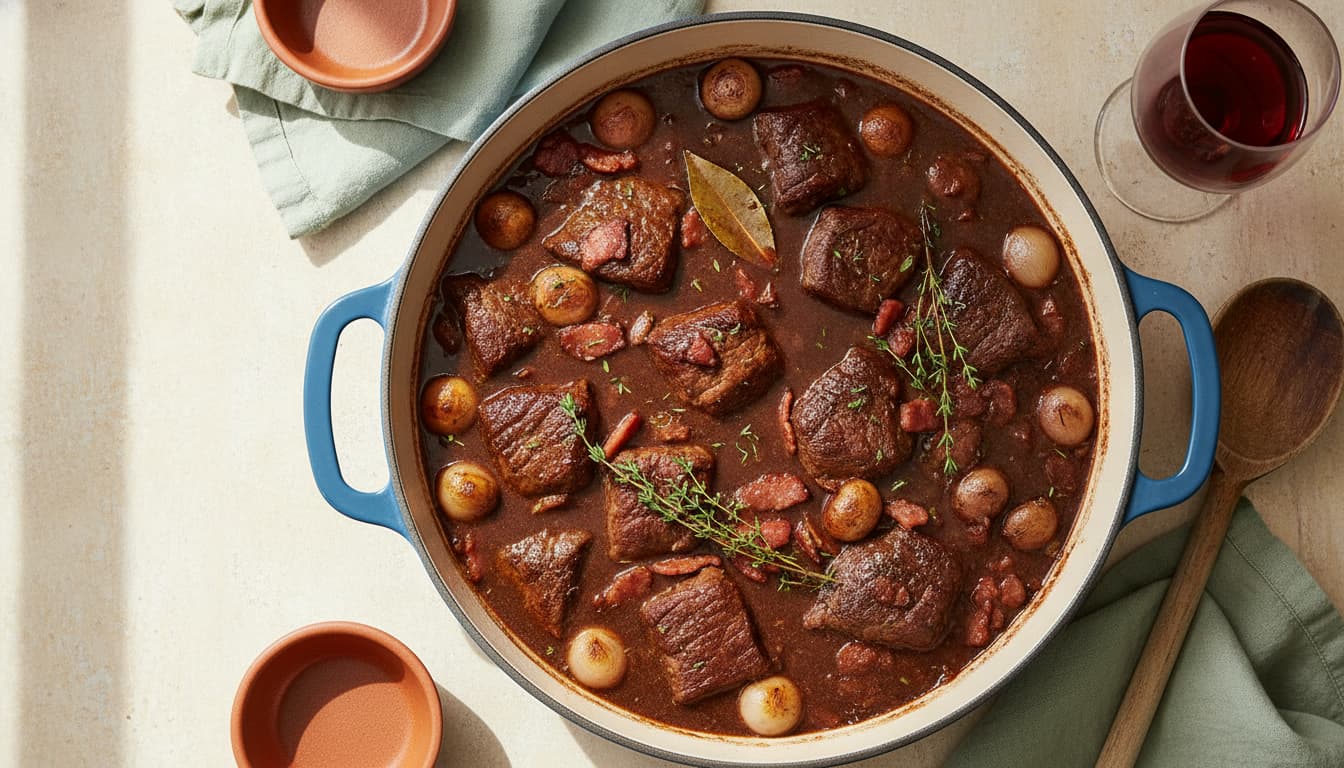
This is a braise that fails at the first step or not at all. Wet beef in a crowded pot steams, and a stew built on steamed beef cannot be rescued later by wine, stock or time. Dry the cubes, brown them in three batches, cook the garnish separately, and give it three hours at 325F. Then, ideally, put it in the fridge overnight, because the second day is a different dish.
Why this works
Every recipe on this site ships with an explanation of the technique decisions, why sear then braise, why the acid goes in at the end, why the fat renders before the aromatics. The method below is those decisions, in order.
Ingredients
Serves 6- 3 lbbeef chuck · cut into 2 inch cubes, trimmed of hard gristle but not of fat
- 6 ozslab bacon or lardons · unsmoked if you can find it, cut into 1/4 inch batons
- 1 1/2 tspkosher salt · for salting the beef an hour ahead
- 1 tspblack pepper · coarsely ground
- 3 tbsptomato paste · cooked out in the pot until it darkens
- 1/4 cupall-purpose flour · or 3 tbsp cornstarch slurry at the end for a gluten-free version
- 1 bottledry red wine · 750ml, a Pinot Noir or a Gamay, something you would actually drink
- 2 cupsbeef stock · low-sodium, warmed
- 2 largecarrots · cut into 1 inch chunks on a bias
- 1 largeonion · roughly chopped, this one dissolves into the sauce
- 4 clovesgarlic · smashed
- 1 wholebouquet garni · 4 thyme sprigs, 2 bay leaves and 10 parsley stems, tied with string
- 18 wholepearl onions · peeled, frozen are fine and save twenty minutes
- 1 lbcremini mushrooms · quartered, or halved if small
- 2 tbspunsalted butter · for the mushrooms and pearl onions
- 1 tbspneutral oil · avocado or refined peanut, for the searing
- 1/4 cupflat-leaf parsley · chopped, for the finish
- 1 tspred wine vinegar · to wake the sauce up at the very end, off the heat
Method
Buy chuck, and buy it as a whole piece
Chuck has the collagen that turns to gelatin over three hours and gives the sauce its body, and it has enough intramuscular fat to stay moist. Buy a whole chuck roast and cut it yourself into two-inch cubes, because pre-cut stewing beef is offcuts from several muscles that cook at different rates, which is why supermarket stew has some pieces dry and some still tough. Brisket and short rib both work. Round, sirloin and anything lean do not, at any cooking time.
Salt the cubes an hour ahead and leave them uncovered
Salt the beef, spread it on a rack over a tray, and leave it in the fridge for at least an hour and up to overnight. Two things happen. The salt penetrates rather than sitting on the surface, which seasons meat you cannot season later once it is in liquid. And the surface dries out, which is the single biggest factor in whether the sear browns or steams. An hour uncovered in a cold fridge is more effective than any amount of patting with paper towel.
Render the bacon first and pull it out
Cold pot, bacon batons, medium heat, eight to ten minutes until they are golden and have given up most of their fat. Lift them out with a slotted spoon and set them aside, because if they stay in for the whole braise they go soft and disappear. They go back in for the last twenty minutes. What you want from them now is the rendered fat, which browns beef better than oil does and carries flavour into everything that follows.
Three batches, and this is the step that decides the dish
Get the fat properly hot, add one third of the cubes with space between every piece, and do not touch them for four minutes. Turn, three more minutes, then out. Repeat twice. A crowded pot drops below the temperature at which the Maillard reaction runs, the meat releases water, and you end up boiling grey cubes in their own juice. There is no later step that puts that flavour back. Twenty minutes across three batches is the correct time budget.
Cook the tomato paste until it changes colour
After the last batch of beef comes out, add the chopped onion, carrot and garlic to the pot and cook for six minutes in the beef and bacon fat, then push them aside and spread the tomato paste across the pot floor. Leave it two full minutes until it goes from bright red to a dark brick colour and smells sweet rather than sharp. Raw tomato paste in a braise reads metallic all the way through and it is one of the more common faults in a home bourguignon.
Flour in the pot, not on the meat
Sprinkle the flour over the vegetables and stir for two minutes so it toasts in the fat before any liquid arrives. Dredging the beef in flour before searing is the classic instruction and it works against you: the coating burns during a proper hard sear, and it insulates the meat surface so it browns less. Toasting the flour separately gives you the same thickening with none of the pastiness. For a gluten-free version, skip it and use a cornstarch slurry at the end.
The wine, and the honest answer about which one
A whole bottle of dry red, and the classic choice is a Burgundy, meaning Pinot Noir. A Gamay or a light Cotes du Rhone works. What matters is that it is dry, not oaky and not a fourteen-percent fruit bomb, because three hours of reduction concentrates everything including the sweetness and the oak. Do not use anything sold as cooking wine, which is salted and thin. You do not need an expensive bottle. You need a drinkable one, and you should drink the rest.
Reduce the wine by a third before the stock goes in
Pour in the wine, scrape every brown patch off the pot floor with a wooden spoon while it bubbles, and let it reduce hard for eight to ten minutes. This drives off the raw alcohol, which otherwise stays sharp and thin through the whole braise, and it concentrates the wine flavour before it gets diluted. Then the stock, the beef with all its resting juices, and the bouquet garni. The liquid should come about three quarters of the way up the meat, not cover it.
Oven at 325F, lid on, three hours, and check at two and a half
The oven is better than the stove because heat comes from all sides and nothing catches on the bottom. Bring the pot to a bare simmer on the hob first, lid on, then into a 325F oven. Three hours. Start testing at two and a half by pressing a cube with a spoon: it should yield with almost no resistance and pull apart, but still be a cube rather than shreds. Overcooked braising beef goes dry and stringy, which surprises people who assume more time is always safer.
Cook the garnish separately, and never skip this
While the pot is in the oven, brown the pearl onions in butter in a skillet with a splash of water and a pinch of sugar until glazed, about twelve minutes, then set aside. In the same pan, cook the mushrooms hard in butter in a single layer without salt until they are deeply browned, eight to ten minutes. Both go into the pot for the last twenty minutes. Mushrooms and onions added at the start turn grey and waterlogged and give the sauce a muddy edge.
Degrease, then reduce the sauce if it needs it
Lift the meat and garnish out with a slotted spoon, and let the liquid settle for five minutes so the fat rises. Skim it with a ladle, or refrigerate overnight and lift the solid cap off, which is far easier. If the sauce is thin, boil it hard for ten minutes to reduce. It should coat the back of a spoon and hold a line when you draw a finger through it. Then everything goes back in, plus the reserved bacon, and warms through for ten minutes.
The overnight rest is worth more than any ingredient upgrade
Cool it, refrigerate it, and eat it the next day. The gelatin sets and redistributes, the wine and stock finish integrating, the fat cap lifts off in one piece, and the beef reabsorbs seasoned liquid as it cools rather than losing it. Reheat gently, covered, at 300F for forty minutes or on the lowest hob setting. Every restaurant that serves this makes it the day before, and if you have any choice about the timing, so should you.
Finish with acid, and serve it with something plain
A teaspoon of red wine vinegar stirred in off the heat lifts three hours of accumulated richness in a way that salt cannot, and nobody will taste vinegar. Then the parsley. Serve over buttered egg noodles, mashed potatoes or the polenta on this site, all of which exist to carry the sauce. A green salad with a sharp mustard vinaigrette on the side. Bread for the bowl. Nothing else on the plate needs to be interesting.
Variations
Substitutions and adaptations land with the photography shoot. The method holds across most reasonable swaps.
Storage
Refrigerator: 3 to 4 days, sealed. Freezer: up to 3 months. Reheat covered to retain moisture.
Why we tested this beef bourguignon: dry the meat, crowd nothing, wait a day 3 times.
Every flagship recipe on this site goes through at least three rounds of kitchen testing before publication. We log what changed between tests so you can see the recipe's evolution, and so we can't quietly drop the failures.
- 01
Test 1
- What we tried
- Seared all three pounds of beef in one crowded batch to save fifteen minutes on a weeknight test.
- What happened
- The pot dropped temperature, the beef released liquid and simmered grey. The finished stew tasted thin and no amount of reduction fixed it.
- What we changed
- Three batches with space between the cubes, twenty minutes total. This is the step that decides the dish.
- 02
Test 2
- What we tried
- Added the mushrooms and pearl onions at the start, along with the wine, for a genuine one-pot version.
- What happened
- Both turned grey and waterlogged over three hours, and the mushrooms leached enough liquid to make the sauce muddy.
- What we changed
- Garnish is browned separately in butter and added for the final twenty minutes.
- 03
Test 3
- What we tried
- Served it straight out of the oven against an identical batch rested overnight and reheated.
- What happened
- The day-one version was good and slightly disjointed, with visible fat on the surface. The day-two version was noticeably deeper, and the fat lifted off in one solid piece.
- What we changed
- The recipe now assumes an overnight rest, with same-day timings given as the compromise rather than the default.
Frequently asked
- What cut of beef is best for beef bourguignon?
- Chuck, bought as a whole roast and cubed at home. It carries the collagen that becomes gelatin over three hours and gives the sauce body, plus enough intramuscular fat to stay moist. Pre-packed stewing beef is offcuts from several different muscles that cook at different rates, which is why some pieces come out dry and some tough in the same pot. Brisket and boneless short rib are both excellent alternatives. Lean cuts like round or sirloin will not work at any cooking time.
- What wine should I use for beef bourguignon?
- A dry red Burgundy, meaning Pinot Noir, is the traditional and the best choice. Gamay, a light Cotes du Rhone or an unoaked Merlot all work. Avoid heavily oaked, jammy or high-alcohol wines, because three hours of reduction concentrates oak and residual sugar into something unpleasant. Never use anything labelled cooking wine, which is salted and thin. You do not need to spend much, but the rule holds: if you would not drink a glass, do not braise in it.
- Can I make beef bourguignon ahead of time?
- You should. It is measurably better on day two, when the gelatin has set and redistributed, the wine and stock have integrated, and the fat has risen into a solid cap you can lift off in one piece. Cool it, refrigerate up to three days, and reheat covered at 300F for forty minutes. It also freezes well for three months, though the pearl onions soften, so add fresh browned ones during the reheat if you care about the texture.
- Why is my beef bourguignon tough?
- Almost always because it is undercooked rather than overcooked. Collagen needs sustained time above about 160F to break down into gelatin, and beef in a braise passes through a stage at ninety minutes where it is firmer than it was raw. Give it another forty-five minutes and test again. The other cause is the wrong cut: a lean cut has no collagen to convert, so it goes from raw to dry with no tender stage in between, and more time makes it worse.
- Can I make beef bourguignon in a slow cooker or Instant Pot?
- Yes, with the searing done on the hob first, which is not optional in either appliance. In a slow cooker, eight hours on low, and reduce the wine separately in a pan first since a slow cooker cannot boil off alcohol. In an Instant Pot, thirty-five minutes at high pressure with a fifteen-minute natural release. Both produce good stew and neither produces the reduced, glossy sauce of the oven version, so plan to reduce the liquid in a wide pan at the end.
- How do I thicken beef bourguignon sauce?
- First reduce it, which concentrates flavour at the same time. Lift the solids out, boil the liquid hard for ten minutes and see where you are. If it still needs help, whisk a tablespoon of cornstarch into two tablespoons of cold water and stir it in over heat, or mash equal parts soft butter and flour into a beurre manie and whisk that in. The sauce is right when it coats the back of a spoon and holds a line drawn with a finger.
- What is the difference between beef bourguignon and beef stew?
- Bourguignon is a specific regional French braise defined by red Burgundy as the braising liquid and by three garnishes added at the end: lardons, glazed pearl onions and browned mushrooms. An American beef stew is usually built on stock with potatoes and carrots cooked in the pot throughout, and it is thicker and less winey. The garnish-cooked-separately step is the main technical difference, and it is why bourguignon has distinct components rather than a uniform texture.
- Is beef bourguignon gluten-free?
- Not as traditionally written, since it is thickened with flour, but it converts easily. Skip the flour entirely, braise as written, then reduce the sauce and finish with a slurry of three tablespoons of cornstarch in cold water. Check the stock, which is where gluten most often hides in this dish, particularly in bouillon cubes and concentrates. Serve it over mashed potatoes or polenta rather than egg noodles and the whole plate is gluten-free.
Related recipes
See all →- High-Protein
How to Cook Tofu: Press It, Coat It in Starch, Sauce It Last
Tofu is bland and soggy for two mechanical reasons, and both are fixable. It is packed in water, so the surface cannot brown until that water is gone, and it is a set protein gel with no internal channels, so marinade does not penetrate it no matter how long you wait. Press it, coat it in cornstarch, fry it hard, and sauce it after it is crisp. An hour, most of it pressing.
60m20g Protein - High-Protein
Enchiladas: Fry the Tortillas, Fry the Sauce, Bake Them Briefly
Nearly every bad enchilada is the same enchilada: a raw corn tortilla soaked in canned sauce and baked until the whole tray turns to porridge. Two steps fix it permanently. Pass each tortilla through hot oil for twenty seconds so it waterproofs, and fry the blended chile sauce in fat before it goes anywhere near the pan. Ninety minutes, most of it the sauce, and twenty of it in the oven.
95m34g Protein - High-Protein
Chicken Parmesan: Pound It Thin, Sauce It Sparingly, Broil It Last
Chicken parmesan fails in one specific way: a good crust drowned under a blanket of sauce and forty minutes in the oven. The fix is to treat the crust as the point. Pound the breasts to an even half inch, coat in panko cut with grated Parmigiano, bake on a rack until crisp, then add sauce only down the centre and finish under the broiler for three minutes. Fifty-five minutes, one tray, and edges that still crunch.
55m52g Protein
Get a tested recipe + a nutritional note in your inbox each Sunday.
One recipe a week, photographed on the same Tuesday it tested. Reviewed by an RD. No promotions, no pop-ups, no tracking.
The Clean Chef Starter Kit.
A 14-day anti-inflammatory meal plan PDF, grocery list by section, macros totaled per day, Sunday prep sequence. Free.
By subscribing, you agree to our Privacy Policy. One calm email a week. Unsubscribe anytime.
We're building a shop.
Curated cookware, pantry staples we actually buy, recipe-bundle PDFs. Be the first to know when it opens.
We'll only email you about the shop opening. Unsubscribe in any email. See our Privacy Policy.