- Calories
- 540
- Protein
- 52g
- Fiber
- 3g
- Sat. fat
- 9g
- Sodium
- 820mg
- Added sugar
- 3g
What this recipe does for you.
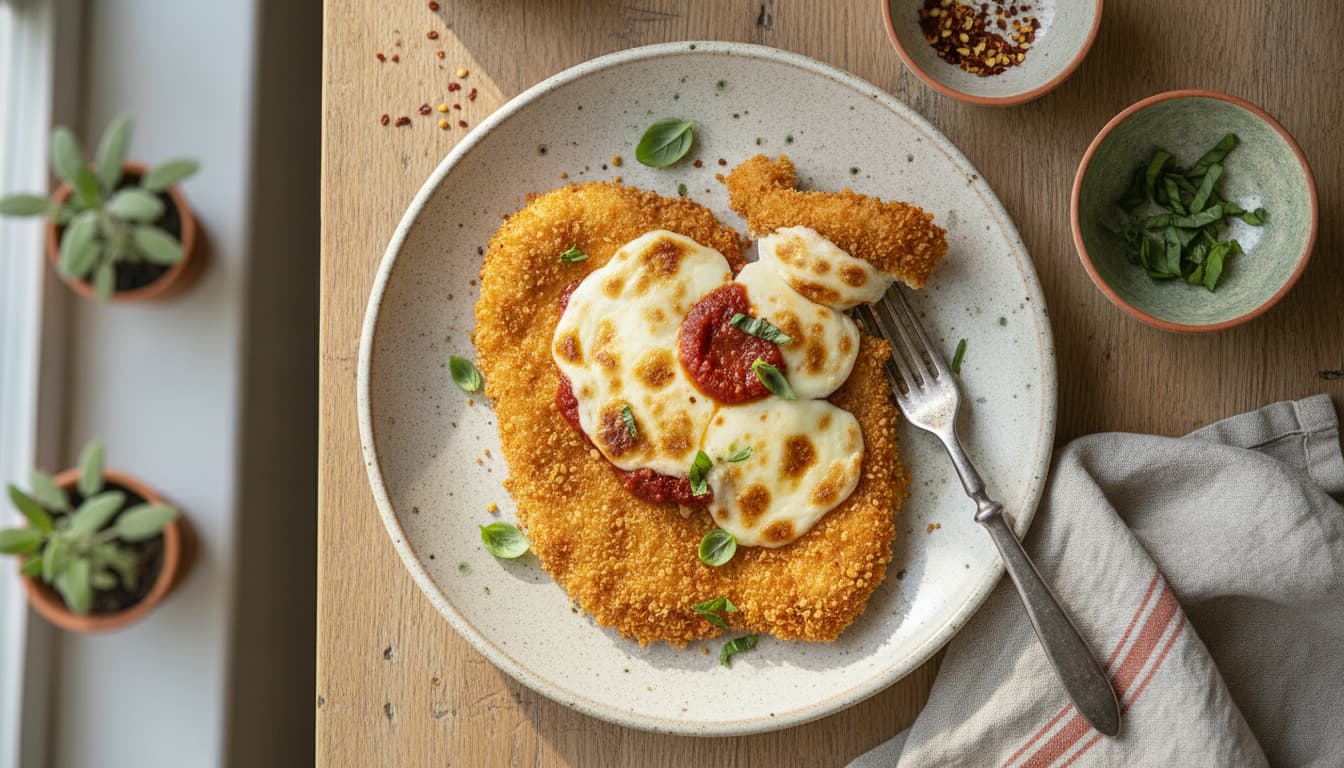
Chicken parmesan fails in one specific way: a good crust drowned under a blanket of sauce and forty minutes in the oven. The fix is to treat the crust as the point. Pound the breasts to an even half inch, coat in panko cut with grated Parmigiano, bake on a rack until crisp, then add sauce only down the centre and finish under the broiler for three minutes. Fifty-five minutes, one tray, and edges that still crunch.
Why this works
Every recipe on this site ships with an explanation of the technique decisions, why sear then braise, why the acid goes in at the end, why the fat renders before the aromatics. The method below is those decisions, in order.
Ingredients
Serves 4- 2 largeboneless skinless chicken breasts · about 1 1/2 lb, halved horizontally into 4 cutlets, then pounded
- 1 1/2 tspkosher salt · for salting the cutlets thirty minutes ahead
- 1/2 cupall-purpose flour · or a cup-for-cup gluten-free blend, seasoned with salt and pepper
- 2 largeeggs · beaten with a tablespoon of water so the wash is thin enough to drain
- 1 1/2 cupspanko breadcrumbs · toasted dry in a pan until pale gold before they touch the chicken
- 3/4 cupParmigiano-Reggiano · finely grated, half into the panko and half over the finished dish
- 1 tspdried oregano · rubbed between your palms into the crumb mixture
- 1/2 tspgarlic powder · in the crumb, because fresh garlic burns in a crust
- 1/2 tspblack pepper · freshly ground, in the crumb
- 1/4 cupextra-virgin olive oil · brushed or drizzled over the crumbed cutlets before baking
- 1 canwhole peeled tomatoes · 28 oz, crushed by hand, San Marzano if the budget allows
- 3 clovesgarlic · thinly sliced, for the sauce
- 2 tbspolive oil · for the sauce
- 1 pinchred pepper flakes · optional, about 1/4 tsp
- 6 leavesfresh basil · torn, half into the sauce at the end and half over the plate
- 6 ozlow-moisture mozzarella · grated from a block, not fresh mozzarella, and not from a bag
- 1 tspred wine vinegar · stirred into the sauce off the heat
Method
Halve the breasts horizontally before you pound anything
A whole chicken breast is an inch and a half thick at one end and a quarter inch at the other, and no amount of pounding evens that out without shredding the thin end. Lay the breast flat, hand on top, and run a sharp knife through it horizontally to make two thin cutlets. Then pound. You get four evenly sized pieces from two breasts, they cook in the same time, and none of them is dry at the tip.
Half an inch, even, and use a bag rather than plastic wrap
Put each cutlet in a zip-top bag with the air pressed out and work from the centre outward with the flat side of a mallet or the base of a heavy pan. Half an inch, and check by eye across the whole surface rather than the middle. The bag stops tearing and stops the counter becoming a biohazard. Thinner than half an inch and the chicken overcooks before the crust colours. Thicker and the reverse happens.
Salt thirty minutes ahead, then dry the surface
Salt the pounded cutlets and leave them on a rack at room temperature for thirty minutes. The salt draws moisture out, dissolves in it, and gets reabsorbed as seasoned brine, which seasons the meat rather than the crust. Just before breading, blot the surface with paper towel. A wet surface makes the flour gluey, and gluey flour is where a crust that slides off in one sheet begins.
Toast the panko before it touches the chicken
Dry skillet, medium heat, panko stirred constantly for four minutes until it is the colour of pale straw. This is the single highest-return step in the recipe. Raw panko in a hot oven has to both cook and colour, and the chicken is done before the crumb has browned, which is why so many baked versions come out pale and sandy. Pre-toasted crumb only needs to crisp, and it goes the colour of good fried chicken.
Parmigiano in the crumb, not just on top
Half the grated Parmigiano goes into the panko with the oregano, garlic powder and pepper. Cheese in the coating browns and hardens into the crust rather than sitting on it, which is where most of the parmesan flavour in a good chicken parmesan actually lives. Grate it fine. Coarse shreds in a crumb create pockets that scorch. The other half goes over the finished plate, where the heat is gone and the flavour stays sharp.
Flour, egg, crumb, and press hard at the last stage
Three shallow dishes. Flour seasoned with salt and pepper, then egg beaten with a tablespoon of water so it drains rather than clings in a thick layer, then the crumb. Shake off the flour, let the egg drip for a count of three, then press the cutlet into the crumb firmly on both sides and on the edges. Pressing is what makes the coating adhere. A crumb that is only sprinkled on falls off in the oven.
Bake on a rack at 425F, and oil the crumb rather than the pan
Set a wire rack inside a rimmed sheet pan, lay the cutlets on it with space between them, and drizzle or brush olive oil over the top surface. The rack lets hot air reach the underside so it crisps rather than steams in its own moisture, which is the whole reason baked versions usually have a soggy bottom. Fifteen minutes at 425F, no flipping. Oil on the crumb rather than the pan means the coating fries where it matters.
Cook the sauce while the chicken bakes, and keep it short
Sliced garlic in olive oil over medium until it is fragrant and just turning gold, ninety seconds. Hand-crushed tomatoes, a pinch of chili flakes, salt, then twenty minutes at a gentle simmer while you deal with the chicken. That is enough. A tomato sauce for this dish should be loose, bright and slightly acidic, because it is a counterweight to a rich fried crust. Basil and a teaspoon of vinegar go in off the heat.
Sauce down the centre only, and leave the edges bare
Two heaped tablespoons per cutlet, spooned in a stripe down the middle, and nothing within an inch of the edge. This is the instruction that separates a good chicken parmesan from a wet one. You get sauce in every bite of the middle and a dry crunchy border all the way around, and the underside never gets a chance to go soft. Sauce poured over the whole cutlet turns the crust you just built into a paste.
Low-moisture mozzarella, grated, and never fresh
Fresh mozzarella packed in water is sixty percent water, and under a broiler it releases all of it directly onto your crust. Low-moisture mozzarella melts into stretchy sheets and browns. Grate it from the block, because bagged shreds are dusted with starch or cellulose that makes them break into oil. About an ounce and a half per cutlet, laid over the sauce stripe only. Provolone mixed in at a quarter is a good sharper variation.
Three minutes under the broiler, watched, and then it is done
Rack six inches from the element, broiler on high, and do not walk away. Three minutes takes the cheese from solid to bubbling with brown blisters. Four takes it to burnt. The chicken is already cooked at this point, so the broiler is doing one job only. Check the thickest part reads 165F on a thermometer before the cheese goes on, not after, because you cannot probe through a molten top without wrecking it.
Why the classic casserole method produces soggy chicken parmesan
The standard instruction is to fry the cutlets, lay them in a baking dish, cover them in sauce and cheese, and bake for twenty-five minutes at 375F. In a covered dish, steam has nowhere to go, so it condenses on the crust from below and above. Everything you gained from the breading is lost in the first ten minutes. Baking on a rack and finishing under a broiler takes the same total time and keeps the texture.
Serve the pasta beside it, not underneath it
A cutlet set on a bed of spaghetti sits in whatever liquid the pasta releases, and the underside is soft before it reaches the table. Dress the pasta separately with the remaining sauce and put it alongside, or skip pasta and serve a sharply dressed escarole or arugula salad with lemon and olive oil, which is what most Italian-American kitchens actually do. Garlic bread is fine. Anything wet under the chicken is not.
Gluten-free, air fryer and make-ahead versions that hold up
For gluten-free, use a cup-for-cup blend in the flour stage and crushed gluten-free cornflakes or GF panko in the crumb, toasted the same way. In an air fryer, 400F for ten minutes crumb-side up, then add sauce and cheese and give it two more. To get ahead, bread the cutlets and refrigerate them uncovered on a rack for up to eight hours, which actually improves adhesion. Do not sauce or cheese anything until the moment it goes under the broiler.
Variations
Substitutions and adaptations land with the photography shoot. The method holds across most reasonable swaps.
Storage
Refrigerator: 3 to 4 days, sealed. Freezer: up to 3 months. Reheat covered to retain moisture.
Why we tested this chicken parmesan: pound it thin, sauce it sparingly, broil it last 3 times.
Every flagship recipe on this site goes through at least three rounds of kitchen testing before publication. We log what changed between tests so you can see the recipe's evolution, and so we can't quietly drop the failures.
- 01
Test 1
- What we tried
- Used untoasted panko and baked at 425F for the full fifteen minutes as written.
- What happened
- The chicken hit 165F on schedule and the crumb was still pale and slightly powdery. Another five minutes browned it and dried the chicken out.
- What we changed
- Panko is toasted dry in a skillet to pale gold before breading. The bake then only has to crisp it, not colour it.
- 02
Test 2
- What we tried
- Assembled the baked cutlets in a dish, covered them fully in sauce and cheese, and baked twenty-five minutes at 375F.
- What happened
- The crust was completely gone. What came out was a good braised chicken cutlet with no texture anywhere on it.
- What we changed
- Sauce goes in a stripe down the centre, edges stay bare, and the finish is three minutes under the broiler on the rack.
- 03
Test 3
- What we tried
- Used fresh mozzarella torn over the top, on the assumption better cheese meant a better dish.
- What happened
- It released a pool of water that ran off the cutlet and softened the crust from the edges inward within two minutes.
- What we changed
- Low-moisture mozzarella grated from the block, which melts and browns without shedding liquid.
Frequently asked
- Why is my chicken parmesan soggy?
- Because the sauce covered the whole cutlet and because it baked covered. A breaded crust survives contact with sauce for a few minutes, not twenty-five. Spoon sauce in a stripe down the centre only, leave an inch of bare crust around the edge, and finish under a broiler for three minutes rather than baking the assembled dish. Baking on a wire rack rather than directly on the pan fixes the other half of the problem, which is a steamed underside.
- Should chicken parmesan be fried or baked?
- Baked on a rack at 425F gets you within a hair of pan-fried, provided you toast the panko first and oil the crumb rather than the pan. Shallow frying in a quarter inch of oil gives a marginally better crust, takes about the same time, and leaves you with a pan of hot oil to deal with. Deep frying is unnecessary for a half-inch cutlet. The pre-toasted crumb is what closes the gap.
- What is the difference between chicken parmesan and chicken parmigiana?
- Nothing. Parmigiana is the Italian name, parmesan is the anglicised one, and parmo in parts of northern England is a related but different dish made with bechamel instead of tomato. The dish itself is Italian-American rather than Italian: melanzane alla parmigiana, made with aubergine, is the Neapolitan original, and the chicken version was built by Italian immigrants in the United States where meat was cheap and plentiful.
- Can I make chicken parmesan ahead of time?
- Bread the cutlets up to eight hours ahead and leave them uncovered on a rack in the fridge. The coating dries slightly and adheres better than freshly breaded chicken does. The sauce keeps five days. What you cannot do ahead is assemble it, because sauce sitting on crumb destroys the crust within an hour. Bake, sauce and broil in the last twenty minutes before you eat, which is a fast finish from a fully prepped start.
- Can I freeze chicken parmesan?
- Freeze the breaded raw cutlets, laid flat on a tray until solid then bagged, for up to three months, and bake from frozen at 425F for about twenty-two minutes before saucing. That works well. Freezing a finished assembled dish does not, because the crust is already compromised and thawing adds more water to it. The sauce freezes perfectly on its own, so making a double batch of sauce is the useful freezer move here.
- What cheese is best for chicken parmesan?
- Low-moisture mozzarella grated from a block for the melt, and Parmigiano-Reggiano for the flavour, split between the crumb coating and the finished plate. Fresh mozzarella releases too much water and will soften the crust under the broiler. Bagged pre-shredded cheese is coated in starch to stop it clumping, and that coating makes it break into oil rather than melt. A quarter of the mozzarella swapped for provolone gives a sharper result.
- How do I keep the breading from falling off?
- Dry the chicken thoroughly before the flour, shake off all excess flour, let the egg drip for a count of three, and then press the crumb on firmly rather than sprinkling it. Excess flour and excess egg both create a slick layer that the crumb sits on rather than bonds to. Chilling the breaded cutlets uncovered on a rack for thirty minutes before baking sets the coating and is worth doing if you have the time.
- Is chicken parmesan high in protein?
- Yes, at about 52g per serving from a six-ounce cutlet plus the cheese, which makes it one of the higher-protein dinners on this site. The calorie load comes from the breading, the oil and the mozzarella rather than from the chicken. If you want to shift the ratio, cut the mozzarella to an ounce per cutlet and serve it with a green salad rather than pasta, which takes about 200 calories off the plate without touching the crust.
- Can I make chicken parmesan gluten-free?
- Easily. Use a cup-for-cup gluten-free flour blend in the dredge and either certified gluten-free panko or crushed gluten-free cornflakes in the crumb, toasted dry in a pan exactly as written. Crushed pork rinds also work and go extremely crisp. Check the canned tomatoes and any stock, and the whole dish is gluten-free. Serve it with a salad or with gluten-free pasta rather than trying to adapt a breadcrumb-heavy side.
Related recipes
See all →- High-Protein
Beef Bourguignon: Dry the Meat, Crowd Nothing, Wait a Day
This is a braise that fails at the first step or not at all. Wet beef in a crowded pot steams, and a stew built on steamed beef cannot be rescued later by wine, stock or time. Dry the cubes, brown them in three batches, cook the garnish separately, and give it three hours at 325F. Then, ideally, put it in the fridge overnight, because the second day is a different dish.
240m42g Protein - High-Protein
How to Cook Tofu: Press It, Coat It in Starch, Sauce It Last
Tofu is bland and soggy for two mechanical reasons, and both are fixable. It is packed in water, so the surface cannot brown until that water is gone, and it is a set protein gel with no internal channels, so marinade does not penetrate it no matter how long you wait. Press it, coat it in cornstarch, fry it hard, and sauce it after it is crisp. An hour, most of it pressing.
60m20g Protein - High-Protein
Enchiladas: Fry the Tortillas, Fry the Sauce, Bake Them Briefly
Nearly every bad enchilada is the same enchilada: a raw corn tortilla soaked in canned sauce and baked until the whole tray turns to porridge. Two steps fix it permanently. Pass each tortilla through hot oil for twenty seconds so it waterproofs, and fry the blended chile sauce in fat before it goes anywhere near the pan. Ninety minutes, most of it the sauce, and twenty of it in the oven.
95m34g Protein
Get a tested recipe + a nutritional note in your inbox each Sunday.
One recipe a week, photographed on the same Tuesday it tested. Reviewed by an RD. No promotions, no pop-ups, no tracking.
The Clean Chef Starter Kit.
A 14-day anti-inflammatory meal plan PDF, grocery list by section, macros totaled per day, Sunday prep sequence. Free.
By subscribing, you agree to our Privacy Policy. One calm email a week. Unsubscribe anytime.
We're building a shop.
Curated cookware, pantry staples we actually buy, recipe-bundle PDFs. Be the first to know when it opens.
We'll only email you about the shop opening. Unsubscribe in any email. See our Privacy Policy.