- Calories
- 520
- Protein
- 38g
- Fiber
- 11g
- Sat. fat
- 4g
- Sodium
- 480mg
- Added sugar
- 1g
What this recipe does for you.
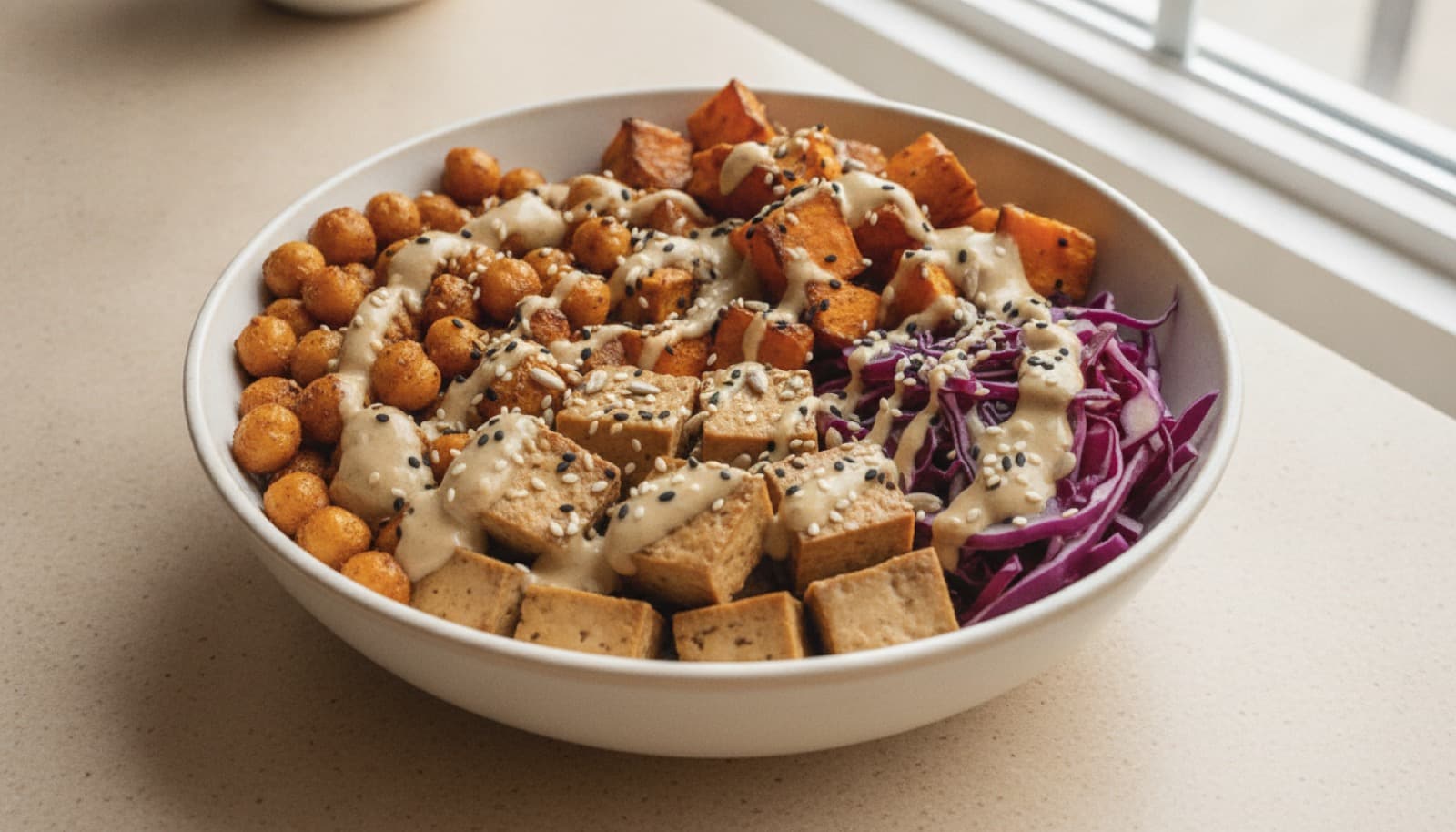
A buddha bowl that actually hits the protein number. Roasted chickpeas and sweet potato off one sheet pan, a grain base, marinated baked tofu or chicken, and a tahini-lemon sauce that ties it together. 35 minutes, 38g protein.
Why this works
Every recipe on this site ships with an explanation of the technique decisions, why sear then braise, why the acid goes in at the end, why the fat renders before the aromatics. The method below is those decisions, in order.
A real protein anchor, not just chickpeas
Most buddha bowls online top out around 15g of protein because they lean on vegetables and a scoop of grains and call the chickpeas the protein. They are not enough on their own. The bowls that actually hit 38g add a dedicated anchor: a block of extra-firm tofu pressed and baked, or shredded chicken, or a couple of soft-boiled eggs, layered on top of the chickpeas rather than instead of them. For the vegetarian version, buy extra-firm tofu and press it; for the meat version, use rotisserie or leftover roast chicken. The chickpeas are the texture and fiber, the anchor is the macro.
Ingredients
Serves 4- 14 ozextra-firm tofu · pressed, cubed (or 1.5 cups shredded cooked chicken)
- 15 ozchickpeas · canned, drained and dried
- 1 mediumsweet potato · peeled, half-inch dice
- 3 tbspolive oil
- 1 tspground cumin
- 1 tspsmoked paprika
- 1 tbsptamari · or soy sauce, for the tofu
- 1 tspcornstarch · for the tofu crust
- 1 cupquinoa · dry
- 1/4 cuptahini
- 1lemon · juiced
- 1 clovegarlic · grated
- 2 cupsred cabbage · shredded, or cucumber and grated carrot
- 2 tbsppumpkin seeds
- kosher salt · to taste
Method
Press the tofu while the oven heats
If you are going vegetarian, a 14-ounce block of extra-firm tofu wrapped in a towel under a heavy pan for 10 minutes, which is exactly the time the oven needs to reach 425F. Pressing drives out water so the tofu browns and crisps instead of steaming. Cut it into cubes after pressing. If you are using chicken, skip this and shred a cup and a half of cooked chicken while the vegetables roast.
One sheet pan: chickpeas and sweet potato together
A drained, rinsed, and well-dried can of chickpeas and one peeled sweet potato in a half-inch dice, tossed with two tablespoons of olive oil, a teaspoon of cumin, smoked paprika, and salt, spread on one sheet pan. Dry the chickpeas hard with a towel first or they will not crisp. Roast at 425F for 20 minutes, shaking the pan once. They share a pan and a temperature, which is the whole time-saving move.
Bake the tofu on its own corner or a second small pan
Toss the pressed tofu cubes in a tablespoon of olive oil, a tablespoon of soy sauce or tamari, and a teaspoon of cornstarch, which is what makes the crust. Give it room on the sheet pan or use a second small one, because crowding steams it. Same 425F, same 20 minutes, flipping once. It comes out golden and chewy rather than wet.
Cook the grain base while the pan roasts
A cup of dry quinoa or brown rice, started in salted water the moment the sheet pan goes in, finishes right as the vegetables do. Quinoa adds about 8g of protein per cooked cup, more than rice, so it is the better base for the macro. Cook it in broth instead of water for more flavor. Fluff and let it sit covered off the heat for 5 minutes so it is not gluey.
Make the tahini-lemon sauce, thin it more than feels right
A quarter cup of tahini, the juice of one lemon, a grated garlic clove, salt, and water added a tablespoon at a time. Tahini seizes and goes paste-thick when the lemon hits it, which alarms people; keep whisking and adding water and it loosens into a pourable, creamy sauce. Make it thinner than looks right, because it firms up on the cold grains. This is what ties the bowl together.
Add a raw, crunchy, and acidic element
Roasted-and-grain bowls go one-note and soft without contrast. Add something raw and crisp: shredded red cabbage, sliced cucumber, or grated carrot, and something acidic like quick-pickled red onion or a handful of arugula. This is the difference between a bowl you finish and one you abandon halfway. Two minutes of knife work, big payoff.
Build it in layers, sauce last
Grain on the bottom, then the roasted chickpeas and sweet potato, then the protein anchor, then the raw crunch, then the sauce drizzled over everything and a scatter of seeds. Building in sections rather than tossing keeps each component distinct and is also what makes a buddha bowl photograph and eat well. Toss it together at the table once you have looked at it.
Finish with seeds or nuts for fat and crunch
A tablespoon of pumpkin seeds, hemp hearts, or chopped toasted almonds over the top adds a final crunch plus a few grams of protein and healthy fat. Hemp hearts are the protein-densest option at about 10g per three tablespoons. Toast nuts in a dry pan for two minutes first; raw nuts on a bowl taste like an afterthought, toasted ones taste deliberate.
Meal prep: store components separately, sauce on the side
This is built for prep. Roast a double batch of chickpeas and sweet potato, cook extra grain, and bake extra tofu, then store each component in its own container for four days. Keep the tahini sauce and the raw vegetables separate so nothing goes soggy, and assemble bowls to order in two minutes. The crisp components soften if dressed and stored, which is the one rule.
Hit the protein number on purpose, not by hope
The arithmetic, per bowl: chickpeas about 7g, quinoa about 8g, tahini and seeds about 6g, and the anchor (tofu or chicken) about 17g, which lands near 38g. Drop the anchor and you are at 21g, a snack bowl, not a meal. If you want 45g-plus, add a soft-boiled egg or a second scoop of tofu. Know which version you are making before you build it.
Variations
Substitutions and adaptations land with the photography shoot. The method holds across most reasonable swaps.
Storage
Refrigerator: 3 to 4 days, sealed. Freezer: up to 3 months. Reheat covered to retain moisture.
Frequently asked
- What exactly is a buddha bowl, and what makes one high-protein?
- A buddha bowl is a one-bowl meal built from a grain base, roasted and raw vegetables, a protein, and a sauce, arranged in sections rather than mixed. There is no single recipe; it is a format. What makes most of them low in protein is treating chickpeas as the only protein, which tops out around 15g. The high-protein version adds a dedicated anchor (tofu, chicken, or eggs) on top of the chickpeas and uses quinoa rather than rice, which together push the bowl to 38g or more.
- How do I get tofu to actually crisp instead of going soggy?
- Three steps. Buy extra-firm, not firm or silken, then press it under a weight for 10 minutes to drive out water, because water is what steams instead of browning. Toss the cubes in a teaspoon of cornstarch along with the oil, which forms the crisp crust in the oven. And give it room on the pan; crowded tofu steams in its own moisture. Baked at 425F for 20 minutes with one flip, pressed and cornstarched tofu comes out golden and chewy.
- Can I make this vegan, and does it stay high-protein?
- Yes on both. The recipe as written with tofu is already vegan if you use tamari rather than fish-sauce-containing soy and skip any egg topping, and it holds 38g of protein from the tofu, chickpeas, quinoa, and seeds. The tahini-lemon sauce is naturally vegan. To go higher, add edamame to the bowl, which brings about 17g per cooked cup, or use hemp hearts generously on top.
- Why use quinoa instead of rice for the base?
- Quinoa is a complete protein and carries about 8g per cooked cup, against roughly 5g for brown rice and less for white, so swapping the base alone adds a few grams toward the target. It also has more fiber, which is part of why this bowl reaches 11g of fiber per serving. Rice is fine if you prefer it or want the milder flavor; you will just lose a little of the protein and fiber and may want to bump the tofu to compensate.
- How long do the components keep for meal prep?
- Four days in the fridge if you store each component separately in glass containers. The roasted chickpeas and sweet potato, the grain, and the tofu all hold well; the chickpeas soften from their peak crisp but still taste good. Keep the tahini sauce in its own jar (it thickens cold, so loosen with a splash of water) and the raw vegetables undressed and separate. Assembled, dressed bowls go soggy within a day, so build them to order.
- My tahini sauce seized into a thick paste. Did I ruin it?
- No, that is normal and fixable. Tahini tightens and clumps the instant acid hits it, which feels like a mistake but is just the emulsion forming. Keep whisking and add water one tablespoon at a time; it will loosen from paste to a smooth, pourable cream within four or five tablespoons of water. Make it looser than you think you want, because it firms up again on the cold grain base in the bowl.
Related recipes
See all →- High-Protein
Beef Bourguignon: Dry the Meat, Crowd Nothing, Wait a Day
This is a braise that fails at the first step or not at all. Wet beef in a crowded pot steams, and a stew built on steamed beef cannot be rescued later by wine, stock or time. Dry the cubes, brown them in three batches, cook the garnish separately, and give it three hours at 325F. Then, ideally, put it in the fridge overnight, because the second day is a different dish.
240m42g Protein - High-Protein
How to Cook Tofu: Press It, Coat It in Starch, Sauce It Last
Tofu is bland and soggy for two mechanical reasons, and both are fixable. It is packed in water, so the surface cannot brown until that water is gone, and it is a set protein gel with no internal channels, so marinade does not penetrate it no matter how long you wait. Press it, coat it in cornstarch, fry it hard, and sauce it after it is crisp. An hour, most of it pressing.
60m20g Protein - High-Protein
Enchiladas: Fry the Tortillas, Fry the Sauce, Bake Them Briefly
Nearly every bad enchilada is the same enchilada: a raw corn tortilla soaked in canned sauce and baked until the whole tray turns to porridge. Two steps fix it permanently. Pass each tortilla through hot oil for twenty seconds so it waterproofs, and fry the blended chile sauce in fat before it goes anywhere near the pan. Ninety minutes, most of it the sauce, and twenty of it in the oven.
95m34g Protein
Get a tested recipe + a nutritional note in your inbox each Sunday.
One recipe a week, photographed on the same Tuesday it tested. Reviewed by an RD. No promotions, no pop-ups, no tracking.
The Clean Chef Starter Kit.
A 14-day anti-inflammatory meal plan PDF, grocery list by section, macros totaled per day, Sunday prep sequence. Free.
By subscribing, you agree to our Privacy Policy. One calm email a week. Unsubscribe anytime.
We're building a shop.
Curated cookware, pantry staples we actually buy, recipe-bundle PDFs. Be the first to know when it opens.
We'll only email you about the shop opening. Unsubscribe in any email. See our Privacy Policy.