- Calories
- 320
- Protein
- 13g
- Fiber
- 11g
- Sat. fat
- 1g
- Sodium
- 380mg
- Added sugar
- 0g
What this recipe does for you.
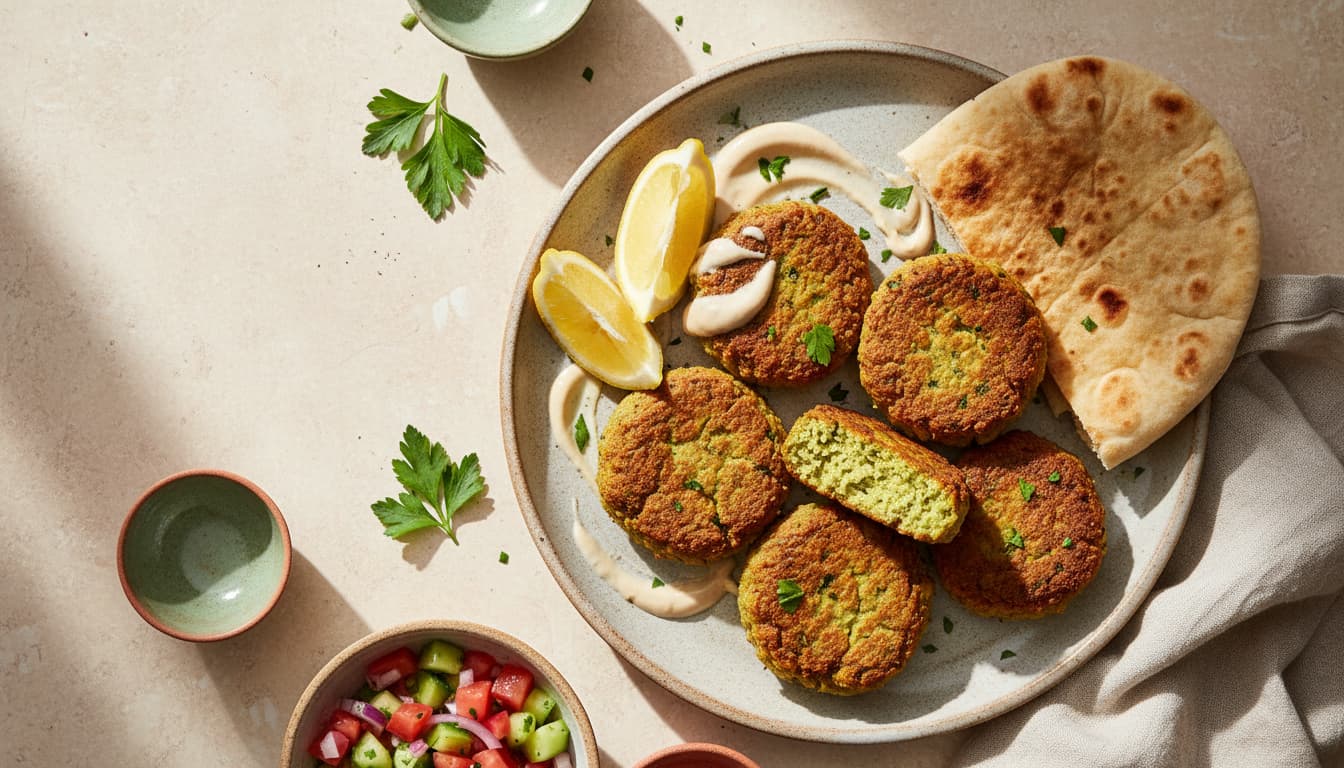
A falafel that comes out crisp outside and fluffy green inside without a vat of frying oil: it is built the authentic way from dried chickpeas soaked overnight and never cooked, packed with parsley and cilantro, ground coarse so it holds together, then baked or air-fried with a brush of oil for a proper crust. It is naturally vegan, gluten-free, and dairy-free, it freezes brilliantly, and there is a clear reason most home falafel falls apart in the pan.
Why this works
Every recipe on this site ships with an explanation of the technique decisions, why sear then braise, why the acid goes in at the end, why the fat renders before the aromatics. The method below is those decisions, in order.
Cuisinart 8-Cup Food Processor
Falafel lives or dies on texture, and that texture only comes from a food processor pulsing soaked raw chickpeas and a bank of fresh herbs into a coarse, cohesive mince rather than a paste. A sturdy full-size processor with a sharp blade does this in a few pulses without overheating the mix or turning it to hummus, and it has the capacity to take the whole batch of chickpeas and herbs at once so the grind stays even. A smaller machine works if you process in two batches and stop before it goes smooth; the one thing that will not work is a blender, which forces you to add liquid and gives you falafel batter instead of falafel.
Ingredients
Serves 4- 1 cupdried chickpeas · soaked overnight, not cooked
- 1large bunch parsley
- 1large bunch cilantro
- 1small onion · quartered
- 4garlic cloves
- 2 tspground cumin
- 2 tspground coriander
- 1/4 tspcayenne
- 2 tbspchickpea flour
- 1/4 tspbaking soda
- 3 tbspolive oil · for brushing
- 1 tspsalt
- 1/2 cuptahini sauce · to serve
Method
Use dried chickpeas, soaked but never cooked
This is the rule that makes real falafel, and it is where almost every failed batch goes wrong. Soak dried chickpeas in plenty of cold water overnight until they roughly triple in size, then drain them well, but do not cook them. Raw soaked chickpeas are firm and starchy, and that raw starch is the glue that binds the falafel and crisps in the heat. Canned or cooked chickpeas are already soft and waterlogged, so they turn to mush, will not hold a shape, and fall apart the moment they hit the pan. There is no shortcut here.
Load it with fresh herbs for the green interior
The bright green inside of good falafel is not food colouring, it is a serious quantity of fresh parsley and cilantro, roughly a large bunch of each for a batch. Do not be timid, because the herbs are as much a main ingredient as the chickpeas and they keep the inside moist and fragrant. Pull the leaves and tender upper stems and give them a rough chop before they go in. If cilantro is not for you, lean harder on parsley and add a little fresh dill or mint, but keep the total volume of greens high.
Build the flavour base with onion, garlic, and spice
Add a quartered small onion, a few cloves of garlic, plenty of ground cumin and coriander, a little salt, and a pinch of cayenne or chilli. Cumin and coriander are the flavours that read as falafel, so use more than feels right, and let the raw onion and garlic go in whole to be broken down by the machine. Toasting and grinding your own cumin and coriander seed lifts it further, but good ground spice is fine. This is the seasoning that carries the whole thing, so do not go light.
Pulse to a coarse mince, not a smooth paste
Put the drained chickpeas, herbs, onion, garlic, and spices in the food processor and pulse in short bursts, scraping down between, until you have a coarse, sandy mixture that just holds together when you squeeze a handful. Stop there. If you run it to a smooth paste the falafel turns dense and gummy and loses the light, crumbly interior that makes it good. You are looking for the texture of coarse wet couscous with flecks of green through it, cohesive but still grainy.
Bind with chickpea flour and a little baking soda
Stir a spoon or two of chickpea flour and a small pinch of baking soda through the mince by hand. The flour tightens the mix so it holds without any egg, keeping it vegan and gluten-free, and the baking soda lightens the texture so the inside comes out fluffy rather than heavy. Add the flour gradually; you want the mixture just cohesive, not stiff and dry. If it feels wet and loose, a little more flour fixes it, but resist over-adding or the falafel goes dense.
Chill the mix so it holds its shape
Cover the bowl and rest it in the fridge for at least twenty to thirty minutes before shaping. Chilling firms the starch and the flour so the patties keep their form and do not spread or crumble in the heat, which is the second most common reason home falafel breaks apart. It also lets the salt and spices settle through the mix. This step costs nothing but time and makes the shaping and cooking far more forgiving, so do not skip it if you can help it.
Shape into small patties and oil them well
Form the mix into small, slightly flattened balls or patties about the size of a walnut, pressing firmly so they are compact. Keeping them small and a little flat is what lets the inside cook through before the outside overbrowns, which matters when you are not deep-frying. Brush or roll them generously in olive oil on all sides, since the oil is what crisps the surface in the oven or air fryer and stands in for the frying fat. A compact, well-oiled patty is the one that comes out crisp.
Bake or air-fry hot until deeply crisp
Bake at around 200C on a hot oiled tray, turning once, for roughly twenty to twenty-five minutes until deep golden and firm, or air-fry at 190C for about fifteen minutes, shaking halfway. High heat and that coat of oil give you the crackly crust deep-frying is famous for, without the oil bath. They should sound hollow and feel crisp, not soft. Serve straight away, tucked into flatbread or over a salad with tahini sauce, pickles, and tomato. They freeze beautifully cooked or shaped raw.
Variations
Substitutions and adaptations land with the photography shoot. The method holds across most reasonable swaps.
Storage
Refrigerator: 3 to 4 days, sealed. Freezer: up to 3 months. Reheat covered to retain moisture.
Frequently asked
- Can I use canned chickpeas for falafel?
- No, and it is the difference between falafel that works and a tray of crumbs. Real falafel is made from dried chickpeas soaked overnight and left raw, because that firm, uncooked starch is what binds the mixture and crisps in the heat. Canned or cooked chickpeas are already soft and full of water, so the mix will not hold a shape, turns gummy, and falls apart as it cooks. Recipes that use canned chickpeas are really making a chickpea fritter, which is fine but is not falafel. Buy dried chickpeas and start the soak the night before.
- Why does my falafel fall apart?
- Usually one of three things. Either cooked or canned chickpeas were used instead of raw soaked ones, which never binds; or the mix was processed too smooth or too wet, so it lacks the coarse structure that holds together; or it was not chilled before shaping. Fix it by using dried soaked chickpeas, pulsing only to a coarse mince that clumps when squeezed, stirring in a little chickpea flour to tighten it, and resting the mixture in the fridge for at least twenty minutes so the patties keep their shape in the heat.
- Is falafel gluten-free?
- Authentic falafel is naturally gluten-free, because it is built from chickpeas, herbs, onion, garlic, and spices, with no wheat at all. This version keeps it that way by binding with chickpea flour rather than wheat flour or breadcrumbs. The things to watch are what surrounds it: standard pita or flatbread contains gluten, and some shop-bought or restaurant falafel is bulked out with wheat flour or fried in shared oil, so check if you are coeliac. Made at home with chickpea flour and served over salad or in gluten-free bread, it is safe.
- Can I freeze falafel?
- Yes, it freezes better than almost anything. You can freeze the shaped raw patties on a tray until solid then bag them, and bake or air-fry them from frozen with a few extra minutes, or freeze them already cooked and reheat in a hot oven or air fryer to bring back the crisp. Avoid the microwave, which makes them soft and steamy. Because falafel is a bit of a project, doubling the batch and freezing half is the sensible move, and they keep well for up to three months.
- Do I have to deep-fry falafel?
- No. Traditional falafel is deep-fried, and that is undeniably how you get the classic shattering crust, but a hot oven or an air fryer gets you most of the way with a fraction of the oil, which is why this recipe bakes them. The trick is to keep the patties small and a little flattened so the middle cooks through, and to brush or roll them generously in oil so the surface actually crisps rather than drying out. Air-frying is the closest to fried, and baking on a preheated oiled tray is a close second.
- What do you serve with falafel?
- The classic pairing is a drizzle of tahini sauce, loosened with lemon and a little water, which brings the richness that a non-fried falafel can otherwise miss. Beyond that, build a plate the Mediterranean way: warm flatbread or a grain bowl, chopped tomato and cucumber salad, quick-pickled onions or turnips, and something sharp like pickles. It also works cold, crumbled over a big salad the next day. Hummus alongside doubles down on the chickpea and makes it a properly filling meatless meal.
Related recipes
See all →Gazpacho: An Emulsion, Not a Cold Tomato Soup
The Andalusian version is thick, orange-pink and creamy without any dairy in it, and the two things that get it there are stale bread and olive oil poured in slowly at the end. Watery red gazpacho is a blender-order problem. It needs genuinely ripe tomatoes, sherry vinegar rather than any other kind, and four hours in the fridge, which the time on this page includes.
270m4g ProteinTabbouleh: A Parsley Salad With Bulgur In It, Not the Reverse
Almost every tabbouleh sold outside the Levant has the ratio backwards: a bowl of wet bulgur with parsley stirred through. The Lebanese version is three quarters herbs by volume, with fine bulgur used the way you would use breadcrumbs, soaked in tomato juice rather than boiled. Forty-five minutes, no cooking at all, and most of the work is drying parsley and chopping it properly.
45m4g ProteinCarbonara: Four Ingredients, One Temperature, No Cream
Carbonara is not a cream sauce and it is not scrambled eggs. It is an emulsion of egg yolk, rendered pork fat, grated sheep cheese and starchy pasta water, held together by heat that stops just short of setting the egg. Everything that goes wrong goes wrong in the last ninety seconds. Thirty minutes, four ingredients, and a pan that comes off the burner before the eggs arrive.
30m27g Protein
Get a tested recipe + a nutritional note in your inbox each Sunday.
One recipe a week, photographed on the same Tuesday it tested. Reviewed by an RD. No promotions, no pop-ups, no tracking.
The Clean Chef Starter Kit.
A 14-day anti-inflammatory meal plan PDF, grocery list by section, macros totaled per day, Sunday prep sequence. Free.
By subscribing, you agree to our Privacy Policy. One calm email a week. Unsubscribe anytime.
We're building a shop.
Curated cookware, pantry staples we actually buy, recipe-bundle PDFs. Be the first to know when it opens.
We'll only email you about the shop opening. Unsubscribe in any email. See our Privacy Policy.