Potassium-rich foods
By The ThatCleanChef Kitchen · Updated September 7, 2026 · 13 min read
A medium banana has 422mg of potassium. A baked potato with the skin on has around 900mg, a cup of white beans about 1,000mg, and a cup of cooked spinach about 840mg. The banana became the symbol because it is portable, not because it is dense. What the number on the plate actually depends on is portion size, whether you cooked it in water, and how much sodium is sitting next to it.
- 01
The target is 4,700mg a day, and most adults land near half of it
The Adequate Intake used in United States guidance sits at 3,400mg a day for adult men and 2,600mg for adult women, with 4,700mg the figure used in the DASH trials and still widely cited as the blood-pressure target. Average intake in national survey data runs well below all of those. Potassium is formally named a nutrient of public health concern in the Dietary Guidelines, which is a short list. This is a gap almost nobody has to be talked into closing.
- 02
Why the banana got the job, and what it actually delivers
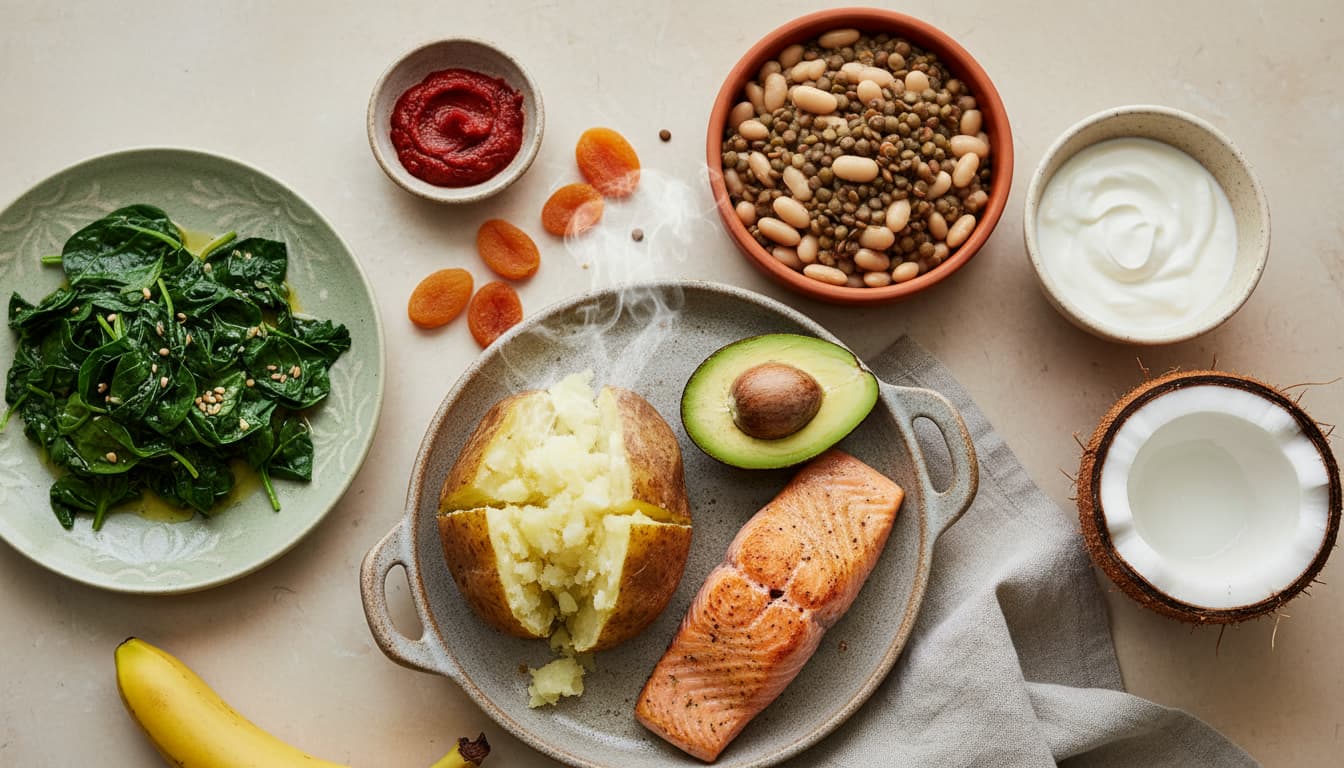
A medium banana carries 422mg, which is respectable and nowhere near the top of any list. It became shorthand for potassium because it is portable, cheap, sold everywhere, needs no preparation and has a marketing body behind it. Ranked by potassium per typical serving, it sits behind potatoes, sweet potatoes, beans, lentils, cooked greens, avocado, dried apricots, tomato paste, plain yogurt, salmon, coconut water and squash. Eat bananas. Just do not use them as your plan.
- 03
The real top of the list, ranked by portion rather than per 100g
Per realistic serving: tomato paste at about 1,100mg per half cup, cooked white beans around 1,000mg per cup, a large baked potato with skin about 940mg, cooked spinach about 840mg, sweet potato about 540mg per medium, plain yogurt about 570mg per cup, lentils about 730mg per cup, an avocado about 690mg, half a cup of dried apricots about 750mg, and cooked salmon about 530mg per fillet. Per-100g tables are misleading because nobody eats 100g of tomato paste.
- 04
Potatoes, and the case for leaving the skin on
A large baked russet with the skin delivers roughly 940mg, one of the densest single servings available in a normal shop. Around a fifth of that sits in and just under the skin, so peeling costs you real milligrams as well as the fiber. More importantly, the cooking method decides the rest: baked or roasted keeps nearly all of it, while boiling peeled cubes can lose a third of it into water you then pour down the sink.
- 05
Beans and lentils are the quiet leaders on this list
White beans, adzuki, lima and kidney beans all land between 700 and 1,000mg a cooked cup, and lentils sit around 730mg, which puts a bowl of the lentil soup on this site ahead of two bananas before you count anything else in it. They also arrive with 13 to 15g of fiber and a similar amount of protein, which almost nothing else on the list does. Canned is fine. Rinsing canned beans removes sodium and only a little potassium.
- 06
Cooked greens beat raw greens, and it is a volume trick
A cup of raw spinach carries about 170mg. A cup of cooked spinach carries about 840mg, because cooking collapses roughly ten cups of leaves into one. Nothing has been created; you are simply able to eat far more of it. The same applies to chard, beet greens and kale. This is the single easiest change on the list: sauteing a bag of spinach into a dish takes four minutes and adds more potassium than three bananas.
- 07
Dairy, fish and meat carry more than most people expect
Potassium is not a plant nutrient. A cup of plain yogurt has around 570mg, a cup of milk about 380mg, a salmon fillet about 530mg, chicken breast about 330mg per serving, and cod around 440mg. Because potassium is an intracellular ion, anything made of cells contains it. This matters if you are building a high-potassium pattern around a high-protein diet rather than a vegetarian one, because the animal side of the plate is contributing more than the tables suggest.
- 08
Boiling leaches potassium, and for some people that is the point
Potassium is water-soluble, so boiling cut vegetables sends a substantial fraction into the water, up to about half for diced potato boiled long enough. Roasting, steaming, microwaving and air-frying all retain far more. Renal dietitians use this deliberately in reverse, with a double-boil leaching method to reduce potassium in vegetables for people who need less. For everyone else the practical rule is simple: roast, steam or microwave, and if you do boil, use the liquid.
- 09
The number that matters is the ratio, not the total
Potassium and sodium work against each other in blood pressure regulation, and a growing body of evidence suggests the ratio between them predicts cardiovascular outcomes better than either figure alone. A day at 4,000mg of potassium and 4,000mg of sodium is not the same as 4,000mg and 2,000mg. Since most sodium in the diet comes from packaged food and restaurant meals rather than the salt cellar, cooking at home moves both numbers in the right direction at once.
- 10
Salt substitutes are potassium chloride, and they are not for everyone
Products sold as low-sodium salt typically replace some or all of the sodium chloride with potassium chloride, and a quarter teaspoon can carry several hundred milligrams. In population trials they lower blood pressure. They are also genuinely dangerous for a specific group: people with chronic kidney disease, and anyone taking ACE inhibitors, angiotensin receptor blockers or potassium-sparing diuretics such as spironolactone. If any of that applies, this is a question for the prescribing clinician, not for a food blog.
- 11
Who needs less potassium rather than more
Healthy kidneys excrete surplus potassium efficiently, which is why dietary excess is close to impossible from food alone. Impaired kidneys cannot, and hyperkalemia is a serious risk in advanced chronic kidney disease, in some heart failure regimens and with several common drug classes. If you have been told to follow a low-potassium diet, this page describes the foods to limit rather than the foods to add, and the leaching method in point eight is the relevant technique.
- 12
Supplements are capped, and the cap is deliberate
Over-the-counter potassium supplements in the United States are generally limited to 99mg per tablet, about two percent of the DASH target, because concentrated potassium can cause gastrointestinal injury and cardiac effects. That cap is a strong hint about where this nutrient should come from. Coconut water at roughly 600mg a cup and low-sodium vegetable juice at around 500mg are the two drinkable options that are simply food, and both are more useful than a 99mg pill.
- 13
A day that lands at 4,700mg without trying hard
Breakfast: a cup of plain yogurt with half a cup of dried apricots, around 1,320mg. Lunch: a bowl of lentil soup with a handful of spinach wilted in, around 1,100mg. Snack: a banana, 422mg. Dinner: baked salmon with a whole roasted sweet potato and a large helping of chard, around 1,400mg. That is roughly 4,240mg before you count the tomato, avocado or beans that would appear in any of those meals. Nothing on that list is unusual or expensive.
- 14
Cooking rules that keep the potassium on the plate
Roast or microwave rather than boil. Leave skins on potatoes and sweet potatoes. If you boil, keep the liquid and use it, which is exactly what a soup or a braise does. Cook greens down rather than serving them raw when volume is the constraint. Use tomato paste rather than fresh tomato when you want concentration. Rinse canned beans for the sodium, and accept the small potassium loss. Salt the food yourself so you control the other side of the ratio.
- 15
Where this fits with the diets already on this site
The DASH pattern is fundamentally a potassium-up, sodium-down prescription built on fruit, vegetables, beans and low-fat dairy, and the DASH meal plan here is a working version of this page. The mediterranean diet lands high on potassium as a byproduct of legumes, greens and tomato. A strict keto pattern is the one that tends to run low, because it removes potatoes, beans and most fruit at once, which is a large part of what people describe as the induction flu.
What people ask us next.
- What food has the most potassium?
- By realistic serving rather than per 100g, tomato paste is the densest common food at around 1,100mg per half cup, followed by cooked white beans at about 1,000mg a cup, a large baked potato with skin at about 940mg, and cooked spinach at about 840mg a cup. Dried apricots, lentils, avocado, plain yogurt, sweet potato and salmon all outperform a banana. Per-100g rankings are misleading here, because portion sizes across these foods differ enormously.
- How much potassium do I need per day?
- United States guidance sets an Adequate Intake of 3,400mg a day for adult men and 2,600mg for adult women. The 4,700mg figure that appears everywhere comes from the DASH blood-pressure trials and is still commonly used as a target for people managing hypertension. Average intake sits well below all three, which is why potassium is listed as a nutrient of public health concern in the Dietary Guidelines. Requirements differ in pregnancy, lactation and kidney disease.
- Do bananas have a lot of potassium?
- A medium banana has 422mg, which is a genuinely useful amount and about twelve percent of the male Adequate Intake. It is simply not the top of the list, or close to it. Bananas became the symbol because they are portable, cheap, need no preparation and have had decades of promotion behind them. Treat them as a convenient contributor rather than as the strategy, and put potatoes, beans and cooked greens at the centre of it instead.
- Does cooking destroy potassium?
- Heat does not destroy it, but water removes it. Potassium is water-soluble and leaches out of cut vegetables into boiling water, with losses of up to about half for diced potato boiled for a long time. Roasting, steaming, microwaving and air-frying retain most of it. If you do boil, keep the cooking liquid and use it, which is what soups, stews and braises do automatically. Leaving skins on also preserves a meaningful share.
- Can you get too much potassium from food?
- Not with healthy kidneys, which excrete the surplus efficiently. There is no Tolerable Upper Intake Level set for potassium from food for that reason. The risk of hyperkalemia is real for people with chronic kidney disease, for some people with heart failure, and for anyone taking ACE inhibitors, angiotensin receptor blockers or potassium-sparing diuretics. Supplements and potassium chloride salt substitutes are a different matter, because they deliver concentrated doses without the food matrix.
- Are potassium salt substitutes safe?
- For most people yes, and large trials have shown blood pressure and cardiovascular benefits from switching. For a specific group they are dangerous: anyone with impaired kidney function, and anyone on ACE inhibitors, ARBs or potassium-sparing diuretics such as spironolactone, all of which reduce the body's ability to clear potassium. A quarter teaspoon can carry several hundred milligrams. If you take any regular medication for blood pressure or heart failure, ask the prescriber before switching.
- What are the signs of low potassium?
- Mild hypokalemia is often silent. As it deepens, the common signs are muscle weakness and cramping, fatigue, constipation and heart palpitations, since potassium is central to nerve conduction and muscle contraction. It is far more often caused by fluid losses, diuretics, vomiting or diarrhoea than by diet alone. This is a blood test rather than a self-diagnosis, and anyone with persistent palpitations or unexplained weakness should be seeing a clinician rather than adjusting their groceries.
- Is potassium listed on nutrition labels?
- Yes, in the United States it has been mandatory on the Nutrition Facts panel since the 2016 label rules took full effect, alongside vitamin D, calcium and iron. Before that it was voluntary and usually absent, which is part of why the nutrient stayed invisible for so long. The panel gives both milligrams and percent Daily Value, with the Daily Value set at 4,700mg, so a food showing 20 percent is delivering around 940mg.
- Which diets tend to be low in potassium?
- Any pattern that removes potatoes, legumes and fruit at the same time. A strict keto diet is the clearest example, and low potassium along with low sodium and magnesium is a large part of what people describe as keto flu in the first two weeks. Very low-carbohydrate and carnivore patterns run the same risk. A diet built mainly on refined grains, packaged food and restaurant meals is the more common version of the problem, because processing strips potassium while adding sodium.
Where the technique comes from
- USDA FoodData Central, reference database for potassium values per food and portion.
- NIH Office of Dietary Supplements, potassium fact sheet for health professionals.
- Dietary Guidelines for Americans 2020-2025, potassium as a nutrient of public health concern.
- Harvard T.H. Chan School of Public Health, The Nutrition Source, on potassium and the sodium-potassium balance.
- Academy of Nutrition and Dietetics, guidance on potassium in kidney and cardiovascular nutrition.
About the ThatCleanChef Kitchen
A small team of recipe developers and food photographers testing recipes in home kitchens on home equipment. Every Nutrition Ledger is USDA FoodData Central-sourced and reviewed by Lena Marsh, RDN, MS. We don't pretend to be a single chef, we're the people behind the plates. Meet the full team →
Related posts
Magnesium-Rich Foods: Pumpkin Seeds Beat Spinach, and Bread Lost Most of Its
An ounce of pumpkin seeds carries about 156mg of magnesium, which is more than a cup of cooked spinach and roughly five times what a banana delivers. Around half of adults in national survey data take in less than the estimated requirement, and the largest single reason is grain refining, which strips about eighty percent of the magnesium out of wheat before it reaches a loaf.
Vegetarian Recipes: Protein, Browning, and Actual Dinners
Vegetarian cooking almost never fails for lack of ideas. It fails on two things: not enough protein on the plate, and not enough browning in the pan. Fix those and a meatless dinner stops reading as the version without the main thing. Where the protein comes from, the four nutrients worth attention, the techniques that make plants taste cooked-for, and a week of dinners.
Iron-Rich Foods: The Number on the Label Is Not the Number You Get
Spinach has more iron per gram than steak and you absorb a fraction of it. That gap between the milligrams printed on a label and the milligrams that actually cross your gut wall is what this page is about. Which foods carry which kind of iron, the four things that block absorption, the one that multiplies it, and how to cook accordingly.
The Clean Chef Starter Kit.
A 14-day anti-inflammatory meal plan PDF, grocery list by section, macros totaled per day, Sunday prep sequence. Free.
By subscribing, you agree to our Privacy Policy. One calm email a week. Unsubscribe anytime.