- Calories
- 320
- Protein
- 14g
- Fiber
- 6g
- Sat. fat
- 3g
- Sodium
- 420mg
- Added sugar
- 2g
What this recipe does for you.
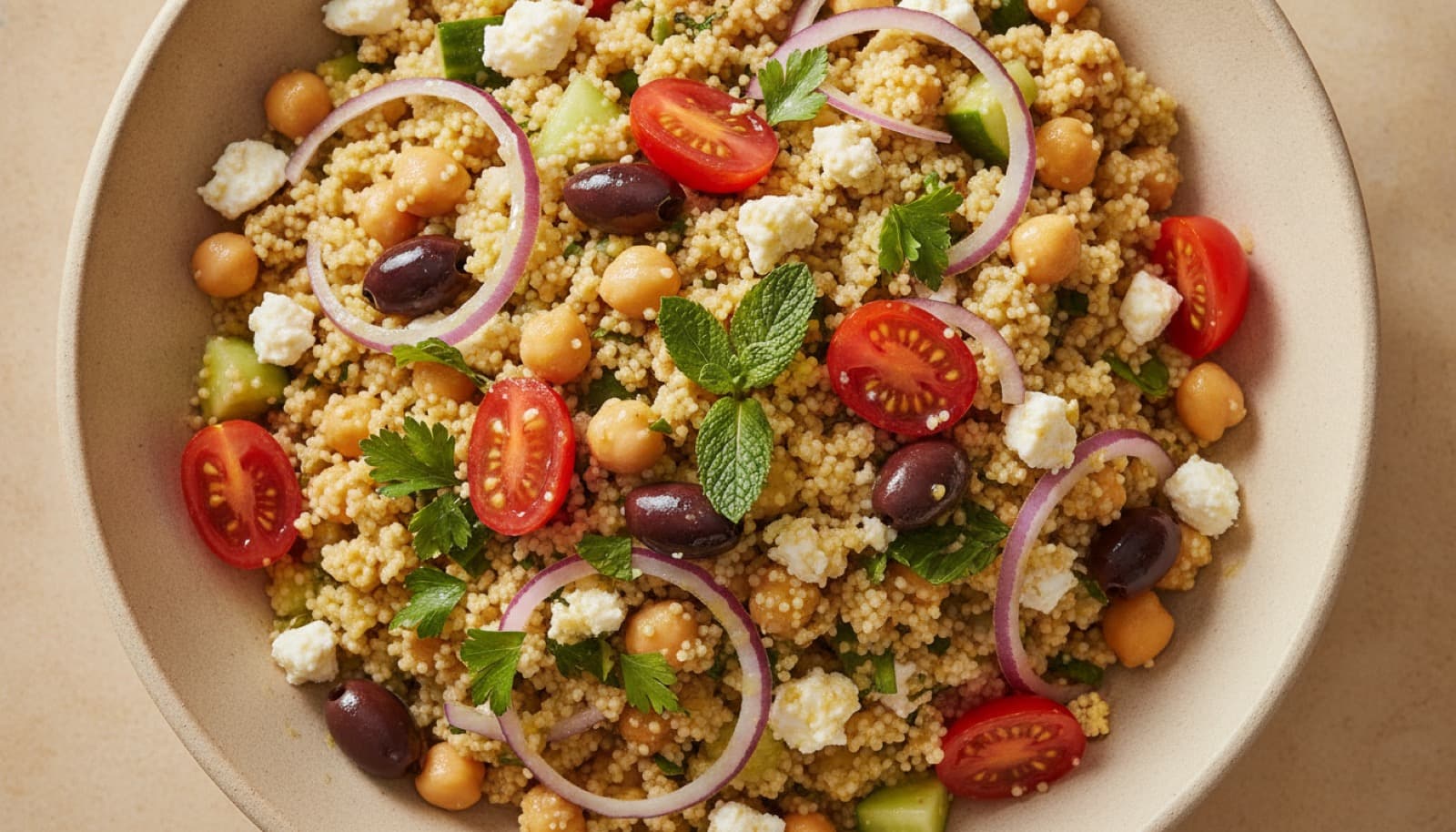
A Mediterranean couscous salad that holds for days and travels to work without weeping. Couscous steamed off the heat, a lemon-olive-oil dressing built right, chickpeas for protein, and enough herbs to matter. 20 minutes, 14g protein, Nutrition Ledger below.
Why this works
Every recipe on this site ships with an explanation of the technique decisions, why sear then braise, why the acid goes in at the end, why the fat renders before the aromatics. The method below is those decisions, in order.
Dress the couscous warm, then let it cool
Couscous salad goes wrong in one of two ways: gluey and clumped, or dry and bland by the time you eat it. Both are fixed by dressing it warm. Fluff the couscous the moment it finishes steaming and pour the lemon-olive-oil dressing over while the grains are still hot, so they drink it in instead of sitting in a puddle at the bottom of the bowl. Then let it cool to room temperature before you add the tomatoes and cucumber, otherwise the heat wilts them. This is also why a couscous salad you make ahead tastes better the next day: the grains have had hours to absorb the dressing. It is genuinely better as leftovers, which is rare.
Ingredients
Serves 6- 1.5 cupscouscous
- 1.5 cupsvegetable broth · boiling
- 1/4 cupolive oil
- 2lemons · juiced
- 2 clovesgarlic · grated
- 1 tspdried oregano
- 1 canchickpeas · drained, rinsed
- 1 pintcherry tomatoes · halved
- 1cucumber · diced
- 1/2red onion · sliced thin
- 1/2 cupKalamata olives
- 1/2 cupfeta · crumbled
- 1 handfulfresh parsley · chopped
- 1 handfulfresh mint · chopped
- kosher salt · to taste
- black pepper · to taste
Method
Steam the couscous, don't boil it
A cup and a half of dry couscous, an equal volume plus a splash of boiling broth poured over, a lid on, off the heat for five minutes, then fluff with a fork. Couscous is steamed, not simmered: it never goes on a flame, which is why this is a no-burner, 20-minute dish for a hot June kitchen. Use broth instead of water and a glug of olive oil in the pot so the grains separate and taste of something.
Build the dressing in the bottom of the bowl
A quarter cup of good olive oil, the juice of two lemons, two grated garlic cloves, a teaspoon of dried oregano, half a teaspoon of salt, and a few grinds of pepper, whisked in the bottom of the serving bowl before anything else goes in. A three-to-one oil-to-acid ratio is the classic vinaigrette, but couscous drinks a lot, so this leans more acidic on purpose. Whisk until it looks creamy and emulsified.
Dress the couscous while it's hot
Tip the warm, fluffed couscous straight onto the dressing and fold it through while the grains are still hot. Hot grains absorb dressing; cold grains let it pool. This single step is the difference between a salad that tastes seasoned all the way through and one that is bland with an oily bottom. Let it sit five minutes to drink it in, then taste and add salt.
Chickpeas are the protein, and they earn their place
A drained, rinsed can of chickpeas folded in adds about 7g of protein per serving and the body that turns a side dish into a lunch. Dry them on a towel first so they do not water down the dressing. This is what takes the salad from a starchy side to a 14g-protein meal you can actually eat for lunch and not be hungry at three.
Add the vegetables after the couscous cools
A pint of cherry tomatoes halved, a cucumber diced, half a red onion sliced thin, and a handful of Kalamata olives, folded in once the couscous has come down to room temperature. Add them to hot couscous and the tomatoes turn to mush and the cucumber wilts. Salt the tomatoes a few minutes before they go in so they release a little brine that seasons the whole bowl.
Feta in at the end, gently
Half a cup of feta crumbled over and folded once at the very end so it stays in pieces rather than smearing into paste. Buy a block in brine and crumble it yourself; pre-crumbled is dry and chalky. The feta is the salty backbone, so go easy on added salt until you have tasted with it in.
Herbs by the handful, not the sprig
A big handful each of chopped parsley and mint, or dill if you prefer. In a couscous salad the herbs are an ingredient, not a garnish: they are what makes it taste fresh and Mediterranean rather than like seasoned starch. Stir them through at the end with the feta so they stay bright green and do not bruise.
Rest it, then taste again
Let the finished salad sit 15 minutes, or ideally an hour, before serving. Cold dulls salt and acid, so a salad that tasted perfect warm will taste flat from the fridge, taste it again before serving and add lemon and salt to wake it up. This is the most-skipped step and the reason restaurant grain salads taste seasoned and home ones taste dull.
Make it a meal: add a protein anchor
As written with chickpeas it is a 14g-protein lunch on its own. To make it a dinner, top each bowl with grilled chicken, a tin of good tuna, or a couple of soft-boiled eggs, which pushes it to 30g-plus. The salad is the base; the anchor is optional but it is how you turn a side into a centerpiece for a summer table.
It keeps four days and gets better
Store it covered in the fridge for four days; the flavor deepens as the couscous keeps absorbing the dressing, which makes this one of the rare salads that is better on day two. The only casualty is the cucumber, which softens, so if you are batching for the week, fold the cucumber in fresh each day. Travels to work without weeping because there is no leafy green to wilt.
Variations
Substitutions and adaptations land with the photography shoot. The method holds across most reasonable swaps.
Storage
Refrigerator: 3 to 4 days, sealed. Freezer: up to 3 months. Reheat covered to retain moisture.
Frequently asked
- How do I stop couscous salad from going gluey and clumped?
- Two things. First, steam the couscous rather than boiling it: pour boiling broth over the dry grains, cover, and leave it off the heat for five minutes, then fluff with a fork, never a spoon, which mashes it. A splash of olive oil in the pot helps the grains separate. Second, dress it while it is still warm so the grains absorb the dressing and stay distinct instead of sticking together as they cool. Gluey couscous is almost always over-wetted, simmered couscous that was left to sit clumped and undressed.
- Can I make this ahead, and how long does it keep?
- Yes, and it is one of the few salads that genuinely improves overnight, because the couscous keeps drinking in the dressing as it sits. It keeps four days covered in the fridge. The one weak point is the cucumber, which softens over a couple of days, so if you are prepping for the whole week, hold the cucumber and fold it in fresh each day. Because there is no leafy green to wilt, it travels to work or a picnic without turning to soup.
- What is the difference between regular couscous and pearl couscous here?
- Regular (Moroccan) couscous is tiny and steams off the heat in five minutes, which is what makes this a no-burner, 20-minute dish. Pearl (Israeli) couscous is the larger, chewier bead and has to be simmered in liquid for about ten minutes like pasta, then drained. Both work; pearl gives a more substantial, chewy salad and regular gives a lighter, fluffier one. If you use pearl, cook and cool it first, then build the salad the same way.
- How do I make this gluten-free?
- Couscous is made from wheat semolina, so it is not gluten-free. The easiest swap that keeps the spirit of the dish is cooked quinoa, which is naturally gluten-free, carries more protein, and takes dressing the same way, dress it warm, cool it, then build. Cooked rice or a gluten-free orzo also work. Everything else in the salad, the chickpeas, vegetables, feta, herbs, and lemon dressing, is already gluten-free.
- Is this enough protein for a real lunch?
- As written, with a full can of chickpeas folded through, it lands at about 14g of protein per serving, plus a few grams from the feta, which is a respectable plant-forward lunch alongside its 6g of fiber. If you want it to hold you like a proper meal, add an anchor: grilled chicken, a tin of tuna, or two soft-boiled eggs per bowl takes it past 30g. The chickpeas-and-feta version is genuinely filling for a midday meal; the anchor is for dinner or a heavy training day.
Related recipes
See all →- Seasonal & Plans
DASH Diet Meal Plan: Seven Days, Sodium Counted
A week built to land near 1,500mg of sodium a day without tasting like a compromise. The Sunday shop, two breakfasts on rotation, lunches that survive a commute, seven dinners with the sodium tallied per plate, and the three places the plan usually breaks in real life.
98g Protein - Seasonal & Plans
Low-FODMAP Meal Plan: A Seven-Day Elimination Week
One week of elimination-phase cooking that tastes like food rather than deprivation. The safe pantry build, why portion size decides almost everything, seven dinners with no onion or garlic, breakfasts and packable lunches, the four places FODMAPs hide in shop-bought ingredients, and how to move into reintroduction without losing the thread.
105g Protein - Seasonal & Plans
Anti-Inflammatory Meal Plan: Seven Days, Cooked and Totaled
Seven days of dinners, breakfasts and lunches built on the four changes that carry almost all of the effect: fatty fish twice, olive oil daily, fiber above thirty grams, and a real reduction in ultra-processed food. Includes the Sunday prep block, the shopping list by aisle, the daily macro totals, and what to do on the night the plan falls apart.
105g Protein
Get a tested recipe + a nutritional note in your inbox each Sunday.
One recipe a week, photographed on the same Tuesday it tested. Reviewed by an RD. No promotions, no pop-ups, no tracking.
The Clean Chef Starter Kit.
A 14-day anti-inflammatory meal plan PDF, grocery list by section, macros totaled per day, Sunday prep sequence. Free.
By subscribing, you agree to our Privacy Policy. One calm email a week. Unsubscribe anytime.
We're building a shop.
Curated cookware, pantry staples we actually buy, recipe-bundle PDFs. Be the first to know when it opens.
We'll only email you about the shop opening. Unsubscribe in any email. See our Privacy Policy.