- Calories
- 1850
- Protein
- 105g
- Fiber
- 38g
- Sat. fat
- 16g
- Sodium
- 2100mg
- Added sugar
- 8g
What this recipe does for you.
Seven days of dinners, breakfasts and lunches built on the four changes that carry almost all of the effect: fatty fish twice, olive oil daily, fiber above thirty grams, and a real reduction in ultra-processed food. Includes the Sunday prep block, the shopping list by aisle, the daily macro totals, and what to do on the night the plan falls apart.
Why this works
Every recipe on this site ships with an explanation of the technique decisions, why sear then braise, why the acid goes in at the end, why the fat renders before the aromatics. The method below is those decisions, in order.
Ingredients
- Full ingredient list ships with photography
Method
Four changes carry the week, everything else is decoration
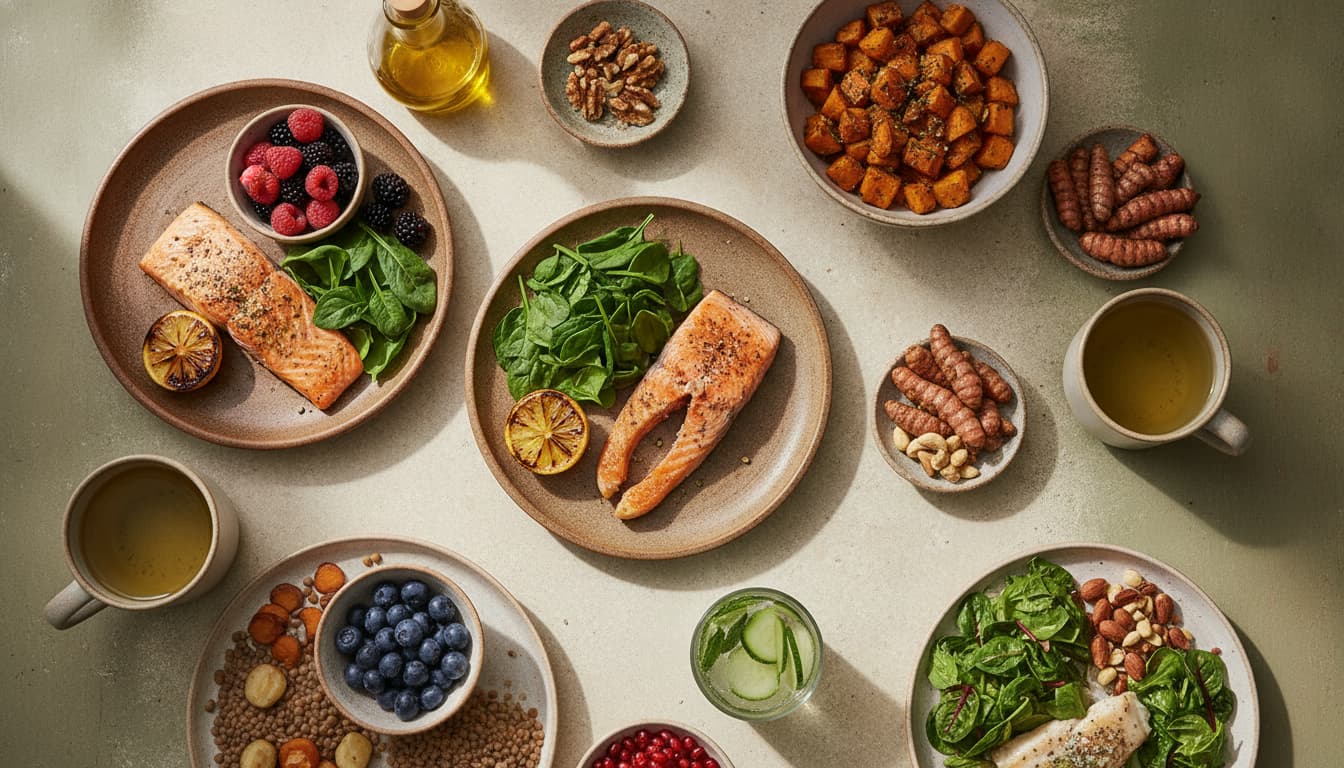
Oily fish twice, extra-virgin olive oil as the default fat at two to four tablespoons a day, fiber above thirty grams from vegetables and pulses, and a genuine cut in ultra-processed food and sugary drinks. Those four are what the dietary-inflammation research keeps pointing at. Turmeric, ginger, tart cherry and green tea are worth cooking with because they taste good and they help at the margins, not because any one of them is doing the heavy lifting.
Sunday prep, 75 minutes, and the week runs itself
Oven to 425F. Two trays go in, one of broccoli and peppers and red onion, one of sweet potato and carrot. On the stovetop, a pot of green lentils, twenty-five minutes, no soaking. While those cook, whisk two dressings, a lemon and olive oil one and a tahini and lemon one, and grate a cucumber for tzatziki. Hard-boil six eggs in the same water the lentils leave behind. Everything cools uncovered on a rack, then boxes. Seventy-five minutes including the washing up.
Nights one to four, the fish and pulse dinners
Night one, ginger-turmeric salmon with the roasted vegetables from Sunday, twenty-five minutes. Night two, lentil and sweet potato stew, one pot, straight from the prepped lentils, so twenty minutes. Night three, golden chicken soup with bone-in thighs, forty minutes, and you deliberately make double. Night four, sardines on whole-grain toast with a chopped tomato salad and a hard-boiled egg, fifteen minutes, which is the night the plan survives a late meeting.
Nights five to seven, and the one you do not cook
Night five is the second half of the soup with a spoon of olive oil stirred in at the bowl. Night six is a sheet-pan Mediterranean chicken with olives, feta and lemon, thirty-five minutes, and it makes lunch for two days. Night seven is deliberately unplanned. Eggs and greens, or a grain bowl out of whatever the trays left, or takeout without any commentary. A plan with no unplanned night is a plan you abandon in week two.
Breakfast is three options on rotation, not seven
Plain full-fat Greek yogurt with walnuts, berries and a spoon of ground flax. Two eggs with spinach and a chopped tomato, cooked in olive oil. Overnight oats with chia, cocoa and berries. Rotate those three and breakfast stops being a decision, which is the actual reason breakfast derails eating patterns. Each one clears twenty grams of protein and six to nine grams of fiber before nine in the morning.
Lunch is last night's dinner plus one no-cook fallback
Cook enough dinner for one extra portion and lunch is solved for the following day, which is the whole trick. The no-cook fallback for the days when there is nothing left: a tin of good tuna or sardines, a tin of chickpeas rinsed, cherry tomatoes, cucumber, lemon, olive oil, and whatever soft herb is still alive in the fridge. Five minutes, no stove, around eighteen grams of fiber.
The macros, and why fiber is the number to watch
The week averages roughly 1,850 calories, 105g protein, 38g fiber, 2,100mg sodium, 16g saturated fat and 8g added sugar a day. The fiber number is the one worth tracking, because the American average sits near fifteen grams and this plan more than doubles it. That jump is the part people feel in the first week, and it is also the part that needs to happen over three or four days rather than overnight.
The shopping list, in the order the shop is laid out
Produce: broccoli, two peppers, two red onions, two sweet potatoes, carrots, two lemons, spinach, cherry tomatoes, cucumber, ginger, garlic, parsley, berries. Fish and meat: two salmon fillets, bone-in chicken thighs, chicken for the traybake, tinned sardines, tinned tuna. Dairy and eggs: plain Greek yogurt, feta in brine, a dozen eggs. Pantry: green lentils, tinned chickpeas, tinned tomatoes, olive oil, tahini, oats, chia, walnuts, turmeric, olives. Around ninety to a hundred and twenty dollars for two people at mid-2026 US averages, and they drift by shop and season.
When the week goes wrong, repair it at the next meal
Not the next day, not next Monday, the next meal. There is no streak here to break and no reset to perform. The pattern is a weekly average, and one takeaway pizza inside seven days of the food above is statistically invisible. The failure mode that actually matters is quitting on day nine because day eight was imperfect, so plan for imperfection and keep the tins stocked.
Variations
Substitutions and adaptations land with the photography shoot. The method holds across most reasonable swaps.
Storage
Refrigerator: 3 to 4 days, sealed. Freezer: up to 3 months. Reheat covered to retain moisture.
Frequently asked
- How long before an anti-inflammatory meal plan makes a difference?
- Digestion and energy usually shift inside one to two weeks, which is mostly the fiber increase and the drop in ultra-processed food rather than anything exotic. Inflammatory markers such as CRP move over roughly eight to twelve weeks in the trial literature when they move at all, and joint symptoms, where people notice the most, are highly individual. Treat two weeks as the test of whether you like cooking this way, and three months as the test of whether your labs care.
- Is this a weight-loss plan?
- No, it is a pattern built around fish, olive oil, pulses and vegetables, and it lands near 1,850 calories a day as written, which happens to be maintenance for a lot of people and a modest deficit for some. Scale the portions to your own appetite rather than trying to hit the number. The fiber and protein content does make it unusually filling, which is generally why people eat less on it without deliberately trying.
- Can I still drink coffee?
- Yes. Coffee is a significant source of polyphenols in most Western diets and there is no case for cutting it here. What matters is what goes in it. Two large sweetened coffee drinks a day can carry more added sugar than everything else in this plan combined, so keep it black, or with milk, and put the sugar somewhere you can taste it.
- Do I need supplements for this to work?
- No. The plan is designed to deliver omega-3s from fish twice a week, polyphenols from olive oil, vegetables, coffee and spices, and fiber from pulses and produce, all as food. Fish-oil capsules are a reasonable fallback if you genuinely will not eat oily fish, and vitamin D is worth a conversation with a doctor at northern latitudes in winter, but neither is what makes this pattern work.
- Which foods actually raise inflammation?
- The consistent signals in the research are sugary drinks, refined carbohydrate eaten in quantity, processed meats, industrial trans fats where they still exist, and a diet high in ultra-processed food generally. Individual so-called inflammatory foods that circulate online, nightshades, gluten for people without coeliac disease, all dairy, do not hold up well as blanket rules. Remove them one at a time if you suspect one, and put them back if nothing changes.
Related recipes
See all →- Seasonal & Plans
DASH Diet Meal Plan: Seven Days, Sodium Counted
A week built to land near 1,500mg of sodium a day without tasting like a compromise. The Sunday shop, two breakfasts on rotation, lunches that survive a commute, seven dinners with the sodium tallied per plate, and the three places the plan usually breaks in real life.
98g Protein - Seasonal & Plans
Low-FODMAP Meal Plan: A Seven-Day Elimination Week
One week of elimination-phase cooking that tastes like food rather than deprivation. The safe pantry build, why portion size decides almost everything, seven dinners with no onion or garlic, breakfasts and packable lunches, the four places FODMAPs hide in shop-bought ingredients, and how to move into reintroduction without losing the thread.
105g Protein - Seasonal & Plans
Whole30 Meal Plan: Thirty Days, Week by Week
A month of compliant cooking laid out as four weeks rather than thirty separate decisions. The one big shop, the four sauces that carry the whole month, the dinner rotation, the two points where people quit, the compliance traps hiding in bacon and broth, and the reintroduction schedule that is the actual purpose of the thirty days.
120g Protein
Get a tested recipe + a nutritional note in your inbox each Sunday.
One recipe a week, photographed on the same Tuesday it tested. Reviewed by an RD. No promotions, no pop-ups, no tracking.
The Clean Chef Starter Kit.
A 14-day anti-inflammatory meal plan PDF, grocery list by section, macros totaled per day, Sunday prep sequence. Free.
By subscribing, you agree to our Privacy Policy. One calm email a week. Unsubscribe anytime.
We're building a shop.
Curated cookware, pantry staples we actually buy, recipe-bundle PDFs. Be the first to know when it opens.
We'll only email you about the shop opening. Unsubscribe in any email. See our Privacy Policy.