- Calories
- 520
- Protein
- 34g
- Fiber
- 3g
- Sat. fat
- 6g
- Sodium
- 890mg
- Added sugar
- 0g
What this recipe does for you.
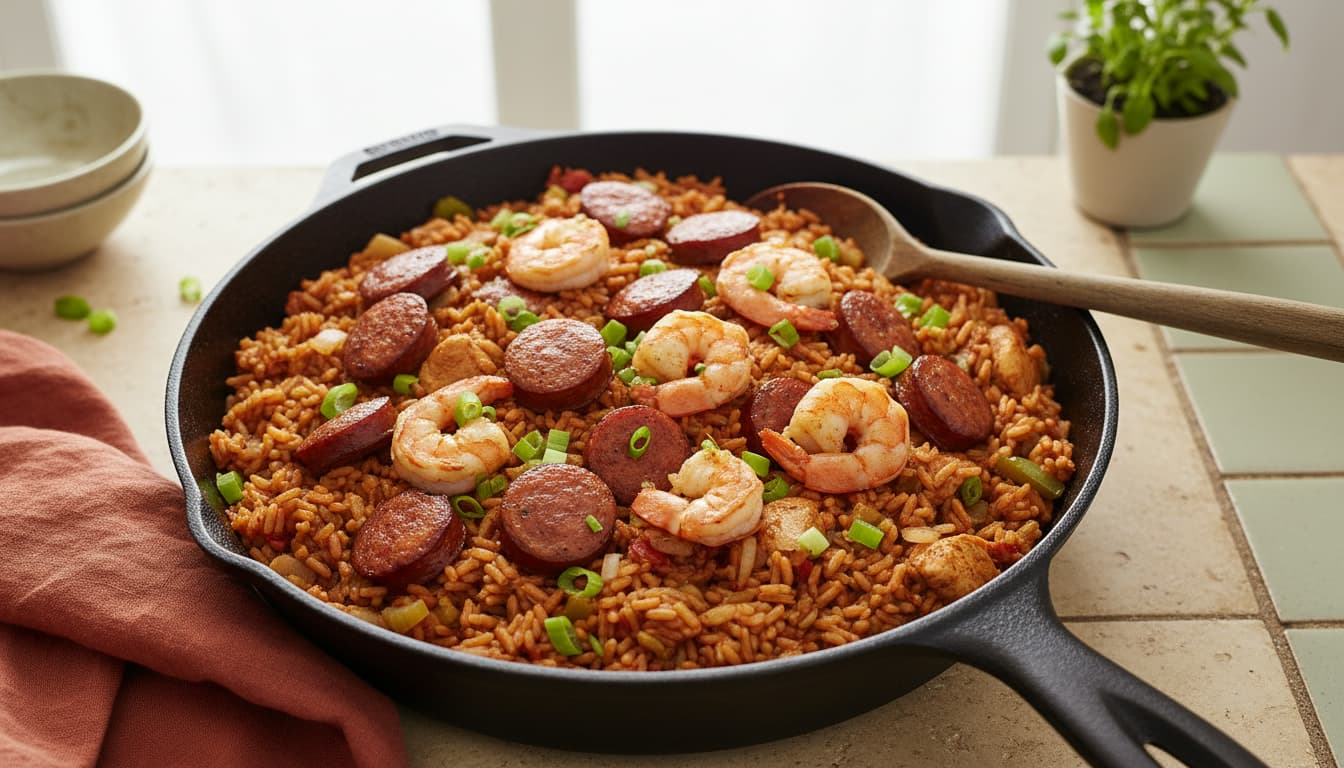
Jambalaya is a rice dish that people cook like a stew, which is why so much of it comes out as porridge. The rice goes in dry, the liquid is measured rather than eyeballed, and once the lid is on nothing touches it for twenty-five minutes. Andouille and chicken thighs first, shrimp in the last four minutes, and the browned layer on the bottom of the pot is a feature.
Why this works
Every recipe on this site ships with an explanation of the technique decisions, why sear then braise, why the acid goes in at the end, why the fat renders before the aromatics. The method below is those decisions, in order.
Ingredients
Serves 8- 2 cupslong-grain white rice · rinsed until the water runs nearly clear, then drained hard
- 3 cupschicken stock · low-sodium, warmed, and measured exactly
- 1 1/4 lbboneless chicken thighs · cut into 1 1/2 inch pieces, patted dry
- 12 ozandouille sausage · sliced into 1/4 inch coins
- 1 lblarge shrimp · peeled and deveined, added in the last four minutes
- 2 tbspneutral oil · avocado or refined peanut, something that takes real heat
- 1 largeonion · diced small
- 1 largegreen bell pepper · diced small
- 3 ribscelery · diced small, this is the third of the trinity
- 4 clovesgarlic · minced
- 1 candiced tomatoes · 14.5 oz, no-salt-added, drained, for the Creole version only
- 3 tbsptomato paste · for the Creole version, cooked out until it darkens
- 2 tspsweet paprika
- 1 1/2 tspdried thyme
- 1 tspcayenne pepper · start at 1/2 tsp if the andouille is already hot
- 2 wholebay leaves
- 1 1/2 tspkosher salt · adjust down if your stock or sausage is salty
- 1 tspblack pepper · coarsely ground
- 4 wholescallions · sliced thin, green parts for the finish
- 1/4 cupflat-leaf parsley · chopped, added off the heat
- 1 wholelemon · cut into wedges, and use them
Method
Decide Creole or Cajun before you shop, because it changes the list
Creole jambalaya, the New Orleans city version, contains tomato and comes out red. Cajun jambalaya, from the country parishes west of the city, has no tomato at all and gets its colour from meat browned hard in the pot and stock poured over the fond. They are genuinely different dishes rather than variations. This recipe is written Creole with the Cajun path noted at each step, and the Cajun version is the better one if your browning is confident.
Brown the andouille first and cook everything else in its fat
Set a heavy Dutch oven over medium heat, add a spoon of oil and the sausage coins in a single layer, and leave them alone for three minutes a side until the edges curl and darken. Lift them out. What is left behind is rendered paprika-red fat and a scattering of stuck brown bits, and that is the flavour base for everything after it. Skimping here is why home jambalaya often tastes like seasoned rice rather than like jambalaya.
Sear the chicken dry, in two batches, and stop before it is cooked
Pat the thigh pieces completely dry, season them, and sear in the sausage fat in two batches so the pot never drops below a sizzle. Three minutes on the first side without moving them, one on the second, then out. They will finish in the rice, so pulling them at seventy percent is correct. A crowded pot steams instead of browning, and once that happens there is no way to get the fond back, which is the difference between a good pot and a beige one.
The trinity goes in cold and comes out soft, not caramelised
Onion, green bell pepper and celery in roughly a two-one-one ratio, all diced small, cooked over medium heat for eight to ten minutes with a good pinch of salt until soft and translucent. You are not looking for colour here. Their job is to melt into the background and give the pot sweetness and body, and browning them makes the finished dish taste of caramelised onion rather than of Louisiana. The salt pulls moisture out, which also lifts the fond off the bottom.
Bloom the spices in fat, then cook the tomato paste until it darkens
Push the vegetables aside, add the garlic, paprika, thyme, cayenne and black pepper into the hot fat and stir for forty-five seconds until they smell toasted. Paprika and thyme are fat-soluble and give up three times as much aroma this way as they do dumped into liquid. Then the tomato paste, spread across the pot floor and left to fry for two full minutes until it goes from bright red to brick. Undercooked tomato paste is the metallic note in a lot of home jambalaya.
Rinse the rice, and use long grain and nothing else
Long-grain white rice, rinsed in three or four changes of cold water until it runs nearly clear, then drained properly. Rinsing takes the loose surface starch off, and that starch is what glues grains together into a mass. Do not use arborio, which is bred to release starch, and do not use parboiled or converted rice, which will not absorb liquid on the same schedule. Brown rice needs almost twice the time and different liquid, so it is a separate recipe rather than a swap.
Toast the drained rice in the pot for two minutes
Add the rice to the pot and stir it through the fat and aromatics for two minutes until the grains turn from chalky white to faintly translucent at the edges and smell slightly nutty. This coats each grain in fat, which slows water absorption at the surface and is a real part of why the finished grains stay separate. Two minutes, stirring, and if the pot looks dry add another spoon of oil rather than pushing on.
The liquid ratio is the whole recipe, so measure it
Three cups of stock to two cups of rice, which is less than the pack instructions and correct here because the tomatoes, the vegetables and the chicken all release liquid into a covered pot. If you are cooking the Cajun version with no tomatoes, go to three and a half cups. Pour the stock in, scrape every brown patch off the bottom with a wooden spoon, return the chicken and sausage with any juices, add the bay leaves, and bring it to a bare simmer.
Lid on, heat low, and do not stir it. At all.
Twenty-five minutes on the lowest heat that keeps a lazy bubble going, lid on, no peeking and absolutely no stirring. Every stir breaks grain surfaces and releases starch, and stirred jambalaya is gluey jambalaya. This is the single instruction people ignore and the single most common failure. If your stove runs hot, a heat diffuser or a folded towel of a flame tamer under the pot is worth more here than any ingredient decision.
Shrimp in the last four minutes, laid on top
At the twenty-one minute mark, lift the lid for the first time, scatter the raw shrimp across the surface in a single layer, and put the lid straight back on. Four minutes of trapped steam turns them opaque and curled into a loose C, and that is done. A tight O means overcooked. Shrimp added at the start of a twenty-five minute braise come out with the texture of an eraser, which is the second most common jambalaya failure after the stirring.
Ten minutes of rest off the heat, still covered
Kill the heat, leave the lid on, and walk away for ten minutes. The grains at the top are still slightly firm and the ones at the bottom are sitting in the last of the liquid, and this rest is when that evens out. Then take the lid off, pull the bay leaves, and fluff once with a fork from the edges toward the middle, lifting rather than stirring. Scallion greens, parsley, and a hard squeeze of lemon go on now, off the heat.
The crust on the bottom is not a mistake
A thin browned layer stuck to the pot floor is called grattons in Louisiana and it is the best part, in the same way socarrat is the point of paella. Scrape it up with the edge of a metal spoon and fold it through. If the whole bottom inch is dark and bitter rather than golden, the heat was too high, and the fix next time is a diffuser rather than more liquid. Adding liquid to prevent a crust is how you end up with jambalaya-flavoured congee.
Sodium, and where the 890mg actually comes from
Andouille carries most of it, at roughly 500 to 700mg per two-ounce link depending on brand, and that is before the stock. Using low-sodium stock and holding the added salt back until you taste at the rest stage keeps the plate near 890mg. If you need it lower, halve the sausage and make up the volume with more chicken, which drops it to around 620mg and costs you less flavour than you would expect because the rendered fat is doing the work, not the volume.
Variations
Substitutions and adaptations land with the photography shoot. The method holds across most reasonable swaps.
Storage
Refrigerator: 3 to 4 days, sealed. Freezer: up to 3 months. Reheat covered to retain moisture.
Why we tested this jambalaya: one pot, no stirring, rice with a bite 3 times.
Every flagship recipe on this site goes through at least three rounds of kitchen testing before publication. We log what changed between tests so you can see the recipe's evolution, and so we can't quietly drop the failures.
- 01
Test 1
- What we tried
- Stirred the pot twice during the covered simmer, out of habit, to check the bottom was not catching.
- What happened
- The rice released enough starch to bind the whole pot. It was edible and it was a casserole, not jambalaya.
- What we changed
- Lid on at the twenty-five minute mark, hands off. The only lid lift is for the shrimp at minute twenty-one.
- 02
Test 2
- What we tried
- Followed the rice packet ratio of one to two, giving four cups of stock for two cups of rice.
- What happened
- Soupy at twenty-five minutes and still wet after the rest, because the tomatoes and vegetables had added liquid of their own.
- What we changed
- Three cups of stock for the Creole version, three and a half for the tomato-free Cajun one.
- 03
Test 3
- What we tried
- Added the shrimp with the stock so everything cooked together in one uninterrupted braise.
- What happened
- Twenty-five minutes turned them tight, grey and rubbery, and they leached iodine flavour through the rice.
- What we changed
- Shrimp go on top for the final four minutes only, with the lid straight back on.
Frequently asked
- What is the difference between jambalaya and gumbo?
- Gumbo is a soup or stew built on a slow-cooked roux and served over rice that was cooked separately. Jambalaya has no roux at all and the rice cooks in the pot, absorbing the stock, so it comes out as a single dish rather than a bowl with rice added. Gumbo is spooned, jambalaya is forked. The two also want different rice: gumbo rice is cooked plain and fluffy, jambalaya rice needs to be rinsed and toasted so the grains stay separate under a lid.
- What is the difference between Creole and Cajun jambalaya?
- Tomato. Creole jambalaya, from New Orleans, includes tomatoes and tomato paste and comes out red. Cajun jambalaya, from the rural parishes, contains none and gets its brown colour from meat seared hard in a heavy pot with the stock poured over the fond. Cajun is generally the more savoury of the two and much less forgiving, because without tomato there is nowhere for weak browning to hide. Use three and a half cups of stock rather than three for the Cajun version.
- Why is my jambalaya mushy?
- Three causes, in order of frequency. You stirred it during the covered simmer, which breaks grain surfaces and releases starch. You used too much liquid, usually by following the rice packet ratio and forgetting the tomatoes and vegetables release their own. Or you used the wrong rice, most often arborio or a medium grain, which is bred to give up starch. Long grain, rinsed, three cups of stock to two of rice, lid on, hands off.
- Can I make jambalaya with brown rice?
- Not as a straight swap. Brown rice needs roughly forty-five minutes and a higher liquid ratio, by which point the chicken has gone stringy and the vegetables have disappeared. If you want it, cook the brown rice separately to about eighty percent, build the rest of the pot as written but with only a cup of stock, then fold the rice in and give it twelve minutes covered. You lose the single-pot advantage and gain about 4g of fiber per serving.
- What can I use instead of andouille sausage?
- Kielbasa is the closest widely available substitute in texture, though it is sweeter and much less smoky, so add half a teaspoon of smoked paprika to compensate. Chorizo works but pushes the dish Spanish. A good smoked pork sausage from a butcher counter is better than any of them. Chicken andouille cuts the saturated fat by roughly half and the sodium by a third, and it browns acceptably if you give it an extra minute and a slightly hotter pan.
- Can jambalaya be made ahead or frozen?
- It reheats better than most rice dishes because the grains are coated in fat, and it keeps four days refrigerated. Reheat covered with two tablespoons of stock per portion over low heat, or in a covered dish in a 325F oven, never in a pan over high heat. Freezing works for up to three months but the shrimp suffer badly, so if you plan to freeze it, leave them out and add fresh ones during the reheat.
- How spicy should jambalaya be?
- Warm rather than hot. It should build across a few bites rather than announce itself, and the cayenne is there to lift the paprika and thyme rather than to dominate. Start at half a teaspoon if your andouille is already assertive, taste at the rest stage, and add more at the table with hot sauce rather than in the pot. Adding heat to a finished pot is easy; taking it out means cooking a second batch and combining them.
- Is jambalaya gluten-free?
- The dish is, since rice is naturally gluten-free and there is no roux, but the sausage is not automatically. Some commercial andouille and kielbasa use wheat-based binders or fillers, so read the label rather than assuming. Stock is the other place gluten hides, particularly in bouillon cubes and concentrates. Check those two items and this recipe is gluten-free as written, which is one reason it is a more useful crowd dish than gumbo.
Related recipes
See all →- High-Protein
Beef Bourguignon: Dry the Meat, Crowd Nothing, Wait a Day
This is a braise that fails at the first step or not at all. Wet beef in a crowded pot steams, and a stew built on steamed beef cannot be rescued later by wine, stock or time. Dry the cubes, brown them in three batches, cook the garnish separately, and give it three hours at 325F. Then, ideally, put it in the fridge overnight, because the second day is a different dish.
240m42g Protein - High-Protein
How to Cook Tofu: Press It, Coat It in Starch, Sauce It Last
Tofu is bland and soggy for two mechanical reasons, and both are fixable. It is packed in water, so the surface cannot brown until that water is gone, and it is a set protein gel with no internal channels, so marinade does not penetrate it no matter how long you wait. Press it, coat it in cornstarch, fry it hard, and sauce it after it is crisp. An hour, most of it pressing.
60m20g Protein - High-Protein
Enchiladas: Fry the Tortillas, Fry the Sauce, Bake Them Briefly
Nearly every bad enchilada is the same enchilada: a raw corn tortilla soaked in canned sauce and baked until the whole tray turns to porridge. Two steps fix it permanently. Pass each tortilla through hot oil for twenty seconds so it waterproofs, and fry the blended chile sauce in fat before it goes anywhere near the pan. Ninety minutes, most of it the sauce, and twenty of it in the oven.
95m34g Protein
Get a tested recipe + a nutritional note in your inbox each Sunday.
One recipe a week, photographed on the same Tuesday it tested. Reviewed by an RD. No promotions, no pop-ups, no tracking.
The Clean Chef Starter Kit.
A 14-day anti-inflammatory meal plan PDF, grocery list by section, macros totaled per day, Sunday prep sequence. Free.
By subscribing, you agree to our Privacy Policy. One calm email a week. Unsubscribe anytime.
We're building a shop.
Curated cookware, pantry staples we actually buy, recipe-bundle PDFs. Be the first to know when it opens.
We'll only email you about the shop opening. Unsubscribe in any email. See our Privacy Policy.