- Calories
- 190
- Protein
- 28g
- Fiber
- 1g
- Sat. fat
- 1g
- Sodium
- 380mg
- Added sugar
- 0g
What this recipe does for you.
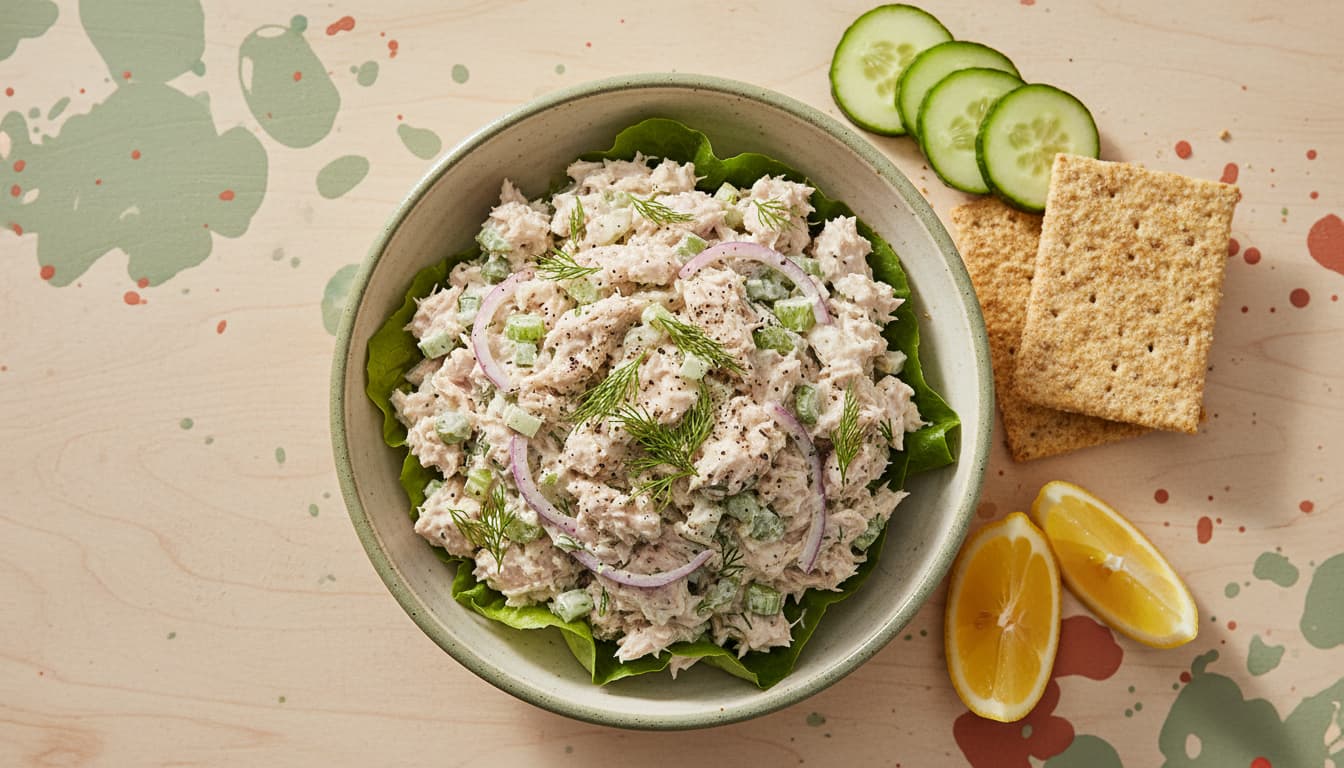
A tuna salad that tastes bright and creamy instead of oily and heavy: drain the tuna properly, build the dressing on Greek yogurt with just a spoon of mayonnaise for richness, and season with acid and crunch so it eats fresh. 28g of protein per serving, ready in ten minutes with no cooking, and it holds three days for lunches. The two moves that stop tuna salad from going watery and dull.
Why this works
Every recipe on this site ships with an explanation of the technique decisions, why sear then braise, why the acid goes in at the end, why the fat renders before the aromatics. The method below is those decisions, in order.
Canned tuna packed in water
Tuna salad is mostly tuna, so the tin is the whole recipe. Choose solid or chunk light or albacore packed in water rather than oil: water-packed tuna drains clean and lets your dressing set the flavour and the fat, while oil-packed tuna arrives already greasy and fights the light Greek-yogurt base. Buy the best tin you can, since a firm, meaty tuna flakes into proper chunks instead of the wet paste that budget tins collapse into. Pole-and-line or skipjack tins are a sensible choice on both quality and sustainability, and any of them make a better bowl than one swimming in oil.
Ingredients
Serves 3- 2 cans (5 oz each)tuna in water · drained well and flaked
- 1/3 cupplain Greek yogurt
- 1 tbspmayonnaise · optional, for richness
- 1 tbspDijon mustard
- 2 stalkscelery · finely diced
- 2 tbspred onion · finely diced
- 1 tbspfresh dill · chopped
- 1 tbsplemon juice
- to tastesalt and black pepper
Method
Drain the tuna properly, then drain it again
Open the tins and press the tuna firmly against the lid to squeeze out every drop of packing liquid, then tip it into a sieve and press once more. This is the single step that separates a fresh tuna salad from a watery one: any liquid left in the tin thins the dressing and makes the whole bowl weep in the fridge. Two minutes with the back of a fork gets the tuna genuinely dry, which means it can soak up seasoning instead of diluting it. Do not skip the second press.
Flake it into chunks, do not mash it
Tip the drained tuna into a bowl and break it up with a fork into flakes and chunks, stopping while there is still texture. Tuna salad wants to feel like actual fish, not a smooth spread, so leave some pieces the size of your thumbnail. Over-mashing turns it pasty and grey and it stops holding the dressing, it just goes gluey. A light hand here keeps the finished bowl feeling like a proper meal rather than a sandwich filler.
Build the dressing on Greek yogurt
In a separate bowl, stir together plain Greek yogurt with just a spoon of mayonnaise and a spoon of Dijon. The yogurt does the creamy, clinging work of a full mayo dressing but adds protein and a little tang instead of pure fat, and the single spoon of mayo is there only for the round richness yogurt cannot quite give. Dijon brings a low background heat and helps the dressing emulsify. Mix the dressing before it meets the tuna so you can taste and adjust it on its own.
Add crunch: celery and red onion, finely diced
Dice celery and a little red onion small and fold them through. Crunch is what makes tuna salad interesting to eat, and celery gives cool, watery snap while red onion adds a sharp savoury edge. Cutting them fine means you get some in every forkful rather than the occasional big shard. If raw onion is too aggressive for you, soak the dice in cold water for five minutes first to take the bite off. This is where the bowl stops being beige and starts being a salad.
Season with acid, not just salt
Add a squeeze of lemon juice along with the salt and pepper, and taste. Tuna is rich and a little metallic straight from the tin, and acid is what lifts it and makes it taste fresh rather than flat. Salt alone cannot do that job. Add the lemon in stages and keep tasting, since the right amount is more than you would guess. A well-seasoned tuna salad should taste bright and almost lemony, which is the flavour most homemade versions are missing.
Fold, do not stir to a paste
Add the dressing and the herbs to the tuna and fold everything together gently with a spatula just until coated. The goal is chunks of tuna held in a light dressing, not a homogenous mush, so stop the moment it comes together. Fresh dill folded in at this stage tastes far greener than dried, and parsley or chives work just as well. Fold, taste one more time for salt and lemon, and it is done. Overworking it now undoes the texture you protected in step two.
Rest it ten minutes so the flavours settle
Give the finished salad ten minutes in the fridge before you eat it if you can. A short rest lets the salt and lemon work through the tuna and the onion mellow, so the bowl tastes seasoned all the way through rather than only on the surface. It is genuinely better after this pause, the same way most dressed salads are. If you are hungry now, eat it now, but the ten minutes is the free upgrade.
Serve it the way that fits the day
Pile it onto crisp lettuce leaves or cucumber rounds for a low-carb plate, spread it on toasted whole-grain bread for a proper sandwich, or scoop it with crackers as a snack. Because the base is Greek yogurt, it carries enough protein to be a real lunch rather than a side. Keep it in a sealed container in the fridge and it holds for three days, though the texture is best on days one and two. A squeeze of fresh lemon just before serving on day three wakes it back up.
Variations
Substitutions and adaptations land with the photography shoot. The method holds across most reasonable swaps.
Storage
Refrigerator: 3 to 4 days, sealed. Freezer: up to 3 months. Reheat covered to retain moisture.
Frequently asked
- Is tuna salad actually healthy?
- Made this way, yes. Tuna is one of the leanest, highest-protein proteins you can keep in the cupboard, and building the dressing on Greek yogurt instead of a full load of mayonnaise keeps this version around 190 calories and 28g of protein per serving with very little saturated fat. The usual problem with tuna salad is the mayo, not the tuna, so swapping most of it for yogurt fixes the calorie and fat load while adding even more protein. Watch the salt, since canned tuna already carries some, and season with lemon before you reach for more.
- How long does tuna salad last in the fridge?
- About three days in a sealed container, and it is best on the first two. After that the celery softens and the dressing can loosen as the salad sits, though a good drain at the start slows that down a lot. Keep it cold the whole time and never leave it out at room temperature for more than an hour or two, as any mayo or yogurt dressing is perishable. If it looks watery on day three, drain off the liquid and refresh it with a squeeze of lemon and a pinch of salt.
- Can I make tuna salad without mayo?
- Yes, and it is barely a change here since this recipe already leans on Greek yogurt for the body. Leave out the single spoon of mayonnaise entirely and add a little more yogurt plus a drizzle of olive oil for richness, and you have a fully mayo-free bowl. It will taste slightly tangier and a touch less rich, which many people prefer. The Dijon, lemon, and dill do enough flavour work that you will not miss it, and the protein and calorie numbers get even better.
- What kind of canned tuna is best for tuna salad?
- Solid or chunk tuna packed in water, either light (skipjack) or albacore. Water-packed drains clean and lets your dressing set the flavour, while oil-packed arrives greasy and fights a light yogurt base. Light tuna is milder, cheaper, and lower in mercury, so it is the sensible everyday choice; albacore is meatier and paler if you want bigger flakes. Whichever you buy, a firmer, better-quality tin flakes into proper chunks instead of collapsing to paste, which is what you want for texture.
- How do I stop tuna salad from being watery?
- Two things: drain the tuna hard, then drain it again, and mix the dressing separately before it meets the fish. Most watery tuna salad is just packing liquid that never got pressed out, thinning everything from the inside. Pressing the tuna dry in a sieve and folding in a pre-mixed dressing rather than adding wet yogurt straight to wet tuna keeps it thick and creamy. Salting the celery is not necessary, but if you use cucumber, salt and drain it first or it will weep into the bowl.
- What goes with tuna salad?
- It is flexible. For a light lunch, serve it on butter lettuce cups or cucumber rounds with lemon; for something more filling, pile it on toasted sourdough or whole-grain bread with tomato and greens. It also works stuffed into an avocado half, scooped with seedy crackers as a snack, or spooned over a green salad as the protein. Because the base is Greek yogurt it brings real protein to any of these, so treat it as a meal component rather than just a spread.
Related recipes
See all →- High-Protein
Beef Bourguignon: Dry the Meat, Crowd Nothing, Wait a Day
This is a braise that fails at the first step or not at all. Wet beef in a crowded pot steams, and a stew built on steamed beef cannot be rescued later by wine, stock or time. Dry the cubes, brown them in three batches, cook the garnish separately, and give it three hours at 325F. Then, ideally, put it in the fridge overnight, because the second day is a different dish.
240m42g Protein - High-Protein
How to Cook Tofu: Press It, Coat It in Starch, Sauce It Last
Tofu is bland and soggy for two mechanical reasons, and both are fixable. It is packed in water, so the surface cannot brown until that water is gone, and it is a set protein gel with no internal channels, so marinade does not penetrate it no matter how long you wait. Press it, coat it in cornstarch, fry it hard, and sauce it after it is crisp. An hour, most of it pressing.
60m20g Protein - High-Protein
Enchiladas: Fry the Tortillas, Fry the Sauce, Bake Them Briefly
Nearly every bad enchilada is the same enchilada: a raw corn tortilla soaked in canned sauce and baked until the whole tray turns to porridge. Two steps fix it permanently. Pass each tortilla through hot oil for twenty seconds so it waterproofs, and fry the blended chile sauce in fat before it goes anywhere near the pan. Ninety minutes, most of it the sauce, and twenty of it in the oven.
95m34g Protein
Get a tested recipe + a nutritional note in your inbox each Sunday.
One recipe a week, photographed on the same Tuesday it tested. Reviewed by an RD. No promotions, no pop-ups, no tracking.
The Clean Chef Starter Kit.
A 14-day anti-inflammatory meal plan PDF, grocery list by section, macros totaled per day, Sunday prep sequence. Free.
By subscribing, you agree to our Privacy Policy. One calm email a week. Unsubscribe anytime.
We're building a shop.
Curated cookware, pantry staples we actually buy, recipe-bundle PDFs. Be the first to know when it opens.
We'll only email you about the shop opening. Unsubscribe in any email. See our Privacy Policy.