- Calories
- 1900
- Protein
- 115g
- Fiber
- 33g
- Sat. fat
- 14g
- Sodium
- 2000mg
- Added sugar
- 12g
What this recipe does for you.
Most PCOS eating advice is a list of banned foods with no mechanism attached. The mechanism worth cooking around is insulin, which is why protein at breakfast, fiber with every carbohydrate, and the order food hits your stomach do more than any elimination list. What the evidence supports, what it does not, and a week of actual dinners.
Why this works
Every recipe on this site ships with an explanation of the technique decisions, why sear then braise, why the acid goes in at the end, why the fat renders before the aromatics. The method below is those decisions, in order.
Ingredients
- Full ingredient list ships with photography
Method
Insulin is the lever, and that is why the food lists never work
Somewhere between sixty and eighty percent of people with PCOS have some degree of insulin resistance, independent of body size. High insulin pushes the ovary toward androgen production and suppresses the liver protein that normally binds testosterone, which is the short version of why the symptoms cluster the way they do. Anything that lowers the insulin load, and that is mostly meal composition, protein, fiber, sleep and muscle, is working upstream. A list of forbidden fruits is working nowhere.
Breakfast at 30g of protein changes the rest of the day
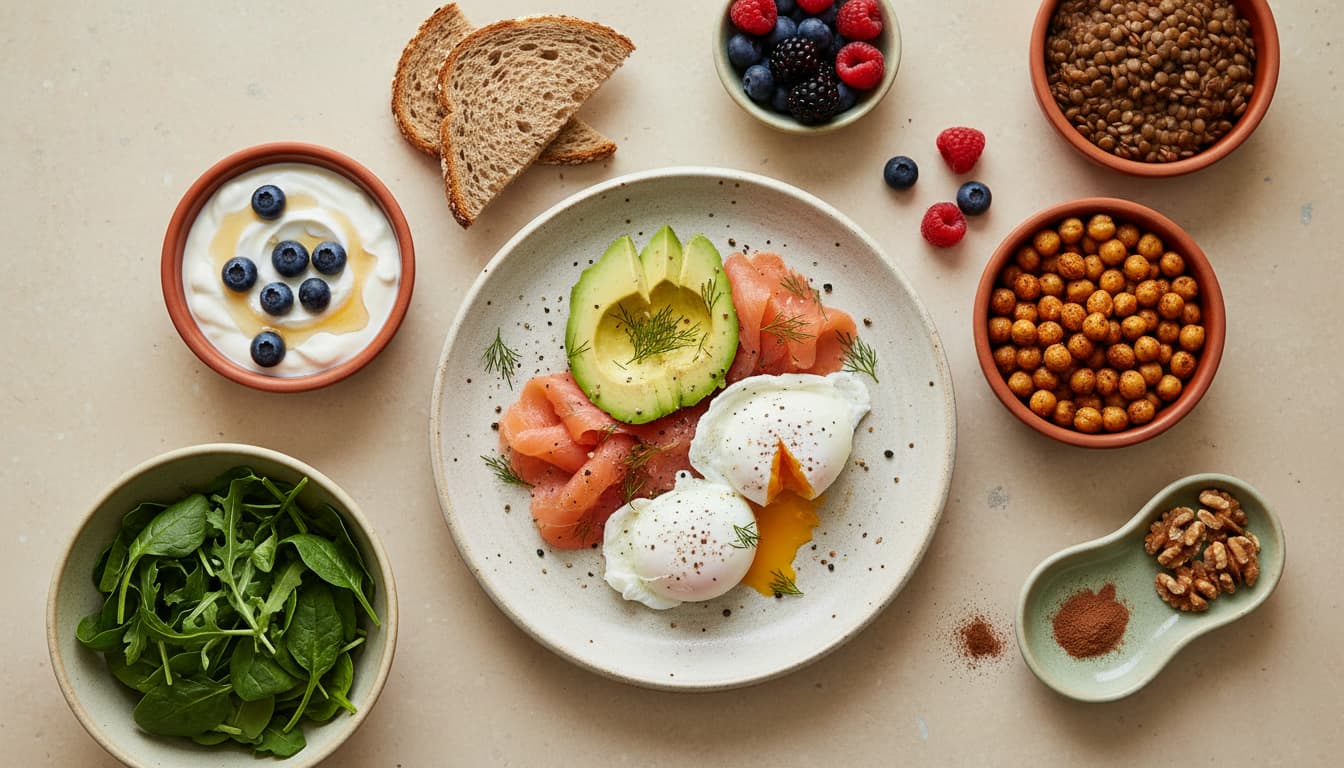
A cereal or toast breakfast produces the largest glucose and insulin excursion of anyone's day, then a crash at eleven that gets treated with more carbohydrate. Front-loading protein flattens that curve and, in several small PCOS trials, front-loading calories earlier in the day improved insulin markers and free testosterone compared to the same food eaten later. Practically: eggs with spinach, Greek yogurt with berries and seeds, cottage cheese with tomato and olive oil, or a savoury bowl with last night's protein. Thirty grams, before ten o'clock.
Carbohydrate is not the enemy, naked carbohydrate is
Very low carbohydrate diets do work for insulin, and they also fail on adherence for most people and can make cycles worse if they push intake too low. The more durable move is to stop eating carbohydrate on its own. Every starch gets protein, fat and fiber attached: rice with chicken and a large vegetable, oats with yogurt and walnuts, fruit with cheese or nuts rather than alone. Same food, different curve. Aim for whole intact grains and legumes over flour, because the physical structure slows digestion more than the glycemic index number suggests.
Meal order is free and measurable
Eating vegetables and protein before the starch, within the same meal, lowers the glucose peak meaningfully in controlled studies. It costs nothing, requires no substitution, and is the single easiest change on this page. In practice it means eating the salad first rather than pushing it around the plate, and putting the bread down until the protein is gone. It is not magic and it will not replace losing insulin resistance, but the effect is real and it stacks with everything else here.
The dairy and gluten question, answered honestly
There is no good evidence that everyone with PCOS should drop dairy or gluten. Dairy is a mild insulin secretagogue and some people report clearer skin without it, which is worth an individual four-week test rather than a blanket rule. Gluten matters if you have coeliac disease, which is worth ruling out because it is more common in autoimmune clusters, and otherwise it mostly matters because cutting it removes a lot of refined flour. If you drop either one, replace it rather than just subtracting, or you end up with a lower-protein diet, which is the wrong direction.
Fats: more olive oil and fish, less of the rest
PCOS runs with low-grade inflammation, and the fat pattern that reads best across the literature is the Mediterranean one: extra-virgin olive oil as the main fat, oily fish twice a week, nuts and seeds daily, and much less of the fried and ultraprocessed fat. Omega-3 intake has shown modest improvements in triglycerides and insulin markers in PCOS trials. This is not a supplement recommendation, it is a reason to buy tinned sardines and salmon and to cook with olive oil rather than with a neutral seed oil by default.
Muscle is a metabolic organ, and this is a food site saying it
Resistance training improves insulin sensitivity in PCOS independently of any weight change, and skeletal muscle is where most post-meal glucose goes. That has two kitchen consequences. First, protein targets are higher than general guidance, in the range of 1.4 to 1.8g per kilogram of body weight, which for many people is 100 to 130g a day and needs planning rather than hoping. Second, a ten-minute walk after dinner blunts the post-meal curve enough to be worth doing on the nights you cannot train.
Supplements, and where they sit relative to the plate
Myo-inositol has the most PCOS-specific evidence of the common supplements, with several trials showing improved ovulatory function and insulin markers, generally at 2g twice daily and often paired with D-chiro-inositol. Vitamin D correction matters if you are deficient, which is worth testing rather than assuming. Berberine and omega-3 have smaller signals. None of these replace metformin or any other prescription, none of them are regulated like a drug, and all of them belong in a conversation with the clinician managing your care rather than in a shopping basket after reading a page.
A week of PCOS cooking, and what to watch for eight weeks
Dinners: chicken thighs roasted over peppers and courgette. Salmon with lentils and lemon. A big pot of turkey chili with beans. Prawn stir-fry with a lot of vegetables and a modest bowl of rice. Cod with tomatoes and capers. A lentil and sweet potato stew. Eggs and roasted vegetables when the week collapses. Track cycle length, energy at four in the afternoon, and how eleven o'clock feels, because those move before any lab does. Give it eight weeks before you judge it.
Variations
Substitutions and adaptations land with the photography shoot. The method holds across most reasonable swaps.
Storage
Refrigerator: 3 to 4 days, sealed. Freezer: up to 3 months. Reheat covered to retain moisture.
Frequently asked
- Is a low-carb or keto diet best for PCOS?
- Lower carbohydrate approaches do improve insulin markers and, in some trials, ovulatory function, so they are a legitimate option rather than a fad. The problems are adherence over years, the risk of driving overall energy intake too low, and the fact that a lot of people end up on a low-fiber version, which is the worst of both worlds. A moderate-carbohydrate Mediterranean pattern with high protein and high fiber gets most of the same insulin benefit and is easier to keep. If you want to try keto, do it with vegetables and a clinician involved.
- Do I have to lose weight to improve PCOS?
- No, and the framing matters. Insulin sensitivity, cycle regularity and androgen markers all improve with meal composition, resistance training and sleep even when body weight does not change, and lean people with PCOS see those same improvements. Where weight loss does help, the literature suggests modest amounts, around five percent, are enough to restore ovulation in many people. Chasing a number harder than that tends to produce restriction, which raises cortisol and makes cycles worse.
- Should I cut out dairy for PCOS?
- Only if you test it and it helps you. There is no population-level evidence that dairy worsens PCOS, and full-fat dairy in particular looks neutral to mildly favourable in most cohort data. The honest approach is a four-week removal with everything else held constant, then a deliberate reintroduction, and a note of what actually changed. If you remove it permanently, replace the protein and calcium rather than leaving a hole, because a lower-protein diet is a worse trade than any dairy effect.
- How much protein do I actually need with PCOS?
- More than the standard recommendation, which is set to prevent deficiency rather than to optimise anything. Most PCOS-focused practitioners work in the 1.4 to 1.8g per kilogram range, which is roughly 100 to 130g a day for a person around 70kg. The practical challenge is not the total, it is the distribution: 30g at breakfast, 30 to 40g at lunch and dinner. Most people eating a Western pattern get 10g in the morning and 60g at night, which is the same total and a worse result.
- Does inositol actually work for PCOS?
- It has the strongest evidence base of the over-the-counter options, with multiple randomised trials showing improved insulin sensitivity and ovulation rates, typically at 2g of myo-inositol twice daily, often combined with D-chiro-inositol in a 40 to 1 ratio. The trials are mostly small and the effect sizes vary. It is not a substitute for metformin if metformin has been prescribed, and supplements are not regulated for content or purity the way medicines are, so bring it to the clinician managing your PCOS before you start.
Related recipes
See all →- Diet-Specific
Magnesium-Rich Foods: Pumpkin Seeds Beat Spinach, and Bread Lost Most of Its
An ounce of pumpkin seeds carries about 156mg of magnesium, which is more than a cup of cooked spinach and roughly five times what a banana delivers. Around half of adults in national survey data take in less than the estimated requirement, and the largest single reason is grain refining, which strips about eighty percent of the magnesium out of wheat before it reaches a loaf.
- Diet-Specific
Potassium-Rich Foods: The Banana Is Not Even in the Top Twenty
A medium banana has 422mg of potassium. A baked potato with the skin on has around 900mg, a cup of white beans about 1,000mg, and a cup of cooked spinach about 840mg. The banana became the symbol because it is portable, not because it is dense. What the number on the plate actually depends on is portion size, whether you cooked it in water, and how much sodium is sitting next to it.
- Diet-Specific
Vegetarian Recipes: Protein, Browning, and Actual Dinners
Vegetarian cooking almost never fails for lack of ideas. It fails on two things: not enough protein on the plate, and not enough browning in the pan. Fix those and a meatless dinner stops reading as the version without the main thing. Where the protein comes from, the four nutrients worth attention, the techniques that make plants taste cooked-for, and a week of dinners.
Get a tested recipe + a nutritional note in your inbox each Sunday.
One recipe a week, photographed on the same Tuesday it tested. Reviewed by an RD. No promotions, no pop-ups, no tracking.
The Clean Chef Starter Kit.
A 14-day anti-inflammatory meal plan PDF, grocery list by section, macros totaled per day, Sunday prep sequence. Free.
By subscribing, you agree to our Privacy Policy. One calm email a week. Unsubscribe anytime.
We're building a shop.
Curated cookware, pantry staples we actually buy, recipe-bundle PDFs. Be the first to know when it opens.
We'll only email you about the shop opening. Unsubscribe in any email. See our Privacy Policy.