Mediterranean diet for weight loss
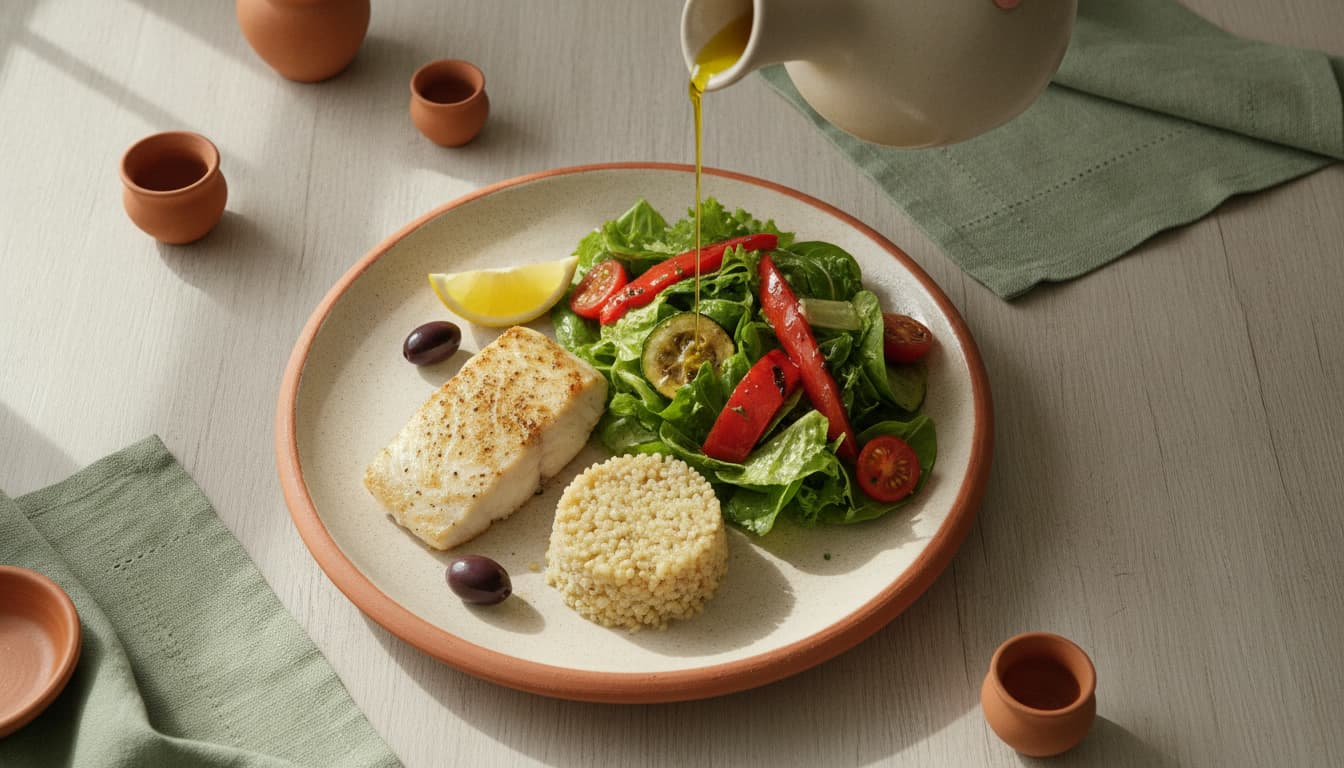
By The ThatCleanChef Kitchen · Updated August 25, 2026 · 13 min read
An honest read of the evidence and then the cooking. What the randomised trials actually found, why the olive oil is not the problem, the two mechanisms that do the work (energy density and satiety), the portion changes that matter more than the ingredient swaps, and a week of dinners built to be filling rather than small.
- 01
What the trials actually found, stated plainly
Across randomised comparisons, a Mediterranean pattern produces modest weight loss, broadly in the range of two to five kilograms over a year, and performs about as well as a low-fat diet and sometimes slightly better over longer follow-up. The interesting result is not the size of the loss, it is the adherence and the maintenance. People stay on it, and the weight tends not to come back as fast, which is where nearly every restrictive diet actually fails.
- 02
The olive oil is not the problem
This is the single largest source of confusion, and it comes from three decades of low-fat messaging. In the PREDIMED trial the group given a litre of extra-virgin olive oil a week did not gain weight relative to the low-fat control, and reported waist measurements went the other way. Fat is calorie-dense, so quantity is not irrelevant, but rationing the olive oil down to a teaspoon makes the vegetables dull, which is how the whole pattern collapses back into snacking.
- 03
Mechanism one, energy density
A plate built on vegetables, pulses and whole grains carries fewer calories per bite than the same volume of refined carbohydrate and cheese. That is the whole trick and it is boring. You eat a similar or larger physical amount of food and take in less energy, without hitting the wall of eating small portions. Nobody sustains small portions. Most people can sustain a big plate that happens to be mostly vegetables and beans.
- 04
Mechanism two, satiety, which is protein plus fiber
Fiber above thirty grams a day and protein in the region of one hundred grams is a combination that keeps people out of the cupboard at half past nine at night. The classic Mediterranean plate under-delivers protein by American standards if you build it purely on grains and vegetables, so put fish, eggs, poultry, yogurt or pulses in every meal deliberately. This is the single most useful modification for anyone using the pattern for body composition.
- 05
The portion changes that matter more than the ingredient swaps
Vegetables become half the plate rather than a garnish. Pasta and rice become a component at around a cup cooked rather than the base of the meal. Bread arrives with the meal rather than before it. Cheese is a flavouring at roughly an ounce rather than a layer. And the pattern includes no snacking as the default, which for a lot of people is a larger change than anything on the shopping list.
- 06
Four dinners that do the job without feeling like less food
Sheet-pan salmon with two trays of vegetables and a lemon and olive oil dressing. A big lentil soup finished with olive oil at the bowl, plus bread. Greek chicken with charred courgette and a yogurt sauce. And a dense bean salad with feta, tomato, cucumber and herbs. Each one lands between four hundred and six hundred calories with real protein and eight to eighteen grams of fiber, and none of them reads as a diet plate.
- 07
Where the calories quietly come back in
Nuts eaten out of the bag rather than measured, cheese by the handful, bread as a pre-meal course, wine as an evening rather than a glass, and olive oil poured with no reference at all. None of these need removing. They need a container, a portion, or a look. Thirty grams of walnuts is a small handful and about two hundred calories, and three of those handfuls is a meal you did not count.
- 08
What to expect, and on what timeline
Digestion and appetite change inside two weeks. Weight moves slowly, usually in the range of half a kilogram a week at most, and it plateaus, repeatedly. Blood lipids and blood pressure often improve on a timeline of eight to twelve weeks whether or not the scale cooperates, which is the argument for judging this pattern on more than one number. If you want faster, this is not the pattern, and faster is not the part that tends to hold.
- 09
What this pattern is not
It is not a cleanse, it is not a fourteen-day protocol, and it does not need a supplement. It also does not need to be perfect: the trials that produced these results ran on scored adherence, not compliance, and people in them ate bread, drank wine and had bad weeks. If you are looking for a rule set to fail at, this is the wrong pattern. It is a way of cooking that happens to make eating less feel unremarkable.
What people ask us next.
- Will I lose weight on the Mediterranean diet?
- Probably some, slowly, and mostly if the pattern replaces ultra-processed food and restaurant meals rather than sitting on top of them. Randomised trials show modest losses in the two to five kilogram range over a year, comparable to low-fat diets, with better long-term adherence. It is not a rapid-loss diet and nobody should sell it as one. Its real advantage is that people are still eating this way in year three.
- How much olive oil is too much?
- The PREDIMED trial used roughly four tablespoons a day and did not produce weight gain against a low-fat comparison, so two to four tablespoons is well inside the range the evidence supports. It is still around 120 calories a tablespoon, so the practical rule is to pour it with a measure for a week until you know what your normal pour looks like. Most people are either drastically under or considerably over, and both are worth knowing.
- Do I need to count calories?
- Not necessarily, and most of the trial protocols did not ask participants to. Counting for one or two weeks is genuinely useful as a calibration exercise, because it tells you what your olive oil, cheese, nuts and bread actually add up to, and almost everyone is surprised by one of those four. After that, the plate structure does most of the work: half vegetables, a real protein, a cup of grain, and fat you poured on purpose.
- Is the Mediterranean diet better than low-carb for weight loss?
- Head to head over six to twelve months, low-carb diets usually produce slightly faster early loss and the difference narrows or disappears by twelve to twenty-four months. Where the Mediterranean pattern wins is adherence and cardiovascular outcome data, which is a longer and better-evidenced record than any low-carb trial can currently show. The best diet in the literature is repeatedly the one the participant was still following at the end.
- How do I get enough protein on it?
- Add it deliberately, because the traditional pattern is not built around it. Fish twice a week, eggs, chicken a few times, plain Greek yogurt daily, and pulses in three meals gets most people comfortably to a hundred grams a day. A useful check is that every plate should have one thing on it you could name as the protein. If you cannot name it, the plate is grain and vegetables, and you will be hungry by nine.
Where the technique comes from
- Mancini JG, et al. Systematic review of the Mediterranean diet for long-term weight loss. Am J Med. 2016.
- Estruch R, et al. Primary prevention of cardiovascular disease with a Mediterranean diet supplemented with extra-virgin olive oil or nuts (PREDIMED). NEJM. 2018.
- Shai I, et al. Weight loss with a low-carbohydrate, Mediterranean, or low-fat diet. NEJM. 2008.
- Dietary Guidelines for Americans 2020-2025, dietary fiber and protein intake reference.
About the ThatCleanChef Kitchen
A small team of recipe developers and food photographers testing recipes in home kitchens on home equipment. Every Nutrition Ledger is USDA FoodData Central-sourced and reviewed by Lena Marsh, RDN, MS. We don't pretend to be a single chef, we're the people behind the plates. Meet the full team →
Related posts
Gazpacho: An Emulsion, Not a Cold Tomato Soup
The Andalusian version is thick, orange-pink and creamy without any dairy in it, and the two things that get it there are stale bread and olive oil poured in slowly at the end. Watery red gazpacho is a blender-order problem. It needs genuinely ripe tomatoes, sherry vinegar rather than any other kind, and four hours in the fridge, which the time on this page includes.
Tabbouleh: A Parsley Salad With Bulgur In It, Not the Reverse
Almost every tabbouleh sold outside the Levant has the ratio backwards: a bowl of wet bulgur with parsley stirred through. The Lebanese version is three quarters herbs by volume, with fine bulgur used the way you would use breadcrumbs, soaked in tomato juice rather than boiled. Forty-five minutes, no cooking at all, and most of the work is drying parsley and chopping it properly.
Carbonara: Four Ingredients, One Temperature, No Cream
Carbonara is not a cream sauce and it is not scrambled eggs. It is an emulsion of egg yolk, rendered pork fat, grated sheep cheese and starchy pasta water, held together by heat that stops just short of setting the egg. Everything that goes wrong goes wrong in the last ninety seconds. Thirty minutes, four ingredients, and a pan that comes off the burner before the eggs arrive.
The Clean Chef Starter Kit.
A 14-day anti-inflammatory meal plan PDF, grocery list by section, macros totaled per day, Sunday prep sequence. Free.
By subscribing, you agree to our Privacy Policy. One calm email a week. Unsubscribe anytime.