- Calories
- 505
- Protein
- 37g
- Fiber
- 3g
- Sat. fat
- 8g
- Sodium
- 920mg
- Added sugar
- 0g
What this recipe does for you.
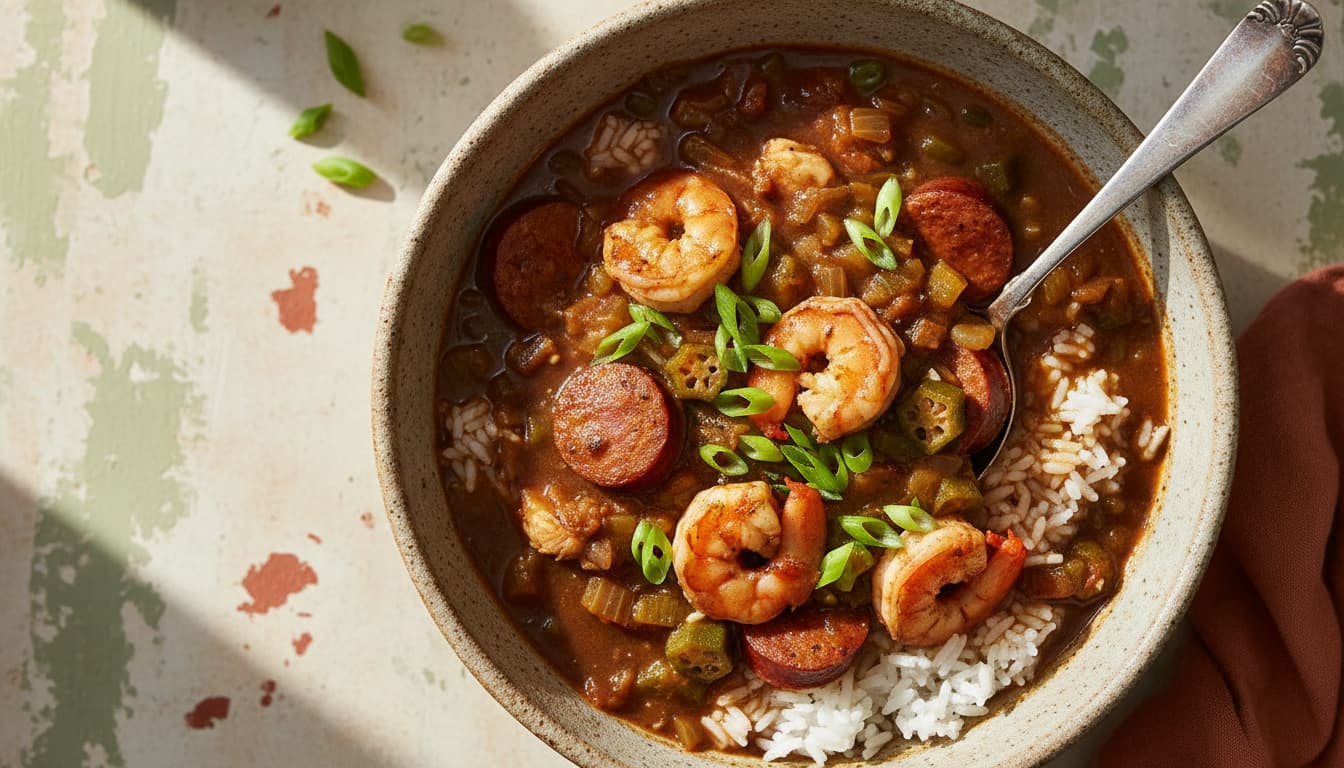
The roux is the dish. Flour and oil taken from white to the color of an old penny over forty minutes at the stove, which cannot be rushed and cannot be walked away from. Past that the rest is straightforward: the trinity, andouille, chicken thighs, warm stock, and shrimp in the last five minutes. Rice goes in the bowl, never in the pot.
Why this works
Every recipe on this site ships with an explanation of the technique decisions, why sear then braise, why the acid goes in at the end, why the fat renders before the aromatics. The method below is those decisions, in order.
Ingredients
Serves 8- 3/4 cupall-purpose flour
- 3/4 cupneutral oil · high smoke point, avocado or refined peanut, not olive oil
- 2 lbbone-in chicken thighs · skin removed, meat pulled off after simmering
- 1 lbandouille sausage · sliced into half-inch coins
- 1 1/4 lblarge shrimp · peeled and deveined, shells reserved for the stock
- 2 largeonions · diced
- 2 wholegreen bell peppers · diced
- 4 ribscelery · diced
- 6 clovesgarlic · minced
- 10 cupschicken stock · simmered 20 minutes with the shrimp shells, then strained and kept warm
- 3 wholebay leaves
- 2 tspdried thyme
- 1 1/2 tspcayenne pepper · start at 1 tsp if you are unsure of your tolerance
- 1 tbspsweet paprika
- 1 tbspkosher salt · the andouille brings its own, taste before you add it all
- 1 tspfile powder · stirred in off the heat, never boiled
- 6 wholescallions · thinly sliced, to finish
- 1/2 cupflat-leaf parsley · chopped
- 3 cupscooked long-grain rice · spooned into the bowl, not cooked in the gumbo
Method
The roux is the dish, and the color is the dial
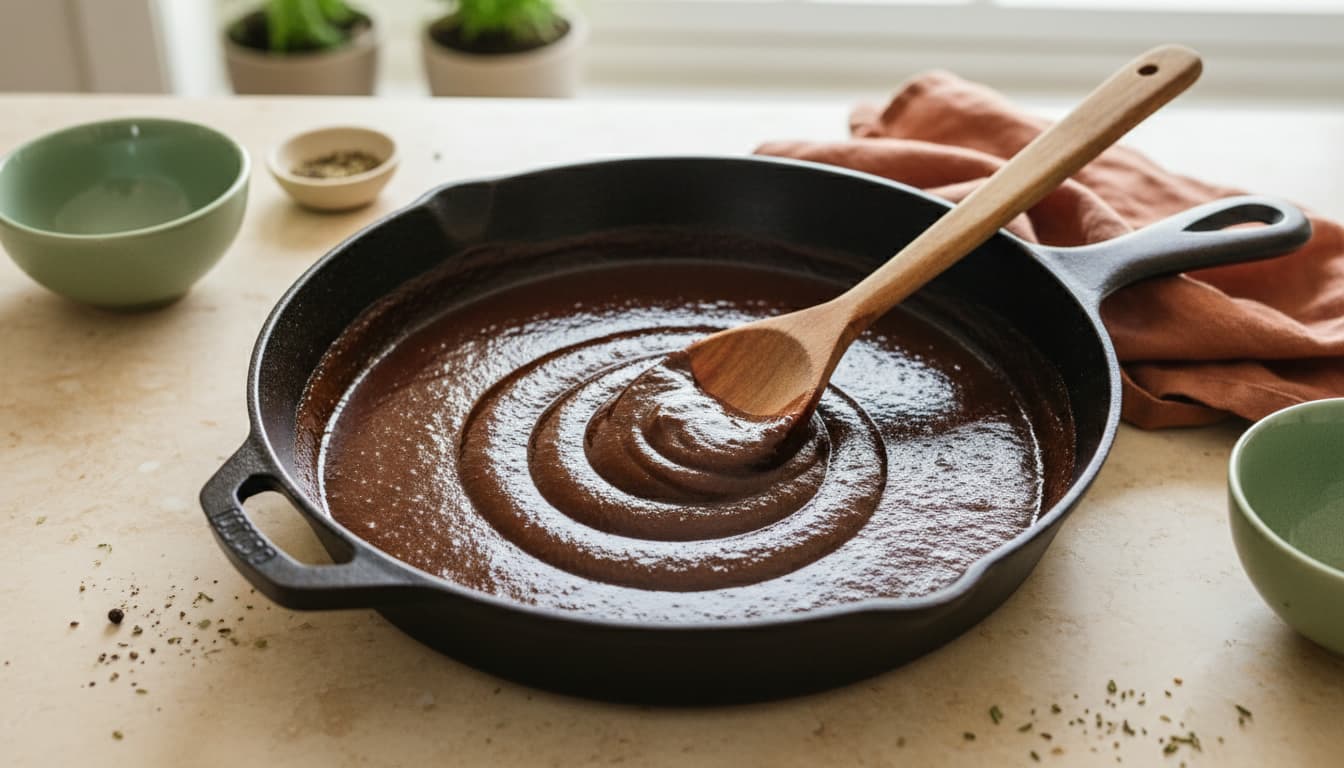
Flour cooked in fat browns through blond, peanut butter, milk chocolate and finally the color of an old copper penny, and each stage tastes different. Dark roux is nutty, smoky and deeply savoury, and it thickens far less than a pale one because the starch has been broken down by the heat. That is the trade you are making: flavour for body. A dark roux gumbo is thin and intensely flavoured, and thickening it with more flour afterwards defeats the point.
Equal parts by volume, a heavy pot, and medium heat
Three quarters of a cup of flour to three quarters of a cup of oil, whisked together in a heavy-bottomed Dutch oven or a cast-iron pot over medium. A thin pan gives you hot spots and hot spots give you black specks, which taste burnt and cannot be picked out. Use a neutral oil with a high smoke point rather than butter, which contains milk solids that scorch, or olive oil, which is not stable enough for forty minutes at this temperature.
Forty minutes, and you cannot leave the stove
Whisk or stir constantly with a flat-edged wooden spoon that reaches the corners, keeping the whole surface of the pot moving. It will look like nothing is happening for fifteen minutes and then change quickly, so pay closer attention as it darkens. Have the diced vegetables sitting beside you before you start, because when it hits the color you want you have about ten seconds to act. If black flecks appear, throw it out and start again, since there is no rescuing a burnt roux.
The trinity goes in hot and stops the roux dead
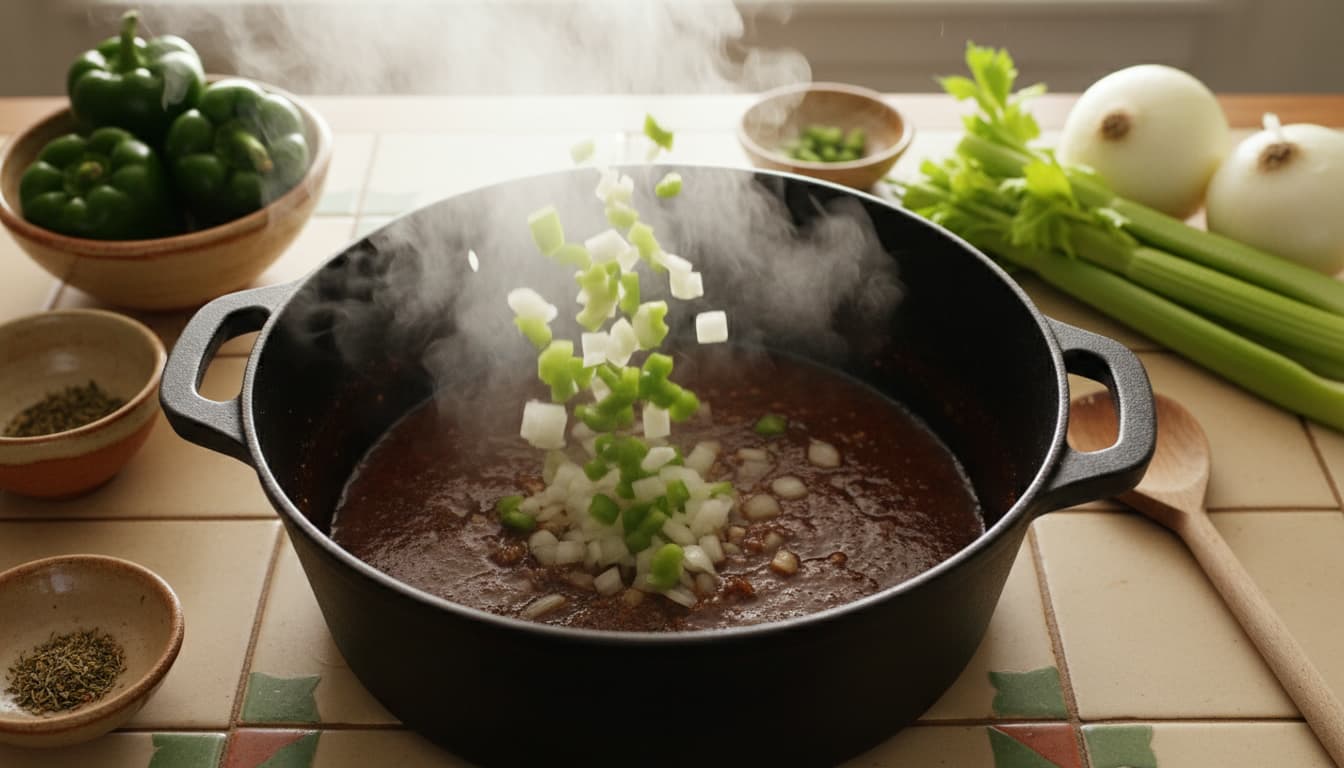
Onion, green bell pepper and celery, roughly two parts onion to one each of the others, all diced small and added straight into the roux at temperature. It will hiss violently and the pot will drop about a hundred degrees, which is exactly what you want, since it arrests the browning before it goes too far. Stir for five minutes until the onions go translucent, then the garlic for one more minute.
Warm stock, a ladle at a time, or the roux seizes
Cold liquid hitting hot roux makes it clump into lumps that will not disperse no matter how long you simmer. Simmer the shrimp shells in the stock for twenty minutes first, strain, and keep it warm on the next burner. Add it to the pot two ladles at a time, stirring each addition until smooth before the next goes in. After the first three or four additions the mixture is loose enough that you can pour the rest in steadily.
Chicken first, sausage second, shrimp in the last five minutes
Add the chicken thighs, bay, thyme, cayenne and paprika and simmer uncovered for forty-five minutes, then lift the thighs out, pull the meat and return it. Add the andouille and simmer another thirty minutes, which is enough for its fat and spice to move into the broth. The shrimp go in for the final four to five minutes only, off a gentle simmer. Shrimp added at the start are rubber by the time the gumbo is ready, and that is not recoverable.
File or okra, and never both at once
Both are thickeners and they do the same job differently. Okra is added with the trinity and cooks down over the whole simmer, giving a slightly viscous body and a green vegetal note. File powder, which is ground sassafras leaf, goes in off the heat at the very end and gives a silky texture and a faint root-beer aroma. Boiling file makes it stringy and unpleasant. Using both is a Louisiana argument you do not need to have on a weeknight.
Skim the fat, and season at the end because the andouille moves
Let the pot sit off the heat for ten minutes and skim the orange fat that rises, which is normal and is where most of the greasiness complaints come from. Only now taste for salt, because a pound of andouille can add anywhere between 400 and 900mg of sodium a serving depending on the brand and you cannot predict it. Add the file powder, the scallions and the parsley, and a splash of vinegar or hot sauce if it needs lifting.
Rice in the bowl, gumbo over it
Cook the rice separately and mound about half a cup in the bottom of each warmed bowl, then ladle the gumbo around and over it. Rice cooked in the pot absorbs the broth, breaks down, and turns the whole thing into a stodgy casserole by the second day. Kept separate, the gumbo stays a broth and the leftovers reheat properly. This is also why gumbo is better on day two while jambalaya is not.
In pictures

Variations
Substitutions and adaptations land with the photography shoot. The method holds across most reasonable swaps.
Storage
Refrigerator: 3 to 4 days, sealed. Freezer: up to 3 months. Reheat covered to retain moisture.
Frequently asked
- How dark should a gumbo roux be?
- For a chicken and sausage gumbo, the color of milk chocolate to an old copper penny, which is roughly thirty-five to forty-five minutes at medium heat. Seafood gumbos are often taken lighter, to peanut butter, because a very dark roux overwhelms delicate shellfish. The darker you go, the more flavour and the less thickening power, so a penny-dark gumbo is soupy by design. Stop the moment it smells nutty and toasted rather than acrid.
- Can I make a roux in the oven instead of stirring for forty minutes?
- Yes, and it is the best trick in this recipe if you are short on attention rather than time. Whisk the flour and oil together in an oven-safe pot, put it in a 350F oven, and stir it every twenty minutes. It takes around ninety minutes to reach dark, but almost all of it is unattended, and there is far less risk of burning because the heat is even. The result is indistinguishable from the stovetop version.
- What is the difference between gumbo and jambalaya?
- Gumbo is a soup or stew built on a roux, served over rice that was cooked separately. Jambalaya is a rice dish, where the rice cooks in the pot and absorbs all the liquid, closer in structure to a paella. Gumbo is thin and eaten with a spoon from a bowl. Jambalaya is a plate of seasoned rice with meat through it. They share the trinity and much of the seasoning and almost nothing else.
- Do I need file powder?
- No. It is one of three thickening and finishing options along with okra and simply a lighter roux, and plenty of good gumbo uses none of them. If you do use it, stir a teaspoon in after the pot comes off the heat and let it sit for two minutes. Never let it boil, which turns it stringy and slightly slimy. It is also easy to add at the table, a small spoonful per bowl, which lets people choose.
- Why is my gumbo greasy?
- Because the roux is half oil and the andouille renders a lot more, and none of it was skimmed. Let the finished pot rest off the heat for ten minutes so the fat rises into a clear orange layer, then take it off with a wide spoon or a ladle. Chilling it overnight makes this trivial, since the fat sets on top and lifts off in a sheet. Some fat should stay, since it carries the spice, but a slick on every spoonful means you skipped the step.
- Can I freeze gumbo?
- Yes, for three months, with one adjustment: freeze it before the shrimp go in. Shrimp that have been cooked, frozen and reheated turn tough and slightly chalky. Freeze the chicken and sausage base in portions, then thaw, bring to a gentle simmer and drop fresh shrimp in for the last four minutes. Freeze the rice separately or cook it fresh. The roux flavour deepens in the freezer rather than fading, so this reheats better than most stews.
Related recipes
See all →- High-Protein
Beef Bourguignon: Dry the Meat, Crowd Nothing, Wait a Day
This is a braise that fails at the first step or not at all. Wet beef in a crowded pot steams, and a stew built on steamed beef cannot be rescued later by wine, stock or time. Dry the cubes, brown them in three batches, cook the garnish separately, and give it three hours at 325F. Then, ideally, put it in the fridge overnight, because the second day is a different dish.
240m42g Protein - High-Protein
How to Cook Tofu: Press It, Coat It in Starch, Sauce It Last
Tofu is bland and soggy for two mechanical reasons, and both are fixable. It is packed in water, so the surface cannot brown until that water is gone, and it is a set protein gel with no internal channels, so marinade does not penetrate it no matter how long you wait. Press it, coat it in cornstarch, fry it hard, and sauce it after it is crisp. An hour, most of it pressing.
60m20g Protein - High-Protein
Enchiladas: Fry the Tortillas, Fry the Sauce, Bake Them Briefly
Nearly every bad enchilada is the same enchilada: a raw corn tortilla soaked in canned sauce and baked until the whole tray turns to porridge. Two steps fix it permanently. Pass each tortilla through hot oil for twenty seconds so it waterproofs, and fry the blended chile sauce in fat before it goes anywhere near the pan. Ninety minutes, most of it the sauce, and twenty of it in the oven.
95m34g Protein
Get a tested recipe + a nutritional note in your inbox each Sunday.
One recipe a week, photographed on the same Tuesday it tested. Reviewed by an RD. No promotions, no pop-ups, no tracking.
The Clean Chef Starter Kit.
A 14-day anti-inflammatory meal plan PDF, grocery list by section, macros totaled per day, Sunday prep sequence. Free.
By subscribing, you agree to our Privacy Policy. One calm email a week. Unsubscribe anytime.
We're building a shop.
Curated cookware, pantry staples we actually buy, recipe-bundle PDFs. Be the first to know when it opens.
We'll only email you about the shop opening. Unsubscribe in any email. See our Privacy Policy.