Slow cooker recipes
By The ThatCleanChef Kitchen · Updated August 31, 2026 · 11 min read
A slow cooker is a collagen machine. Give it chuck, shin, shoulder, thigh or dried legumes and eight hours turns them into something a fast method cannot reach. Give it chicken breast, pork loin or a pile of vegetables and eight hours ruins them. Which cuts, how much liquid, when the vegetables go in, and why you still sear first.
We'd rather answer the question you actually asked in the first paragraph, then earn your trust by showing the chef notes.
What actually matters, in order.
- 01
Collagen is the entire selection criterion
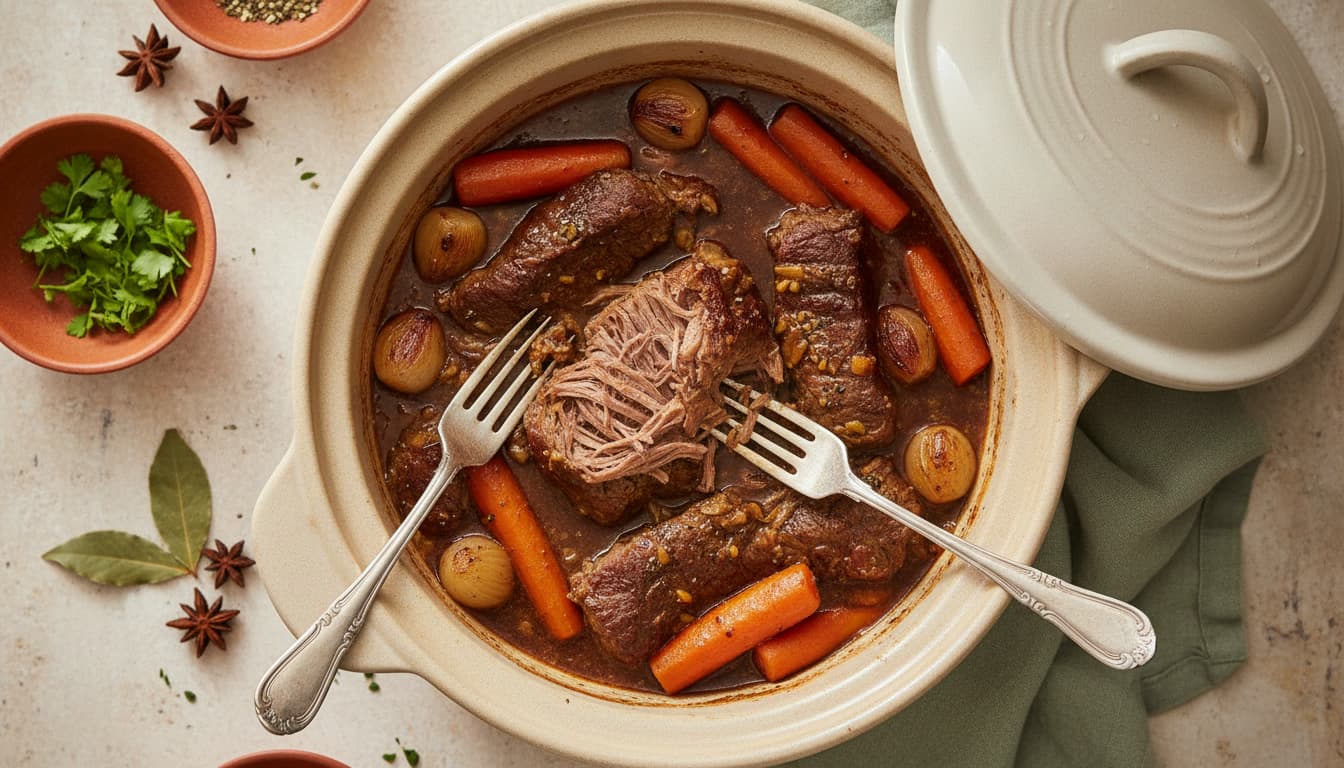
This is a meal prep appliance before it is anything else, and the cuts that work are the ones the animal used: shoulder, shin, chuck, brisket, oxtail, short rib, chicken and turkey thigh, lamb neck. They are full of connective tissue, and connective tissue held between 160F and 200F for hours converts into gelatin, which is what makes a braise feel rich without any cream in it. The cuts that fail are the tender ones, breast and loin and fillet, which have almost no collagen to convert and simply dry out. The cheap cuts are the right cuts, which is unusual and worth exploiting.
- 02
Low and high reach the same temperature, only the pace differs
Both settings climb to roughly the same simmer, around 200F. High just gets there faster. As a rule, 4 hours on high is about 8 hours on low, and if a recipe gives you both, they are not different recipes. Low is better for collagen because the meat spends longer in the conversion window before the muscle fibers tighten, so if you have the time, use it. High is what you use when you started at two in the afternoon.
- 03
Sear first, and deglaze into the pot
Nothing browns inside a slow cooker, ever. It is a moist chamber at a simmer, which is below the temperature the Maillard reaction needs. So the browning has to happen in a skillet first: meat in batches until genuinely brown, then onions, then a splash of wine or stock to lift the fond, and all of it scraped into the ceramic. This is fifteen minutes and it is the difference between a stew that tastes of beef and one that tastes of hot water. Skip everything else before you skip this.
- 04
Use half the liquid you think, because nothing evaporates
A sealed slow cooker loses almost no moisture, and the meat and vegetables release plenty of their own. A stovetop recipe that calls for six cups of stock wants about two and a half here, enough to come halfway up the meat rather than to cover it. Overfilled, you get a thin, washed-out braise and meat that has boiled rather than braised. If you end up with too much liquid anyway, pour it into a pan and reduce it hard for ten minutes while the meat rests.
- 05
Vegetables go in at different times, and root vegetables go at the bottom
Carrots, potatoes, swede and onion go in at the start, arranged under the meat where the heat is highest, because they take longer than most people expect. Peppers, courgette, mushrooms and green beans go in for the last hour or they dissolve. Peas, spinach and fresh herbs go in for the last five minutes. Sequencing this is most of the difference between a slow-cooker dinner with texture and the uniform brown mass that gives the appliance its reputation.
- 06
Dairy, acid and fresh herbs belong at the end
Cream, yogurt, creme fraiche and soft cheese split over eight hours, so stir them in at the finish with the heat off. Lemon juice and vinegar go dull and flat, so add them in the last few minutes where they still lift the dish. Delicate herbs turn to sludge, so parsley, dill, basil and coriander are a garnish rather than an ingredient here. What does survive the long cook is dried herbs, bay, whole spices and hardy thyme and rosemary stems.
- 07
The lean-protein trap, and the one workaround
Chicken breast in a slow cooker is dry at three hours and shredded sawdust at six, because there is nothing to convert and the fibers just keep contracting. The workaround is to use thighs, which cost less and are better. If you genuinely must use breast, add it whole for the final 90 minutes on low, sitting in the liquid, and pull it at 165F. Pork loin, fish and shrimp have the same problem and the same answer, which is that they belong in a different appliance.
- 08
Food safety: fill level and the first two hours
Fill the crock between half and two thirds. Below half it scorches at the edges, above two thirds the middle sits in the 40F to 140F range too long. Never start with frozen meat, because the thaw happens inside that range. Do not use the slow cooker to reheat leftovers, which climb too slowly, and do not lift the lid to peek, since each look costs roughly 20 minutes of recovery. Cool leftovers in shallow containers rather than in the crock, which holds heat for hours.
- 09
Five that actually work, with honest timings
Beef chuck braised in stock, tomato and red wine, 8 hours on low, seared first. Pulled pork shoulder with a dry rub and a splash of cider vinegar, 9 hours on low. Chicken thigh and white bean stew, 6 hours on low with the beans soaked. A pot of dried chickpeas with garlic and bay, 7 hours on low, no salt until the last hour. And lamb neck with tomato and cinnamon, 8 hours on low, which is the best argument for the machine anyone has ever made.
The questions cooks bring us.
- Is low or high better on a slow cooker?
- Low, whenever you have the time. Both settings end up at roughly the same simmering temperature, but low takes longer to get there, and that slow climb keeps the meat in the collagen-conversion window for longer before the muscle fibers squeeze out their moisture. The practical conversion is that 4 hours on high equals about 8 on low. Use high only when you started late, and expect a slightly firmer result.
- Do I really have to brown the meat first?
- If you want the dish to taste like a braise rather than a boil, yes. The Maillard reaction that makes browned meat taste of meat needs a dry surface above roughly 300F, and a slow cooker never gets close. Fifteen minutes with a hot skillet buys you the entire savoury base of the dish. Deglaze the skillet with stock or wine afterwards and pour that in too, since a meaningful part of the flavour is stuck to the pan rather than to the meat.
- Can I put frozen meat in a slow cooker?
- No, and this is the one hard safety rule here. Frozen meat spends too long between 40F and 140F while the crock warms, which is exactly the range where bacteria multiply fastest, and the appliance heats too gently to move it through quickly. Thaw in the fridge overnight, or use a pressure cooker, which reaches a safe temperature fast enough that frozen is fine. If you are thawing in a hurry, cold running water, not the counter.
- Why is my slow cooker chicken dry?
- Almost certainly breast rather than thigh, and almost certainly for too long. Breast has very little connective tissue, so there is no gelatin to gain, and past about 165F the fibers keep contracting and squeezing out water for as long as you leave them. Switch to bone-in or boneless thighs, which are more forgiving by hours rather than minutes and cost less. If it must be breast, add it for the last 90 minutes only.
- Can I leave a slow cooker on all day while I am out?
- That is what it is designed for, and modern units with an automatic keep-warm are built to run unattended for the full cycle. Put it on a clear counter away from the wall and anything flammable, not on top of the stove, and check that the cable is not draped over the edge. Fill between half and two thirds, resist the urge to lift the lid before you leave, and let the keep-warm setting take over rather than continuing to cook.
- Why is my slow cooker sauce watery?
- Because nothing evaporated. In a sealed crock, the liquid you put in plus the liquid the food releases is the liquid you end up with. Start with about half of what a stovetop version would call for. To fix it at the end, lift the meat out to rest, pour the liquid into a wide pan and reduce it hard for eight to ten minutes, which concentrates it far better than a cornflour slurry and does not dull the flavour.
Where the technique comes from
About the ThatCleanChef Kitchen
A small team of recipe developers and food photographers testing recipes in home kitchens on home equipment. Every Nutrition Ledger is USDA FoodData Central-sourced and reviewed by Lena Marsh, RDN, MS. We don't pretend to be a single chef, we're the people behind the plates. Meet the full team →
Related posts
How to Cook Steak: Salt It Early, Dry It Properly, Use a Thermometer
There are only four variables in a steak and none of them is the pan. Thickness decides the method, surface moisture decides whether it browns or steams, internal temperature decides doneness, and the rest decides how much of the juice ends up on the board instead of in the meat. Salt forty-five minutes ahead, cook to a number rather than to a timer, and stop cutting into it to check.
Scrambled Eggs: Low Heat, Constant Motion, Off the Hob Early
Scrambled eggs are a temperature exercise with an eight-minute margin for error and almost nobody uses it. Egg protein sets between 145F and 165F, and above that it squeezes out water and turns to rubber sitting in a grey puddle. Low heat, a spatula that never stops, fat that goes in cold, salt at the start, and the pan off the burner while they still look underdone.
Mashed Potatoes: Cold Water Start, Warm Dairy, and Never a Blender
Gluey mash is not a seasoning problem, it is a mechanical one. Potato starch granules burst when you agitate them, and once they have burst nothing brings the texture back. Start the potatoes in cold salted water so they cook evenly, dry them over the burner, push them through a ricer rather than beating them, and add butter before dairy. Forty-five minutes including the pot you have to wash.
The Clean Chef Starter Kit.
A 14-day anti-inflammatory meal plan PDF, grocery list by section, macros totaled per day, Sunday prep sequence. Free.
By subscribing, you agree to our Privacy Policy. One calm email a week. Unsubscribe anytime.