- Calories
- 190
- Protein
- 6g
- Fiber
- 3g
- Sat. fat
- 1g
- Sodium
- 260mg
- Added sugar
- 0g
What this recipe does for you.
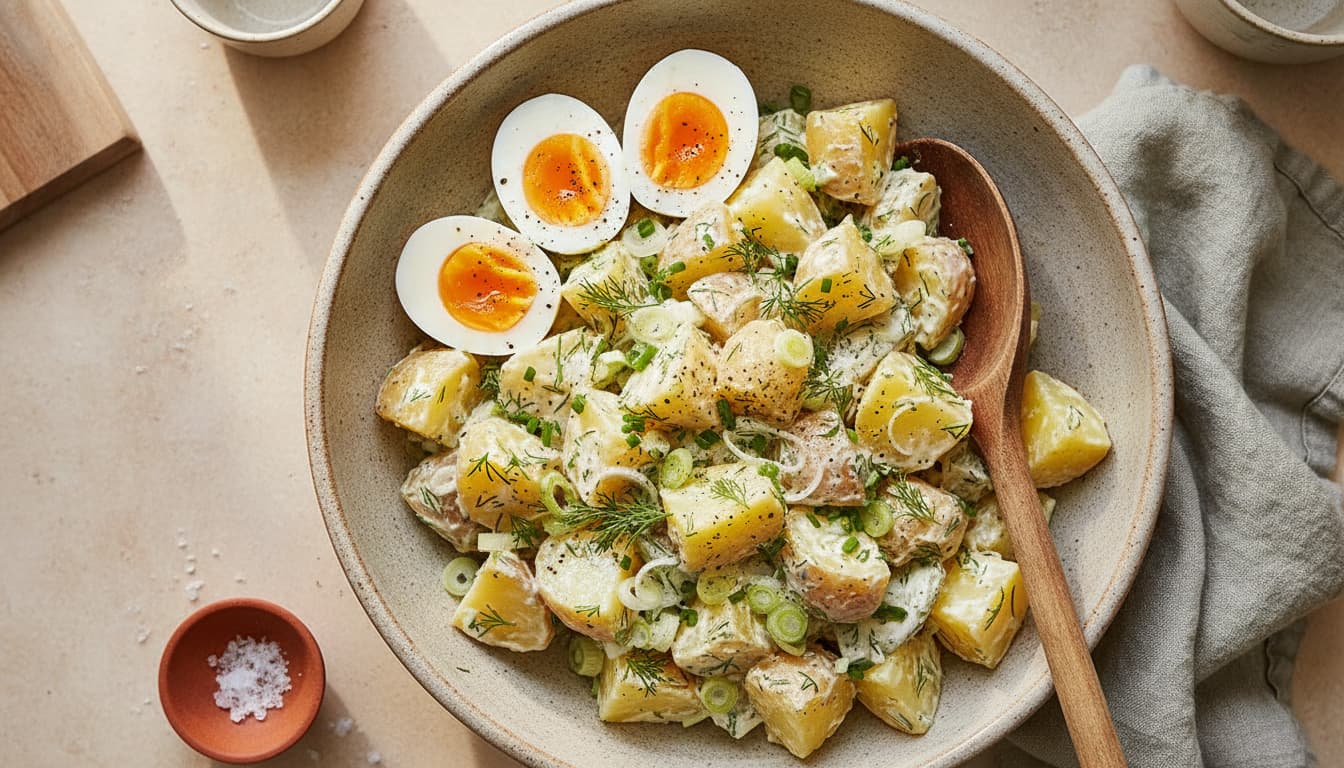
A potato salad that tastes bright and creamy instead of heavy and bland: waxy potatoes cooked whole so they stay firm, seasoned with vinegar while still warm so the flavour goes all the way through, then dressed in a light Greek-yogurt-and-mustard base that keeps the richness but drops most of the mayonnaise. It holds up at a barbecue, gets better after an hour in the fridge, and hinges on two steps almost everyone skips.
Why this works
Every recipe on this site ships with an explanation of the technique decisions, why sear then braise, why the acid goes in at the end, why the fat renders before the aromatics. The method below is those decisions, in order.
OXO Good Grips Stainless Steel Wire Potato Masher and Colander Set
Potato salad turns on two unglamorous jobs done well: cooking the potatoes evenly and draining them fast so they do not turn to paste. A sturdy wide colander with feet lets a whole pot of just-tender potatoes drain and steam-dry standing up, which is what keeps the salad from going watery and gluey, and it is the piece most home cooks make do without by tipping potatoes into a sieve balanced in the sink. Stainless steel does not warp or stain from vinegar and hot potatoes the way cheap plastic does, and it handles everything else you rinse and drain for the rest of the week. It is the least exciting tool in the drawer and the one this recipe leans on hardest.
Ingredients
Serves 6- 2 lbwaxy potatoes · Yukon Gold or red-skinned
- 2 tbspwhite wine vinegar
- 3/4 cupGreek yogurt
- 2 tbspmayonnaise
- 1 tbspDijon mustard
- 1 tspwholegrain mustard
- 1/2lemon · juiced
- 3spring onions · thinly sliced
- 2celery stalks · diced
- 1dill pickle · diced
- 2 tbspfresh dill · chopped
- 2 tbspchives · chopped
- kosher salt · to taste
- black pepper · to taste
Method
Choose waxy potatoes, not floury ones
The variety decides whether you get distinct, creamy chunks or a bowl of mash pretending to be salad. Waxy potatoes, Yukon Gold, red-skinned, new potatoes, or fingerlings, are low in starch and high in moisture, so they hold their shape after cooking and slicing and give you that clean bite a good potato salad needs. Floury bakers like Russets are the opposite: they are lovely roasted or mashed, but in a salad they crumble and go grainy as soon as you dress them. If you can only find one type, reach for Yukon Gold, which is the most forgiving all-rounder and stays creamy without falling apart.
Cook them whole in well-salted water
Cut potatoes leak starch and soak up water at every exposed edge, which is how salads turn gluey and waterlogged, so cook them whole in their skins whenever the potato is small enough. Start them in cold, generously salted water, a good tablespoon of salt, and bring them up to a simmer together so they cook evenly from the outside in rather than blasting the outsides while the middles stay raw. Salting the water is your only chance to season the potato itself all the way through, so do not be shy. If your potatoes are large, halve them, but keep the pieces as big as you sensibly can.
Cook to just-tender, then drain and steam-dry
Test with the tip of a knife: it should slide in with only slight resistance, tender but not falling apart, usually fifteen to twenty minutes at a gentle simmer depending on size. Overcooked potatoes disintegrate the moment you stir in the dressing, so pull them a touch early rather than late. Drain them well in a colander and let them sit for a few minutes so the surface steam-dries; a dry potato grips dressing, a wet one dilutes it. A rolling boil batters the potatoes against each other and breaks the edges, so keep the water at a lazy simmer throughout.
Season with vinegar while the potatoes are still warm
This is the step that makes people ask what your secret is. As soon as the potatoes are drained and just cool enough to handle, cut them into bite-size chunks and toss them with a couple of tablespoons of vinegar, white wine, apple cider, or plain white, plus a little salt and pepper. Warm potatoes are porous and drink the vinegar deep into the flesh, seasoning them from the inside rather than leaving all the tang on the surface. Skip this and dress cold potatoes, and the salad tastes flat no matter how good the dressing is. Let them cool with the vinegar on before the creamy dressing goes anywhere near.
Build a lighter creamy dressing on Greek yogurt
The heaviness of classic potato salad comes from a full load of mayonnaise, and you can keep the creaminess while dropping most of it. Whisk together a base that is mostly thick Greek yogurt with just a spoon or two of mayonnaise for its particular richness, then sharpen it with Dijon and a little wholegrain mustard, a squeeze of lemon, salt, and black pepper. The yogurt brings tang and body along with a hit of protein, the mustard carries the flavour, and you end up with a dressing that clings and coats without the greasy weight. Taste and adjust; it should read a touch too sharp on its own, because the bland potatoes will pull it back into balance.
Add crunch, allium, and plenty of fresh herbs
Texture and freshness are what lift potato salad above stodge. Fold in thinly sliced spring onions or a little finely diced red onion for bite, chopped celery or a diced dill pickle for crunch, and a generous handful of fresh herbs, dill and chives are the classic pairing, with parsley a good all-rounder. A spoon of the pickle brine or a little chopped caper adds another layer of acidity that keeps everything bright. Season as you go, because potatoes are hungry for salt. This is the same principle that makes a good broccoli salad work: a creamy base needs sharp, crunchy, herby things running through it.
Fold gently and rest before serving
Combine the dressed, cooled potatoes with the dressing and add-ins using a folding motion and a flexible spatula rather than vigorous stirring, which smashes the edges and turns the salad cloudy. You want the chunks coated and intact. Then, crucially, give it at least an hour in the fridge before serving; the rest lets the flavours marry and the potatoes finish absorbing the seasoning, and it is genuinely better after that time than straight away. Taste again just before serving and correct the salt and acid, because chilling dulls both and cold potato salad almost always needs a final adjustment.
Keep it food-safe at the table
Potato salad has a reputation as a picnic hazard, and the fix is simple handling rather than avoiding it. A yogurt-based dressing is no more or less risky than mayonnaise; the real issue is time in the warmth. Keep the salad refrigerated until you serve it, and do not leave it sitting out for more than about two hours, or one hour if it is a hot day above ninety degrees. For a long barbecue, nest the serving bowl in a larger bowl of ice to keep it cold, and refrigerate leftovers promptly. Stored properly it keeps three to four days and, like many dressed salads, often tastes best on day two.
Variations
Substitutions and adaptations land with the photography shoot. The method holds across most reasonable swaps.
Storage
Refrigerator: 3 to 4 days, sealed. Freezer: up to 3 months. Reheat covered to retain moisture.
Frequently asked
- What are the best potatoes for potato salad?
- Waxy potatoes, because they hold their shape. Yukon Gold, red-skinned potatoes, new potatoes, and fingerlings are all low-starch and high-moisture, so they stay in distinct creamy chunks after cooking and dressing rather than crumbling. Yukon Gold is the most reliable single choice if you can only find one, since it is creamy but sturdy. Avoid floury baking potatoes like Russets; they are brilliant mashed or roasted but fall apart in a salad and go grainy the moment they meet the dressing. If you are stuck with what is in the cupboard, cook them a touch less and handle them gently to minimise the damage.
- Why is my potato salad bland or watery?
- Two fixable mistakes cause almost all of it. Bland usually means the potatoes were not seasoned from within: salt the cooking water heavily, and toss the warm, drained potatoes with vinegar and salt before the creamy dressing so the flavour soaks in. Watery usually means the potatoes went in wet or overcooked; drain them well, let them steam-dry for a few minutes, and pull them from the pot while just tender rather than falling apart. A wet or under-seasoned potato dilutes and dulls even the best dressing, so both fixes happen before the dressing is anywhere near the bowl.
- Can I make potato salad without mayonnaise?
- Easily. This recipe already cuts most of it by building the dressing on thick Greek yogurt with only a spoon of mayo for richness, and you can drop that last spoon entirely with no real loss. For a fully dairy-free and vegan version, use a plant-based yogurt or a good olive oil and mustard vinaigrette instead, which gives you something closer to a German-style dressed potato salad, bright, sharp, and lighter still. Either way the vinegar-on-warm-potatoes step matters even more, because a lighter dressing leans harder on the seasoning built into the potato itself.
- How far ahead can I make potato salad?
- It is genuinely a make-ahead dish and better for it. You can make it a full day in advance, and an overnight rest in the fridge lets the flavours settle and deepen, so many people prefer it on day two. Keep it covered and cold, and taste it again just before serving, because chilling mutes both salt and acid and it will almost always want a little more of each and perhaps a splash of vinegar to freshen it. If prepping very far ahead, hold back the fresh herbs and any crunchy pickle until closer to serving so they stay bright and crisp.
- How long does potato salad last in the fridge?
- Three to four days in a sealed container in the fridge, whether the dressing is yogurt or mayonnaise based. The limiting factor is not the dressing but time spent warm, so refrigerate it promptly and do not count any hours it spent sitting out at a barbecue against that window. Give it a stir and a taste before serving leftovers, adding a little salt, acid, or fresh herbs to wake it back up. If it smells sour beyond the pleasant tang of the dressing, or the texture has gone slippery, let it go rather than risk it.
- Is potato salad safe to leave out at a barbecue?
- Only briefly, and this is where potato salad earns its risky reputation unfairly. The danger is not the mayonnaise or yogurt specifically but the temperature: any dressed salad left in the warmth grows bacteria, so keep it out for no more than two hours, or one hour if it is above ninety degrees. Keep it in the fridge until people are ready to eat, and for a long outdoor meal set the serving bowl inside a larger bowl of ice to hold it cold. Refrigerate what is left as soon as you are done rather than leaving it on the table.
Related recipes
See all →- Meal Types
Fried Rice: Cold Rice, Hot Pan, and Soy Down the Side
Fried rice is a moisture-management problem wearing a stir-fry costume. Freshly cooked rice is saturated and its starch is still gelatinised, so it clumps and steams. Rice that has spent a night uncovered in the fridge has lost surface water and retrograded, and it separates into individual grains in a hot pan. Twenty-five minutes of cooking, and one decision made the day before.
25m22g Protein - Meal Types
Apple Crisp: Two Varieties, Cold Butter, Forty-Five Minutes
A watery apple crisp is not a topping problem. It is an apple problem and a time problem. One variety of apple gives you either mush or raw wedges, and thirty minutes is long enough to brown a topping but not long enough to cook fruit through and drive off its water. Two varieties, a spoon of cornstarch, coarse oat topping made with cold butter, and forty-five minutes at 375F. Seventy-five minutes total, and it wants twenty of them to rest.
75m3g Protein - Meal Types
Coleslaw: Salt the Cabbage, Squeeze It, Then Dress It
Coleslaw goes watery for one reason. Cabbage is ninety-two percent water, and if you dress it raw, the salt in the dressing pulls that water out over the next hour and dilutes everything you just made. Salt the shredded cabbage first, let it drain for thirty minutes, squeeze it, and then dress it. Fifty minutes including the wait, and the difference is a slaw that is still crunchy on day three.
50m3g Protein
Get a tested recipe + a nutritional note in your inbox each Sunday.
One recipe a week, photographed on the same Tuesday it tested. Reviewed by an RD. No promotions, no pop-ups, no tracking.
The Clean Chef Starter Kit.
A 14-day anti-inflammatory meal plan PDF, grocery list by section, macros totaled per day, Sunday prep sequence. Free.
By subscribing, you agree to our Privacy Policy. One calm email a week. Unsubscribe anytime.
We're building a shop.
Curated cookware, pantry staples we actually buy, recipe-bundle PDFs. Be the first to know when it opens.
We'll only email you about the shop opening. Unsubscribe in any email. See our Privacy Policy.