Instant Pot recipes
By The ThatCleanChef Kitchen · Updated August 31, 2026 · 12 min read
Pressure cooking is not fast for everything, it is fast for a specific and fairly short list: dried beans, stock, tough collagen-heavy cuts, and whole grains. Everywhere else the come-up time eats the saving. Which dishes are worth the pot, why the printed cook time is never the real time, and how to stop the burn warning.
We'd rather answer the question you actually asked in the first paragraph, then earn your trust by showing the chef notes.
What actually matters, in order.
- 01
Pressure raises the boiling point, and that is the entire mechanism
Seal the pot and the steam cannot leave, pressure climbs to about 11.6 psi above atmospheric on the standard setting, and water boils at roughly 240F instead of 212F. Collagen dissolves into gelatin far faster at that temperature, and dried starches hydrate faster too. That is why the machine transforms beans, stock and shin of beef, and does almost nothing useful for a chicken breast, which was never limited by that chemistry in the first place.
- 02
The come-up time is real, and nobody puts it in the recipe
A recipe that says 8 minutes means 8 minutes at pressure. Before that the pot has to reach pressure, which takes 8 to 20 minutes depending on how much cold liquid and cold food is in it, and afterwards it has to release, which is either 2 minutes of hissing or 15 to 25 minutes of waiting. A realistic total for a so-called 8-minute recipe is 35 to 45 minutes. We put the honest number on every timing here for exactly this reason.
- 03
Where it genuinely wins: beans, stock, tough cuts, whole grains
Unsoaked dried beans go from 90 minutes to about 35 at pressure plus release, and they hold their shape better. A stock that wants 4 hours on the stove is done in 45 minutes and comes out clearer, because the liquid never rolls. Chuck, shin, oxtail, short rib and pork shoulder go tender in around an hour instead of three. Brown rice, farro and wheat berries cook hands-off. Those four categories justify the machine on their own.
- 04
Where a skillet beats it, easily
Anything you want browned, because a sealed pot is a steam chamber and nothing browns in steam. Chicken breast, fish, and lean pork, which get stringy well before the timer helps. Green vegetables, which go from raw to olive-drab in the space of a minute. Pasta, which cooks in 9 minutes anyway and turns gummy under pressure. And any dish with dairy in it, which splits. If the pot is not solving a collagen or a dried-starch problem, use a pan.
- 05
Natural release versus quick release changes the food, not just the clock
Quick release drops the pressure in about two minutes, which makes the liquid inside the food flash to steam and blow it apart. That is exactly what you want for green vegetables and exactly what you do not want for meat, which loses juice and seizes. Natural release lets the pressure fall over 15 to 25 minutes while the food keeps cooking gently, which is why meat recipes almost always specify it. Rice, beans and stock also want natural release. Use ten minutes of natural release then a quick release as the compromise.
- 06
The burn warning is almost always one of three things
Not enough thin liquid, usually less than the one cup the machine needs to generate steam. Something thick sitting on the base, above all tomato paste, a flour-thickened sauce or dairy, which scorches before pressure builds. Or fond stuck to the bottom after sauteing that was never deglazed. The fix is the same each time: deglaze properly, keep thick ingredients layered on top and unstirred, and add tomato and dairy after pressure cooking rather than before.
- 07
Use the saute function, because the pot cannot brown for you
Sear the meat on saute, in batches, until it is genuinely brown rather than grey. Cook the onions down. Deglaze with stock or wine and scrape the base clean with a wooden spoon. Then seal and pressure cook. Skipping this is the single biggest reason a pressure-cooked stew tastes flat compared with the oven version, and it costs ten minutes. At the other end, use saute again with the lid off to reduce a thin sauce, since nothing evaporated while it was sealed.
- 08
Two cycles is a week of meal prep
The meal prep pattern that earns its counter space: one cycle of beans or lentils, one cycle of a shredded braise, both on the same evening. That gives you a fiber base and a protein base that combine into bowls, tacos, soups and grain plates all week without cooking anything twice. Cook the grains in the same pot between the two cycles, using the pot-in-pot method with a trivet, and you have three components from one appliance and one wash.
- 09
Five to start with, timed honestly
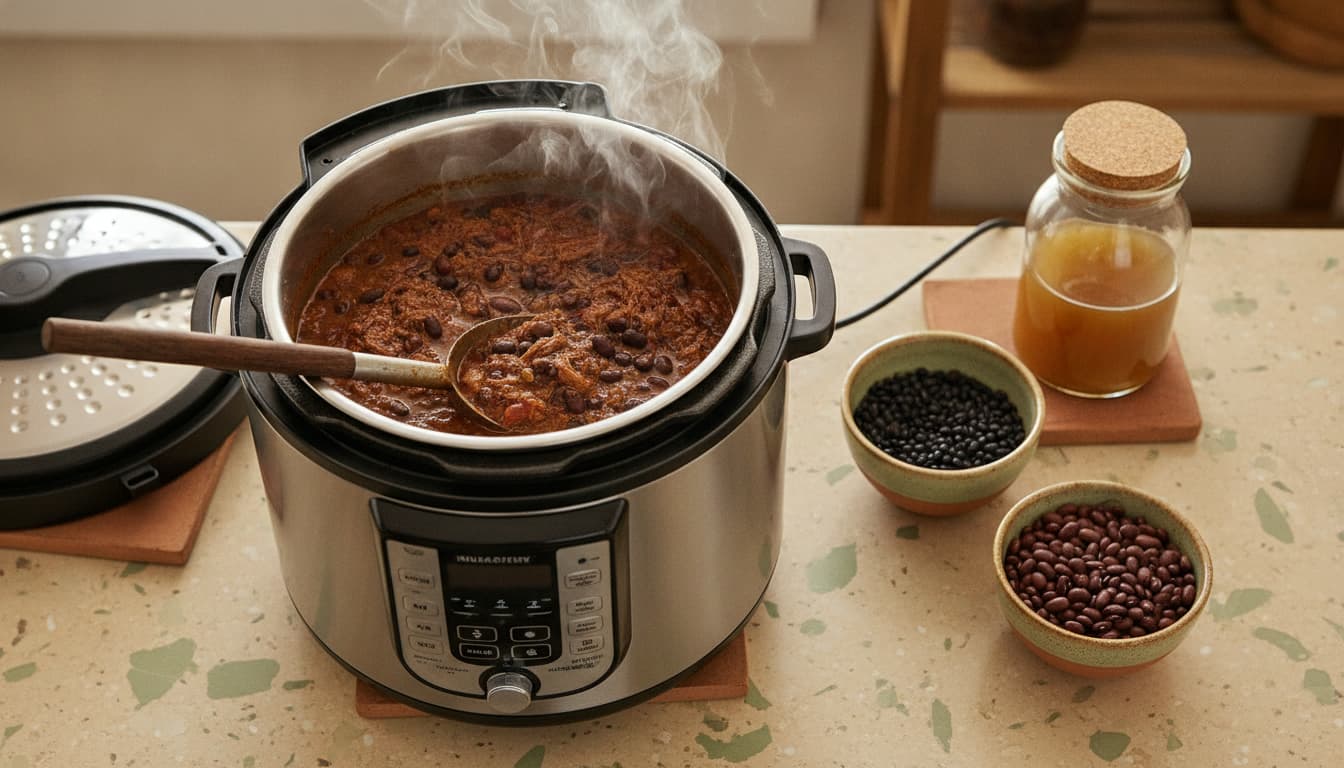
Unsoaked black beans, 30 minutes at pressure plus full natural release, about 55 minutes total. Chicken stock from a carcass, 45 minutes plus natural release, about 75 total. Shredded pork shoulder for tacos, 60 minutes plus natural release, about 95 total. Brown rice, 22 minutes plus 10 minutes natural, about 45 total. Lentil and vegetable soup, 12 minutes plus quick release, about 35 total. Every one of those numbers includes the come-up.
The questions cooks bring us.
- How long does an Instant Pot take to come to pressure?
- Between 8 and 20 minutes, and it scales with the volume and the starting temperature of what is inside. Six cups of cold stock and two pounds of cold meat sits at the top of that range. Warm liquid and a small volume sits at the bottom. If you want to shorten it, heat the liquid on the saute function first, which uses the same energy but at least lets you see progress. Add the come-up and the release to every printed cook time before you plan dinner around it.
- Do I still need to soak dried beans?
- Not for texture or time, since unsoaked beans cook well under pressure in roughly 30 to 40 minutes depending on type and age. Soaking still helps two things: it leaches out some of the oligosaccharides that cause gas, and it gives a slightly more even skin. Salt the cooking water, which is the opposite of the old advice and produces beans with softer skins and better seasoning. Do not add acid, so no tomato and no vinegar, until the beans are already tender.
- Why does my Instant Pot say BURN?
- The base sensor has read a temperature spike, which means something is scorching before pressure has built. Release, open, and look at the bottom. Nine times out of ten there is stuck fond from searing that was never deglazed, or tomato paste sitting on the base. Add a cup of thin liquid, scrape the base clean with a wooden spoon, and layer anything thick on top without stirring it in. Do not simply reseal and hope, because the scorched flavour spreads through the whole pot.
- Can I cook frozen meat in an Instant Pot?
- Yes, and this is one of the machine's genuinely good tricks, but two things change. The come-up time roughly doubles, so a solid frozen block can take 25 minutes to reach pressure. And you cannot brown it first, so the dish will taste less deep. Add about half again to the pressure time for a frozen roast, use natural release, and check with a thermometer rather than a chart. Frozen chicken thighs from solid take about 15 minutes at pressure plus natural release.
- Is pressure cooking bad for the nutrients in food?
- It is generally better than long boiling, not worse. The temperature is higher but the time is much shorter, and less water-soluble vitamin content leaches out because you usually eat the cooking liquid rather than pouring it away. Heat-sensitive vitamin C and folate do take a hit, as they do in any cooking. Where pressure cooking is clearly favourable is legumes, where it degrades lectins and phytates more thoroughly than a simmer.
- Instant Pot or slow cooker, if I can only have one?
- Ask when you decide what is for dinner. If you know at eight in the morning, the slow cooker is better, because the long low braise gives a rounder result and you come home to a finished meal. If you decide at six in the evening, the pressure cooker is the only one that can still deliver a braise. The pressure cooker is also the far better machine for beans, stock and grains, which is what tips it for most people cooking from scratch.
Where the technique comes from
About the ThatCleanChef Kitchen
A small team of recipe developers and food photographers testing recipes in home kitchens on home equipment. Every Nutrition Ledger is USDA FoodData Central-sourced and reviewed by Lena Marsh, RDN, MS. We don't pretend to be a single chef, we're the people behind the plates. Meet the full team →
Related posts
How to Cook Steak: Salt It Early, Dry It Properly, Use a Thermometer
There are only four variables in a steak and none of them is the pan. Thickness decides the method, surface moisture decides whether it browns or steams, internal temperature decides doneness, and the rest decides how much of the juice ends up on the board instead of in the meat. Salt forty-five minutes ahead, cook to a number rather than to a timer, and stop cutting into it to check.
Scrambled Eggs: Low Heat, Constant Motion, Off the Hob Early
Scrambled eggs are a temperature exercise with an eight-minute margin for error and almost nobody uses it. Egg protein sets between 145F and 165F, and above that it squeezes out water and turns to rubber sitting in a grey puddle. Low heat, a spatula that never stops, fat that goes in cold, salt at the start, and the pan off the burner while they still look underdone.
Mashed Potatoes: Cold Water Start, Warm Dairy, and Never a Blender
Gluey mash is not a seasoning problem, it is a mechanical one. Potato starch granules burst when you agitate them, and once they have burst nothing brings the texture back. Start the potatoes in cold salted water so they cook evenly, dry them over the burner, push them through a ricer rather than beating them, and add butter before dairy. Forty-five minutes including the pot you have to wash.
The Clean Chef Starter Kit.
A 14-day anti-inflammatory meal plan PDF, grocery list by section, macros totaled per day, Sunday prep sequence. Free.
By subscribing, you agree to our Privacy Policy. One calm email a week. Unsubscribe anytime.