- Calories
- 230
- Protein
- 18g
- Fiber
- 16g
- Sat. fat
- 0g
- Sodium
- 200mg
- Added sugar
- 0g
What this recipe does for you.
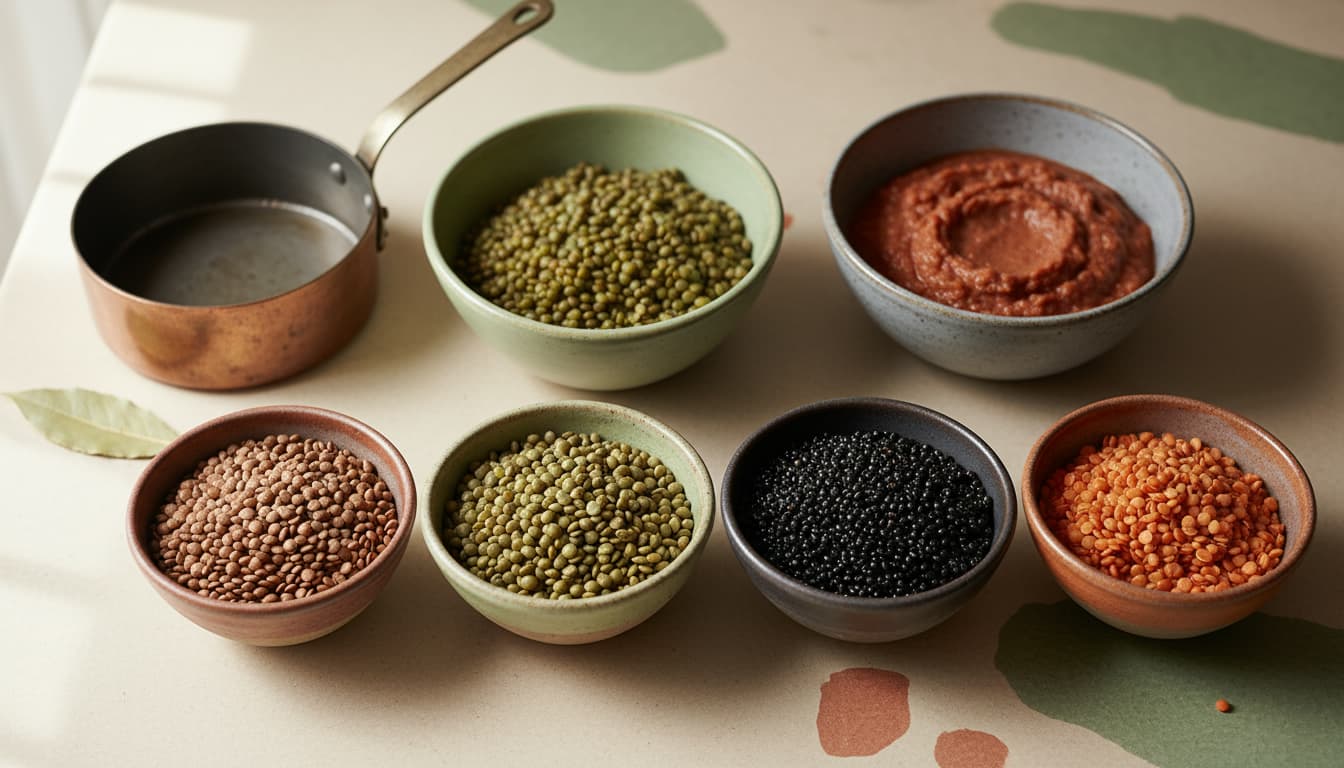
Four common varieties, four completely different outcomes, and one recipe on the back of the bag for all of them. Brown lentils hold for twenty-five minutes then collapse. Puy and beluga stay intact for forty. Red lentils are not meant to hold their shape at all. Salt the water from the start, keep it below a boil, and finish with acid off the heat.
Why this works
Every recipe on this site ships with an explanation of the technique decisions, why sear then braise, why the acid goes in at the end, why the fat renders before the aromatics. The method below is those decisions, in order.
Ingredients
Serves 6- 2 cupsdried lentils · brown, green, Puy or beluga, picked over and rinsed
- 6 cupswater or unsalted stock · enough to cover by two inches, topped up if it drops
- 1 1/2 tspkosher salt · in the water from the start, despite what you have read
- 1 wholeonion · halved, skin on, fished out at the end
- 4 clovesgarlic · smashed, skin on
- 2 wholebay leaves
- 4 sprigsthyme · or a small rosemary sprig, tied with the bay if you want it easy to remove
- 1 stripkombu · about 4 inches, optional, it adds glutamate and may ease digestion
- 2 tbspextra-virgin olive oil · stirred in at the end, off the heat
- 2 tbspred wine vinegar or lemon juice · added only after the lentils are tender
- 1/2 tspblack pepper · freshly ground
Method
Know which lentil you bought, because the times are not close
Brown lentils, the cheap supermarket default, take twenty to twenty-five minutes and start breaking down at thirty. Green lentils run twenty-five to thirty and hold slightly better. French Puy and Italian black beluga are smaller, denser and thicker-skinned, and stay intact for thirty-five to forty minutes, which is why they are the ones for salads. Split red and yellow lentils collapse into a puree in fifteen to twenty and are not supposed to hold their shape at all.
Pick them over, then rinse, and do the picking first
Tip the lentils onto a rimmed sheet and spread them into a single layer with your hand. You are looking for small stones, clods of dirt and the occasional shrivelled lentil, all of which are ordinary in a bag of a legume harvested from the ground. It takes forty seconds and it saves a tooth. Then rinse in a sieve under cold water until the water runs clear. Rinsing after picking, not before, because wet lentils stick to the tray.
Do not soak them, with one exception
Lentils are small and thin-skinned and cook through in under forty minutes dry, so soaking gains you very little and costs you texture, because soaked lentils turn to mush at the edges before the centres are done. The exception is age. A bag that has been in the cupboard for two years has dried out and hardened and may never soften properly at all, and a one-hour soak helps. If your lentils are still hard after fifty minutes, they are old, not undercooked.
Salt the water, and here is where the myth came from
The old rule says salt toughens legume skins and must be added at the end. Side-by-side testing does not support it for lentils, and salted lentils actually hold their shape slightly better while tasting seasoned all the way through rather than seasoned on the surface. What genuinely does toughen skins and stall cooking is acid, which is why tomatoes, vinegar and lemon must wait until the lentils are already tender. Salt at the start, acid at the end.
Aromatics in the pot cost nothing and change the result
Half an onion skin on, four smashed garlic cloves, two bay leaves and a few thyme sprigs, all fished out before serving. Lentils cooked in plain water taste of plain water, and this is a thirty-second job that gives you seasoned lentils rather than a component you have to rescue later. A four-inch strip of kombu adds glutamate and, in traditional practice and some laboratory work, may soften the oligosaccharides that cause the bloating people associate with legumes.
A bare simmer, never a rolling boil
Bring the pot up to a boil, then drop it immediately to the lowest heat that keeps a few bubbles breaking the surface. A rolling boil knocks the lentils against each other and the pot walls, which splits skins and turns the top third of the batch into cloudy sludge while the bottom is still firm. This is the same principle as poaching an egg or simmering a stock. Lid off or ajar, so you can see what the surface is doing.
Cover by two inches and top up with hot water
Lentils absorb roughly two and a half times their volume, so start with three times the water and check at the twenty-minute mark. If the level has dropped below the lentils, add hot water rather than cold, because cold water drops the pot temperature and stalls cooking unevenly. Do not treat this as an absorption method like rice. You are boiling in excess liquid and draining, which gives you far more control over the finished texture.
Start tasting five minutes before you think you should
A lentil goes from firm to perfect to blown out in about four minutes, and the window is narrower than for any bean. Start eating one every two minutes from the twenty-minute mark for brown lentils and the thirty-minute mark for Puy. Done means tender all the way through with the skin still intact and a very slight resistance at the centre. If the skins are floating loose in the water, you are past it. Different bags of the same variety vary by five minutes.
Drain, then dress while they are hot
Drain immediately, because lentils left sitting in their hot cooking water keep cooking and will be mush by the time you eat. Pull the aromatics out, tip the lentils into a bowl, and add the olive oil, vinegar and black pepper while they are still steaming. Warm legumes absorb dressing in a way cold ones simply do not, and this single habit is the difference between a lentil salad that tastes of dressing and one that tastes of dressing sitting on top of lentils.
Red lentils are a different job with a different goal
Split red and yellow lentils have had the skin removed, so they cannot hold a shape and are not trying to. Fifteen to twenty minutes in one part lentils to three parts liquid, stirred occasionally, and they break down into a thick golden puree that is the base of dal and of most lentil soups. They need no draining, they take spices bloomed in fat extremely well, and they will catch on the bottom of the pot if you walk away, unlike the whole varieties.
The pressure cooker and the batch-cook plan
In an Instant Pot, brown and green lentils take eight minutes at high pressure with a ten-minute natural release, and Puy takes ten. Water at two to one rather than three to one, since nothing evaporates. It is faster and it is also less controllable, because you cannot taste at minute twenty-two. For meal prep, cook two cups dry on a Sunday, which gives about five cups cooked, dress half and leave half plain, and keep both refrigerated for five days.
What a cup of them actually delivers
One cup of cooked lentils is around 230 calories with 18g of protein and 16g of fiber, which is over half a day's fiber target in a single portion and more protein than two eggs. That fiber is largely soluble, which is the fraction associated with lower LDL cholesterol in the trial literature. It is also why a sudden jump from no legumes to a cup a day produces gas: ramp over two weeks, drink water, and the adaptation is real and fairly quick.
Storage, freezing and the five-day rule
Cooked lentils keep five days refrigerated in a sealed container, and undressed ones keep better than dressed ones because the acid slowly softens them further. They freeze well for three months, which beans do not always manage, so portion them flat in bags. Save the cooking liquid if you used stock and aromatics, since it is a light brown broth worth building a soup on. Do not leave the drained lentils at room temperature for more than two hours.
Variations
Substitutions and adaptations land with the photography shoot. The method holds across most reasonable swaps.
Storage
Refrigerator: 3 to 4 days, sealed. Freezer: up to 3 months. Reheat covered to retain moisture.
Why we tested this how to cook lentils: times by variety, and the salt myth 3 times.
Every flagship recipe on this site goes through at least three rounds of kitchen testing before publication. We log what changed between tests so you can see the recipe's evolution, and so we can't quietly drop the failures.
- 01
Test 1
- What we tried
- Cooked two identical pots of brown lentils, one salted from the start and one salted only at the end.
- What happened
- The salted pot was seasoned through and, if anything, held its shape marginally better. The late-salted pot tasted seasoned only on the outside.
- What we changed
- Salt goes in with the cold water. The old rule about salt toughening skins did not survive the test.
- 02
Test 2
- What we tried
- Added a can of chopped tomatoes at the start of a brown lentil pot, for a one-pot stew.
- What happened
- At fifty minutes the lentils were still chalky in the centre. Acid genuinely does stall the softening of legume skins.
- What we changed
- Tomatoes, vinegar and lemon go in only after the lentils are already tender.
- 03
Test 3
- What we tried
- Held a pot at a rolling boil for the full twenty-five minutes rather than dropping it to a bare simmer.
- What happened
- The top third had burst and clouded the water while lentils from the bottom were still firm at the centre.
- What we changed
- Bare simmer, lid ajar, and taste every two minutes from minute twenty.
Frequently asked
- Do you need to soak lentils before cooking?
- No. Lentils are small and thin-skinned and cook through in twenty to forty minutes depending on variety, so soaking gains almost nothing and tends to make the outsides mushy before the centres are done. The one exception is very old lentils that have been in the cupboard for a couple of years, which have dried out and hardened, and where an hour's soak can help. If a bag will not soften after fifty minutes of simmering, age is the reason and no soak will fully fix it.
- Should you salt lentils before or after cooking?
- Before. The long-standing rule that salt toughens legume skins does not hold up in side-by-side testing with lentils, and salting the water gives you lentils seasoned all the way through instead of seasoned on the surface. What genuinely does stall cooking is acid, so tomatoes, wine, vinegar and lemon juice must wait until the lentils are already tender. Add them a minute before you take the pot off the heat and the difference is dramatic.
- How long do lentils take to cook?
- Brown lentils twenty to twenty-five minutes, green lentils twenty-five to thirty, French Puy and black beluga thirty-five to forty, and split red or yellow lentils fifteen to twenty as they break down into a puree. Those are guides rather than rules, because a bag that has sat in a warehouse for a year cooks slower than a fresh one. Start tasting five minutes before you expect them to be ready, because the window between perfect and blown out is roughly four minutes.
- Which lentils hold their shape best?
- French Puy and Italian black beluga, comfortably. They are smaller and denser with thicker skins, and they stay intact through forty minutes of simmering and through a couple of days sitting in dressing, which makes them the ones to buy for salads and grain bowls. Green lentils are the next best. Brown lentils are fine if you catch them at twenty-two minutes but collapse quickly after. Split red lentils cannot hold a shape at all and are not meant to.
- How much protein and fiber is in a cup of lentils?
- About 18g of protein and 16g of fiber in a cup of cooked lentils, for roughly 230 calories. The fiber figure is over half the daily target for most adults in a single serving, which is why lentils show up in almost every high-fiber eating pattern. Lentils are low in the amino acid methionine, so pair them with a grain across the day if they are a main protein source, which is what rice and lentils has been doing for several thousand years.
- Why do lentils give me gas, and can I stop it?
- The oligosaccharides in legumes are fermented by gut bacteria rather than digested, which produces gas. Three things measurably help. Ramp intake over two weeks rather than jumping straight to a cup a day, since the gut microbiome adapts. Rinse well and cook in fresh water. And add a strip of kombu to the pot. Red lentils, being split and skinned, are the gentlest variety to start with. If lentils cause severe symptoms, they are high in the GOS group on a low-FODMAP protocol, where a small portion of canned rinsed lentils is generally better tolerated.
- Can you cook lentils in an Instant Pot?
- Yes. Brown and green lentils take eight minutes at high pressure with a ten-minute natural release, Puy and beluga take ten, and split red lentils take about five and will foam, so keep the pot under half full. Use two parts liquid to one part lentils rather than three, since nothing evaporates under pressure. The trade-off is control: you cannot taste at minute twenty-two, and lentils go from firm to mush faster than beans do.
- How long do cooked lentils keep?
- Five days refrigerated in a sealed container, and undressed lentils keep better than dressed ones because acid continues to soften them. They freeze genuinely well for up to three months, unlike some beans, so it is worth cooking two cups dry and freezing half flat in bags. Keep the cooking liquid if you built it with stock and aromatics, because it is a light savoury broth that makes a better soup base than water.
Related recipes
See all →- Technique
How to Cook Steak: Salt It Early, Dry It Properly, Use a Thermometer
There are only four variables in a steak and none of them is the pan. Thickness decides the method, surface moisture decides whether it browns or steams, internal temperature decides doneness, and the rest decides how much of the juice ends up on the board instead of in the meat. Salt forty-five minutes ahead, cook to a number rather than to a timer, and stop cutting into it to check.
80m42g Protein - Technique
Scrambled Eggs: Low Heat, Constant Motion, Off the Hob Early
Scrambled eggs are a temperature exercise with an eight-minute margin for error and almost nobody uses it. Egg protein sets between 145F and 165F, and above that it squeezes out water and turns to rubber sitting in a grey puddle. Low heat, a spatula that never stops, fat that goes in cold, salt at the start, and the pan off the burner while they still look underdone.
15m19g Protein - Technique
Mashed Potatoes: Cold Water Start, Warm Dairy, and Never a Blender
Gluey mash is not a seasoning problem, it is a mechanical one. Potato starch granules burst when you agitate them, and once they have burst nothing brings the texture back. Start the potatoes in cold salted water so they cook evenly, dry them over the burner, push them through a ricer rather than beating them, and add butter before dairy. Forty-five minutes including the pot you have to wash.
45m5g Protein
Get a tested recipe + a nutritional note in your inbox each Sunday.
One recipe a week, photographed on the same Tuesday it tested. Reviewed by an RD. No promotions, no pop-ups, no tracking.
The Clean Chef Starter Kit.
A 14-day anti-inflammatory meal plan PDF, grocery list by section, macros totaled per day, Sunday prep sequence. Free.
By subscribing, you agree to our Privacy Policy. One calm email a week. Unsubscribe anytime.
We're building a shop.
Curated cookware, pantry staples we actually buy, recipe-bundle PDFs. Be the first to know when it opens.
We'll only email you about the shop opening. Unsubscribe in any email. See our Privacy Policy.