- Calories
- 530
- Protein
- 38g
- Fiber
- 5g
- Sat. fat
- 10g
- Sodium
- 740mg
- Added sugar
- 0g
What this recipe does for you.
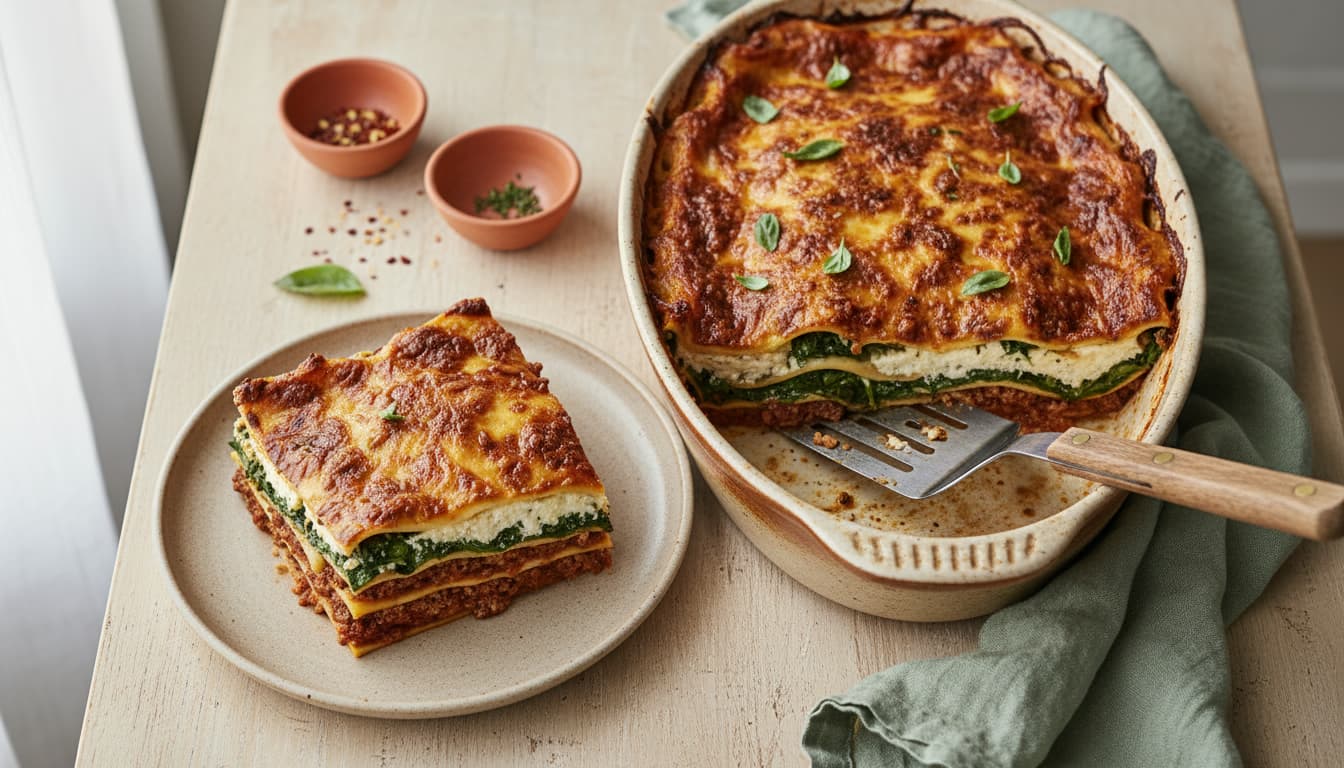
The two things that separate a lasagna you can cut from a lasagna you serve with a spoon: a sauce reduced until it is thick rather than saucy, and a twenty-minute rest out of the oven. Ricotta bound with an egg, spinach squeezed properly dry, whole-wheat noodles for real fiber, and mozzarella only on top where it can brown.
Why this works
Every recipe on this site ships with an explanation of the technique decisions, why sear then braise, why the acid goes in at the end, why the fat renders before the aromatics. The method below is those decisions, in order.
Ingredients
Serves 8- 1 1/2 lblean ground beef · 90/10, or ground turkey thigh
- 1 tbspextra-virgin olive oil
- 1 wholeyellow onion · finely chopped
- 4 clovesgarlic · minced
- 2 tbsptomato paste
- 28 ozcrushed tomatoes · one tin, no added sugar
- 1 tspdried oregano
- 1/2 tspchili flakes
- 1 1/2 tspkosher salt · divided between sauce and ricotta
- 15 ozwhole-milk ricotta
- 1 largeegg · beaten into the ricotta
- 1 cupParmesan · finely grated, divided
- 10 ozfrozen spinach · thawed and squeezed completely dry
- 12 ozwhole-wheat lasagna noodles
- 8 ozlow-moisture mozzarella · grated, for the top only
- 1/4 cupfresh basil · torn, to finish
Method
Reduce the sauce until it is thick, not saucy
This is the whole recipe. Brown the beef hard, add the onion and garlic, cook the tomato paste for a minute until it darkens, then the crushed tomatoes, and simmer twenty to twenty-five minutes uncovered until a spoon dragged through the pan leaves a channel that holds. Every recipe that produces a soupy lasagna skipped this. A watery sauce has nowhere to go but out of the cut.
Bind the ricotta with an egg
One beaten egg into fifteen ounces of ricotta, plus half the Parmesan and half a teaspoon of salt. The egg sets during the bake and turns the ricotta layer from a loose spread into something structural that holds its own line in the slice. Without it the ricotta stays a paste that slumps out the side the moment you cut. Whole-milk ricotta, not part-skim, which is grainier and wetter.
Squeeze the spinach until it is genuinely dry
Ten ounces of thawed frozen spinach holds close to a cup of water and it will all end up in the pan. Wring it in a tea towel until it is a dense green puck about the size of a tennis ball, then break it up with your fingers before stirring it into the ricotta. Fresh spinach needs wilting and squeezing too, and you will need about a pound and a half of it to get there.
Whole-wheat noodles, and do not pre-boil them
Whole-wheat lasagna sheets bring the dish to five grams of fiber a serving and hold their texture better in a long bake than white ones, which go soft. Layer them dry, unboiled. The sauce and the ricotta carry enough moisture to hydrate them in an hour under foil, and skipping the boil means no torn sheets, no scalded hands, and no pot to wash.
The layer order, and there are only five layers
Thin scrape of sauce on the bottom so nothing welds to the dish. Then noodles, ricotta and spinach, sauce, and repeat twice more. End on noodles, then the last of the sauce, then the mozzarella and the remaining Parmesan. Mozzarella belongs only on top where it can brown; buried in the middle it turns into a rubbery seam and pushes out water.
Covered for forty minutes, uncovered for twenty
Oven at 375F. Foil on for the first forty minutes so the noodles steam and hydrate, then off for the last twenty so the top browns and the surface moisture evaporates. If the foil touches the cheese it will lift it off when you pull it, so tent it or oil the underside. You want the edges bubbling and the top mottled brown, not uniformly pale.
Rest it twenty minutes, and this is not negotiable
Straight out of the oven a lasagna is molten and structurally nothing. Twenty minutes on a rack lets the starch and the egg-set ricotta firm up enough to hold a wall. Thirty is better if you can stand it. Cut it at minute three and it will slide across the plate, which is what has happened every time someone told you lasagna cannot be cut neatly.
Build it ahead, or freeze it before baking
Assembled and refrigerated it keeps two days raw, and add ten to fifteen minutes to the covered stage if it goes into the oven cold. Frozen unbaked it keeps three months; thaw overnight and bake as written. Baked leftovers keep four days and reheat better in a 350F oven for fifteen minutes than in a microwave, which turns the edges to leather.
What is actually in the 530 calories
Most of it is the cheese and the beef, and both are load-bearing. The changes that pull it down from a typical restaurant portion are lean ground beef instead of a beef and pork mix, mozzarella limited to the top rather than every layer, no cream or bechamel, and no sugar in the sauce. That gets you to 38g of protein and 5g of fiber a serving without making it taste like a compromise.
Variations
Substitutions and adaptations land with the photography shoot. The method holds across most reasonable swaps.
Storage
Refrigerator: 3 to 4 days, sealed. Freezer: up to 3 months. Reheat covered to retain moisture.
Frequently asked
- Why is my lasagna watery?
- Almost always one of three things. The sauce was not reduced, so it went in as liquid. The spinach or other vegetables were not squeezed dry. Or it was cut before resting, so what would have set had no chance to. Fix the sauce first, it is the biggest contributor. If you are using fresh vegetables such as courgette or mushroom, roast or saute them first to drive the water off before they go anywhere near the dish.
- Do I need to boil the noodles first?
- No, and there is no advantage to it in a sauce this thick and a bake this long. Regular dried lasagna sheets hydrate perfectly in an hour under foil. What matters is that every sheet is fully covered by sauce or ricotta, because an exposed corner will stay crunchy. If your sauce is on the thick side, add a quarter cup of water to the tin when you rinse it out and stir that in.
- Can I use cottage cheese instead of ricotta?
- Yes, and it raises the protein a few grams a serving. Blend it smooth first, otherwise the curds stay visible and slightly squeaky. Use the same weight, keep the egg, and expect a slightly tangier and looser layer, so drain any liquid off the top of the tub before blending. Ricotta gives the more traditional texture; cottage cheese gives the better macros.
- How long does lasagna need to rest before cutting?
- Twenty minutes minimum, thirty if you can wait. The centre is above 200F when it comes out and the starch has not set. Resting is not about temperature for eating, it is about structure, which is why covering it and leaving it on the counter works better than any other approach. It will still be hot at the twenty-minute mark, comfortably so.
- Can I make it vegetarian?
- Replace the beef with a pound of brown or green lentils cooked down into the tomato sauce, plus a pound of mushrooms browned hard in a dry pan first. Both need the same reduction treatment as the meat sauce, and the mushrooms in particular must give up their water before the tomatoes go in. You land around 24g of protein and 11g of fiber a serving, which is a fair trade.
Related recipes
See all →- Meal Types
Fried Rice: Cold Rice, Hot Pan, and Soy Down the Side
Fried rice is a moisture-management problem wearing a stir-fry costume. Freshly cooked rice is saturated and its starch is still gelatinised, so it clumps and steams. Rice that has spent a night uncovered in the fridge has lost surface water and retrograded, and it separates into individual grains in a hot pan. Twenty-five minutes of cooking, and one decision made the day before.
25m22g Protein - Meal Types
Apple Crisp: Two Varieties, Cold Butter, Forty-Five Minutes
A watery apple crisp is not a topping problem. It is an apple problem and a time problem. One variety of apple gives you either mush or raw wedges, and thirty minutes is long enough to brown a topping but not long enough to cook fruit through and drive off its water. Two varieties, a spoon of cornstarch, coarse oat topping made with cold butter, and forty-five minutes at 375F. Seventy-five minutes total, and it wants twenty of them to rest.
75m3g Protein - Meal Types
Coleslaw: Salt the Cabbage, Squeeze It, Then Dress It
Coleslaw goes watery for one reason. Cabbage is ninety-two percent water, and if you dress it raw, the salt in the dressing pulls that water out over the next hour and dilutes everything you just made. Salt the shredded cabbage first, let it drain for thirty minutes, squeeze it, and then dress it. Fifty minutes including the wait, and the difference is a slaw that is still crunchy on day three.
50m3g Protein
Get a tested recipe + a nutritional note in your inbox each Sunday.
One recipe a week, photographed on the same Tuesday it tested. Reviewed by an RD. No promotions, no pop-ups, no tracking.
The Clean Chef Starter Kit.
A 14-day anti-inflammatory meal plan PDF, grocery list by section, macros totaled per day, Sunday prep sequence. Free.
By subscribing, you agree to our Privacy Policy. One calm email a week. Unsubscribe anytime.
We're building a shop.
Curated cookware, pantry staples we actually buy, recipe-bundle PDFs. Be the first to know when it opens.
We'll only email you about the shop opening. Unsubscribe in any email. See our Privacy Policy.