- Calories
- 430
- Protein
- 24g
- Fiber
- 7g
- Sat. fat
- 4g
- Sodium
- 660mg
- Added sugar
- 3g
What this recipe does for you.
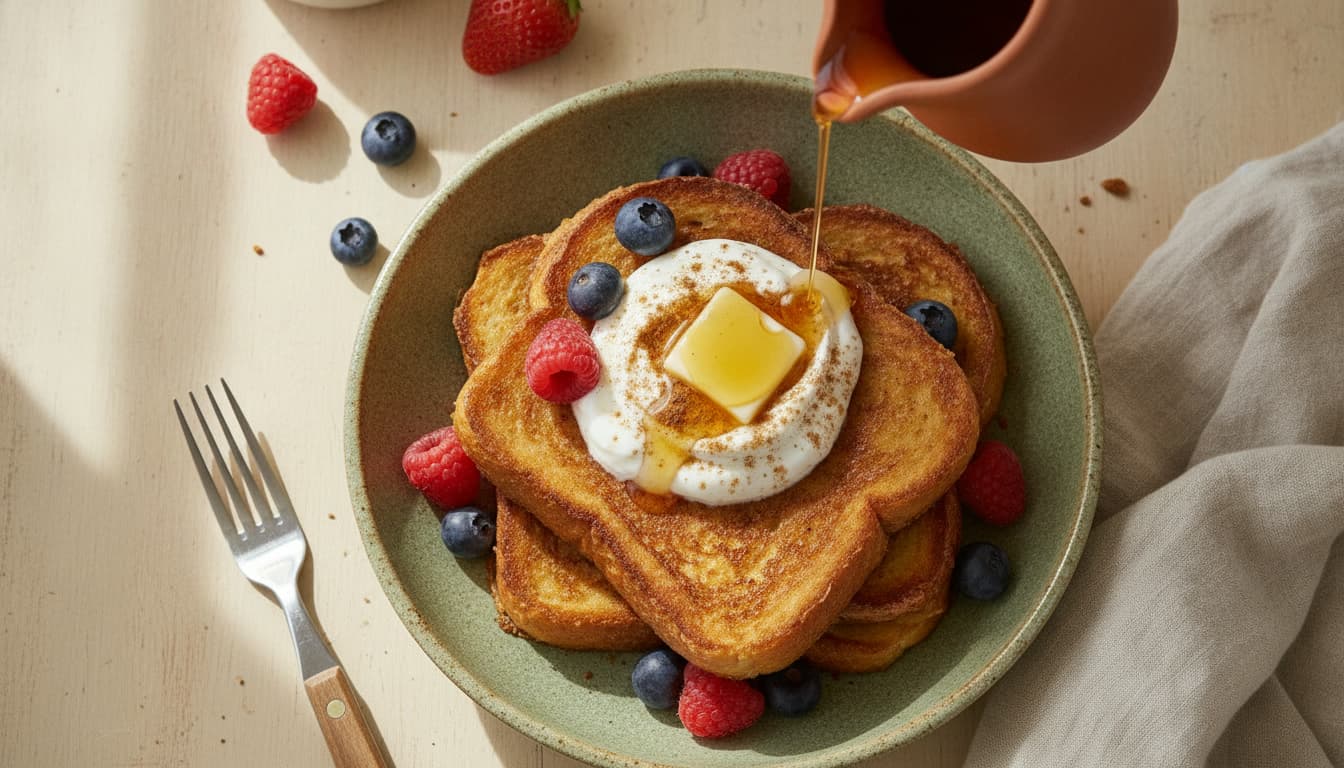
The custard is blended with cottage cheese, which triples the protein and, more usefully, sets properly instead of weeping. Day-old bread, a thirty-second dip rather than a soak, medium heat rather than high, and a pan you do not crowd. Four servings, 24g protein each, 35 minutes including the second batch and the washing up.
Why this works
Every recipe on this site ships with an explanation of the technique decisions, why sear then braise, why the acid goes in at the end, why the fat renders before the aromatics. The method below is those decisions, in order.
Ingredients
Serves 4- 8 sliceswhole-grain sandwich bread · day-old, cut 3/4-inch thick
- 5 largeeggs
- 1 1/4 cupslow-fat cottage cheese · blended smooth, not spooned in
- 1/2 cupwhole milk
- 1 tbspmaple syrup · in the custard, not on top
- 2 tspvanilla extract
- 1 tspground cinnamon
- 1/4 tspkosher salt
- 1 1/2 tbspunsalted butter · divided across two batches
- 1 cupblueberries or raspberries · to serve
- 1/2 cupplain Greek yogurt · to serve, optional
Method
Blend the cottage cheese into the custard, do not stir it
Thirty seconds in a blender or a hard minute with an immersion blender turns the cottage cheese into a smooth base you cannot detect. Stirred in by hand it stays as curds, and those curds sit on the surface of the bread and scorch before the inside sets. The blender is the difference between 24g of protein you cannot taste and a breakfast that looks curdled.
Use day-old bread, and cut it thick
Fresh bread is already saturated with its own moisture and has nowhere to put the custard, so it collapses. Stale bread is thirsty. If your loaf is fresh, lay the slices on a rack in a 300F oven for eight minutes and let them cool, which dries them out without toasting. Three quarters of an inch is the right thickness. Thin sandwich slices cannot hold enough custard to be worth the protein.
Thirty seconds a side, not a soak
This is the mistake that produces soggy French toast, and almost everyone makes it. Dip, count to thirty, flip, count to thirty, lift and let the excess run off for a second before it goes in the pan. The custard should penetrate about a quarter inch from each side and leave a dry-ish core that cooks into something between bread and pudding. Bread left to sit in the dish for five minutes never recovers.
Medium heat, and give it four minutes a side
High heat browns the outside in ninety seconds while the custard inside is still liquid, which is why so much French toast is simultaneously burnt and raw. Medium, a full four minutes on the first side, three to four on the second. You are cooking egg custard, and egg custard needs time. If the butter is browning fast and hissing, the pan is too hot.
Two batches, and fresh butter for each
Four slices at a time in a 12-inch skillet, with space between them. Crowded slices steam each other and go pale and damp. Wipe the pan between batches, because the milk solids left from the first batch are already dark and will taste burnt on the second, and add the other half of the butter. Hold batch one on a rack in a 200F oven, never on a plate, where the underside sweats.
The sugar goes in the custard, not on the plate
One tablespoon of maple in the whole batch is about three grams of added sugar a serving, and because it is inside the bread you register it as sweetness throughout rather than as a syrup layer on top. Then finish with berries and a spoon of plain Greek yogurt. Most French toast carries twenty-five to forty grams of added sugar a serving once the syrup goes on, and it does not taste better for it.
Salt the custard, or it tastes flat
A quarter teaspoon across five eggs is not enough to taste as salt, and it is exactly what makes the cinnamon and vanilla read as flavour rather than as a vague sweetness. Unsalted egg custard is the reason a lot of home French toast tastes like nothing until syrup is applied. Salt and a real pinch of cinnamon do more for this recipe than any amount of syrup.
It freezes properly, which makes this a weekday breakfast
Cool the cooked slices completely on a rack, freeze them flat on a tray for an hour, then bag them. From frozen they go straight into a toaster or a 375F oven for eight minutes and come back crisp, which is more than can be said for most reheated breakfasts. Double the batch on Sunday and the weekday version takes eight unattended minutes and no washing up.
Variations
Substitutions and adaptations land with the photography shoot. The method holds across most reasonable swaps.
Storage
Refrigerator: 3 to 4 days, sealed. Freezer: up to 3 months. Reheat covered to retain moisture.
Frequently asked
- Can you taste the cottage cheese?
- Not if you blend it, which is the whole reason the method specifies a blender. Once it is smooth it behaves exactly like the cream or half-and-half that a classic custard uses, adding body and a very slight tang that the cinnamon and vanilla cover completely. Spooned in unblended it is obvious, both in texture and in the way the curds catch in the pan, so do not skip the thirty seconds.
- What is the best bread for French toast?
- Something sturdy and a day old. A dense whole-grain sandwich loaf is what this recipe is built on because it brings six to seven grams of fiber per serving. Challah, brioche and sourdough all work beautifully and are more traditional, with brioche giving the richest result and sourdough the best contrast. What does not work is fresh, thin, soft supermarket white, which turns to paste in the custard.
- Why is my French toast soggy in the middle?
- Three causes, in order of likelihood. The bread soaked too long, so it is saturated rather than coated. The heat was too high, so the outside set before the inside had time. Or the slices were too thick for the cooking time, in which case finish them for five minutes in a 350F oven after they have browned. Thirty seconds a side, medium heat, and four minutes a side fixes it almost every time.
- Can I make this dairy-free?
- You can make it without milk by using unsweetened almond or oat milk, but the cottage cheese is doing the structural and nutritional work here and there is no direct plant substitute that behaves the same way. A blended silken tofu version at the same volume gets you close on texture and lands around 18g of protein a serving. Use oil rather than butter in the pan and the recipe is otherwise unchanged.
- How far ahead can I make the custard?
- Up to two days in the fridge in a sealed jar. Blend it, chill it, shake it hard before you use it because the cottage cheese solids settle. Doing this the night before turns a 35-minute breakfast into a 20-minute one, which is the difference between cooking it on a Tuesday and not. Do not dip the bread ahead of time under any circumstances.
Related recipes
See all →- Meal Types
Fried Rice: Cold Rice, Hot Pan, and Soy Down the Side
Fried rice is a moisture-management problem wearing a stir-fry costume. Freshly cooked rice is saturated and its starch is still gelatinised, so it clumps and steams. Rice that has spent a night uncovered in the fridge has lost surface water and retrograded, and it separates into individual grains in a hot pan. Twenty-five minutes of cooking, and one decision made the day before.
25m22g Protein - Meal Types
Apple Crisp: Two Varieties, Cold Butter, Forty-Five Minutes
A watery apple crisp is not a topping problem. It is an apple problem and a time problem. One variety of apple gives you either mush or raw wedges, and thirty minutes is long enough to brown a topping but not long enough to cook fruit through and drive off its water. Two varieties, a spoon of cornstarch, coarse oat topping made with cold butter, and forty-five minutes at 375F. Seventy-five minutes total, and it wants twenty of them to rest.
75m3g Protein - Meal Types
Coleslaw: Salt the Cabbage, Squeeze It, Then Dress It
Coleslaw goes watery for one reason. Cabbage is ninety-two percent water, and if you dress it raw, the salt in the dressing pulls that water out over the next hour and dilutes everything you just made. Salt the shredded cabbage first, let it drain for thirty minutes, squeeze it, and then dress it. Fifty minutes including the wait, and the difference is a slaw that is still crunchy on day three.
50m3g Protein
Get a tested recipe + a nutritional note in your inbox each Sunday.
One recipe a week, photographed on the same Tuesday it tested. Reviewed by an RD. No promotions, no pop-ups, no tracking.
The Clean Chef Starter Kit.
A 14-day anti-inflammatory meal plan PDF, grocery list by section, macros totaled per day, Sunday prep sequence. Free.
By subscribing, you agree to our Privacy Policy. One calm email a week. Unsubscribe anytime.
We're building a shop.
Curated cookware, pantry staples we actually buy, recipe-bundle PDFs. Be the first to know when it opens.
We'll only email you about the shop opening. Unsubscribe in any email. See our Privacy Policy.