- Calories
- 390
- Protein
- 34g
- Fiber
- 1g
- Sat. fat
- 8g
- Sodium
- 480mg
- Added sugar
- 0g
What this recipe does for you.
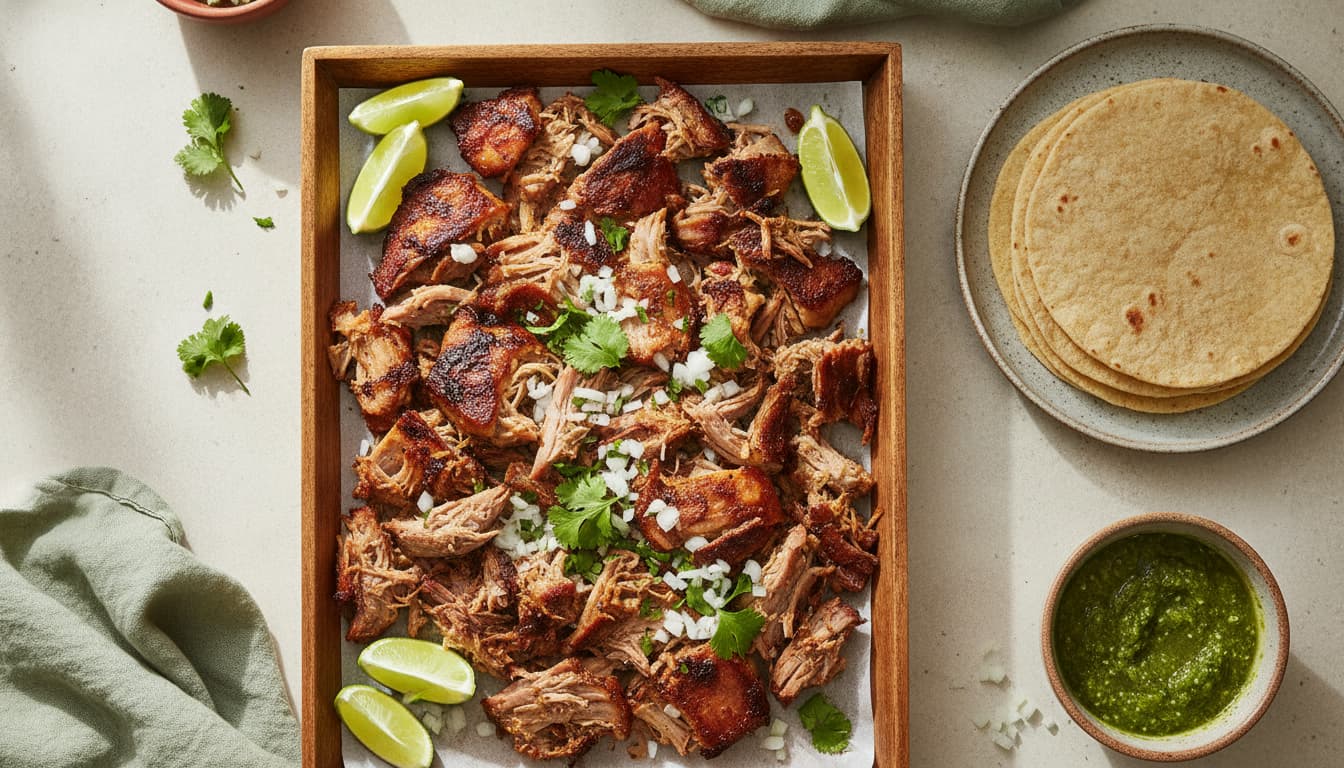
Traditional carnitas are confited in a bathtub of lard. This version braises pork shoulder in a small amount of liquid, skims the rendered fat, and then uses two tablespoons of it under a hot broiler to build the crisp edges that make the dish. Three and a half hours, almost all of it unattended, eight servings at 34g protein.
Why this works
Every recipe on this site ships with an explanation of the technique decisions, why sear then braise, why the acid goes in at the end, why the fat renders before the aromatics. The method below is those decisions, in order.
Ingredients
Serves 8- 4 lbboneless pork shoulder · also sold as pork butt, outer fat cap trimmed to 1/4 inch
- 1 tbspkosher salt · for the overnight dry brine
- 2 tspground cumin
- 2 tspdried Mexican oregano · regular oregano works
- 1/2 tspblack pepper · coarsely ground
- 1 wholewhite onion · quartered
- 6 clovesgarlic · smashed, skins on
- 1 wholeorange · juiced, then both spent halves into the pot
- 2 wholebay leaves
- 1 small stickcinnamon · optional, it rounds the orange out
- 1 cupwater or unsalted chicken stock
- 2 tbspreserved rendered pork fat · skimmed from the braise, for the broiler stage
- 2 wholelimes · cut into wedges, to finish
- 1/2 cupcilantro · roughly chopped, to finish
Method
Salt it the night before, and cut it into chunks
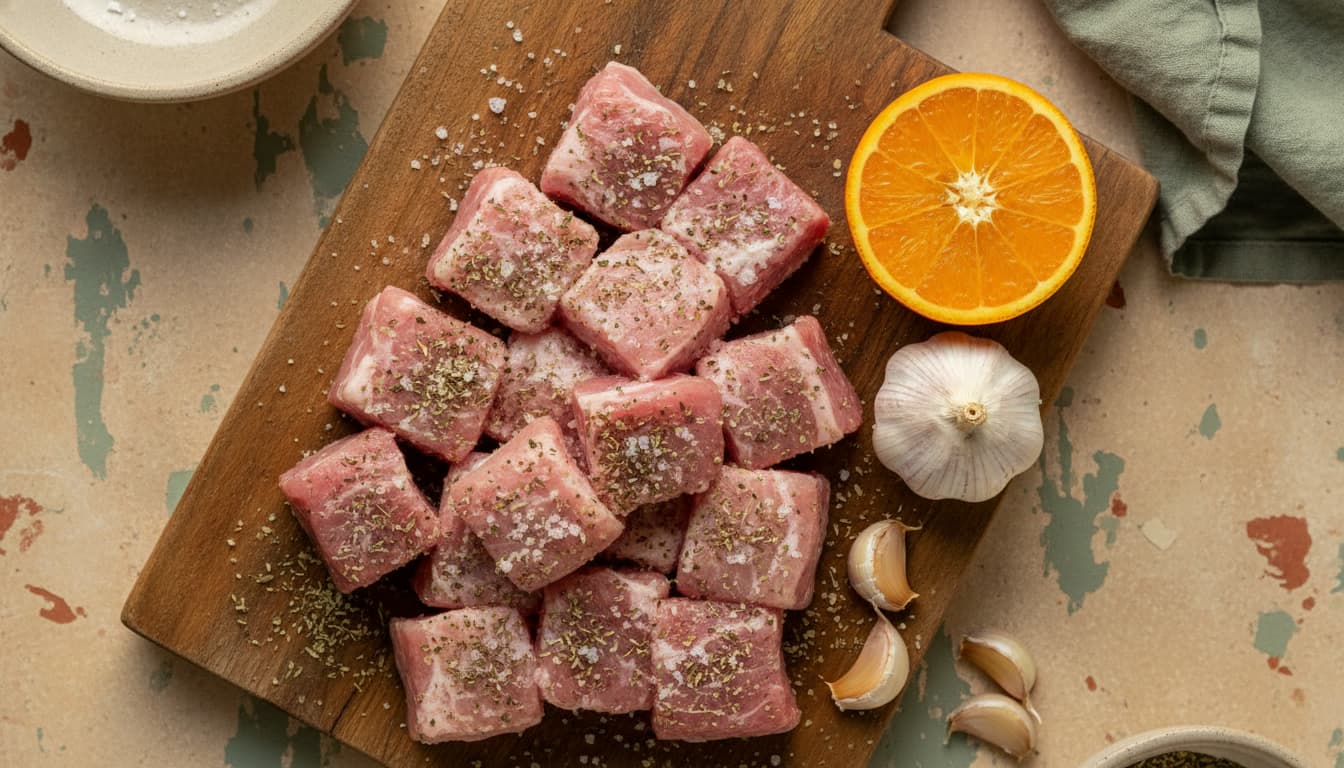
Cut the shoulder into pieces about two inches across, which is the step most recipes skip. A whole roast cooks unevenly and gives you almost no surface to crisp later, while chunks give you eight times the edge. Toss them with the salt, cumin, oregano and pepper and leave them uncovered in the fridge overnight, or at minimum for an hour on the counter. The salt gets into the meat instead of sitting on it, and the surface dries, which matters at the broiler stage.
Use one cup of liquid, not a pot full
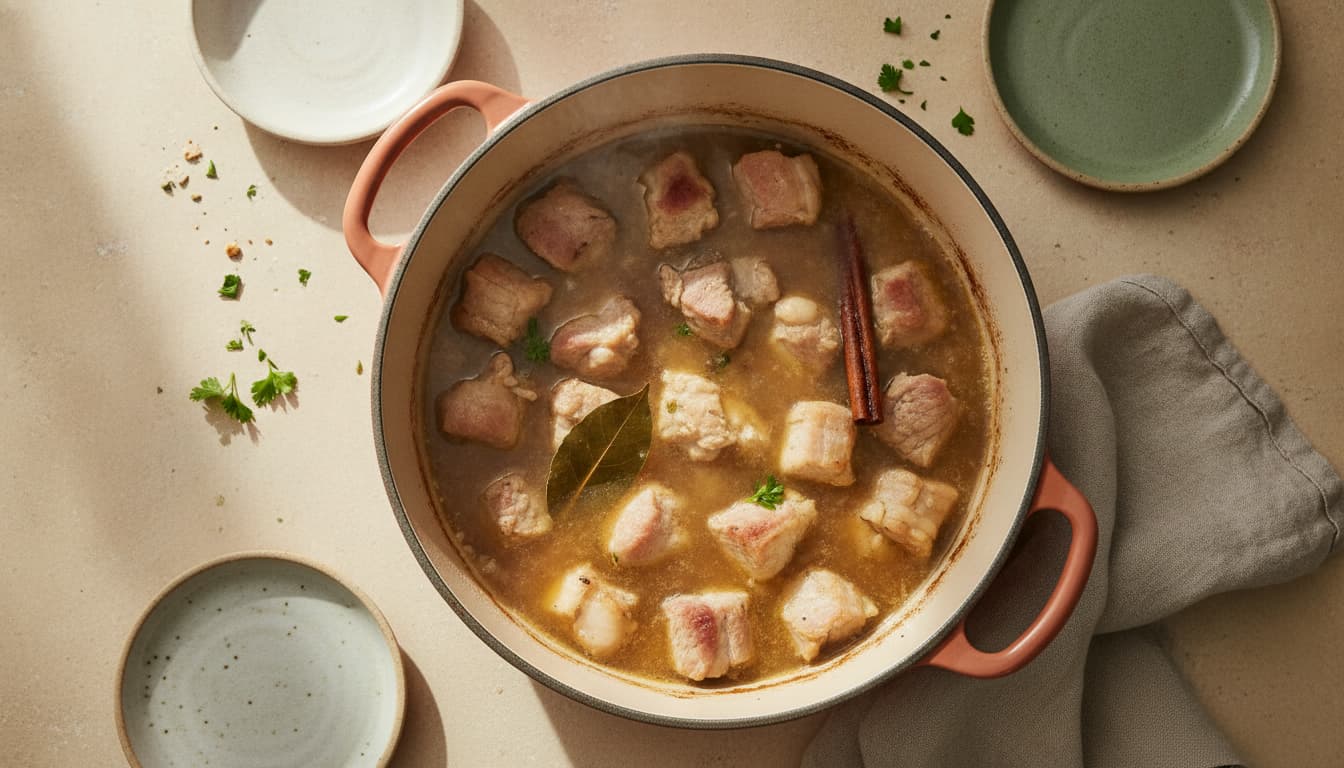
Confit means submerging in fat, and it is why restaurant carnitas taste the way they do and why home versions turn into a greasy project. Pork shoulder at this weight releases well over a cup of its own fat and a good deal of water during three hours in a covered pot, so it ends up braising in its own rendering. Start with one cup of water or stock, the onion, garlic, bay, cinnamon, the orange juice and the two spent halves. That is enough.
300F for three hours, and judge it with a fork
Lid on, oven at 300F, three hours. Do not go hotter to save time; above about 325F the exterior tightens before the collagen has converted and you get dry meat that still shreds. It is done when a fork pushed into a chunk twists with no resistance, which usually lands between two hours forty and three hours twenty depending on how the shoulder was cut. If it fights you, give it another twenty minutes and check again rather than pulling it early.
Skim the fat, and keep two tablespoons of it
Lift the pork out with a slotted spoon and pour the liquid into a wide bowl or a fat separator. The fat rises within five minutes and you can spoon it straight off. Keep two tablespoons for the crisping and refrigerate or discard the rest, which is what pulls this from a very rich dish to 390 calories a serving. Fish out and discard the onion, garlic skins, orange halves, bay and cinnamon. Save the defatted braising juices, they are the best thing in the pot.
Shred into shards, not threads
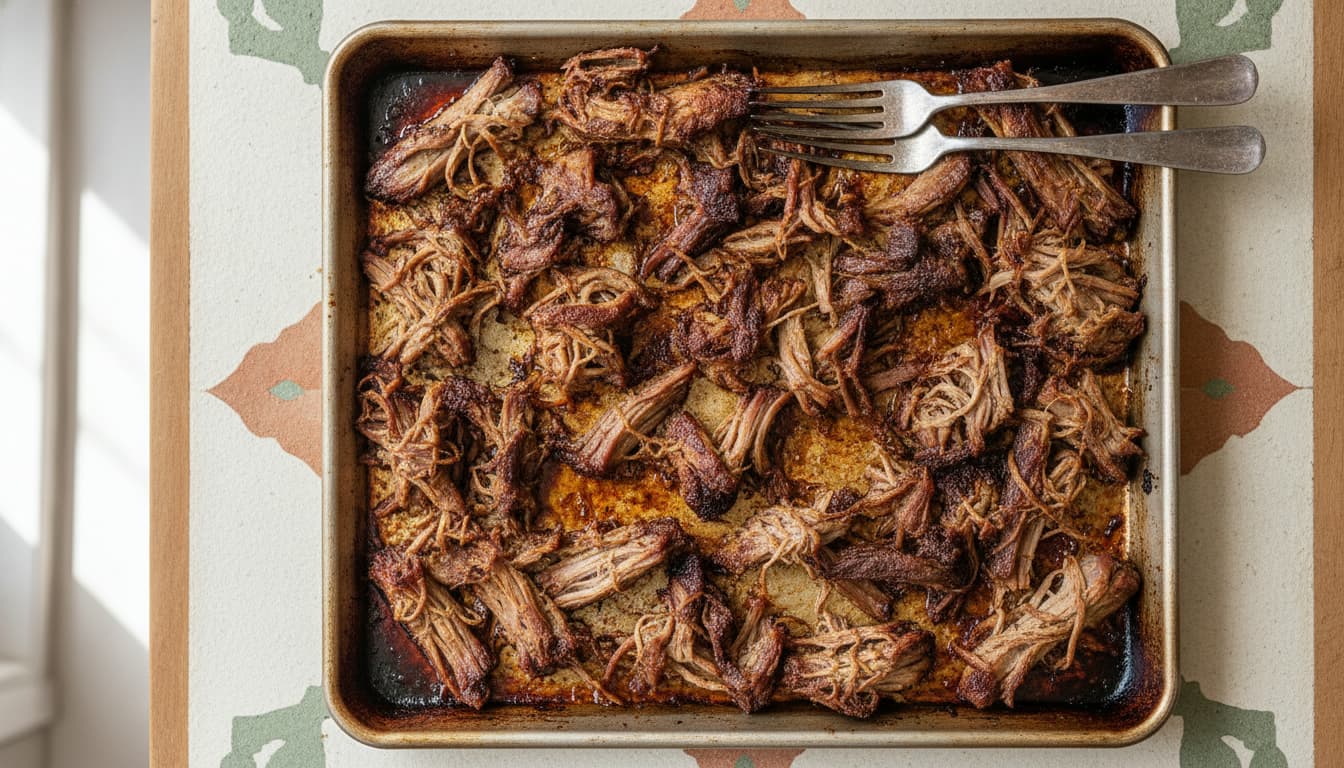
Pull each chunk into two or three pieces with your hands or two forks and stop there. Carnitas want big irregular shards with intact edges, because those edges are what crisp and what give you the contrast between crunchy outside and soft inside. Shredding it to a fine pulp like barbecue pork gives you a uniform texture that goes from wet to dry with nothing in between, and it is the most common reason home carnitas taste flat.
Broiler on high, one layer, no crowding
Spread the shards over a rimmed sheet pan in a single layer with gaps between them, drizzle over the two tablespoons of reserved fat, and put it about six inches under a broiler set to high. Eight to ten minutes, turning the pan once at the halfway mark. You are looking for dark brown tips and a few genuinely crunchy pieces, not uniform colour. Two pans is better than one crowded pan, because crowded meat steams and stays pale.
Then put the juices back
Straight out of the broiler, spoon three or four tablespoons of the defatted braising liquid over the pan and toss once. This is the move that separates good carnitas from dry ones: you have driven moisture off the surface to build crust, and then you return flavour without softening what you just made. Do it at the pan, not at the table, and do it just before serving. Then lime and cilantro, both off the heat.
Storage, and how to reheat without ruining the crisp
Braised and shredded but not yet broiled, it keeps four days in the fridge with its juices, and three months frozen in portions with a few spoons of liquid in each bag. That is the right stage to store at, because you can then broil only what you are eating and the crisp is always fresh. Reheating already-broiled carnitas in a microwave undoes all of it; use a hot dry skillet for three minutes instead.
What is actually in the 390 calories
Pork shoulder is a fatty cut and that is why it works, but most of that fat ends up in the pot rather than on the plate. Skimming the braise and returning only two tablespoons is worth roughly 150 calories a serving compared to tossing the meat in all of it, and it costs nothing in flavour because the flavour is water-soluble and stayed in the juices. Trimming the outer cap to a quarter inch before cooking accounts for most of the rest.
In pictures
Variations
Substitutions and adaptations land with the photography shoot. The method holds across most reasonable swaps.
Storage
Refrigerator: 3 to 4 days, sealed. Freezer: up to 3 months. Reheat covered to retain moisture.
Frequently asked
- What cut of pork is best for carnitas?
- Boneless pork shoulder, sold as pork butt or Boston butt, and there is no good substitute. It has the collagen that converts to gelatin over a long low cook and enough intramuscular fat to stay moist through three hours. Pork loin or tenderloin will be dry and stringy no matter what you do, because there is nothing in them to convert. A bone-in shoulder works and tastes marginally better, just buy five pounds instead of four to account for the bone.
- Can I make carnitas in a slow cooker or pressure cooker?
- Yes, and the broiler stage is still mandatory in both cases, because neither appliance browns. Slow cooker: same aromatics, cut the liquid to half a cup because nothing evaporates, low for eight hours. Pressure cooker: one cup of liquid, high pressure for forty-five minutes, then a natural release. Both give you tender pork with no texture, which the ten minutes under the broiler fixes. Skim the fat in either case, there will be a lot of it.
- Why do my carnitas turn out dry?
- Usually the oven was too hot, which tightens the muscle before the collagen breaks down, or the meat was shredded too fine so there is nothing but surface. The third cause is broiling for too long without returning the braising juices afterwards. Fix them in that order: 300F, big shards, and always spoon the defatted liquid back over the pan at the end. A dry carnitas is almost never an undercooked one.
- Is orange traditional in carnitas?
- In Michoacan, yes, along with milk, cola or condensed milk in some versions, all of which are there for sugar to help browning and for acid to balance the fat. Orange is the version that tastes least like a shortcut. The spent halves go in with the juice because most of the aromatic oil is in the peel, and they contribute more than the juice does. Skip the cinnamon if you want something more straightforwardly savoury.
- What do I serve with carnitas?
- Warm corn tortillas, diced white onion, cilantro, lime and a salsa with some acid to cut the fat, either a tomatillo salsa or a simple pico. Beyond tacos: over rice with black beans, on top of a bowl with pickled red onion and avocado, in eggs the next morning, or piled on roasted sweet potato. Keep the accompaniments sharp rather than creamy, because the pork is already rich and does not need cheese or sour cream doing the same job.
Related recipes
See all →- Meal Types
Fried Rice: Cold Rice, Hot Pan, and Soy Down the Side
Fried rice is a moisture-management problem wearing a stir-fry costume. Freshly cooked rice is saturated and its starch is still gelatinised, so it clumps and steams. Rice that has spent a night uncovered in the fridge has lost surface water and retrograded, and it separates into individual grains in a hot pan. Twenty-five minutes of cooking, and one decision made the day before.
25m22g Protein - Meal Types
Apple Crisp: Two Varieties, Cold Butter, Forty-Five Minutes
A watery apple crisp is not a topping problem. It is an apple problem and a time problem. One variety of apple gives you either mush or raw wedges, and thirty minutes is long enough to brown a topping but not long enough to cook fruit through and drive off its water. Two varieties, a spoon of cornstarch, coarse oat topping made with cold butter, and forty-five minutes at 375F. Seventy-five minutes total, and it wants twenty of them to rest.
75m3g Protein - Meal Types
Coleslaw: Salt the Cabbage, Squeeze It, Then Dress It
Coleslaw goes watery for one reason. Cabbage is ninety-two percent water, and if you dress it raw, the salt in the dressing pulls that water out over the next hour and dilutes everything you just made. Salt the shredded cabbage first, let it drain for thirty minutes, squeeze it, and then dress it. Fifty minutes including the wait, and the difference is a slaw that is still crunchy on day three.
50m3g Protein
Get a tested recipe + a nutritional note in your inbox each Sunday.
One recipe a week, photographed on the same Tuesday it tested. Reviewed by an RD. No promotions, no pop-ups, no tracking.
The Clean Chef Starter Kit.
A 14-day anti-inflammatory meal plan PDF, grocery list by section, macros totaled per day, Sunday prep sequence. Free.
By subscribing, you agree to our Privacy Policy. One calm email a week. Unsubscribe anytime.
We're building a shop.
Curated cookware, pantry staples we actually buy, recipe-bundle PDFs. Be the first to know when it opens.
We'll only email you about the shop opening. Unsubscribe in any email. See our Privacy Policy.